

P0736 on 2021-2023 Ford Bronco: Reverse Incorrect Ratio Causes and Fixes
On a 2021-2023 Ford Bronco, code P0736 is most often caused by a software issue, a faulty transmission valve body, or an internal hydraulic leak from a failed CDF clutch cylinder sleeve, all documented in Ford TSB 23-2250. The first step is a dealer software update; more complex mechanical repairs may be required. This is a known issue across many Ford vehicles using the 10R80 transmission.
- P0736 on a 2021-2023 Bronco indicates a serious reverse gear ratio problem, often with noticeable symptoms like failure to engage reverse.
- Do not assume a major mechanical failure first. Ford TSB 23-2250 identifies a software update as a primary potential fix that should be checked by a dealer.
- If software doesn't fix it, the cause is likely a known mechanical issue with either the valve body or the CDF clutch cylinder, both of which are complex repairs.
- This is not a DIY-friendly repair. Due to the complexity of the 10-speed transmission and the need for specialized tools and software, professional service is required.
- Driving with this code is not recommended, as you may lose the ability to reverse and could cause further, more expensive damage to the transmission.
What's Unique About the 2021-2023 Ford BRONCO
The 2021-2023 Bronco uses Ford's 10-speed automatic transmission (10R60 or 10R80). For this specific platform, P0736 is strongly linked to known issues that Ford has addressed in Technical Service Bulletins (TSBs). Unlike a simple sensor failure, this code on a Bronco often points toward either a required software update or specific mechanical failures within the transmission, such as sticking valves in the main control body or a problematic CDF clutch cylinder sleeve that 'walks out' of position. This is a common problem shared with other 10R80-equipped vehicles like the F-150 and Ranger.
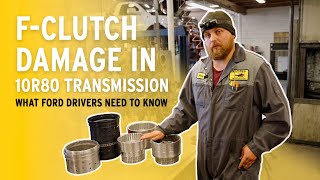
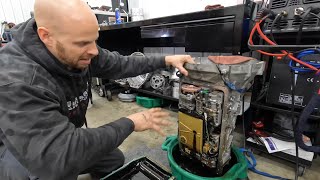
🎬 Watch: Overview of common 10R80 transmission failures and problems.Diagnostic Flowchart
Tap your situation to follow the diagnostic path that matches what you're seeing on this vehicle.
Symptoms You May Notice
- Check Engine Light or Malfunction Indicator Lamp (MIL) is on.
- Transmission refuses to shift into reverse or has a long delay.
- Harsh clunking or grinding noise when shifting into reverse.
- Vehicle slips or won't move when in reverse.
- Illuminated wrench light or other transmission warning on the dash.
- Vehicle enters a limited power "limp mode".
- Replacing only the transmission speed sensors without checking for TSBs or mechanical issues first. On the 10-speed transmission, P0736 is more often a sign of a software or internal mechanical fault.
- Assuming the entire transmission needs to be replaced immediately. A software update or a valve body/CDF drum repair as outlined in TSBs may resolve the issue without a full replacement.
- Performing a simple fluid change to fix the problem. While fresh fluid might temporarily improve symptoms, it will not fix a mechanical fault like a 'walked-out' CDF drum sleeve or sticking valves.
Most Likely Causes
- Powertrain/Transmission Control Module (PCM/TCM) Software Issue 🔴 High Probability → Shop Transmission Assembly Ford has explicitly identified software as a potential cause for a wide range of shifting issues and DTCs, including P0736, on vehicles with the 10-speed transmission. TSB 23-2250 lists software as a primary diagnostic branch.
How to confirm: A Ford dealership or a qualified shop with Ford's diagnostic software (FDRS) can check for and apply any available software updates. This is the first step in the diagnostic procedure outlined by Ford.
Typical fix: Reprogramming the PCM/TCM to the latest calibration. In some cases, a 'Transmission Accelerated Main Control Break In' routine may be performed via FDRS after the update.
Est. part cost: $0-$200 - Sticking Valves in Main Control Valve Body 🟡 Medium Probability → Shop Transmission Valve Body TSB 23-2250 directly names sticking valves in the main control valve body as a cause for this and related codes on the 10R60/10R80 transmission. Debris from clutch wear or manufacturing imperfections can cause valves to stick, leading to incorrect hydraulic pressure and cross-leaks.
How to confirm: After ruling out software, a technician may perform advanced diagnostics, including a valve body inspection and cleaning as per TSB 23-2250's procedure. This is often confirmed by removing and overhauling the valve body.
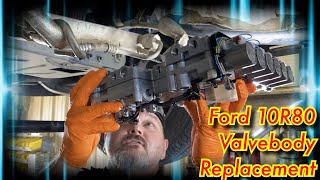
Typical fix: Overhauling (cleaning and inspecting) the main control valve body or replacing it entirely with an updated assembly. 🎬 See this step-by-step 10R80 valve body replacement walkthrough.
Est. part cost: $500-$1200 - Failed CDF Clutch Cylinder Sleeve 🟡 Medium Probability → Shop Automatic Transmission Coast Clutch Hub A known mechanical weak point in some 10R80 transmissions is the sleeve for the 'CDF' clutch drum, which can move out of position ('walk out') and cause a major hydraulic leak by uncovering fluid passages. This is a specific failure mode addressed by Ford's TSBs and an updated part design.
How to confirm: This requires significant transmission disassembly to visually inspect the CDF clutch drum assembly. It is typically the last step in the diagnostic process after software and valve body checks have been exhausted.
Typical fix: Partial transmission overhaul to replace the CDF clutch cylinder with an updated part (JL3Z-7H351-B). The revised part has a machined lip to prevent the sleeve from walking out. 🎬 Watch: A quick overview of the CDF drum replacement process.
Est. part cost: $150-$300 for the part, but labor is extensive. - Low or Contaminated Transmission Fluid ⚪ Low Probability → Shop Transmission Assembly While a universal cause for transmission issues, it's less likely to be the primary cause on a newer vehicle unless there is a leak or internal component failure (like the CDF drum) has contaminated the fluid with debris. The 10-speed transmission is very sensitive to fluid level and condition.
How to confirm: The fluid level and condition must be checked. The 10-speed transmission has no dipstick, so this is a complex procedure that must be done from under the vehicle at a specific operating temperature.
Typical fix: Perform a transmission fluid service using the correct Motorcraft MERCON ULV fluid. If fluid is low, the source of the leak must be found and repaired. If the fluid is full of metallic debris, it indicates a serious internal failure.
Est. part cost: $150-$300 for a fluid and filter service.
Rare But Worth Checking
- Faulty Transmission Speed Sensor: → Shop Transmission Assembly While possible, a failing input or output speed sensor is less common than the software or specific mechanical issues identified in Ford's TSBs for this platform. It would typically be accompanied by other speed sensor-specific codes.
- Damaged Wiring or Connectors: Corrosion or damage to the transmission wiring harness can interrupt signals, but this is less probable on a newer vehicle unless it has sustained physical damage or has been improperly serviced.
Diagnosis Steps
- Check for Technical Service Bulletins (TSBs). The first step for any professional is to check for TSBs related to P0736 and the 10-speed transmission, specifically TSB 23-2250.
- Scan for all DTCs. Note any other gear ratio or solenoid codes that are present to help narrow down the fault, as many are listed together in the TSB.
- Check for Software Updates. Connect the vehicle to Ford's diagnostic system (FDRS) to determine if a PCM/TCM software update is available. This is a primary step recommended by Ford.
- Check Transmission Fluid Level and Condition. This must be performed by a technician according to the specific procedure for the 10R60/10R80 transmission, as there is no dipstick.
- Perform Transmission Diagnostic Routines. Using FDRS, a technician may run routines like the 'Transmission Accelerated Main Control Break In' to test clutch operation, especially after a software update.
- Inspect the Main Control Valve Body. If software and fluid checks pass, the next step is often to remove, overhaul (clean and inspect), and test the valve body for sticking valves or debris.
- Inspect Internal Components. If the valve body is clean, the final step involves transmission disassembly to inspect for mechanical failures like the CDF clutch cylinder sleeve for axial movement ('walking out').
Parts You'll Likely Need
- Main Control Valve Body Assembly
(OEM #JL3Z-7A100-C)— Sticking valves are a common cause cited in TSB 23-2250. Often, the entire assembly is replaced to ensure reliability. Part numbers vary by model and build date; JL3Z-7A100-C is a common replacement for 10R80 applications. A dealer must verify the exact part.
Trusted brands: Motorcraft
OEM price range: $700-$1200
Aftermarket price range: $500-$900 - CDF Clutch Cylinder
(OEM #JL3Z-7H351-B)— This is the updated part for the specific, known failure point in the 10R80 transmission that causes hydraulic leaks and triggers ratio codes. It supersedes older parts HL3Z-7H351-A and JL3Z-7H351-A and features a lip to prevent sleeve movement.
Trusted brands: Motorcraft
OEM price range: $150-$250 - Motorcraft MERCON ULV Automatic Transmission Fluid
(OEM #XT-12-QULV)— This is the only specified fluid for the 10R60/10R80 transmission. Any service will require refilling with the correct fluid.
Trusted brands: Motorcraft
OEM price range: $10-$15 per quart
Related Codes That Often Appear With This One
- P0729, P0731-P0735 — These are incorrect gear ratio codes for other gears. Their presence alongside P0736 strongly points to a systemic issue like software, low fluid, or a faulty valve body affecting multiple gear shifts. TSB 23-2250 lists all of these codes together.
- P0751, P0756, P0761, etc. — These are codes for specific shift solenoids. TSB 23-2250 lists these alongside the gear ratio codes, indicating that the root cause could be sticking valves or a solenoid performance issue within the valve body.
Technical Service Bulletins (TSBs) & Recalls
- This is the primary TSB for this issue, superseding previous versions. It covers a wide range of 2017-2023 Ford and Lincoln vehicles with the 10R60/10R80 transmission. It identifies the cause of harsh/delayed shifts and numerous DTCs (including P0736) as being due to software, sticking valves in the main control body, or axial movement of the CDF clutch cylinder sleeve. It provides a detailed diagnostic and repair procedure.
Platform-Specific Known Issues
- TSB 23-2250 is a key document for this issue on the 2021-2023 Bronco. It explicitly states that P0736 (and many other codes) can be caused by software, sticking valves in the main control valve body, or axial movement of the CDF clutch cylinder sleeve.
Mechanic-Grade Diagnostic Values
- Shift Solenoid (A-F) Resistance — expected: 20-30 Ohms. Failure: Readings outside this range indicate a faulty solenoid coil.
- Electronic Pressure Control (EPC) Solenoid Resistance — expected: 3.0-5.0 Ohms. Failure: A reading outside this range suggests the EPC solenoid is failing.
- Turbine/Intermediate/Output Speed Sensor Resistance — expected: 325-485 Ohms at 70°F. Failure: An open circuit (infinite resistance) or a reading far outside the specified range points to a failed sensor.
Scan Tool Commands That Help
- Ford FDRS (Ford Diagnostic & Repair System): Software Update Check — This is the first diagnostic step mandated by TSB 23-2250 to rule out software-related issues before any hardware replacement.
- Ford FDRS: PCM - Transmission Accelerated Main Control Break In — Used after a software update or valve body repair to perform a guided relearn of clutch apply pressures and shift timing, as specified in TSB 23-2250.
- Ford FDRS: Programmable Module Installation (PMI) — Required when replacing the Transmission Control Module (TCM) or Powertrain Control Module (PCM) to load the correct software and vehicle-specific calibration data.
Wiring & Ground Locations
- C175T — This is a main connector at the Powertrain Control Module (PCM).. This connector contains the pins for critical transmission components, including the Turbine Speed Sensor (TSS), Output Shaft Speed Sensor (OSS), Transmission Fluid Temperature (TFT) sensor, and various shift solenoids. Checking for voltage and continuity at these pins is a key step in diagnosing electrical faults.
- G102 — Located on the right-hand side of the engine compartment.. This is a primary ground point in the engine bay. A loose or corroded ground here can cause a wide range of unpredictable electronic issues, including faulty sensor readings and incorrect module behavior that could potentially trigger transmission codes.
Real Owner Repair Stories
- Reddit user in r/f150 (2019 Ford F-150 with 10R80 transmission) — Delayed engagement (2-3 seconds) when shifting from Park to Drive/Reverse, or between Drive and Reverse.
❌ Tried (didn't work) A previous software reflash and parts swap per a TSB had been performed for a different harsh shifting issue.
✅ What actually fixed it The delayed engagement was fixed by replacing the CDF clutch drum. However, this was followed by a new issue of very hard shifts into third gear, which was then resolved by replacing the main control valve body assembly. This shows that multiple components are often at fault.
"I Checked Everything" — The Actual Cause
- In the context of this transmission code, the equivalent of a 'smoke test clean' scenario is when initial, less invasive repairs recommended by the TSB do not fully resolve all symptoms. A common pattern reported by owners is that a software update provides no fix, leading to a major mechanical repair. In some cases, even after a primary mechanical fault like the CDF drum is replaced, secondary issues like harsh shifting may appear, ultimately requiring the replacement of the valve body as well to complete the repair.
When the Usual Fixes Don't Work
- While TSB 23-2250 provides a clear diagnostic path (software -> valve body -> CDF drum), real-world cases show this may not be a simple one-and-done fix. An owner of a 10R80-equipped truck had the CDF drum replaced to fix a gear engagement delay, only to develop a new harsh shifting problem immediately after. A subsequent replacement of the valve body was required to make the transmission shift smoothly. This indicates that the damage from one component (like a slipping clutch from the failed drum) can create debris that causes a secondary failure in another (sticking valves in the valve body), requiring a more comprehensive repair than initially diagnosed.
OEM Part Supersession History
HL3Z-7H351-A, JL3Z-7H351-A→JL3Z-7H351-B— The original CDF clutch cylinder sleeve could 'walk' out of position, causing a major hydraulic leak. The updated JL3Z-7H351-B part features a machined lip on the drum that physically prevents the sleeve from moving.
Heads up: The older parts are prone to failure and should always be replaced with the updated -B version during a rebuild.HL3Z-7A100-B, JL1Z-7A100-A→JL3Z-7A100-C (Varies by application)— Valve body assemblies are frequently updated to address sticking valves and improve shift quality. TSBs often call for replacement with the latest available part number.
Heads up: Valve body part numbers are highly specific to the vehicle model, year, and even column vs. electronic shifter. Always verify the correct part number with a VIN at a Ford dealership. A remanufactured OEM part may be available under part number JL3Z-7A100-CRM.
Model Year Variations Within This Range
- 2021 - Mid-2022: Vehicles built on or before approximately August 15, 2022, were manufactured with the original CDF clutch drum design that is prone to sleeve movement. These vehicles are the primary candidates for the CDF drum failure.
- Late 2022 - 2023: Vehicles built after August 15, 2022, should have the updated CDF clutch drum (JL3Z-7H351-B) with the preventative machined lip from the factory, making the CDF drum failure much less likely. While not impossible, a P0736 code on these later models is more likely to be related to software or the valve body.
Helpful Videos
We Have This Part in Stock


The information in this article is provided for general reference and educational purposes only. Vehicle specifications, procedures, and part compatibility can vary by production date, trim level, and region. Always consult your vehicle's factory service manual and verify part numbers before purchasing or performing repairs. Safety-critical components such as airbags, seat belts, and braking systems should be installed by a qualified professional.
- Ford BRONCO:
- 🧭 Diagnostic Flowchart
- 🎬 Helpful Videos
- 🛍️ Shop This Part
- What's Unique About the 2021-2023 Ford BRONCO
- Symptoms You May Notice
- Most Likely Causes
- Rare But Worth Checking
- Diagnosis Steps
- Parts You'll Likely Need
- Related Codes That Often Appear With This One
- Technical Service Bulletins (TSBs) & Recalls
- Platform-Specific Known Issues
- Mechanic-Grade Diagnostic Values
- Scan Tool Commands That Help
- Wiring & Ground Locations
- Real Owner Repair Stories
- "I Checked Everything" — The Actual Cause
- When the Usual Fixes Don't Work
- OEM Part Supersession History
- Model Year Variations Within This Range
- 🎟️ Get 5% Off