

P0736 on 2020-2023 Ford Explorer: Reverse Incorrect Ratio Causes and Fixes
On a 2020-2023 Ford Explorer, P0736 means the transmission has a problem with reverse gear. The most common causes are internal, specifically sticking valves in the main control valve body, or a software issue. A dealer visit is necessary to check for software updates and perform diagnostics, which may lead to a valve body replacement. In some cases, an internal failure of the CDF clutch drum assembly may be the cause.
- P0736 on a 2020-2023 Explorer indicates a serious problem with reverse gear.
- Do not drive the vehicle; have it towed to a professional to avoid further damage and for safety reasons.
- The most likely causes are specific to this platform: a software glitch or a faulty transmission valve body, both of which are documented in Ford's Technical Service Bulletins.
- The first step in diagnosis should always be to check for software updates and TSBs at a dealership or qualified shop.
- Repair is not a DIY job and requires professional diagnosis and specialized tools.
What's Unique About the 2020-2023 Ford EXPLORER
The 2020-2023 Ford Explorer uses a 10-speed automatic transmission (10R60 or 10R80), co-developed with GM. This specific platform has been subject to multiple Technical Service Bulletins (TSBs) for harsh or delayed shifting and various gear ratio codes, including P0736. These bulletins frequently point to either PCM/TCM software needing an update or internal issues with sticking valves in the main control valve body. A newer TSB also identifies potential axial movement of the CDF clutch cylinder sleeve as a cause, which is a known mechanical weak point in this transmission family.
Diagnostic Flowchart
Tap your situation to follow the diagnostic path that matches what you're seeing on this vehicle.
Symptoms You May Notice
- Check Engine Light is on
- Delayed or no engagement when shifting into reverse. 🎬 Watch: A technician's guide to diagnosing delayed reverse issues.
- A long delay followed by a harsh 'clunk' or 'bang' when shifting into reverse.
- Transmission slipping in reverse (engine RPMs increase but vehicle doesn't move accordingly).
- Vehicle may enter "limp mode," limiting available gears to prevent damage.
- Increased fuel consumption.
- In some cases, the vehicle may roll forward slightly before reverse engages.
- Replacing transmission speed sensors without checking for TSBs first.
- Assuming a full transmission replacement is needed before diagnosing the valve body or checking for software updates.
Most Likely Causes
- Sticking Valves in Main Control Valve Body 🔴 High Probability → Shop Transmission Valve Body Multiple Ford TSBs (including TSB 22-2102 and the superseding TSB 22-2428) for this specific vehicle and transmission explicitly name "sticking valves in the main control valve body" as the primary cause for a group of codes that includes P0736. The aluminum valve body is known to be a common failure point.
How to confirm: A technician can use Ford's diagnostic software (FDRS) to run a "Transmission Accelerated Main Control Break-In" routine. If this does not resolve the issue, the TSB directs the technician to overhaul or replace the valve body.
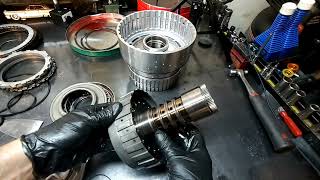
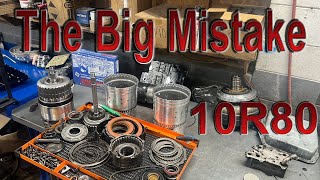
Typical fix: Replacement of the main control valve body assembly. 🎬 Watch: Step-by-step walkthrough of a 10R80 valve body replacement.
Est. part cost: $700-$1200 - Powertrain/Transmission Control Module (PCM/TCM) Software Issue 🔴 High Probability → Shop Transmission Assembly Ford has issued TSBs, such as TSB 26-2046, 22-2428, and 23-2176, indicating that this code and related symptoms can be caused by a software calibration issue in the PCM or TCM. These updates are designed to improve shift quality and adjust for learned transmission parameters.
How to confirm: A Ford dealership or qualified shop with access to Ford's diagnostic software (FDRS) can check the current software calibration level against the latest available version.
Typical fix: Reprogramming the PCM/TCM to the latest software version.
Est. part cost: $0 (if under warranty) - $180 - Low or Contaminated Transmission Fluid 🟡 Medium Probability → Shop Transmission Assembly
How to confirm: Check the transmission fluid level and condition. The fluid should be at the correct level, red in color, and free of debris or a burnt smell. Note: The 10R60/80 transmission does not have a traditional dipstick, requiring a specific service procedure at operating temperature (206°-215°F) to check the fluid. 🎬 See how to access the short dipstick under the vehicle.
Typical fix: Perform a transmission fluid drain-and-fill or a full fluid exchange with the correct Motorcraft MERCON ULV fluid.
Est. part cost: $150-$300
Rare But Worth Checking
- CDF Clutch Cylinder Sleeve Failure: → Shop Automatic Transmission Coast Clutch Hub TSB 22-2428 introduced "axial movement of the CDF clutch cylinder (7H351) sleeve" as a potential cause for these symptoms. This is a known mechanical failure point in the 10R80 where a bushing can walk out of place, causing a loss of hydraulic pressure and clutch failure. This often requires transmission removal and replacement of the CDF drum assembly. Ford has released an updated drum with a machined lip to prevent the sleeve from moving.
- Internal Transmission Mechanical Failure: → Shop Transmission Assembly While less common than a valve body or software issue, worn clutches, damaged seals, or other internal hard-part failures can cause this code. This would typically be a last resort after all other causes are ruled out and may require a full transmission rebuild or replacement.
- Faulty Input/Output Speed Sensor: Though a common cause on many vehicles, for this specific Explorer generation, TSBs point more directly to software and valve body issues. However, a failing sensor can still provide incorrect data to the TCM, causing the code.
Diagnosis Steps
- Connect a professional OBD-II scanner to verify the presence of P0736 and any other related codes.
- Check for any applicable Technical Service Bulletins (TSBs) for your vehicle's VIN. Specifically look for TSB 22-2428, which supersedes several previous bulletins, and TSB 23-2176 for 2.3L models.
- Have a Ford dealer or qualified shop use Ford's Diagnosis and Repair System (FDRS) to check the PCM/TCM software calibration and update it if a newer version is available.
- Check the transmission fluid level and condition following the manufacturer's specific procedure. The fluid temperature must be between 206°-215°F for an accurate reading. Low or dirty fluid can cause hydraulic issues.
- If software and fluid are good, use an advanced scan tool to monitor live data for input and output speed sensors while attempting to engage reverse to look for discrepancies.
- Perform diagnostic routines as specified in the TSBs, such as the PCM - Transmission Accelerated Main Control Break-In routine.
- If the break-in procedure fails or is not applicable, further diagnosis will focus on the main control valve body, including its solenoids and wiring.
- If the valve body is confirmed to be functioning correctly, the final step is to inspect for internal mechanical wear or damage, paying close attention to the CDF clutch cylinder sleeve as noted in TSB 22-2428.
Parts You'll Likely Need
- Main Control Valve Body
(OEM #HL3Z-7A100-B (supersedes HL3Z-7A100-A))— Ford TSBs directly identify sticking valves within this component as a primary cause of P0736 and related shifting issues on this platform.
Trusted brands: Motorcraft
OEM price range: $700-$1200
Aftermarket price range: $500-$800 - Automatic Transmission Fluid
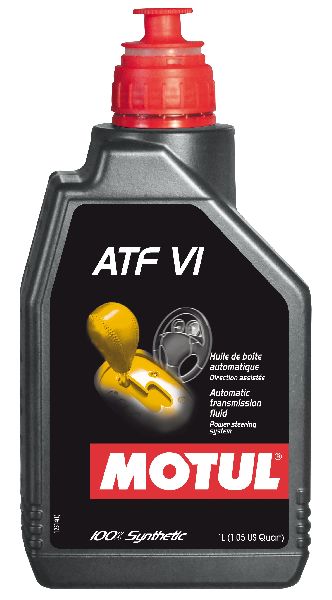
(OEM #Motorcraft MERCON ULV (XT-12-QULV))— Low or contaminated fluid is a common cause of transmission problems. A fluid service may be attempted as a first step or will be required as part of a valve body replacement.
Trusted brands: Motorcraft
OEM price range: $15-$25 per quart - CDF Drum Clutch Hub Assembly
(OEM #JL3Z-7H351-B)— If the CDF clutch cylinder sleeve has failed as described in TSB 22-2428, this assembly may need to be replaced. This is a major internal repair.
Trusted brands: Motorcraft
OEM price range: $350-$500
Related Codes That Often Appear With This One
- P0729, P0731-P0735 — These are codes for incorrect gear ratios in other gears (6th, 1st, 2nd, 3rd, 4th, 5th). They are all cited together with P0736 in Ford TSBs, pointing to a common underlying cause like the valve body or software.
- P2700-P2705 — These codes relate to transmission clutch application timing. They are also listed in the same TSBs and indicate a hydraulic or mechanical control issue within the transmission.
Technical Service Bulletins (TSBs) & Recalls
- TSB 22-2428: Supersedes previous TSBs. Cites software, sticking valves in the main control, and a moving CDF clutch cylinder sleeve as causes for P0736 and other codes across many Ford/Lincoln models with 10R transmissions.
- TSB 26-2046: Cites P0736 and other codes as potentially being due to PCM software.
- TSB 22-2102: (Superseded by 22-2428) Links P0736 to delayed/harsh shifts and points to sticking components in the main control.
- TSB 21-2434: (Superseded by 22-2428) Similar to 22-2102, identifies sticking components as a cause for P0736 and other shift-related codes.
- TSB 23-2176: Specifically for 2020-2022 Explorers with the 2.3L engine and 10R60 transmission, this TSB addresses delayed reverse engagement and calls for a PCM reprogram.
Platform-Specific Known Issues
- A series of Technical Service Bulletins, most recently TSB 22-2428, have been issued for 2020-2023 Explorers with the 10R60/10R80 transmission for harsh/delayed shifts and gear ratio codes, including P0736. The primary causes cited are PCM software, sticking valves in the main control valve body, and axial movement of the CDF clutch cylinder sleeve.
- Owner forums contain numerous reports of these transmission issues, sometimes occurring at very low mileage. In one case, a 2020 Explorer with 1,000 miles had a transmission failure. Another owner of a 2020 model experienced loud clunking and shifting issues that required a valve body replacement, and the problems returned shortly after.
Mechanic-Grade Diagnostic Values
- Transmission Fluid Temperature for Level Check — expected: 206°F - 215°F (96°C - 101°C). Failure: Checking the fluid level outside this temperature range will result in an inaccurate reading, either too high or too low.
Scan Tool Commands That Help
- Ford Diagnosis and Repair System (FDRS): PCM - Transmission Accelerated Main Control Break-In — This routine is specified in TSBs to address harsh or delayed shifting issues. It attempts to relearn the valve body characteristics and can sometimes resolve issues without parts replacement.
- Ford Diagnosis and Repair System (FDRS) or equivalent professional scan tool: Clear the Transmission Adaptive Tables — This should be performed after a PCM reprogram or replacement of a major transmission component like the valve body or the entire transmission. It forces the TCM to start a new learning process for shift strategy.
Wiring & Ground Locations
- Transfer Case Control Module (TCCM) — Underneath the driver's seat, below the carpet and an HVAC vent. Requires seat removal or sliding it fully forward to access.. While P0736 is a transmission ratio code, communication issues with related drivetrain modules can sometimes cause unpredictable behavior. A video on a 2021 Explorer with a '4WD Fault' and transmission stuck in gear showed a loss of communication with this module (Code U02). Checking for water intrusion or connector issues at this location is a valid diagnostic step if other drivetrain error messages are present.
- Transmission Connector C168A — Main electrical connector on the transmission case.. This is the primary interface for all sensors and solenoids within the transmission. A wiring diagram for a 2021 Explorer shows pins related to transmission fluid pump control and monitoring, which are critical for maintaining hydraulic pressure needed to engage reverse. Damage or corrosion at this connector could directly cause P0736.
OEM Part Supersession History
Unknown, early-design CDF drum→Updated CDF Drum (e.g., included in assemblies like JL3Z-7H351-B)— The original design allowed an internal sleeve/bushing to slide out of position, exposing fluid passages and causing pressure loss.
Heads up: The updated part is a permanent fix; it has a machined lip on the inner half of the drum to prevent the sleeve from moving. Using an old-stock original design part would leave the vehicle susceptible to the same failure again.HL3Z-7A100-A→HL3Z-7A100-B— Part revision/update by the manufacturer. Reasons are not officially published but typically involve improvements to address known failure points like sticking valves.
Model Year Variations Within This Range
- 2020-2022: TSB 23-2176 specifically targets 2020-2022 Explorer models with the 2.3L engine and 10R60 transmission for delayed reverse engagement, identifying a PCM software issue as the cause and reprogramming as the sole fix. This is more specific than the broader TSBs that cover multiple engines and potential mechanical causes.
Helpful Videos


We Have This Part in Stock


The information in this article is provided for general reference and educational purposes only. Vehicle specifications, procedures, and part compatibility can vary by production date, trim level, and region. Always consult your vehicle's factory service manual and verify part numbers before purchasing or performing repairs. Safety-critical components such as airbags, seat belts, and braking systems should be installed by a qualified professional.
- Ford EXPLORER:
- 🧭 Diagnostic Flowchart
- 🎬 Helpful Videos
- 🛍️ Shop This Part
- What's Unique About the 2020-2023 Ford EXPLORER
- Symptoms You May Notice
- Most Likely Causes
- Rare But Worth Checking
- Diagnosis Steps
- Parts You'll Likely Need
- Related Codes That Often Appear With This One
- Technical Service Bulletins (TSBs) & Recalls
- Platform-Specific Known Issues
- Mechanic-Grade Diagnostic Values
- Scan Tool Commands That Help
- Wiring & Ground Locations
- OEM Part Supersession History
- Model Year Variations Within This Range
- 🎟️ Get 5% Off