

P0740 on 2005-2012 Dodge Grand Caravan: TCC Solenoid and Torque Converter Guide
For 2008-2012 models with the 62TE transmission, P0740 almost always means a failed torque converter, a major repair. For 2005-2007 models with the 41TE, a faulty solenoid pack is a more common and less expensive fix. Always check fluid first for level, color, and metallic debris.
- The most important first step is to identify your transmission. 2008-2012 models likely have the 62TE; 2005-2007 models may have the 41TE.
- For 62TE transmissions, a P0740 code strongly points to a failed torque converter, not just a solenoid, per a manufacturer TSB.
- For 41TE transmissions, a faulty solenoid pack is a very common and less expensive fix to try first.
- Always check transmission fluid level and condition before attempting any repairs.
- Due to the complexity and labor involved, especially with torque converter replacement, this is a job best left to professional technicians.
What's Unique About the 2005-2012 Dodge GRAND CARAVAN
The 2005-2012 Grand Caravan spans two key transmissions. The 2008-2012 models primarily use the 6-speed 62TE, while earlier 2005-2007 models often have the 4-speed 41TE (also called A604). This distinction is critical for P0740. For the 62TE, a manufacturer Technical Service Bulletin (TSB #9004009) directly states that if the TCC solenoid tests okay, this code is indicative of a torque converter failure. Owner and technician experiences from forums and repair videos overwhelmingly support that on the 62TE, the torque converter itself is the most common failure point, not just the solenoid.
Diagnostic Flowchart
Tap your situation to follow the diagnostic path that matches what you're seeing on this vehicle.
Generation note: Yes, this range covers the end of the 4th generation (2005-2007, 'RS' platform) and the beginning of the 5th generation (2008-2012, 'RT' platform). The primary difference for this code is the transmission: 4th gen vans often used the 4-speed 41TE, where a solenoid pack is a very common culprit for P0740. 5th gen vans used the 6-speed 62TE, where TSB #9004009 points to the torque converter itself as the likely failure point.
Symptoms You May Notice
- Check Engine Light is on
- Vehicle may shudder or vibrate when shifting or at cruising speeds, often between 35-50 mph as the TCC attempts to engage.
- Engine RPMs are higher than usual at highway speeds (feels like it's not shifting into the final gear)
- Reduced fuel economy due to transmission slippage.
- Stalling when coming to a stop if the clutch is stuck engaged.
- A whining noise from the transmission/torque converter area.
- In some cases, no noticeable driving issues other than the check engine light, as reported in NHTSA complaint #11161242.
- Replacing only the TCC solenoid on a 62TE transmission. As TSB #9004009 and numerous mechanic reports indicate, the code often returns because the root cause is the torque converter itself.
- Replacing the valve body and solenoids when the torque converter is the actual problem, as described in owner complaint NHTSA ODI #11161242.
- Assuming a fluid and filter change will fix the problem when significant metallic debris is present. The debris is a symptom of the failure, not the cause.
Most Likely Causes
- Failed Torque Converter 🔴 High Probability → Shop Automatic Transmission Torque Converter For models with the 62TE transmission (2008-2012), TSB #9004009 specifically identifies the torque converter as the likely failure point if the TCC solenoid is functional. The internal clutch lining wears out, sheds material, and can no longer hold pressure to lock up. This is widely corroborated by mechanics and owners.
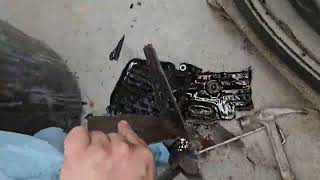
How to confirm: Use a scan tool to monitor TCC slip RPM. If the PCM commands lock-up and the slip remains high (e.g., over 100 RPM), and the solenoid/wiring are good, the converter is bad. A visual confirmation is finding excessive metallic 'glitter' in the transmission pan and fluid.
Typical fix: Replace the torque converter. This is a labor-intensive job that requires removing the transmission. It is also recommended to replace the TCC solenoid at the same time.
Est. part cost: $200-$600 - Failed TCC Solenoid / Solenoid Pack 🔴 High Probability → Shop Transmission Valve Body On the 41TE transmission (common in 2005-2007 models), the entire solenoid pack is a frequent failure item and is replaced as a single unit. On the 62TE, while less likely to be the final fix than the converter, the individual TCC solenoid can still fail electrically or become clogged with debris.
How to confirm: Test the solenoid's resistance with a multimeter; it should typically be between 1-3 ohms. A capable scan tool can also command the solenoid on/off to check its response. Visually inspect the solenoid for debris upon removal.
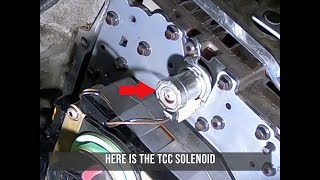
Typical fix: On 41TE models, replace the entire solenoid pack. 🎬 Watch: Step-by-step 41TE solenoid pack replacement guide On 62TE models, replace the individual TCC solenoid. This is located inside the transmission's side pan.
Est. part cost: $50-$250 - Low or Contaminated Transmission Fluid 🟡 Medium Probability → Shop Transmission Assembly Chrysler transmissions are notoriously sensitive to fluid level and type (ATF+4). Low fluid causes pressure loss, while old, burnt, or contaminated fluid loses its hydraulic properties and can contain clutch debris that clogs solenoids and passages.
How to confirm: Check the transmission fluid level and condition. The fluid should be bright red and not smell burnt. Dark, gritty fluid (often described as looking like it has 'glitter' in it) is a strong indicator of internal wear, likely from the torque converter.
Typical fix: Perform a transmission fluid and filter change. If the fluid is very contaminated, this is a sign of a larger mechanical failure and a fluid change alone will not fix the issue.
Est. part cost: $50-$150 - Damaged Wiring or Connectors ⚪ Low Probability
How to confirm: Visually inspect the wiring harness leading to the transmission for any signs of damage, corrosion, or loose connections, particularly at the main connector on the solenoid pack/case. Test for continuity from the PCM/TCM connector to the transmission connector.
Typical fix: Repair or replace the damaged section of the wiring harness.
Est. part cost: $20-$100
Rare But Worth Checking
- Failed Powertrain Control Module (PCM): → Shop Engine Control Module (ECM) This is extremely rare. The PCM should only be considered after every other possibility, including wiring and all mechanical components, has been definitively ruled out.
- Worn Valve Body: → Shop Transmission Valve Body The valve body directs hydraulic fluid. Wear in the bores, particularly the solenoid switch valve bore, can cause pressure leaks that prevent proper TCC operation. Sonnax makes oversized plugs (92835-18K) to repair worn bores.
Diagnosis Steps
- Check and verify the transmission fluid level and condition. Ensure it is at the correct level. Inspect the fluid on the dipstick for a bright red color. If it is dark, smells burnt, or has visible metallic particles ('glitter'), this points to significant internal wear.
- Scan the system for all codes. Note if P0700 or other transmission codes like P2764 are present.
- Using a professional scan tool, monitor the 'Torque Converter Clutch Slip Speed' data PID.
- While driving at a steady cruising speed (above 45 mph), observe if the PCM commands the TCC to lock (EMCC status).
- If lock-up is commanded but the slip RPM remains high (over 100 RPM for more than a few seconds), it confirms a mechanical slip condition.
- If no slip is detected but the code is present, the issue is likely electrical. Park the vehicle and test the TCC solenoid circuit. Check for proper voltage and resistance at the solenoid connector. Resistance should be low, typically 1-3 Ohms.
- If the solenoid and wiring test good, the problem is mechanical. Based on TSB #9004009 for the 62TE, the torque converter is the primary suspect.
- For 41TE models, if the solenoid pack resistance is out of spec or it fails a scan tool actuation test, replacing the solenoid pack is the most likely fix.
Parts You'll Likely Need
- Torque Converter — This is the most common failure for P0740 on 2008-2012 models with the 62TE transmission, as confirmed by a TSB and extensive field reports.
Trusted brands: Mopar, LuK, Transtar, Precision of New Hampton
OEM price range: $500-$800
Aftermarket price range: $200-$400 - Transmission Solenoid Pack (41TE)
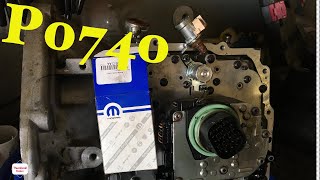
(OEM #4800879AB)— This is a very common failure for P0740 on 2005-2007 models with the 41TE transmission. The TCC solenoid is part of this assembly.
Trusted brands: Mopar, Dorman, Rostra
OEM price range: $200-$350
Aftermarket price range: $100-$200 - TCC Solenoid (62TE)
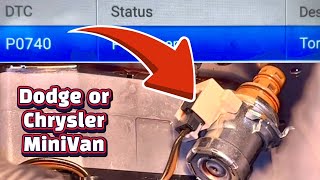
(OEM #68053831AA)— For the 62TE transmission, this individual solenoid can be replaced. While often not the root cause, it's sometimes replaced as part of the diagnosis or along with the torque converter.
Trusted brands: Mopar
OEM price range: $25-$50
Aftermarket price range: $15-$30 - Mopar ATF+4 Automatic Transmission Fluid
(OEM #68218057AC)— The correct fluid is critical for the hydraulic operation of Chrysler transmissions. Using anything other than licensed ATF+4 can cause shifting problems and solenoid malfunctions.
Related Codes That Often Appear With This One
- P0700 — P0700 is a generic code that simply means the Transmission Control Module (TCM) has requested the Check Engine Light to be turned on. It will almost always appear alongside a specific transmission code like P0740.
- P2764 — This code is for 'Torque Converter Clutch Pressure Control Solenoid Control Circuit Range/Performance'. It is mentioned alongside P0740 in TSB #9004009 as another indicator of potential torque converter failure on 62TE transmissions.
Technical Service Bulletins (TSBs) & Recalls
- A critical TSB for 62TE-equipped vehicles. It states that if P0740 or P2764 are present and the TCC solenoid tests okay, the codes are indicative of a torque converter failure and the torque converter should be replaced.
- An earlier TSB related to the 62TE transmission that involves reprogramming the Powertrain Control Module (PCM) or Transmission Control Module (TCM) to address shudder complaints, which can be an early symptom of TCC lock-up issues.
Platform-Specific Known Issues
- TSB #9004009 for 62TE Transmissions: A key document states that for vehicles with the 62TE transmission (common in 2008-2012 models), if codes P0740 or P2764 are present and the TCC solenoid is functioning correctly, the torque converter has failed and must be replaced. This is the most important piece of information for diagnosing this code on 5th generation vans.
- 41TE Solenoid Pack vs. 62TE Individual Solenoid: On the older 41TE transmission, the TCC solenoid is integrated into a larger 'solenoid pack' which is replaced as one unit. On the newer 62TE, the TCC solenoid is a small, individual component that can be replaced separately by removing the transmission's side cover.
Mechanic-Grade Diagnostic Values
- TCC Solenoid Resistance (41TE Transmission) — expected: 1.0 - 2.0 Ohms. Failure: A reading outside this range (open or shorted) indicates a failed solenoid within the pack.
- TCC (EMCC VFS) Solenoid Resistance (62TE Transmission) — expected: Approximately 5.0 - 5.3 Ohms. Failure: A significantly different reading, or an open/shorted circuit, points to a failed solenoid.
- Other Shift Solenoids Resistance (62TE Transmission) — expected: 1.6 - 1.8 Ohms (temperature dependent). Failure: A reading that is significantly higher or lower than the other similar solenoids in the pack indicates a failure. For example, one user reported all solenoids reading high around 4.1 Ohms, indicating a potential internal ground issue in the pack.
- P0740 Set Condition (62TE) — expected: TCC slip should be under 60-100 RPM when lockup is commanded.. Failure: The code sets after 10 seconds and three occurrences of either: Full lockup (FEMCC) with slip greater than 100 RPM, or partial lockup (PEMCC) with a duty cycle greater than 85%.
Scan Tool Commands That Help
- Professional Scan Tool (e.g., Witech): TCC Solenoid Actuation Test / Bidirectional Control — This command allows a technician to manually energize the TCC solenoid with the engine off or running. It helps determine if the solenoid clicks (activates) and if the wiring between the PCM/TCM and the solenoid is intact. If the solenoid clicks but the problem persists, it points towards a mechanical or hydraulic issue rather than an electrical one.
- Professional Scan Tool (e.g., Witech): View Clutch Volume Index (CVI) data — CVI values represent the volume of fluid needed to apply a clutch pack. While not directly for the TCC, monitoring the L/R (Low/Reverse) clutch CVI can be insightful, as the L/R solenoid is often shared or related to the TCC circuit on the 62TE. A CVI value that is out of specification can indicate internal leaks or worn clutches that may be related to the overall hydraulic integrity needed for TCC operation.
Wiring & Ground Locations
- Transmission Solenoid/TRS Assembly Connector (62TE) — The main electrical connector on the transmission case, connecting the vehicle harness to the internal solenoid assembly.. This is the primary point for testing the entire solenoid pack electrically without opening the transmission. Technicians test resistance and voltage at the pins of this connector.
- Pin 3 (T84 EMCC VFS Control Circuit) at Transmission Connector (62TE) — Pin 3 on the main transmission harness connector.. This is the specific control wire from the PCM to the TCC solenoid (Variable Force Solenoid). Testing for opens, shorts to ground, or shorts to voltage on this pin is a critical step in diagnosing an electrical fault for P0740.
- Pin 10 (Common Power Feed) at Transmission Connector (62TE) — Pin 10 on the main transmission harness connector.. This pin provides the power feed from the transmission control relay to multiple solenoids in the pack. It is used as the common positive lead when performing resistance checks on most of the individual solenoids.
Real Owner Repair Stories
- YouTube channel 'Codeman's Auto' (Dodge Grand Caravan with 62TE transmission (year not specified, but within 2008-2019 range)) — P0740 code that returned instantly after being cleared, even with the engine off.
❌ Tried (didn't work) Visual inspection of the external wiring harness, which had been previously re-taped by someone else.
✅ What actually fixed it The TCC solenoid itself had an internal electrical short. Replacing the single TCC solenoid inside the transmission's side pan resolved the issue. The instant return of the code was the key clue pointing to a dead short rather than a mechanical slip issue. - YouTube channel 'white trash racing' (2011 Dodge Grand Caravan with 131,000 miles) — P0740, shuddering when putting the van in drive, whining noise from torque converter area, and observable failure to lock up at highway speeds.
❌ Tried (didn't work) The diagnosis confirmed the wiring was good and the PCM was commanding lock-up, ruling out electrical issues.
✅ What actually fixed it Replacing the torque converter and, as a preventative measure, the TCC lock-up solenoid. The final fix confirmed the torque converter was the mechanical failure point. - YouTube channel 'Online Mechanic Tips' (Chrysler/Dodge vehicle with 62TE transmission and 149,000 miles) — P0740, vehicle shaking.
❌ Tried (didn't work) The mechanic explicitly warns against replacing the TCC solenoid or the entire valve body, stating that in 100% of his experiences with P0740 on this transmission, those were not the root cause.
✅ What actually fixed it The definitive fix is replacing the physical torque converter itself, as the internal clutch material is worn out and can no longer hold pressure. He also recommends replacing the front pump and reverse flushing the transmission cooler at the same time.
OEM Part Supersession History
4504570AC, 5015646AB, 5015646AC→5140429AA— Updated design for the 41TE solenoid pack, potentially for improved reliability.
Heads up: The newest design solenoid pack (5140429AA) does not require the original metal separator plate that was installed between the old pack and the transmission case.
Helpful Videos


We Have This Part in Stock

The information in this article is provided for general reference and educational purposes only. Vehicle specifications, procedures, and part compatibility can vary by production date, trim level, and region. Always consult your vehicle's factory service manual and verify part numbers before purchasing or performing repairs. Safety-critical components such as airbags, seat belts, and braking systems should be installed by a qualified professional.
- Dodge GRAND CARAVAN:
- 🧭 Diagnostic Flowchart
- 🎬 Helpful Videos
- 🛍️ Shop This Part
- What's Unique About the 2005-2012 Dodge GRAND CARAVAN
- Symptoms You May Notice
- Most Likely Causes
- Rare But Worth Checking
- Diagnosis Steps
- Parts You'll Likely Need
- Related Codes That Often Appear With This One
- Technical Service Bulletins (TSBs) & Recalls
- Platform-Specific Known Issues
- Mechanic-Grade Diagnostic Values
- Scan Tool Commands That Help
- Wiring & Ground Locations
- Real Owner Repair Stories
- OEM Part Supersession History
- 🎟️ Get 5% Off