

P0740 on 2008-2012 Ford Escape: Torque Converter Clutch Circuit Malfunction Causes and Fixes
On a 2008-2012 Ford Escape, code P0740 is most often caused by a faulty Torque Converter Clutch (TCC) solenoid within the valve body or low/degraded transmission fluid. For the common 6F35 transmission, this is a well-documented issue. A fluid and filter change followed by replacing the TCC solenoid or the entire solenoid body is the most common fix, costing between $150 and $400 in parts.
- P0740 on a 2008-2012 Escape indicates an electrical fault in the Torque Converter Clutch (TCC) circuit, most commonly due to a failed TCC solenoid or contaminated fluid, especially in models with the 6F35 transmission.
- While you can drive the vehicle, it's not recommended as it will cause increased transmission heat and wear, potentially leading to more severe damage.
- The most common repair is replacing the TCC solenoid or the entire solenoid body, which requires removing the transmission pan and valve body.
- For the 6F35 transmission (2009-2012), it is critical to reprogram the PCM with the new solenoid strategy after replacement to ensure proper shifting.
- Always start diagnosis by checking the transmission fluid level and condition, as low or dirty fluid is a frequent contributor to this issue.
What's Unique About the 2008-2012 Ford Escape
The 2008-2012 Ford Escape spans two key automatic transmissions. The 2008 four-cylinder models often used the 4-speed CD4E, while 2009-2012 models with the 2.5L and 3.0L V6 engines used the 6-speed 6F35. The 6F35 transmission is notoriously prone to issues, including harsh shifting, shuddering, and premature failure, which led to a class-action lawsuit. 🎬 Watch: Common Ford Escape transmission faults and repair options Its design makes it sensitive to fluid condition, and degraded fluid can cause solenoids, including the TCC solenoid, to stick or fail electrically. Therefore, fluid condition and solenoid failure are primary suspects for P0740 on 2009 and newer Escapes.
Symptoms You May Notice
- Check Engine Light is on
- Wrench light may be illuminated on the dash
- Vehicle shudders or vibrates at highway speeds (40-55 mph)
- Engine stalls when coming to a stop
- Noticeable decrease in fuel economy
- Transmission may feel like it's slipping, shifting harshly, or not shifting into the highest gear
- Engine RPMs are higher than usual at cruising speeds
- Transmission may overheat, especially under load
- Replacing the entire transmission when only a solenoid, solenoid body, or wiring repair is needed.
- Replacing the torque converter when the issue is a much cheaper solenoid or fluid problem.
- Failing to reprogram the PCM with the new solenoid strategy after replacing the solenoid body, leading to persistent shifting issues.
Most Likely Causes
- Low or Dirty Transmission Fluid 🔴 High Probability → Shop Transmission Assembly The 6F35 transmission used from 2009-2012 is known for rapid fluid degradation, which can clog passages and cause solenoids to malfunction. A class-action lawsuit cited issues with the transmission fluid and failing fluid seal integrity.
How to confirm: Check the transmission fluid level and condition via the dipstick. The fluid should be bright red (Mercon LV) and not smell burnt. Dark or burnt-smelling fluid indicates a problem.
Typical fix: Perform a transmission fluid and filter change. This is a critical first step, but if the solenoid has already failed electrically, a fluid change alone will not resolve the P0740 code.
Est. part cost: $80-$150 - Failed Torque Converter Clutch (TCC) Solenoid or Solenoid Body 🔴 High Probability → Shop Automatic Transmission Torque Converter The TCC solenoid is the primary component commanded by the circuit. It can fail electrically (internal short/open) or get stuck from contaminated fluid. In the 6F35, solenoids are a known failure point, and often the entire solenoid body assembly is replaced.
How to confirm: After checking fluid, a mechanic will test the solenoid's resistance with a multimeter at the transmission connector. A reading outside the manufacturer's specification (typically 10-20 ohms, but varies) indicates failure. A scan tool can also command the solenoid on/off to check for an electrical response.
Typical fix: Replace the TCC solenoid or the entire solenoid body assembly. This requires draining the fluid, removing the transmission pan, and the valve body to access the solenoids. The new solenoid body ID must then be programmed into the PCM.
Est. part cost: $50-$250 for a single solenoid, $200-$400 for a complete solenoid body. - Damaged Wiring or Electrical Connectors 🟡 Medium Probability
How to confirm: Visually inspect the wiring harness leading to the transmission for any signs of damage, corrosion, or loose connections. A mechanic will perform a continuity test from the PCM connector to the transmission connector to check for opens or shorts in the TCC solenoid circuit. A manufacturer service bulletin for other Ford models, TSB Bulletin #SSM 46719, suggests checking specific connector pins for correct fitment prior to replacing any components when P0740 is stored.
Typical fix: Repair the damaged section of the wire or replace the faulty connector.
Est. part cost: $10-$100
Rare But Worth Checking
- Internal Failure of the Torque Converter: → Shop Automatic Transmission Torque Converter Although P0740 is an electrical code, a mechanically failing torque converter (e.g., failed welds, bad clutch lining) can sometimes trigger it, especially if accompanied by severe shuddering or excessive metal shavings in the transmission pan.
- Faulty Powertrain Control Module (PCM): → Shop Engine Control Module (ECM) In rare cases, the driver circuit within the PCM that controls the TCC solenoid can fail. This is usually the last item to be diagnosed after all other possibilities (fluid, solenoid, wiring) have been ruled out.
Diagnosis Steps
- Verify the code with an OBD-II scanner. Note any other transmission-related codes.
- Check the transmission fluid level and condition. Ensure it is full, clean, and the correct type (Mercon LV for the 6F35 transmission). Burnt or dark fluid suggests internal wear.
- Inspect the transmission wiring harness and connectors for any visible damage, corrosion, or loose connections, paying close attention to the main connector at the transmission case.
- Using a professional scan tool, monitor the TCC command status (is the PCM trying to lock it?) and the torque converter slip RPM. A slip of over 200 RPM when lock-up is commanded points to a problem.
- Perform a resistance test on the TCC solenoid through the transmission's main electrical connector to check for an open or shorted solenoid coil. Compare the reading to the manufacturer's specifications (e.g., 10-20 ohms).
- If the solenoid resistance is out of spec, the solenoid/solenoid body needs replacement.
- If the solenoid resistance is within spec, perform a continuity check on the wiring between the PCM and the transmission connector to rule out a wiring issue.
- If both the solenoid and wiring are confirmed to be good, the issue may be a clogged valve body, a mechanical failure in the torque converter, or a faulty PCM.
Parts You'll Likely Need
- Torque Converter Clutch (TCC) Solenoid or Solenoid Body
(OEM #7G383 (Base part number for individual solenoid), Motorcraft solenoid bodies are also common replacements.)— This is the most common component to fail electrically, triggering the P0740 circuit code. In the 6F35, it's often sold as part of the complete solenoid body.
Trusted brands: Motorcraft, Rostra
OEM price range: $80-$150 (single solenoid), $300-$500 (solenoid body)
Aftermarket price range: $40-$90 (single solenoid), $200-$350 (solenoid body) - Transmission Fluid (Mercon LV)
(OEM #XT-10-QLVC)— Correct, clean fluid is required for any transmission repair. The 6F35 transmission is particularly sensitive to fluid type and condition.
Trusted brands: Motorcraft, Valvoline MaxLife LV, Castrol Transmax LV
OEM price range: $8-$12 per quart
Aftermarket price range: $7-$10 per quart - Transmission Filter and Pan Gasket Kit — The filter should be replaced whenever the transmission pan is removed for service to ensure contaminants are removed.
Trusted brands: Motorcraft, ATP, Wix
OEM price range: $40-$70
Aftermarket price range: $20-$40
Related Codes That Often Appear With This One
- P0741 — P0741 indicates 'TCC System Stuck Off'. If the PCM detects an electrical fault (P0740), it may also log this performance fault if it sees that the clutch is not engaging as expected.
- P0743 — P0743 indicates 'TCC Circuit Electrical'. This is a very similar code and can be logged for the same root causes related to an electrical failure in the solenoid or wiring.
- P1744 — A Ford-specific code for 'Torque Converter Clutch System Performance'. It often appears with P0740 and indicates a mechanical or hydraulic issue with the TCC lock-up mechanism, such as slipping, which can be a consequence of the electrical fault.
Technical Service Bulletins (TSBs) & Recalls
- TSB 16-0043: Addresses a fluid leak at the left-side half-shaft seal on 6F35 transmissions, which can lead to low fluid levels—a potential cause of various transmission codes including P0740.
- TSB Bulletin #SSM 46719: Notes that vehicles may exhibit an illuminated MIL with DTCs P0740 or P0743 and advises technicians to check connector pin fitment before replacing components.
Platform-Specific Known Issues
- Models equipped with the 6F35 transmission (2009-2012) are prone to premature transmission fluid degradation, which is a leading contributor to solenoid failures and other transmission problems. Regular fluid changes (every 30,000-50,000 miles) are highly recommended to prolong transmission life, regardless of Ford's 'lifetime fluid' claims.
- A class-action lawsuit was filed against Ford for the 6F35 transmission, alleging defects causing shuddering, delayed acceleration, and premature failure in models including the 2009-2021 Escape.
Mechanic-Grade Diagnostic Values
- TCC Solenoid Resistance (6F35 Transmission) — expected: 4.00 - 5.89 Ohms at 68-86°F (20-30°C). The resistance changes with temperature.. Failure: A reading of 0 ohms (short circuit) or infinite/OL (open circuit). A reading significantly outside the temperature-corrected range also indicates a problem.
- TCC Solenoid Circuit Voltage (at C175T connector) — expected: Power is supplied on Pin 12 (typically a YE-RD wire). The PCM provides a ground path on Pin 8 (typically a VT-GY wire) to activate the solenoid.. Failure: No power on Pin 12 indicates a fuse or wiring issue upstream. If the PCM does not provide a ground on Pin 8 when lock-up is commanded on a scan tool, it could be a wiring or PCM driver fault.
Scan Tool Commands That Help
- FORScan / Ford IDS: TCC Solenoid On/Off Bidirectional Test — This command allows a technician to manually activate the TCC solenoid circuit while monitoring system voltage or RPM slip. If the command is sent but the circuit doesn't respond (no voltage drop, no change in slip), it confirms a fault in the wiring, solenoid, or PCM.
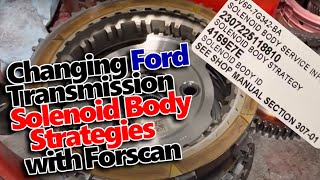
- FORScan / Ford IDS: Transmission Characterization / Solenoid Body Strategy Programming — This is a mandatory procedure after replacing the transmission solenoid body. The new part has a unique 13-digit code that must be programmed into the PCM to ensure correct shift pressures and timing. Failure to perform this step will result in poor shift quality and potential damage.
- FORScan / Ford IDS: Clear Transmission Adaptive Tables — This should be performed after any transmission repair, especially solenoid body replacement. It erases the PCM's learned shift adjustments, allowing it to re-learn the characteristics of the new components for optimal performance.
Wiring & Ground Locations
- C175T — The main external electrical connector on the 6F35 transmission case.. This is the primary access point for testing the TCC solenoid and its wiring without removing the transmission pan. The TCC solenoid circuit can be tested for resistance and voltage at Pin 8 and Pin 12 of this connector.
- G109 (2.5L Engine) — On the firewall in the rear of the engine compartment.. This is a major engine-area ground point. While not directly for the transmission harness, a poor ground here can introduce electrical noise and voltage issues that can affect PCM and sensor operation, potentially contributing to intermittent codes.
- Engine Block Ground (2.5L) — On the engine block, next to the oil filter.. A video for a 2010 Escape identified a key negative ground cable from the battery connecting to the block in this location. A corroded or loose connection here can cause a wide range of seemingly unrelated electrical issues, as it affects the entire vehicle's grounding system.
Real Owner Repair Stories
- Reddit user on r/fordescape (2012 Ford Escape XLT 3.0L V6) — Check Engine Light and Wrench Light on with code P0740.
❌ Tried (didn't work) The user took the vehicle to a Ford dealer for diagnosis. The dealer presumably tested the wiring and solenoid, as their final diagnosis was not one of the common causes.
✅ What actually fixed it The Ford dealer diagnosed a faulty Powertrain Control Module (PCM). The code indicates a circuit fault, and if the wiring and the solenoid (the load) are good, the only remaining part of the circuit is the driver within the PCM. - NHTSA ODI #10191579 — An owner of a similar Ford model reported a persistent SES light with code P0740, noting that the vehicle experienced a rough ride and stalling.
OEM Part Supersession History
N/A (Varies)→N/A (Varies)— Solenoid Flow Rate Matching
Heads up: The individual variable force solenoids in the 6F35 are 'banded' into 5 different flow rates, marked with a letter (A-E). When replacing a single solenoid, it is critical to order and install a new solenoid with the exact same letter/part number as the one being removed. Installing an incorrect band will cause shift quality issues or transmission damage.Varies by vehicle→Varies by replacement part— Solenoid Body Replacement
Heads up: Every 6F35 solenoid body has a unique 13-digit 'Solenoid Strategy' code and a 7-digit 'Solenoid ID' code printed on it. If the solenoid body is replaced, these new numbers MUST be programmed into the PCM using Ford IDS or FORScan. The vehicle will not shift correctly if the old strategy is used with the new part. This is a very common trap for DIY and professional repairers.
Model Year Variations Within This Range
- 2009 only: The 2009 model year was the first to use the 6F35 transmission in the Escape. Some early units experienced software-related shifting issues that were later addressed by Ford with PCM calibration updates. When diagnosing a 2009 model, it's worth checking if the PCM has the latest software version.
Diagnostic Flowchart
Other Known Issues on This Vehicle
Issues unrelated to this code that are worth knowing about as an owner of this generation:
- Electric Power Steering (EPS) Failure 🔴 High — Very common across 2008-2011 models. Can occur suddenly without warning. (Ref: Recall 14S05 was issued, which involved either a PCM software update or replacement of the steering torque sensor or entire steering column. Many owners report failures even after the recall was performed.)
- Rear Shock Tower Rust 🔴 High — Extremely common in regions that use road salt. The passenger side is noted to rust through more frequently. The shock can detach from the body. (Ref: No recall, but it is a widely documented problem. Aftermarket repair panels are readily available (e.g., Dorman 924-358) to weld or bond in place of the rusted section.)
- 6F35 Transmission Harsh Shifting and Failure 🔴 High → Shop Transmission Assembly — Widespread on 2009-2012 models. Symptoms include shuddering, hesitation, and eventual complete failure. Subject of a class-action lawsuit. (Ref: No recall has been issued for the transmission itself, though various TSBs address specific symptoms like fluid leaks.)
- Throttle Body Failure 🟠 Medium — Common issue causing the vehicle to enter 'limp mode' with a wrench light, resulting in sudden loss of power. (Ref: Ford had a customer satisfaction program (13N03) that extended the warranty on the throttle body for some vehicles, but it has since expired.)
Used vs. New Parts: Buying Guide for This Vehicle
When a used part is the smart pick: For this specific repair (P0740), sourcing a used solenoid body or individual solenoids from a junkyard is NOT recommended. The failure modes often involve internal wear and electrical fatigue that are invisible to the naked eye.
What to inspect on the donor part:
- If forced to consider a used part, obtaining the Solenoid Strategy ID from the donor transmission is non-negotiable, as it's required for programming.
- There are no reliable visual cues to determine the health of a used solenoid body; the risk of inheriting the same problem is extremely high.
OEM-only on this vehicle (don't cheap out):
- Solenoid Body Assembly: While high-quality remanufactured units are a good option, a new OEM Motorcraft part is the safest choice. Avoid cheap, unbranded new parts and used parts entirely.
Aftermarket brands forum-validated for this vehicle:
- Rostra (for individual solenoids)
- Reputable transmission part remanufacturers (for complete valve/solenoid bodies, research specific company reviews)
Brands owners have reported issues with on this vehicle:
- Unbranded, 'white-box' solenoid bodies from online marketplaces. These often have high failure rates and may not come with the critical Solenoid Strategy ID information required for programming.
Real Owner Stories
Aggregated from forums and TSBs cited above. Mileages and costs reflect what owners reported in those sources.
2012 Ford Escape 3.0L
Symptoms: The vehicle was stuttering and threw the P0740 code.
What fixed it: The diagnostic path initially suggested a broken wire, but the final resolution was identified as a faulty PCM.
Source hint: fordforums.com thread titled '2012-ford-escape-p0740-code'
2009-2012 Ford Escape
Symptoms: P0740 and P0741 codes present; torque converter clutch solenoid circuit open.
What fixed it: Replacing the valve body/solenoid assembly.
Source hint: escape-city.com thread titled 'p0740-and-p0741-torque-converter-clutch-solenoid-circuit-open'
2009-2012 Ford Escape
Symptoms: TCC stuck off issue.
What fixed it: Replacing the TCC solenoid.
Source hint: YouTube - Ford Tech Makuloco video commentary regarding 6F35 solenoid replacement
Ford Owner Report
Symptoms: Persistent SES light with code P0740, accompanied by a rough ride and stalling.
What fixed it: NHTSA ODI #10191579 notes these symptoms were common and suggested issues with manifolds or gaskets in some instances, though the code specifically points to the TCC circuit.
Related OBD-II Codes
Frequently Asked Questions
Does TSB 16-0043 apply to my 2009-2012 Ford Escape with a P0740 code?
Is there a recall for the 6F35 transmission issues in the 2009-2021 Ford Escape?
Can I just change the fluid to fix a P0740 on my Escape?
What specific transmission fluid should I use for my 2009-2012 Ford Escape?
Do I need to do anything special after replacing the solenoid body?
How often should I change the transmission fluid to avoid these solenoid failures?
Helpful Videos
We Have This Part in Stock

The information in this article is provided for general reference and educational purposes only. Vehicle specifications, procedures, and part compatibility can vary by production date, trim level, and region. Always consult your vehicle's factory service manual and verify part numbers before purchasing or performing repairs. Safety-critical components such as airbags, seat belts, and braking systems should be installed by a qualified professional.
- Ford Escape:
- 🧭 Diagnostic Flowchart
- 🎬 Helpful Videos
- 🛍️ Shop This Part
- What's Unique About the 2008-2012 Ford Escape
- Symptoms You May Notice
- Most Likely Causes
- Rare But Worth Checking
- Diagnosis Steps
- Parts You'll Likely Need
- Related Codes That Often Appear With This One
- Technical Service Bulletins (TSBs) & Recalls
- Platform-Specific Known Issues
- Mechanic-Grade Diagnostic Values
- Scan Tool Commands That Help
- Wiring & Ground Locations
- Real Owner Repair Stories
- OEM Part Supersession History
- Model Year Variations Within This Range
- Other Known Issues on This Vehicle
- Used vs. New Parts: Buying Guide for This Vehicle
- Real Owner Stories
- 2012 Ford Escape 3.0L
- 2009-2012 Ford Escape
- 2009-2012 Ford Escape
- Ford Owner Report
- Related OBD-II Codes
- Frequently Asked Questions
- 🎟️ Get 5% Off