

P0740 on 1998-2002 Honda Accord: Torque Converter Clutch Fault Causes and Fixes
P0740 on a 6th generation Honda Accord usually indicates a problem with the torque converter lock-up system, often due to a faulty TCC solenoid or contaminated fluid. On this platform, the code signifies a hydraulic fault (slippage) more often than a purely electrical one. Replacing the externally-mounted TCC solenoid assembly is a common first step, but be aware this code is frequently an early sign of internal transmission failure requiring a rebuild or replacement.
- P0740 on a 1998-2002 Accord means the torque converter isn't locking up as it should, usually due to a hydraulic issue.
- Always start diagnosis by checking the transmission fluid. Use only Genuine Honda ATF. A few drain-and-fills can sometimes resolve the issue.
- The next logical step is replacing the TCC/lock-up solenoid assembly, which is accessible on the outside of the transmission.
- Be prepared for the possibility that this code indicates a failing torque converter or transmission, which is a common and well-documented issue on this vehicle generation.
- Simply clearing the code will not fix the problem; it will return as soon as the car is driven at highway speeds again.
What's Unique About the 1998-2002 Honda Accord
The 4-speed (BAXA, MAXA) and 5-speed automatic transmissions in the 1998-2002 Honda Accord are a known weak point, with high failure rates. Unlike many vehicles where P0740 points strictly to an electrical solenoid failure, on these Accords it frequently indicates a hydraulic fault. This means that while the solenoid itself might be the problem, the code is often triggered by internal clutch material breaking down and clogging the fluid passages and solenoid screens, preventing proper hydraulic operation. Therefore, P0740 can unfortunately be an early warning sign of a failing torque converter or a transmission that needs to be rebuilt or replaced.
Symptoms You May Notice
- Check Engine Light is on.
- Reduced fuel economy.
- Engine RPMs are higher than usual at highway speeds (e.g., above 55 mph).
- Vehicle may shudder or vibrate at cruising speeds.
- In some cases, the engine may stall when coming to a stop if the clutch fails to disengage.
- The 'D4' or 'D' transmission indicator light may blink, which is Honda's equivalent of a transmission-specific check engine light.
- Harsh or jolting shifts, particularly from 1st to 2nd gear, sometimes chirping the tires.
- Transmission hesitation, as noted in NHTSA ODI #10460493.
- Transmission "flaring" or slipping between gears during acceleration, specifically from 1st to 2nd and 2nd to 3rd gear (NHTSA ODI #10713481).
- The vehicle may feel as though it is slipping out of gear or "basically stops" when turning corners (NHTSA ODI #10631906).
- Replacing only the TCC solenoid without addressing fluid quality. If the fluid is full of debris, the new solenoid will soon clog and fail as well.
- Assuming the code is purely electrical. On these Hondas, P0740 is a symptom of slippage, which is often a hydraulic problem caused by internal wear, not just a bad solenoid. An electrical-only code would typically be P1753.
Most Likely Causes
- Low or Dirty Transmission Fluid 🔴 High Probability → Shop Transmission Assembly Transmission fluid degrades over time, and on high-mileage vehicles, it becomes contaminated with friction material from wearing clutches. This debris is a primary cause of solenoid and valve body issues.
How to confirm: Check the transmission fluid level and condition using the dipstick (engine off, on level ground). The fluid should be at the correct level, red in color, and not smell burnt. If it's dark, brown, or contains visible metallic debris when wiped on a white towel, it is contaminated and needs changing.
Typical fix: Perform three consecutive drain-and-fills using only Honda Genuine ATF-DW1 (the modern replacement for ATF-Z1). This replaces a majority of the old fluid. Do NOT perform a pressurized 'flush' as this can dislodge debris and cause more harm. 🎬 Watch: How to perform a proper transmission fluid drain and fill.
Est. part cost: $40-$120 for fluid - Failed Torque Converter Clutch (TCC) Solenoid Assembly 🔴 High Probability → Shop Automatic Transmission Torque Converter The solenoids can fail electrically, but more commonly on this platform, their internal screens become clogged with debris from transmission wear, impeding fluid flow and causing a hydraulic malfunction.
How to confirm: The solenoid assembly can be removed and tested. The solenoids should have a resistance between 12-25 Ohms. Visually inspect the screens on the solenoid and the small filter pipes in the transmission case for metallic debris or sludge. A clogged screen is a definitive sign of internal wear, even if the solenoid itself tests okay electrically.
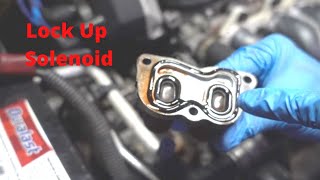
Typical fix: Replace the TCC solenoid assembly, which is located on the front of the transmission. Cleaning the old solenoid screens is a temporary fix at best; the debris indicates a larger problem.
Est. part cost: $100-$350 - Failing Torque Converter or Internal Transmission Failure Medium_to_high Probability → Shop Automatic Transmission Torque Converter The automatic transmissions in this generation are known for premature wear of the internal clutch packs and torque converters. This wear generates the debris that clogs passages and causes the P0740 code. The code is often the first symptom of this impending failure.
How to confirm: If the code returns quickly after replacing the fluid and solenoid(s), it's a strong sign of a deeper issue. A mechanic can perform a line pressure test. Straining the old fluid through a paint strainer or coffee filter and finding excessive black clutch material is a definitive sign of internal failure.
Typical fix: The transmission will need to be rebuilt by a specialist or replaced with a remanufactured unit. NHTSA ODI #10482434 notes that some owners have experienced these torque converter issues in as little as 50,000 miles.
Est. part cost: $1500-$3000 for a remanufactured transmission
Rare But Worth Checking
- Damaged Wiring Harness: While less common than internal issues, wiring to the TCC solenoid can become frayed or damaged, causing an electrical fault. A visual inspection of the harness leading to the transmission is worthwhile.
- Faulty Transmission Control Module (TCM): → Shop Transmission Assembly It is extremely rare for the TCM itself to fail. This should only be considered after all other possibilities, including a full transmission replacement, have been exhausted.
Diagnosis Steps
- Check the transmission fluid level and condition. If low, top it off with Honda ATF-DW1 and check for leaks. If dark, burnt, or full of debris, this is a strong clue.
- Perform a series of three drain-and-fills with Honda Genuine ATF-DW1. Drive the car for a short period between each drain to circulate the new fluid. Clear the code and see if it returns.
- If the code returns, locate the TCC/Lock-up solenoid assembly on the front of the transmission housing.
- Inspect the wiring and connector going to the solenoid for any visible damage or corrosion.
- Remove the TCC solenoid assembly (typically held by 3 or more 10mm bolts). Inspect the small filter screens on the solenoid gasket and in the transmission case ports for metallic debris or sludge. Clogged screens point towards internal transmission wear.
- Test the resistance of the solenoid(s) using a multimeter. It should typically be between 12-25 ohms. You can also apply 12V power to test for an audible click, but a clicking solenoid can still be bad/clogged. 🎬 Watch: Easy steps to test your Honda TCC solenoid.
- If the screens were clogged or the solenoid tests bad, replace the TCC solenoid assembly with a new OEM or high-quality aftermarket part. Clean the mounting surface and use new gaskets.
- Clear the code and perform a thorough test drive, including highway speeds (over 55 mph), to see if the code returns.
- If the code comes back after replacing the fluid and solenoid, the issue is almost certainly internal to the torque converter or transmission, requiring a rebuild or replacement.
Parts You'll Likely Need
- Torque Converter Clutch (TCC) / Lock-Up Solenoid Assembly
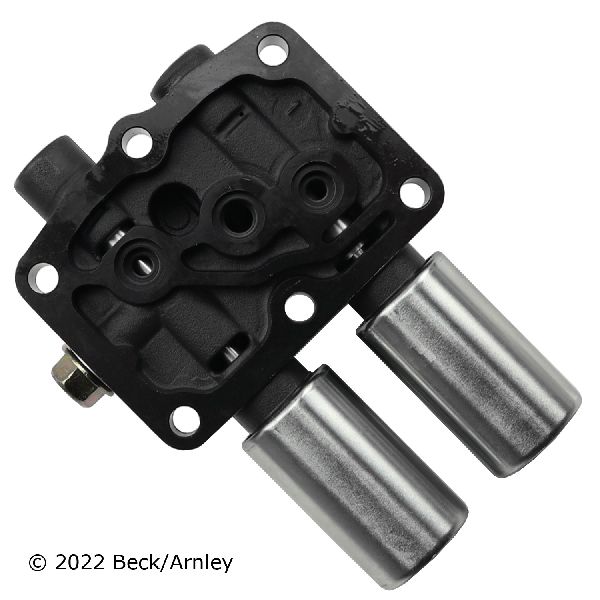
(OEM #V6: 28250-P6H-024 (Dual Linear Solenoid Assembly). 4-Cyl: 28300-PX4-003 (Lock-Up Solenoid).)— This solenoid controls the lock-up function. It can fail electrically or become clogged with debris. For the V6, it's a larger dual-solenoid assembly. For the 4-cylinder, it's a smaller, single lock-up solenoid. 🎬 See this walkthrough for fixing P0740 on 4-cylinder models.
Trusted brands: Genuine Honda, WSO, Rostra, ATP
OEM price range: $250-$400
Aftermarket price range: $80-$250 - Honda Genuine Automatic Transmission Fluid (ATF-DW1)
(OEM #08200-9008)— Using the correct fluid is critical for Honda transmissions. Dirty or incorrect fluid is a primary cause of shifting problems and solenoid failure.
Trusted brands: Genuine Honda
OEM price range: $10-$15 per quart
Aftermarket price range: N/A - Solenoid Gasket
(OEM #Varies by solenoid)— The gasket often includes a new filter screen and should always be replaced when the solenoid is removed. Clogged screens are a key diagnostic clue.
Trusted brands: Genuine Honda
OEM price range: $15-$30
Aftermarket price range: $10-$20
Related Codes That Often Appear With This One
- P0730 — Incorrect Gear Ratio. This code often appears with P0740 when the transmission is experiencing significant internal slippage, indicating widespread failure. An owner reported both P0730 and P0740 occurring simultaneously during gear flaring (NHTSA ODI #10713481).
- P0700 — Transmission Control System Malfunction. This is a generic code indicating that the Transmission Control Module (TCM) has stored a specific fault code, in this case, P0740.
Technical Service Bulletins (TSBs) & Recalls
- While no specific TSB is solely for P0740, Honda issued numerous bulletins regarding the automatic transmissions of this era. For example, recall 04V176000 for 2003-2004 V6 models addressed a gear lubrication issue that could cause lock-up, highlighting the transmission's sensitivity. Other TSBs addressed harsh shifting and other symptoms related to the eventual failure that triggers P0740.
Platform-Specific Known Issues
- The 4-speed (BAXA/MAXA) and 5-speed (B7XA) automatic transmissions used in the 1998-2002 Accords (especially V6 models) had a high failure rate. Honda faced class-action lawsuits and issued extended warranties (e.g., to 109,000 miles), though they have long since expired. The P0740 code is often the first sign of this well-documented transmission failure.
- The root cause is often traced to rapid wear of the clutch packs inside the transmission, which sheds material that clogs the hydraulic passages and solenoid screens, leading to a loss of pressure and the P0740 slippage code.
- Some owners on forums report success with swapping in a JDM (Japanese Domestic Market) equivalent transmission, which are perceived to be more robust, though this is an advanced repair.
Mechanic-Grade Diagnostic Values
- Torque Converter Clutch (TCC) Solenoid and Shift Solenoid A Resistance — expected: 12-25 Ohms. Failure: A reading outside this range indicates an electrical failure in the solenoid coil.
- TCC Solenoid and Shift Solenoid A Function Test — expected: An audible 'click' when 12V power is applied to the respective terminal pin and the solenoid body is grounded.. Failure: No click indicates a dead solenoid. However, a click does not guarantee the solenoid is good; it can still be clogged or mechanically sticking.
- Differential Bearing Wear Check — expected: No up/down or lateral movement of the axle stub where it enters the transmission.. Failure: Any noticeable play or movement in the axle stub suggests a worn differential bearing, which requires a transmission rebuild or replacement.
Scan Tool Commands That Help
- Honda Diagnostic System (HDS) or equivalent advanced scan tool: TCC ON/OFF Test — A technician can use a bidirectional scan tool to command the TCC solenoid on and off while monitoring engine RPM and transmission input speed. This helps to verify if the solenoid is responding to commands and if the hydraulic circuit is capable of achieving lock-up, isolating a control-side issue from a hydraulic/mechanical issue.
Wiring & Ground Locations
- G101 — On 4-cylinder models, G101 is located on the driver's side of the intake manifold plenum. On some models, it is found on the thermostat housing. It serves as a primary ground for the ECU/PCM and engine sensors.. A poor connection at G101 can cause a host of erratic electrical issues, including incorrect sensor readings and improper solenoid function that could indirectly contribute to or mimic transmission problems.
- TCC/Shift Solenoid A Connector (4-Cyl) — A 2-pin connector on the solenoid assembly at the front of the transmission.. For testing, Terminal 1 (often a Yellow wire) is for the TCC solenoid, and Terminal 2 (often a Green wire) is for Shift Solenoid A. Resistance is measured between the pin and the solenoid body (ground).
- Dual Linear Solenoid Connector (V6) — A larger connector on the solenoid assembly (Part No. 28250-P6H-024) located on the top/front of the V6 transmission.. This is the main connector for testing or replacing the solenoid assembly responsible for clutch pressure control, which directly impacts the P0740 code on V6 models.
Real Owner Repair Stories
- BundysGarage on YouTube / Acura Forums (1999-2003 Acura TL (shares V6 transmission with Accord)) — Extremely harsh, violent shift from 1st to 2nd and 2nd to 3rd that would chirp the tires. No slipping, just a hard jolt. Threw code P0740.
❌ Tried (didn't work) The owner noted that testing the old solenoid by applying 12V power resulted in an audible 'click', which would normally suggest the solenoid is functional.
✅ What actually fixed it Replacing the Dual Linear Solenoid Assembly (Honda Part No. 28250-P6H-024) completely solved the violent shifting and the P0740 code. This highlights that a solenoid can be mechanically faulty (sticking/clogged) even if it passes a simple electrical click test. - Honda-Tech forum user (1998 Honda Accord LX 4-cyl with 285,000 miles) — Transmission slipping, especially from 1st to 2nd gear, with RPMs flaring up to 5-6k before shifting. P0740 code was set.
❌ Tried (didn't work) The user was advised to check fluid and solenoids.
✅ What actually fixed it A senior forum member pointed out that before wasting time on fluid or solenoids, the user should check for a failed differential bearing, a common issue on these transmissions. This is done by jacking up the car and checking for any up-and-down or lateral play in the axle stub where it enters the transmission. If there is movement, the transmission requires a rebuild, and other fixes are futile. - NHTSA ODI #10726717 — An owner reported that the car started shifting hard into first and second gears before the check engine light illuminated with code P0740.
Documented NHTSA Reports
- NHTSA ODI #10713481 describes a situation where the automatic transmission flares upon acceleration between 1st to 2nd and 2nd to 3rd gears, triggering codes P0730 and P0740. This occurred even on a second transmission that had been replaced under a settlement agreement.
- NHTSA ODI #10460493 reports that the P0740 code keeps coming on accompanied by transmission hesitation.
- NHTSA ODI #10631906 notes that the vehicle slips in and out of gear and basically stops when turning a corner, with the TCC solenoid valve being activated by the TCM while in D4.
- NHTSA ODI #10482434 highlights that the torque converter code P0740 is a known issue for this vehicle range and can lead to transmission failure in as little as 50,000 miles, creating safety concerns during operation.
OEM Part Supersession History
28250-P6H-004→28250-P6H-024— This is the Dual Linear Solenoid Assembly for V6 models. The part was updated by Honda, likely to improve reliability or address common failure modes.
Heads up: The new part number (28250-P6H-024) is the correct replacement for the original. Using a used part with the old number is not recommended.
Model Year Variations Within This Range
- 1998-2002: 4-cylinder models use a single TCC/Lock-Up solenoid (Part No. approx. 28300-PX4-003) as part of a smaller assembly. V6 models use a larger, more complex Dual Linear Solenoid Assembly (Part No. 28250-P6H-024). The failure modes are similar (clogging, electrical failure), but the parts are not interchangeable and have different replacement procedures.
Diagnostic Flowchart
Real Owner Stories
Aggregated from forums and TSBs cited above. Mileages and costs reflect what owners reported in those sources.
1998 Honda Accord 4cyl
Symptoms: Triggered a P0740 code. Noted that the issue was hydraulic/slippage related rather than an electrical failure.
What fixed it: Ultimately required a full transmission replacement.
Source hint: Honda-Tech: '1998 Accord 4cyl - P0740 - Torque Converter Clutch Solenoid Circuit'
1998 Honda Accord V6
Symptoms: Received the P0740 code. Described the vehicle's transmission as a 'ticking time bomb' with an unpredictable timeline before complete failure.
What fixed it: No permanent fix mentioned; owners discussed driving it until failure.
Source hint: Reddit r/MechanicAdvice: 'Experience With Transmission Life After P0740 Code (1998 Honda Accord V6)?'
1998-2002 Honda Accord
Symptoms: Experienced the P0740 code as a hydraulic fault. Lived with the code for 2 years with only a minor impact on gas mileage.
What fixed it: Continued driving without immediate repair, illustrating that immediate failure is not always the case.
Source hint: Honda Accord Forum: 'p0740 tcc soloniod'
Acura CL (Platform Mate)
Symptoms: P0740 code appeared. Described as the 'doomsday clock ticking' for transmission failure due to deteriorating clutch material clogging the TCC solenoid screen.
What fixed it: Transmission replacement or rebuild due to internal failure.
Source hint: AcuraZine: 'P0740 code... death of transmission?'
Related OBD-II Codes
Frequently Asked Questions
Is my 1998-2002 Accord's transmission covered under the extended warranty for P0740?
Should I get a transmission flush to fix the P0740 code on my Accord?
My D4 light is blinking along with the check engine light. What does this mean?
If my TCC solenoid tests fine electrically, can it still cause the P0740 code?
Does recall 04V176000 apply to my 1998-2002 Accord for this issue?
Can I just clean the TCC solenoid screens instead of replacing the transmission?
Helpful Videos
We Have This Part in Stock

The information in this article is provided for general reference and educational purposes only. Vehicle specifications, procedures, and part compatibility can vary by production date, trim level, and region. Always consult your vehicle's factory service manual and verify part numbers before purchasing or performing repairs. Safety-critical components such as airbags, seat belts, and braking systems should be installed by a qualified professional.
- Honda Accord:
- 🧭 Diagnostic Flowchart
- 🎬 Helpful Videos
- 🛍️ Shop This Part
- What's Unique About the 1998-2002 Honda Accord
- Symptoms You May Notice
- Most Likely Causes
- Rare But Worth Checking
- Diagnosis Steps
- Parts You'll Likely Need
- Related Codes That Often Appear With This One
- Technical Service Bulletins (TSBs) & Recalls
- Platform-Specific Known Issues
- Mechanic-Grade Diagnostic Values
- Scan Tool Commands That Help
- Wiring & Ground Locations
- Real Owner Repair Stories
- Documented NHTSA Reports
- OEM Part Supersession History
- Model Year Variations Within This Range
- Real Owner Stories
- 1998 Honda Accord 4cyl
- 1998 Honda Accord V6
- 1998-2002 Honda Accord
- Acura CL (Platform Mate)
- Related OBD-II Codes
- Frequently Asked Questions
- 🎟️ Get 5% Off