

P0740 on 2004-2016 Nissan Armada: Torque Converter Clutch Circuit Malfunction Guide
P0740 on a Nissan Armada indicates a problem with the torque converter clutch (TCC) solenoid circuit. The most common cause is internal transmission failure related to coolant contamination from a faulty radiator, which requires a transmission rebuild or replacement. A less common but possible cause is a failed TCC solenoid itself or a wiring issue on the valve body.
- P0740 on a 2004-2015 Armada is a serious code that often signals impending transmission failure.
- The most critical first step is to check the transmission fluid for coolant contamination (a pink, milky appearance).
- If coolant is present, the radiator and transmission must be replaced or rebuilt together. Simply fixing one part will not solve the problem.
- If the fluid is clean, the issue is likely a faulty TCC solenoid or wiring, which is a much less expensive repair.
- Due to the complexity and high cost of the most common failure, professional diagnosis is strongly recommended.
What's Unique About the 2004-2016 Nissan Armada
The 2004-2015 Nissan Armada uses the RE5R05A 5-speed automatic transmission, which is known for a specific, catastrophic failure mode. The transmission cooler, which is integrated into the bottom of the engine's radiator, is prone to internal leaks. When this happens, engine coolant (antifreeze) mixes with the automatic transmission fluid (ATF). This contaminated fluid, often called the "strawberry milkshake of death" (SMOD), quickly destroys transmission seals, clutch materials, and electronic components. Coolant is particularly damaging to the Transmission Control Module (TCM), which on these models is located inside the transmission on the valve body, submerged in fluid. The coolant causes corrosion and short circuits on the TCM's solder joints and solenoid terminals. Therefore, a P0740 code on this vehicle is often a symptom of this much larger, well-documented issue rather than just a simple solenoid failure.
Generation note: The specified range 2004-2016 primarily covers the first-generation (TA60) Armada. Production for the U.S. market ran from 2004 through 2015. This generation uses the RE5R05A transmission, which is highly susceptible to the radiator/coolant contamination issue. While some sources may list a 2016 model year, it is an overlap/carryover year, and the second-generation Armada (Y62) with a different transmission began in 2017. This guide is most relevant to the 2004-2015 models.
Symptoms You May Notice
- Check Engine Light is on
- Transmission may not shift properly or may feel like it's slipping
- Shuddering or vibration at highway speeds (45-60 mph), similar to driving over rumble strips
- Reduced fuel economy
- Engine RPMs are higher than usual at cruising speeds
- Stalling when coming to a stop (if the clutch fails to disengage)
- Transmission overheating warning light or a burning smell
- Replacing only the TCC solenoid when the transmission fluid is contaminated with coolant. The new solenoid will quickly fail, and the rest of the transmission remains damaged.
- Assuming the torque converter is bad when the root cause is coolant contamination that has damaged the entire transmission, including the converter.
- Replacing the entire transmission without also replacing the faulty radiator, leading to a repeat failure.
Most Likely Causes
- Internal Radiator Leak & Coolant Contamination (SMOD) 🔴 High Probability → Shop Radiator The RE5R05A transmission is paired with a radiator that has a known design flaw, where the internal transmission cooler develops cracks, allowing coolant to mix with the transmission fluid. This is the most common and well-documented failure for this platform.
How to confirm: Check the transmission fluid for a milky, pinkish appearance (the "strawberry milkshake"). Check the coolant overflow tank for signs of transmission fluid contamination. A professional may also perform a glycol test on the fluid.
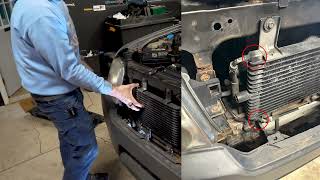
Typical fix: This requires a complete transmission rebuild or replacement, along with replacing the radiator with an updated part and flushing all cooling lines. Simply replacing the TCC solenoid will not fix the underlying damage. Many owners perform a preventative bypass of the radiator cooler, 🎬 Watch: How to perform a radiator bypass to prevent SMOD. though this can affect transmission warm-up in cold climates.
Est. part cost: $2000-$4500 (for remanufactured transmission and new radiator) - Failed Torque Converter Clutch (TCC) Solenoid 🟡 Medium Probability → Shop Automatic Transmission Torque Converter Solenoids can fail electrically or become clogged with debris. Coolant contamination can also directly cause the solenoid to short out or jam.
How to confirm: A technician can test the solenoid's resistance with a multimeter. This requires dropping the transmission pan to access the valve body. For the RE5R05A, the TCC solenoid should have a resistance of approximately 23 ohms, while other solenoids are around 3.3 ohms. A reading far outside this range indicates failure.
Typical fix: Replace the TCC solenoid, which is located on the valve body inside the transmission. This also involves replacing the pan gasket and fluid. 🎬 See this walkthrough for a transmission filter and gasket service.
Est. part cost: $50-$150 - Damaged Wiring or Faulty TCM ⚪ Low Probability
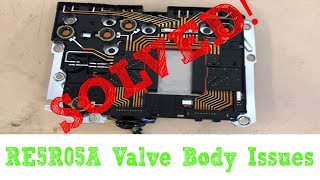
How to confirm: Visually inspect the external wiring harness to the transmission for damage. More commonly, the issue is internal on the valve body itself. Inspect the TCM (which is part of the valve body) for cracked or broken solder joints at the solenoid connection points. 🎬 Watch: How to diagnose and fix TCM and solenoid issues. A technician can perform a continuity test on the TCC solenoid circuit from the TCM connector.
Typical fix: Repair or replace the damaged section of the external wiring harness. If a solder joint on the TCM is broken, it can sometimes be re-soldered. Otherwise, the entire valve body/TCM assembly must be replaced.
Est. part cost: $20-$1000 (depending on wiring repair vs. valve body replacement) - Low or Dirty Transmission Fluid ⚪ Low Probability → Shop Transmission Assembly
How to confirm: Check the transmission fluid level and condition via the dipstick (on models that have one). Fluid should be reddish-pink and not smell burnt. If it's low, dark, or contains debris, it's a problem.
Typical fix: Perform a transmission fluid and filter change using the correct Nissan Matic S fluid. If the fluid is very low, the source of the leak must be found and repaired.
Est. part cost: $50-$120 (for fluid and filter)
Rare But Worth Checking
- Failed Torque Converter: → Shop Automatic Transmission Torque Converter While the solenoid circuit is the focus of the code, a mechanical failure within the torque converter's clutch assembly (e.g., worn clutch material) can prevent lock-up and sometimes trigger this electrical fault code as a secondary effect.
- Faulty Transmission Control Module (TCM): → Shop Transmission Assembly This is very rare as a standalone failure without coolant contamination. The TCM is integrated into the valve body inside the transmission. It should only be considered after all other possibilities, especially SMOD, have been exhaustively ruled out. Failure is often due to broken solder joints rather than a complete electronic failure.
Diagnosis Steps
- Scan the vehicle's computer to confirm P0740 is the active code and check for any other related transmission codes.
- Check the transmission fluid level and condition. Look for the tell-tale 'strawberry milkshake' color that indicates coolant contamination. Also check the radiator overflow for oily residue.
- If fluid is contaminated, the diagnosis is complete: the radiator has failed and the transmission is compromised. A rebuild or replacement is necessary.
- If the fluid looks normal, inspect the external wiring harness to the transmission for any visible damage or corrosion.
- If wiring is okay, drop the transmission oil pan to access the valve body and the integrated TCM.
- Visually inspect the TCM for cracked or broken solder joints where the solenoids connect.
- Test the resistance of the TCC solenoid with a multimeter. It should read approximately 23 ohms. If it's open (infinite resistance) or shorted (zero resistance), it has failed.
- If the solenoid tests bad, replace it, the pan gasket, the filter, and refill with fresh Nissan Matic S fluid.
- If the solenoid and wiring test good, the problem could be a more complex internal issue with the valve body, a mechanical failure within the torque converter itself, or a deeper failure of the TCM.
Parts You'll Likely Need
- Remanufactured RE5R05A Transmission — This is the most common fix due to the high likelihood of catastrophic failure from coolant contamination.
Trusted brands: Street Smart Transmission, Jasper Engines & Transmissions, Xtreme Performance
Aftermarket price range: $2500-$4500 - Radiator
(OEM #21460-ZZ90A (supersedes 21460-9FD1B, 21460-ZV00A, 21460-9FD0B, etc.))— Must be replaced along with the transmission to prevent the same failure from happening again. Using the updated OEM part number is recommended.
Trusted brands: Nissan Genuine, Denso, Spectra Premium
OEM price range: $550
Aftermarket price range: $150-$300 - Torque Converter Clutch (TCC) Solenoid — If coolant contamination is not present, a failed solenoid is the next most likely cause. It is located on the valve body.
Related Codes That Often Appear With This One
- P0744 (Torque Converter Clutch Circuit Intermittent)
- P1754 (Input Clutch Solenoid)
- P1764 (Direct Clutch Solenoid)
- Multiple other transmission solenoid codes if the TCM is shorting out due to coolant contamination.
Technical Service Bulletins (TSBs) & Recalls
- While there is no single, specific TSB for P0740 that covers the widespread SMOD issue, Nissan has issued numerous bulletins for the RE5R05A transmission and related components. For example, TSB NTB18-077C addresses DTCs on a different CVT transmission but serves as an example of Nissan's diagnostic and repair documentation process. The SMOD issue is considered common knowledge in the repair community, extensively documented in forums rather than a single recall or TSB.
Platform-Specific Known Issues
- The primary issue for the 2004-2015 Armada is the failure of the integrated transmission cooler within the radiator, leading to coolant contaminating the transmission fluid (SMOD). This is a widely documented problem for Nissan vehicles using the RE5R05A transmission. A preventative measure many owners take is to bypass the factory radiator cooler and install a separate, external transmission cooler. This completely isolates the transmission fluid from the engine coolant, eliminating the risk of SMOD.
Mechanic-Grade Diagnostic Values
- TCC Solenoid Resistance — expected: ~23 ohms. Failure: A reading of infinite resistance (open) or near-zero resistance (shorted).
- Other RE5R05A Solenoids Resistance (for comparison) — expected: ~3.3 ohms. Failure: A reading significantly different from 3.3 ohms.
- TCC Solenoid Current (Live Scan Tool Data) — expected: 0.2 - 0.4 amps during slip; 0.4 - 0.7 amps when fully locked.. Failure: Current readings outside of these ranges or 0 amps when commanded on.
Scan Tool Commands That Help
- Nissan CONSULT or compatible advanced scan tool: TCC Solenoid Active Test / Bidirectional Control — This command allows a technician to manually command the TCC solenoid on and off while monitoring the circuit's voltage or amperage. It is used to confirm if the solenoid is mechanically and electrically responding to commands from the TCM, helping to isolate the fault between the TCM, wiring, and the solenoid itself.
Wiring & Ground Locations
- Transmission Harness Connector — The main electrical connector on the outside of the RE5R05A transmission case. For models with the TCM on the valve body (2004+), this is a single green connector.. This is the primary point for testing the external wiring harness continuity to the TCM. Corrosion or damage here can cause P0740 and other transmission codes.
- TCM / Valve Body Internal Harness — Inside the transmission oil pan, connecting the TCM to the various solenoids, including the TCC solenoid.. This is where failures are common, especially due to coolant contamination (SMOD) causing short circuits, or from cracked solder joints on the TCM itself where the solenoid pins connect. Visual inspection is critical once the pan is dropped.
- Ground Distribution — Multiple ground points are located on the engine block, chassis frame rails, and near the battery. Specific locations are detailed in the 'PG' (Power Supply, Ground & Circuit Elements) section of the factory service manual.. A poor ground connection for the TCM or main engine harness can cause erratic voltage and trigger various electrical fault codes, including P0740. Verifying clean and tight main ground connections is a fundamental step.
Real Owner Repair Stories
- BobIsTheOilGuy forum user (2008 Nissan Frontier 2WD (uses same RE5R05A transmission)) — After a full transmission rebuild due to glycol (SMOD) contamination, the truck would lose 4th and 5th gear once it reached operating temperature (165-185°F), throwing P0734 (4th gear ratio) and P0735 (5th gear ratio) codes.
❌ Tried (didn't work) A complete transmission rebuild with a remanufactured valve body/TCM and new torque converter was performed, but the issue appeared post-rebuild.
✅ What actually fixed it The discussion pointed towards a common RE5R05A rebuild error: improperly installed or damaged input shaft sealing rings. These rings are notoriously difficult to install without damage, and failure causes a pressure loss to the 4th/5th gear clutches when the fluid gets hot and thins out. The resolution is to tear down the transmission again and correctly replace the input shaft seals. - NHTSA ODI #10758676 — While reported on a different Nissan model (Versa), an owner described experiencing issues between 20-30 MPH; a diagnostic test confirmed DTC P0740 for the torque converter circuit.
OEM Part Supersession History
21460-ZV00A, 21460-9FD0B, 21460-9FD1B, and others→21460-ZZ90A— The original radiator designs had a flawed internal transmission cooler that was prone to cracking and causing coolant contamination (SMOD).
Heads up: When replacing the radiator due to SMOD, it is critical to use the latest superseded part number (21460-ZZ90A) or a quality aftermarket equivalent known to have resolved the cooler issue. Installing an old stock or incorrect radiator will lead to a repeat failure.
Model Year Variations Within This Range
- 2002 - Mid-2004 (Applies to other Nissan/Infiniti models, pre-Armada): Early RE5R05A transmissions had an external TCM located in the passenger kick panel.
- Mid-2004 - 2015 (All Armadas in this range): The TCM is integrated into the valve body, located inside the transmission oil pan. This makes it directly vulnerable to coolant contamination (SMOD).
- 2006, 2009: The valve body itself underwent several design changes. A 2006 redesign changed the TCC solenoid's pressure source and accumulators. A 2009 redesign eliminated most pressure switches and one of the temperature sensors, requiring different TCM programming. This is critical when sourcing used or remanufactured valve bodies, as they are not all interchangeable.
Diagnostic Flowchart
Used vs. New Parts: Buying Guide for This Vehicle
When a used part is the smart pick: For this specific P0740 issue, a used part is almost never a smart choice. A used transmission or valve body/TCM assembly from a junkyard has a high probability of either having existing SMOD damage or being susceptible to the same failure. The only exception might be sourcing a minor external component like a wiring harness connector.
Donor-vehicle mileage cap: roughly under 50000 miles for the part to have meaningful remaining life.
What to inspect on the donor part:
- For a complete transmission: MUST have verifiable proof of a radiator replacement or an external cooler bypass from early in the vehicle's life.
- Check the donor vehicle's radiator for a date code or part number to see if it's an updated replacement.
- If possible, pull the dipstick from the donor transmission. Any sign of milky, pink, or brown sludgy fluid is an absolute deal-breaker.
- Ask for a warranty. Reputable sellers of used transmissions should offer at least a 30-day warranty.
OEM-only on this vehicle (don't cheap out):
- Radiator: While quality aftermarket options exist, using the latest Nissan Genuine part (21460-ZZ90A) is the safest bet to guarantee the SMOD issue is resolved.
- Transmission Control Module (TCM): If replacing separately, an OEM or a professionally remanufactured and VIN-programmed unit is required. A used TCM may have incompatible programming from a different year or model.
Aftermarket brands forum-validated for this vehicle:
- Radiators: Denso, Spectra Premium (often cited as reliable alternatives to OEM).
- Remanufactured Transmissions/Valve Bodies: Street Smart Transmission, Jasper Engines & Transmissions, Xtreme Performance (These companies often address the root cause failures in their remanufacturing process).
Brands owners have reported issues with on this vehicle:
- Avoid unbranded, 'white box' radiators or valve body solenoids from online marketplaces. The risk of premature failure is extremely high and can lead to destroying the entire transmission again.
Real Owner Stories
Aggregated from forums and TSBs cited above. Mileages and costs reflect what owners reported in those sources.
Nissan Armada/Xterra/Pathfinder
Symptoms: Solenoid codes were present.
What fixed it: The issue was traced to a broken solder joint on the TCM, which is located on the valve body. The joint was re-soldered to fix the problem.
Source hint: YouTube: 'SOLVED: RE5R05A Valve Body Issues TCM Solenoid Nissan Xterra Pathfinder Armada Frontier' by 'Fixing cars and stuff'
Nissan Xterra (RE5R05A)
Symptoms: Torque converter shudder, even after the radiator had been replaced following a SMOD event.
What fixed it: The owner was considering a full transmission rebuild, indicating that the initial radiator replacement did not fix the lasting internal damage caused by coolant contamination.
Source hint: Reddit r/Xterra - A thread titled 'RE5R05A Torque converter shudder, considering rebuild'
Nissan (pre-2009 model) — ~175000 miles
Symptoms: Transmission light on with code P0740.
What fixed it: Technicians advised that at high mileage, a full transmission replacement is often more prudent than attempting a solenoid-only repair.
Source hint: Nissan Forum - A 2009 thread titled 'Transmission Light/P0740 Code/Judgement is 7'
Nissan Owner Report
Symptoms: An owner reported experiencing issues between 20-30 MPH.
What fixed it: A diagnostic test identified DTC P0740 related to the torque converter (NHTSA ODI #10758676).
Related OBD-II Codes
Frequently Asked Questions
What is 'SMOD' and is my 2004-2016 Armada at risk for it?
How can I check for the SMOD coolant contamination issue myself?
Is there a way to prevent the SMOD failure from happening to my Armada?
Can I just replace the TCC solenoid to fix code P0740?
My mechanic is testing the TCC solenoid. What should its resistance be on my Armada's RE5R05A transmission?
What type of transmission fluid should be used in my Nissan Armada?
Do the Nissan Titan and Infiniti QX56 have the same P0740 transmission problems?
Helpful Videos

The information in this article is provided for general reference and educational purposes only. Vehicle specifications, procedures, and part compatibility can vary by production date, trim level, and region. Always consult your vehicle's factory service manual and verify part numbers before purchasing or performing repairs. Safety-critical components such as airbags, seat belts, and braking systems should be installed by a qualified professional.
- Nissan Armada:
- 🧭 Diagnostic Flowchart
- 🎬 Helpful Videos
- What's Unique About the 2004-2016 Nissan Armada
- Symptoms You May Notice
- Most Likely Causes
- Rare But Worth Checking
- Diagnosis Steps
- Parts You'll Likely Need
- Related Codes That Often Appear With This One
- Technical Service Bulletins (TSBs) & Recalls
- Platform-Specific Known Issues
- Mechanic-Grade Diagnostic Values
- Scan Tool Commands That Help
- Wiring & Ground Locations
- Real Owner Repair Stories
- OEM Part Supersession History
- Model Year Variations Within This Range
- Used vs. New Parts: Buying Guide for This Vehicle
- Real Owner Stories
- Nissan Armada/Xterra/Pathfinder
- Nissan Xterra (RE5R05A)
- Nissan (pre-2009 model) — ~175000 miles
- Nissan Owner Report
- Related OBD-II Codes
- Frequently Asked Questions
- 🎟️ Get 5% Off