

P0741 on 2004-2012 GMC Canyon: Torque Converter Clutch Causes and Fixes
On a 2004-2012 GMC Canyon, code P0741 most often points to a faulty TCC solenoid or a bad internal transmission wiring harness inside the 4L60-E transmission. For 2012 models specifically, a known TSB addresses this exact issue. Expect to pay $200-$400 for a solenoid and harness replacement if you do it yourself, or $500-$800 at a shop.
- P0741 on a 2004-2012 Canyon means the torque converter clutch is failing to lock up as commanded.
- The most likely causes are a bad TCC solenoid or a faulty internal transmission wiring harness, especially on 2012 models.
- Do not immediately assume the torque converter or the entire transmission has failed; the problem is often a smaller, less expensive component inside the transmission pan.
- This is not a beginner-friendly DIY repair. It requires dropping the transmission pan and working with sensitive components.
- Driving for an extended period with this code can cause severe transmission damage from overheating.
What's Unique About the 2004-2012 GMC Canyon
The 2004-2012 GMC Canyon uses the 4L60-E automatic transmission. While generally reliable, this transmission is known for specific issues that can trigger a P0741 code. For the 2012 model year, GM issued a Special Coverage bulletin (14404) specifically for P0741 caused by a faulty internal transmission wiring harness. This suggests that on later models of this generation, wiring and solenoid issues within the transmission are a primary concern, sometimes more so than the torque converter itself. The TCC solenoid is often integrated into the harness, making it a common point of failure. Manufacturer TSB Bulletin #15111 further confirms that a faulty harness can cause the Check Engine Light to illuminate and may result in the transmission exhibiting a harsh shift from first gear to second gear.
Symptoms You May Notice
- Check Engine Light is on
- Higher than normal engine RPM at highway speeds
- Noticeable decrease in fuel economy
- Transmission may feel like it's slipping
- Possible harsh shifting, particularly between 1st and 2nd gear.
- Vehicle may shudder or vibrate at cruising speeds, sometimes described as feeling like driving over rumble strips.
- Flashing overdrive light may be present on some models.
- Replacing the entire transmission when only a solenoid or wiring harness was needed.
- Replacing the torque converter before properly diagnosing the TCC solenoid, wiring, and valve body.
- Assuming a simple fluid change will fix a confirmed electrical or mechanical fault.
Most Likely Causes
- Faulty Torque Converter Clutch (TCC) Solenoid 🔴 High Probability → Shop Automatic Transmission Torque Converter The TCC solenoid in the 4L60-E is a very common failure point. It is an electro-hydraulic valve that can fail electrically (coil burns out) or get stuck mechanically due to contaminated fluid or wear. TSB Bulletin #PIP5009G notes that technicians may need to replace the torque converter clutch solenoid along with the wire harness to resolve the P0741 code.
How to confirm: A technician can use a scan tool to command the TCC solenoid on and off while monitoring TCC slip RPM. If the solenoid doesn't respond, it's likely faulty. The solenoid's resistance can also be tested with a multimeter after removing the transmission pan; it should be within a specific range (typically 10-15 ohms for a 4L60-E). A reading far outside this range indicates a failed solenoid.
Typical fix: Replace the TCC solenoid. This is located inside the transmission on the valve body and requires removing the fluid pan for access. It is often replaced along with the internal wiring harness.
Est. part cost: $40-$80 - Faulty Internal Transmission Wiring Harness 🔴 High Probability → Shop Transmission Assembly GM issued Special Coverage bulletin 14404 for 2012 models, identifying a faulty internal wiring harness as the direct cause for P0741. The harness can become brittle and fail from heat cycles, causing poor connections to the solenoids. TSB Bulletin #15111 explicitly instructs dealers to replace the automatic transmission wiring harness if DTC P0741 is found.
How to confirm: Visual inspection of the harness inside the transmission pan for brittle, cracked, or broken wires. A technician may also check for continuity from the main transmission connector to the solenoid.
Typical fix: Replace the internal transmission wiring harness. This is often done at the same time as the TCC solenoid, as access is the same and they are often sold as an assembly.
Est. part cost: $50-$100 - Low or Dirty Transmission Fluid 🟡 Medium Probability → Shop Transmission Assembly Low fluid level prevents the hydraulic pressure needed to engage the TCC. Dirty or degraded fluid containing debris can cause solenoids and valves to stick or wear prematurely.
How to confirm: Check the transmission fluid level and condition with the engine running and at operating temperature. The fluid should be red and clear, not brown, black, or smell burnt. Burnt fluid may indicate clutch material from the torque converter is circulating in the system.
Typical fix: Perform a transmission fluid and filter change. If the fluid is very low, the source of the leak must be found and repaired. A fluid change alone will not fix a mechanical or electrical failure.
Est. part cost: $60-$120 - Worn or Sticking TCC Regulator Valve in Valve Body 🟡 Medium Probability → Shop Transmission Valve Body Debris in the transmission fluid can cause the TCC regulator valve in the valve body to wear its bore, creating a hydraulic leak that prevents the TCC from applying correctly. This is a well-documented wear point in the 4L60-E valve body.
How to confirm: This is a more advanced diagnosis. After confirming the solenoid and wiring are good, a technician may use a vacuum test on the valve body to check for wear in the TCC regulator valve bore. Sonnax is a well-known manufacturer of tools and kits for this specific issue.
Typical fix: The valve body must be removed and the worn valve bore reamed to accept an oversized replacement valve. Sonnax and Fitzall offer kits for this repair, which is a job for a transmission specialist or experienced DIYer.
Est. part cost: $100-$200 for a valve kit
Rare But Worth Checking
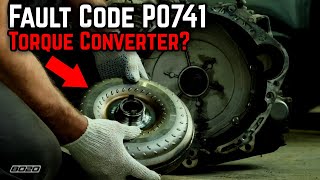
- Failing Torque Converter: → Shop Automatic Transmission Torque Converter While the solenoid and wiring are more common culprits on this platform, the internal clutch of the torque converter can fail mechanically. This is a major repair that requires removing the entire transmission. Debris from a failing converter can contaminate the entire transmission, necessitating a flush or rebuild.
- Damaged Transmission Pump: → Shop Transmission Assembly Debris from a failing torque converter can pass through and damage the transmission pump, leading to low line pressure. If line pressure is below specifications, the pump may need to be inspected and replaced.
Diagnosis Steps
- Verify the code P0741 is present using an OBD-II scanner.
- Check the transmission fluid level and condition. The engine should be warm and running in Park. If the fluid is low, top it off and check for leaks. If it's dark or burnt, a fluid and filter change is a good first step, but may not solve the underlying issue.
- Using a capable scan tool, monitor the TCC Slip Speed data while driving at a steady cruise (above 45 mph). If the PCM commands the TCC on, but the slip speed remains high (over 200 RPM), a problem is confirmed.
- Drop the transmission oil pan to access the internal components. Inspect the fluid in the pan and the magnet for excessive metal shavings, which would indicate a more serious internal failure.
- Visually inspect the internal wiring harness for any signs of damage, such as brittle insulation or broken wires near the connectors.
- Test the TCC solenoid's resistance with a multimeter. Compare the reading to the manufacturer's specification (typically 10-15 ohms for a 4L60-E). A reading outside this range indicates a failed solenoid.
- If the solenoid and wiring test good, the next step is to inspect the TCC regulator valve in the valve body for scoring or sticking. This may require specialized tools like a vacuum tester.
- If all internal hydraulic and electrical components are confirmed to be working, the torque converter itself is the likely point of failure. This requires transmission removal to replace.
Parts You'll Likely Need
- Torque Converter Clutch (TCC) PWM Solenoid
(OEM #24227792)— This solenoid is a frequent failure point in the 4L60-E transmission and is directly responsible for controlling the TCC lock-up.
Trusted brands: ACDelco, Sonnax
OEM price range: $40-$60
Aftermarket price range: $25-$50 - Automatic Transmission Internal Wiring Harness
(OEM #24237980)— A known failure point, especially on 2012 models, as documented in GM Special Coverage 14404. It's often replaced along with the TCC solenoid.
Trusted brands: ACDelco
OEM price range: $70-$100
Aftermarket price range: $50-$80 - Transmission Filter and Pan Gasket Kit
(OEM #8654799)— Required for any repair that involves dropping the transmission pan. The gasket part number is mentioned in TSB 14404.
Trusted brands: ACDelco, Wix
OEM price range: $30-$50
Aftermarket price range: $20-$40 - DEXRON-VI Automatic Transmission Fluid — The correct fluid is required when refilling the transmission after service. A pan drop requires approximately 5-6 quarts.
Trusted brands: ACDelco, Valvoline, Castrol
Related Codes That Often Appear With This One
- P0700: Transmission Control System Malfunction - This is a generic code indicating the TCM has stored a fault, which in this case would be P0741.
Technical Service Bulletins (TSBs) & Recalls
- 14404 / N152007260: Special Coverage for P0741 and harsh 1-2 shift on 2012 models due to a faulty internal transmission wiring harness.
- PIP5009F: Preliminary Information bulletin for technicians advising them to replace the TCC solenoid and harness on 2012 models built after 10/01/2011 when servicing the transmission for a P0741 code.
- Bulletin #15111: Manufacturer bulletin stating that the transmission may exhibit a harsh shift from first gear to second gear and set DTC P0741; dealers are instructed to replace the automatic transmission wiring harness.
- Bulletin #PIP5009G: Technical guidance regarding vehicles with a harsh 1-2 shift and P0741, advising the replacement of the torque converter clutch solenoid and wire harness.
Platform-Specific Known Issues
- GM Special Coverage bulletin 14404 (NHTSA ID 10058223) was issued for some 2012 GMC Canyon models. It addresses the P0741 code accompanied by a harsh 1-2 shift, caused by a faulty internal transmission wiring harness (part number 24237980). The coverage extended the warranty for this specific repair to 10 years or 120,000 miles.
Mechanic-Grade Diagnostic Values
- TCC PWM Solenoid Resistance — expected: 10 to 15 ohms. Failure: A reading significantly outside this range, or an open/short circuit, indicates a failed solenoid.
- TCC On/Off Solenoid Resistance (if applicable, earlier models) — expected: 12 to 28 Ohms. Failure: A reading outside this range indicates failure.
- TCC Slip Speed (Live Data) — expected: Near 0 RPM when TCC is commanded ON and locked.. Failure: A slip speed consistently over 150-200 RPM when lockup is commanded indicates a problem.
- Valve Body TCC Regulator Valve Bore Vacuum Test — expected: Above 15 in-Hg (inches of Mercury). Failure: A reading below 15 in-Hg, especially below 10, indicates significant wear in the valve bore, causing a hydraulic leak.
Scan Tool Commands That Help
- Tech2/GDS2 or equivalent professional scanner: TCC Solenoid Control (On/Off/PWM Duty Cycle) — This bidirectional command is crucial for diagnosis. A technician can manually command the TCC solenoid on and off, or vary its duty cycle, while monitoring TCC slip RPM. This directly tests the solenoid's electrical circuit and its mechanical response. If the slip RPM doesn't change when the solenoid is commanded, it points to a failure in the solenoid, wiring, or hydraulic circuit.
Wiring & Ground Locations
- Transmission Case Connector (Main Harness) — Passenger side of the transmission case.. This is the main external connection point for all internal transmission electronics. Pin 'T' is typically the TCC Solenoid (On/Off or PWM) control wire from the TCM. Pin 'E' is the 12V+ power feed to the solenoids. Testing for voltage at Pin E and a command signal (ground or PWM) at Pin T can diagnose external wiring or TCM issues without dropping the pan.
Real Owner Repair Stories
- Forum user on 355nation.net (2009 Chevy Colorado (shared platform/drivetrain)) — P0741 code, no TCC lockup.
❌ Tried (didn't work) Initial diagnosis pointed towards the common causes.
✅ What actually fixed it The user replaced the TCC solenoid and the internal wiring harness. After the replacement, the P0741 code was cleared and did not return, confirming the fix.
Model Year Variations Within This Range
- 1995-onward: In 1995, the 4L60-E transmission was updated to use a Pulse Width Modulated (PWM) TCC solenoid. This allows for a smoother, more controlled lock-up engagement compared to the simple on/off solenoid used in 1993-1994 models. The GMC Canyon (2004-2012) uses this PWM system. Using a non-PWM solenoid or computer in a PWM transmission (or vice-versa) will cause lock-up issues and codes.
- 2006-onward: Starting in 2006, some 4L60-E family transmissions (often called 4L65E/4L70E) began incorporating an Input Speed Sensor (ISS). This required changes to the pump, stator, input shaft, and internal harness. While the core TCC function is similar, swapping parts between ISS and non-ISS units can cause major problems. The harness for an ISS unit has a different plug to accommodate the extra sensor.
Diagnostic Flowchart
Other Known Issues on This Vehicle
Issues unrelated to this code that are worth knowing about as an owner of this generation:
- HVAC Blower Motor Resistor Failure 🟡 Low — Very common. Typically results in the fan only working on the highest setting (speed 4). The resistor and its connector pigtail often melt and should be replaced together.
- Passlock Anti-Theft System Failure 🟠 Medium — Common issue causing intermittent no-start conditions where the engine cranks but won't fire, often accompanied by a flashing security light.
- Worn Valve Seats (3.5L I5 Engine) 🔴 High — A known issue on the 3.5L L52 engine where premature valve seat wear can cause low compression, leading to misfires (P0300) and rough idle. Requires cylinder head repair.
- Cracked Exhaust Manifold (5-Cylinder Engines) 🟠 Medium — The exhaust manifold on the inline-5 engines is prone to cracking, causing an exhaust leak that is audible as a ticking noise, especially when cold.
- EVAP Vent Valve Solenoid Failure 🟡 Low — Common failure leading to a Check Engine Light with EVAP codes (e.g., P0450). The valve gets stuck due to dirt and debris, and is located near the spare tire.
- Throttle Body Carbon Buildup 🟡 Low — The throttle body can accumulate carbon, leading to a low or unstable idle and potentially setting a P0506 code. Regular cleaning is the fix.
Used vs. New Parts: Buying Guide for This Vehicle
When a used part is the smart pick: For this repair, sourcing a complete used valve body from a low-mileage donor vehicle can be a cost-effective alternative to attempting a valve bore repair, especially if you lack the specialized tools. A used torque converter is generally not recommended due to the high labor cost of installation and the unknown condition of the internal clutch.
Donor-vehicle mileage cap: roughly under 80000 miles for the part to have meaningful remaining life.
What to inspect on the donor part:
- For a valve body: Check the fluid color from the donor transmission; it should be bright red, not brown or black.
- Inspect the donor vehicle for signs of a major collision that could have damaged the transmission case.
- Ask for any available service history of the donor vehicle; regular fluid changes are a good sign.
OEM-only on this vehicle (don't cheap out):
- Internal Wiring Harness: Aftermarket harnesses can have issues with connector fitment and wire quality. Given the GM TSB pointing to this part, using the OEM (ACDelco) replacement is strongly advised.
Aftermarket brands forum-validated for this vehicle:
- Sonnax: For TCC solenoids and valve body repair kits (oversized valves, reaming tools). They are a highly respected name in the transmission repair industry.
- Fitzall: Offers alternative valve body repair kits that are also well-regarded by transmission specialists.
- TransGo: Known for their shift kits, which often include improved TCC regulator valves to fix bore wear issues.
Brands owners have reported issues with on this vehicle:
- Unbranded, no-name solenoid kits from online marketplaces. While cheap, they have a high failure rate. A review of one such kit noted that while it worked, only one part was actually a name brand, and the rest were in plain boxes, suggesting lower quality.
Real Owner Stories
Aggregated from forums and TSBs cited above. Mileages and costs reflect what owners reported in those sources.
2012 GMC Canyon
Symptoms: P0741 code accompanied by a harsh 1-2 shift.
What fixed it: Replacement of the internal transmission wiring harness (part number 24237980) under Special Coverage bulletin 14404.
Source hint: GM Special Coverage bulletin 14404 (NHTSA ID 10058223)
2006-2010 Hummer H3 — ~150000 miles
Symptoms: RPM flare and no torque converter lock-up.
What fixed it: Replacement of the TCC solenoids; discussion also noted potential torque converter failure at high mileage.
Source hint: Hummer4x4Offroad.com - 'P0741 TCC Solenoid Circuit Performance/Stuck Off'
2006-2010 Hummer H3
Symptoms: P0741 code and general transmission woes.
What fixed it: DIY replacement of the internal wiring harness and solenoids.
Source hint: Hummer Forums - 'P0741 Transmission Woes'
Related OBD-II Codes
Frequently Asked Questions
I have a 2012 GMC Canyon with P0741 and a harsh 1-2 shift; is there a special warranty for this?
My 2012 Canyon was built in late 2011 and has code P0741. What does GM recommend technicians do?
Can I fix the P0741 code on my Canyon by just changing the fluid and filter?
What specific part is often recommended to fix the TCC regulator valve wear in the 4L60-E?
Is the P0741 issue unique to the GMC Canyon, or do other similar trucks have it?
Helpful Videos

We Have This Part in Stock

The information in this article is provided for general reference and educational purposes only. Vehicle specifications, procedures, and part compatibility can vary by production date, trim level, and region. Always consult your vehicle's factory service manual and verify part numbers before purchasing or performing repairs. Safety-critical components such as airbags, seat belts, and braking systems should be installed by a qualified professional.
- GMC Canyon:
- 🧭 Diagnostic Flowchart
- 🎬 Helpful Videos
- 🛍️ Shop This Part
- What's Unique About the 2004-2012 GMC Canyon
- Symptoms You May Notice
- Most Likely Causes
- Rare But Worth Checking
- Diagnosis Steps
- Parts You'll Likely Need
- Related Codes That Often Appear With This One
- Technical Service Bulletins (TSBs) & Recalls
- Platform-Specific Known Issues
- Mechanic-Grade Diagnostic Values
- Scan Tool Commands That Help
- Wiring & Ground Locations
- Real Owner Repair Stories
- Model Year Variations Within This Range
- Other Known Issues on This Vehicle
- Used vs. New Parts: Buying Guide for This Vehicle
- Real Owner Stories
- 2012 GMC Canyon
- 2006-2010 Hummer H3 — ~150000 miles
- 2006-2010 Hummer H3
- Related OBD-II Codes
- Frequently Asked Questions
- 🎟️ Get 5% Off