

P0741 on 2007-2011 Honda CR-V: Torque Converter Clutch Fixes and Causes
For a 2007-2011 Honda CR-V, code P0741 is most often caused by old, low, or incorrect transmission fluid. Start by checking the fluid and performing a '3x drain-and-fill' with Honda ATF DW-1. This procedure replaces a majority of the old fluid. If that doesn't resolve the issue, the next likely cause is a faulty or clogged torque converter clutch (TCC) linear solenoid, which is an external part on this transmission and accessible for testing and replacement.
- Always start diagnosis by checking the transmission fluid. Use only Honda ATF DW-1.
- This code is a serious issue that can lead to transmission failure; do not ignore it.
- The control solenoids are located on the outside of the transmission and are a common failure point after fluid issues are ruled out.
- Do not assume you need a new transmission or torque converter until the fluid and external solenoids have been thoroughly checked.
What's Unique About the 2007-2011 Honda CR-V
The 2007-2011 Honda CR-V (third generation) uses a 5-speed automatic transmission (codename GZBA for AWD models) paired with the K24Z1 engine. Unlike other Hondas from the same era that had known TSBs for internal torque converter failures in their 6-speed transmissions, this model's P0741 issues are more commonly related to fluid condition or its externally-mounted control solenoids. Diagnosis should focus on these areas rather than assuming the widespread torque converter defects found on models like the Odyssey or Pilot.
Symptoms You May Notice
- Check Engine Light is on
- Engine RPM is higher than usual at highway speeds (e.g., 3000 RPM at 60 MPH instead of 2200 RPM)
- A noticeable decrease in fuel economy
- Sensation of transmission slipping or flaring between shifts
- Shuddering or vibration at cruising speeds (like driving over rumble strips)
- In some cases, the 'D' (Drive) indicator on the dashboard may flash
- Assuming the torque converter has failed before checking the fluid and testing the external solenoids. Many shops may quote a full transmission replacement when a much cheaper fluid or solenoid fix is all that's needed.
- Replacing solenoids without first performing a 3x drain-and-fill. The new solenoids can be immediately clogged or damaged by the old, dirty fluid remaining in the system.
Most Likely Causes
- Low, Degraded, or Incorrect Automatic Transmission Fluid (ATF) 🔴 High Probability → Shop Transmission Assembly Honda automatic transmissions are notoriously sensitive to fluid condition and type. The system relies on clean fluid for proper hydraulic pressure. Using anything other than the specified fluid can cause shifting problems and solenoid issues.
How to confirm: Check the transmission fluid dipstick (yellow handle) with the engine OFF on level ground. The fluid should be at the correct level, pinkish-red, and not smell burnt. The correct fluid is Honda ATF DW-1 (ATF-Z1 was the previous spec, DW-1 is the replacement).
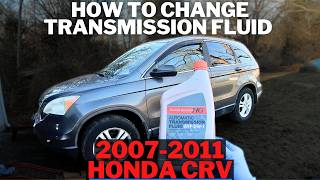
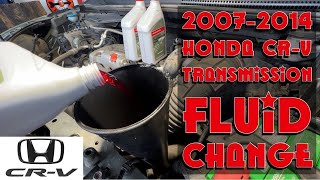
Typical fix: Perform a '3x drain-and-fill' procedure. 🎬 Watch: Step-by-step guide for a proper transmission fluid change. This involves draining ~3 quarts, refilling, driving a short distance to circulate the new fluid, and repeating the process two more times. This replaces a high percentage of the total fluid. Use only Honda ATF DW-1.
Est. part cost: $70-$100 for ~9 quarts of Honda ATF DW-1 - Faulty Torque Converter Clutch (TCC) Solenoid / Linear Solenoid 🟡 Medium Probability → Shop Automatic Transmission Torque Converter Debris from old, broken-down fluid can clog the fine mesh screens on the solenoids or cause the internal spool valves to stick, preventing proper hydraulic control. Electrical failure is also possible over time.
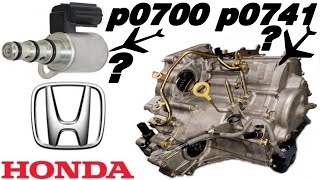
How to confirm: After confirming fluid is good, the solenoids can be tested. They are located externally on the front of the transmission case. A mechanic can test them electronically, or a DIYer can test resistance with a multimeter (typically 12-25 ohms) and apply 12V power to listen for a distinct click. 🎬 See how to diagnose P0741 and test your solenoids. No click means the solenoid is stuck.
Typical fix: Replace the faulty solenoid assembly. It's common to replace the suspect one (often Solenoid A) or both as a set, along with their gaskets. Cleaning the screens on the old solenoids is sometimes attempted but replacement is more reliable.
Est. part cost: $150-$700 per OEM solenoid - Failed Torque Converter ⚪ Low Probability → Shop Automatic Transmission Torque Converter This is less common than fluid or solenoid issues but can occur at high mileage, especially if driven for a long time with the P0741 code active. The internal lock-up clutch wears out and can no longer hold, or the internal seals fail.
How to confirm: This is typically diagnosed after fluid and solenoids have been ruled out. A key sign is finding significant metallic debris or clutch material in the transmission fluid pan or on the magnetic drain plug during a fluid service. Professional diagnosis is required.
Typical fix: Replace the torque converter. This is a major repair that requires removing the transmission from the vehicle.
Est. part cost: $300-$800 for the part, plus significant labor
Rare But Worth Checking
- Clogged Internal Hydraulic Passages / Faulty Valve Body: → Shop Transmission Valve Body If fluid is clean and solenoids test good, the issue may be a blockage or a stuck valve inside the transmission's valve body, preventing fluid from reaching the TCC. In some Honda models, a loose transmission pressure valve has been identified as a contributing factor to the P0741 code (NHTSA ODI #11162829).
- Wiring Harness Damage: The wiring to the external transmission solenoids could be damaged by road debris, improper repair, or corrosion, though this is uncommon. A visual inspection of the harness and connectors is a valid diagnostic step.
- Clogged External ATF Filter: This transmission has a small, replaceable cartridge-style ATF filter (Part # 25430-PLR-003) located externally. If this filter becomes completely clogged, it can restrict flow and pressure, contributing to solenoid and clutch engagement issues. It is often replaced as preventative maintenance during a fluid service.
Diagnosis Steps
- Scan for all diagnostic trouble codes. Note if P0700 is present with P0741.
- Check the automatic transmission fluid (ATF) level and condition using the dipstick. The engine should be off and the vehicle on level ground. Note fluid color and smell.
- If the fluid is dark, burnt, or has particles, perform a '3x drain-and-fill' using only Honda ATF DW-1. Inspect the magnetic drain plug for excessive metal shavings (a fine paste is normal, large chunks are not).
- After the fluid service, clear the codes and perform an extended test drive to see if the code returns. If it does, proceed to the next step.
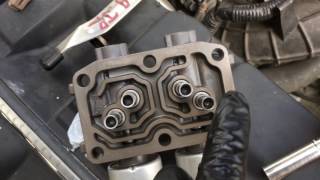
- Locate the linear solenoid assemblies on the front of the transmission case. They are accessible after removing the air intake and battery/battery tray. 🎬 Watch this walkthrough for replacing the transmission solenoids.
- Inspect the wiring and connectors to the solenoids for any visible damage, corrosion, or fluid intrusion.
- Test the suspect solenoid(s). Disconnect the connector and check the electrical resistance between the two pins with a multimeter (should be 12-25 ohms). Apply 12V power directly to the solenoid terminals and listen for an audible 'click', which indicates mechanical operation. Note that even if a solenoid passes an electrical activation test, it may still fail under driving conditions (NHTSA ODI #11681218).
- If a solenoid fails these tests or its screen is visibly clogged with debris, replace it along with its gasket.
- If the fluid, solenoids, and wiring are all good, the problem is likely an internal issue with the torque converter or valve body, which requires professional diagnosis.
Parts You'll Likely Need
- Automatic Transmission Fluid (ATF DW-1)
(OEM #08200-9008 (1 Quart))— Dirty, low, or incorrect fluid is the most common cause of this code on Honda transmissions. A 3x drain and fill requires approximately 9 quarts.
Trusted brands: Honda Genuine
OEM price range: $10-$15 per quart
Aftermarket price range: N/A (OEM fluid is strongly recommended) - Linear Solenoid Assembly 'A'
(OEM #28250-R90-003)— This is one of the primary solenoids controlling hydraulic pressure for shifting and TCC lock-up. It can fail electrically or become clogged.
Trusted brands: Honda Genuine, Standard Motor Products (TCS67), Rostra (52-0533)
OEM price range: $500-$700
Aftermarket price range: $150-$300 - Linear Solenoid Assembly 'B'
(OEM #28260-R90-004)— This is the secondary solenoid that works with Solenoid 'A' to control the transmission's hydraulic circuits.
Trusted brands: Honda Genuine, Standard Motor Products (TCS68), Rostra
OEM price range: $600-$800
Aftermarket price range: $150-$300 - Linear Solenoid Gasket
(OEM #28252-R90-003)— This metal gasket with integrated screens seals the solenoid to the transmission case. It is essential to replace this whenever a solenoid is removed to prevent leaks and ensure proper fluid filtration.
Trusted brands: Honda Genuine
OEM price range: $15-$25
Related Codes That Often Appear With This One
- P0700 — P0700 is a generic code that simply means the Transmission Control Module (TCM) has stored a fault code and has requested the main ECU to turn on the Check Engine Light. It will almost always appear alongside a more specific transmission code like P0741.
Technical Service Bulletins (TSBs) & Recalls
- No specific TSB for P0741 on this model is widely reported. However, TSBs for related issues on other Hondas confirm the diagnostic pattern of checking fluid and external solenoids before condemning internal components.
Documented NHTSA Reports
- NHTSA ODI #11702634 — An owner reported that the vehicle would only move in reverse and required a mechanic. Diagnostic results confirmed P0741 (Torque Converter Clutch Circuit Performance/Stuck Off) alongside P0780 (Shift Malfunction) and P0746 (Pressure Control Solenoid).
- NHTSA ODI #11140610 — A report filed for a similar Honda powertrain (Pilot) noted the engine light illuminated with code P0741, specifically stating the torque converter was stuck off.
- NHTSA ODI #10846060 — A manufacturer record for a related Honda model describes a scenario where the P0741 code returned after only 50 miles of driving following a solenoid replacement, highlighting the need for thorough hydraulic system cleaning.
Mechanic-Grade Diagnostic Values
- TCC/Shift Solenoid Resistance — expected: 12 - 25 Ohms. Failure: A reading of infinite Ohms (open circuit) or near zero Ohms (short circuit) indicates a failed solenoid coil.
- A/T Clutch Pressure Control Solenoid Resistance — expected: ~5 Ohms. Failure: A reading significantly different from 5 Ohms suggests the solenoid is faulty.
- Solenoid Mechanical Actuation Test — expected: A distinct 'click' sound when 12V power is briefly applied to the solenoid's terminals.. Failure: No click indicates the solenoid's internal plunger is mechanically stuck or the coil is completely dead.
Scan Tool Commands That Help
- Honda Diagnostic System (HDS): Shift Solenoid Valve E Test — This is a specific bidirectional test listed in the Honda diagnostic flowchart for P0741. It allows the technician to command the solenoid on and off to verify its mechanical and basic electrical function without removing it from the transmission.
- Honda Diagnostic System (HDS): A/T Clutch Pressure Control Solenoid Valve A Test — This is another HDS-specific function in the diagnostic procedure for P0741. It tests a related pressure control solenoid and provides a 'NORMAL' or 'FAILURE' result, helping to isolate the fault within the hydraulic control system.
Wiring & Ground Locations
- G101 — Bolted to the engine block, typically on or near the thermostat housing, which is on the driver's side of the engine.. G101 serves as a primary ground termination point for the ECU and multiple engine/transmission sensors and actuators. Corrosion or a loose connection at this point can cause erratic voltage, leading to incorrect sensor readings and improper solenoid function, which can mimic the symptoms of a failed solenoid or trigger a P0741 code.
Real Owner Repair Stories
- CRV Owners Club Forum (synthesized from multiple threads) (2008 Honda CR-V, ~130,000 miles) — Check engine light on with P0741 and P0700. Flashing 'D' light on the dashboard. No major shifting problems noticed, but RPMs were slightly higher than normal on the highway.
❌ Tried (didn't work) A single drain-and-fill of the transmission fluid. The code returned within a week.
✅ What actually fixed it The owner performed a full '3x drain-and-fill' using 9 quarts of genuine Honda ATF DW-1. After the third drain, the fluid was much cleaner. The codes were cleared and did not return after several hundred miles of driving. This confirms that depleted fluid was the root cause, and a single drain-and-fill was not sufficient to resolve the hydraulic pressure issue. - YouTube Repair Channel Comment Section (2010 Honda CR-V, 165,000 miles) — P0741, noticeable shudder at highway speeds, felt like driving over rumble strips.
❌ Tried (didn't work) Performed a 3x drain-and-fill with Honda ATF DW-1. The shudder improved slightly but the P0741 code came back after 20 minutes of highway driving.
✅ What actually fixed it After the fluid change failed to fix it, the owner replaced the Torque Converter Clutch Linear Solenoid (Solenoid A, P/N 28250-R90-003) and its gasket. The screens on the old solenoid were visibly dark and clogged with fine debris. After replacing the solenoid and clearing the code, the shudder was eliminated and the code did not return.
OEM Part Supersession History
Honda ATF-Z1→Honda ATF DW-1 (P/N 08200-9008)— ATF DW-1 is a newer, full-synthetic fluid developed to provide better performance at low temperatures, which improves cold-start shifting and fuel economy.
Heads up: ATF DW-1 is fully backward-compatible and is the recommended fluid for all 2010 and older Honda automatics that originally specified ATF-Z1. While the two fluids can be mixed, doing so will dilute the performance advantages of the newer DW-1 fluid. For a full benefit, a complete fluid exchange (like a 3x drain-and-fill) to DW-1 is recommended. Do NOT use ATF-Z1 in 2011 or newer models.
Model Year Variations Within This Range
- 2007-2011: The powertrain, specifically the K24Z engine and the 5-speed automatic transmission, remained consistent throughout the third generation (2007-2011). A mid-cycle refresh for the 2010 model year involved cosmetic updates and minor feature changes but did not alter the transmission or the common causes and fixes for code P0741.
Diagnostic Flowchart
Other Known Issues on This Vehicle
Issues unrelated to this code that are worth knowing about as an owner of this generation:
- A/C Compressor Clutch Failure ('Black Death') 🔴 High — Extremely common. The clutch fails, often catastrophically, sending metal debris through the entire A/C system, requiring replacement of the compressor, condenser, and expansion valve. (Ref: TSB 12-072 (Warranty extension for the clutch, now expired))
- VTC Actuator Rattle on Cold Start 🟠 Medium — Very common. A loud, grinding rattle for ~2 seconds on cold startup. Caused by a faulty Variable Timing Control (VTC) actuator. (Ref: TSB 09-010)
- Excessive Oil Consumption 🟠 Medium — Common on 2010-2011 models. Caused by sticking piston rings, leading to oil burning. This was part of a broader class-action lawsuit affecting several Honda models. (Ref: TSB 12-089 (Product Update/Warranty Extension))
- Failing Door Lock Actuators 🟡 Low — Extremely common across all years. Actuators fail, preventing doors from locking or unlocking electronically. (Ref: TSB 14-083, TSB 14-084)
- Rear Differential Groan/Noise 🟡 Low — Common if fluid is not changed regularly. A groaning or grinding noise from the rear during slow turns is fixed by replacing the rear differential fluid with Honda Dual Pump II fluid.
Used vs. New Parts: Buying Guide for This Vehicle
When a used part is the smart pick: For external components like the linear solenoid assemblies, a used OEM part from a low-mileage, reputable salvage yard can be a cost-effective alternative to a new OEM part, and often more reliable than a cheap, unbranded aftermarket part.
Donor-vehicle mileage cap: roughly under 80000 miles for the part to have meaningful remaining life.
What to inspect on the donor part:
- Verify the donor vehicle's mileage if possible.
- Inspect the solenoid's fluid screens; they should be intact and free of heavy, metallic debris.
- If possible, test the resistance of the used solenoid with a multimeter before purchase to ensure it's within the 12-25 Ohm specification.
OEM-only on this vehicle (don't cheap out):
- Automatic Transmission Fluid (ATF): Only Honda Genuine ATF DW-1 should be used. Honda transmissions are extremely sensitive to fluid chemistry, and using a 'universal' or incorrect fluid type is a primary cause of shifting problems and solenoid failure.
Aftermarket brands forum-validated for this vehicle:
- Rostra
- Standard Motor Products (SMP)
Brands owners have reported issues with on this vehicle:
- Generic, unbranded solenoid assemblies from online marketplaces should be avoided. They often have high failure rates, incorrect resistance values, or use materials that are not compatible with ATF, leading to premature failure.
Real Owner Stories
Aggregated from forums and TSBs cited above. Mileages and costs reflect what owners reported in those sources.
2010 Honda CR-V
Symptoms: Bad gas mileage, stalling, stuttering, and a Check Engine Light that would go off when the car was turned off but eventually return.
What fixed it: The owner was diagnosing the torque converter clutch solenoid circuit performance (P0741).
Source hint: reddit r/AskAMechanic
2008 Honda CR-V — 150000 miles
Symptoms: P0741 code and a flashing 'D' (Drive) indicator light on the dashboard.
What fixed it: Performed a 3x drain and fill with Honda DW-1 ATF.
Source hint: crvownersclub.com - Thread 'P0741 code, what to do?'
2007 Honda CR-V
Symptoms: P0741 code persisting after fluid changes were unsuccessful.
What fixed it: Replacing the 'A' and 'B' linear solenoids (28250-R90-003 and 28260-R90-004) along with new metal gaskets.
Source hint: crvownersclub.com - Thread '2007 CRV P0741 TCC Solenoid'
Related OBD-II Codes
Frequently Asked Questions
What is the correct transmission fluid for my 2007-2011 Honda CR-V to prevent P0741?
My 2008 CR-V has a flashing 'D' light and P0741; do I really need a $4,000 transmission replacement?
Where are the TCC solenoids located on the 2007-2011 CR-V?
Can I just clean the solenoid screens instead of buying new OEM parts?
Is there a TSB for P0741 on this specific CR-V generation?
What are the specific part numbers for the solenoids if I need to replace them?
Helpful Videos


We Have This Part in Stock

The information in this article is provided for general reference and educational purposes only. Vehicle specifications, procedures, and part compatibility can vary by production date, trim level, and region. Always consult your vehicle's factory service manual and verify part numbers before purchasing or performing repairs. Safety-critical components such as airbags, seat belts, and braking systems should be installed by a qualified professional.
- Honda CR-V:
- 🧭 Diagnostic Flowchart
- 🎬 Helpful Videos
- 🛍️ Shop This Part
- What's Unique About the 2007-2011 Honda CR-V
- Symptoms You May Notice
- Most Likely Causes
- Rare But Worth Checking
- Diagnosis Steps
- Parts You'll Likely Need
- Related Codes That Often Appear With This One
- Technical Service Bulletins (TSBs) & Recalls
- Documented NHTSA Reports
- Mechanic-Grade Diagnostic Values
- Scan Tool Commands That Help
- Wiring & Ground Locations
- Real Owner Repair Stories
- OEM Part Supersession History
- Model Year Variations Within This Range
- Other Known Issues on This Vehicle
- Used vs. New Parts: Buying Guide for This Vehicle
- Real Owner Stories
- 2010 Honda CR-V
- 2008 Honda CR-V — 150000 miles
- 2007 Honda CR-V
- Related OBD-II Codes
- Frequently Asked Questions
- 🎟️ Get 5% Off