

P0741 on 2009-2013 Subaru Forester 2.5L: Torque Converter Clutch Fixes
On a 2009-2013 Forester with the 4EAT automatic transmission, code P0741 is most often caused by a failed torque converter lock-up solenoid. This solenoid is an electro-hydraulic valve that controls fluid flow to engage the lock-up clutch. Replacing this solenoid, which is accessible after dropping the transmission pan, is the most common and cost-effective fix. Expect to pay $50-$150 for an aftermarket solenoid and around $300-$500 for a shop to perform the labor.
- P0741 on a 2009-2013 Forester means the torque converter is failing to lock up, hurting fuel economy and potentially damaging the transmission.
- The most likely culprit is a bad torque converter clutch (TCC) solenoid, which is located inside the transmission oil pan.
- Before attempting major repairs, always check the transmission fluid level and condition. Use only Subaru ATF-HP fluid.
- This is a serious code that should be addressed promptly to avoid overheating and more expensive transmission damage.
- DIY repair is possible for experienced mechanics but is considered difficult (4/5) due to the need to work inside the transmission.
What's Unique About the 2009-2013 Subaru Forester
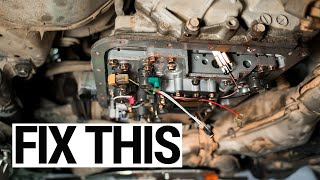
The 2009-2013 Forester uses Subaru's 4-speed electronic automatic transmission (4EAT), not the later CVT models. For this specific 4EAT transmission, the P0741 code is very commonly traced back to a single, replaceable component: the torque converter lock-up duty solenoid. While internal transmission failure is possible, many owners have successfully resolved the code by replacing only this solenoid, which is located on the valve body and accessible after removing the transmission oil pan. This is a well-documented failure point for the 4EAT across multiple Subaru models.
🎬 Watch: How one owner diagnosed and fixed this 4EAT solenoid issueSymptoms You May Notice
- Check Engine Light is on
- Flashing "AT OIL TEMP" light on the dashboard (this is a common Subaru indicator for any transmission-related fault code).
- Engine RPMs are higher than normal at highway speeds (e.g., RPMs jump by about 300 when the code sets).
- A sensation of shuddering or vibration during light acceleration or when cruising.
- Noticeable decrease in fuel economy.
- Vehicle may feel sluggish or like it's slipping, especially during gear shifts.
- In some cases, the engine may stall or feel like it's about to stall when coming to a stop from highway speeds.
- Replacing the entire torque converter when the issue is only the much cheaper and more accessible TCC lock-up solenoid.
- Replacing the entire transmission without first diagnosing the individual components like the solenoid or valve body.
- Assuming a flashing 'AT OIL TEMP' light means the fluid is simply low or old, without pulling the codes to find the underlying P0741 fault.
Most Likely Causes
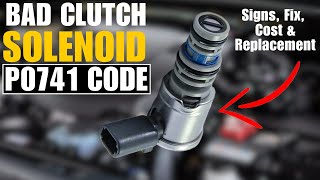
- Faulty Torque Converter Clutch (TCC) Lock-Up Solenoid 🔴 High Probability → Shop Automatic Transmission Torque Converter The solenoid is a known common failure point in the 4EAT transmission. It can fail electrically (open or shorted coil) or become mechanically stuck due to age or contaminated fluid, preventing it from actuating the lock-up clutch.
How to confirm: After dropping the transmission pan, the solenoid can be tested with a multimeter. The resistance should be within factory specification, typically between 11-13 ohms at 20°C (68°F). An advanced scan tool can also monitor the TCM's command to the solenoid versus the actual slip RPM to confirm the fault.
Typical fix: Replace the TCC lock-up solenoid, which is located on the valve body inside the transmission oil pan. This also involves draining the fluid, replacing the pan gasket/sealant, and refilling with fresh fluid. 🎬 Watch: Step-by-step Subaru 4EAT solenoid replacement walkthrough
Est. part cost: $50-$150 - Low, Dirty, or Incorrect Transmission Fluid 🟡 Medium Probability → Shop Transmission Assembly The 4EAT is sensitive to fluid level and condition. Old, degraded fluid loses its hydraulic properties and can contain debris that clogs the fine passages in the valve body or causes solenoids to stick. Using a fluid other than the specified Subaru ATF-HP can also cause issues.
How to confirm: Check the transmission fluid dipstick with the engine running and transmission warm. The fluid should be at the 'HOT' mark, pink/red in color, and not smell burnt. Dark, brown, or glittery fluid indicates a problem.
Typical fix: Perform a transmission fluid drain-and-fill with the correct Subaru ATF-HP fluid. If the fluid is very dark or contains debris, a full flush is generally not recommended for high-mileage transmissions as it can dislodge sludge and cause more problems. A simple drain and fill is safer.
Est. part cost: $60-$120 - Failed Torque Converter ⚪ Low Probability → Shop Automatic Transmission Torque Converter
How to confirm: This is typically diagnosed after the TCC solenoid has been replaced and fluid condition has been verified, but the problem persists. A professional may perform a stall test or analyze fluid for excessive clutch material. A failing torque converter can also be the source of the debris that caused the solenoid to fail in the first place.
Typical fix: The entire torque converter must be replaced. This is a major repair that requires removing the transmission from the vehicle.
Est. part cost: $200-$500 - Damaged Internal Wiring or Valve Body Issue ⚪ Low Probability → Shop Transmission Valve Body
How to confirm: Visually inspect the wiring harness inside the transmission pan for breaks, corrosion, or burnt connectors when replacing the solenoid. A faulty valve body is usually diagnosed by a transmission specialist after eliminating all other possibilities, as it can have internal blockages or worn bores not visible to the naked eye.
Typical fix: Repair the damaged wiring. In the case of a valve body fault, the entire valve body assembly is typically replaced. Some shops may attempt to clean or rebuild it, but replacement is more common.
Est. part cost: $500-$1200
Rare But Worth Checking
- Faulty Transmission Control Module (TCM): → Shop Transmission Assembly This is very uncommon and should only be considered after all other mechanical, hydraulic, and electrical causes have been ruled out by a professional. It's more likely to be a wiring issue between the TCM and the transmission than the module itself.
Diagnosis Steps
- Confirm P0741 (and likely P0700) are present using an OBD-II scanner.
- Check the transmission fluid level and condition with the engine warm and running. Ensure the fluid is clean, red, and at the proper level. Note any burnt smell or metallic particles.
- Using a scan tool with live data, monitor TCC slip speed, TCC solenoid command (On/Off or Duty %), engine RPM, and transmission input speed. While driving at a steady highway speed (above 45 mph), verify the TCM commands lock-up. If the command is sent but slip remains several hundred RPM, a mechanical/hydraulic fault is confirmed.
- Drop the transmission oil pan and visually inspect the fluid and pan magnet for excessive metal shavings or clutch material. A small amount of fine, grey material is normal.
- Locate the TCC lock-up solenoid on the valve body. Test its resistance with a multimeter and compare it to the factory specification (typically 11-13 ohms). Also test for a short to ground.
- Inspect the internal wiring harness connected to the solenoid for any signs of damage, corrosion, or loose connections. Pay close attention to the connector itself.
- If the solenoid and wiring test good, the fault is likely more severe, pointing towards a clogged valve body passage, a worn seal in the torque converter circuit, or a failed torque converter itself, requiring professional diagnosis.
Parts You'll Likely Need
- Torque Converter Clutch (Lock-Up) Solenoid
(OEM #31939AA191)— This solenoid is the most common failure point for the P0741 code on the Subaru 4EAT transmission. The OEM part has been superseded multiple times (from 31939AA130, 31939AA150, etc.).
Trusted brands: Rostra, Subaru (OEM), Transtar
OEM price range: $150-$250
Aftermarket price range: $50-$150 - Subaru ATF-HP Transmission Fluid
(OEM #SOA427V1500)— The correct fluid is required when refilling the transmission after dropping the pan. Using non-specified fluid can cause shifting problems. A drain and fill requires approximately 4-5 quarts.
Trusted brands: Subaru (OEM), Idemitsu ATF HP
OEM price range: $12-$18 per quart
Aftermarket price range: $9-$15 per quart - Transmission Pan Gasket / Sealant — A new seal is required when reinstalling the transmission pan. This transmission does not use a pre-formed gasket, but rather a form-in-place gasket (FIPG) sealant. ThreeBond 1217B or Permatex Ultra Black are commonly used.
Trusted brands: Permatex (Ultra Black), ThreeBond, Fujibond
Aftermarket price range: $10-$25
Related Codes That Often Appear With This One
- P0700 — P0700 is a generic code that simply means the Transmission Control Module (TCM) has stored a fault code. It acts as a 'check engine light' for the transmission and will almost always be present alongside a specific transmission code like P0741.
Technical Service Bulletins (TSBs) & Recalls
- TSB 16-90-13R: While not directly for P0741, this TSB addresses an issue with torque converters on some Subaru models causing stalling or low RPM when stopping. It involves a countermeasure torque converter, highlighting that Subaru has acknowledged issues in this area.
Platform-Specific Known Issues
- A flashing 'AT OIL TEMP' light is the vehicle's primary way of alerting the driver to a transmission fault code being stored; it does not always mean the fluid is actually overheating at that moment, but that continued driving will likely cause it to.
- Some owners on forums have successfully resolved the code simply by performing several consecutive drain-and-fills of the transmission fluid, suggesting that degraded fluid or minor blockages can be a cause.
Mechanic-Grade Diagnostic Values
- Torque Converter Clutch (TCC) Solenoid Resistance — expected: 11 to 13 Ω at 20°C (68°F). Failure: A reading of 0 ohms (short), infinite ohms (open), or a value significantly outside the expected range indicates a failed solenoid coil.
- TCC Slip RPM (Live Scan Tool Data) — expected: Near 0 RPM when lock-up is commanded and engaged at cruising speed.. Failure: A sustained slip of over 200 RPM for more than a few seconds while lock-up is commanded ON will trigger the P0741 code.
Hidden / Shadow Codes Worth Checking
- U1222: Indicates a data communication error between modules, potentially between the Engine Control Module (ECM) and the Transmission Control Module (TCM). (see via This is a 'U-code' (network code) that may only be visible on more advanced, professional-grade scan tools, not basic OBD-II readers. A user reported seeing this alongside P0741, suggesting a communication issue could be the root cause.)
Scan Tool Commands That Help
- Subaru Select Monitor (SSM) or equivalent professional scan tool: Active Test / Actuator Test for TCC Solenoid (or Shift Solenoid Valve DSL) — This function allows a technician to manually command the TCC solenoid on and off with the engine off or running. It is used to verify the electrical integrity of the circuit and the mechanical function of the solenoid. A distinct 'click' should be heard from the transmission pan area when the solenoid is activated, confirming it is not seized.
Real Owner Repair Stories
- Reddit user on r/Subaru_Outback (2005 Subaru Outback (4EAT Phase 2, same family as Forester's)) — P0741 and P0700 codes, lockup disengages on highway, RPMs jump 300, flashing dash lights, cruise control disabled.
❌ Tried (didn't work) Pulled the valve body, cleaned and inspected it., Bench-tested the TCC solenoid and confirmed its resistance was good.
✅ What actually fixed it The user had not found a final fix but provided extremely valuable insight: they drove over 30,000 miles with the condition, including towing over mountains. The primary impact was annoyance (no cruise control) rather than catastrophic failure, suggesting the car can be driven for an extended period if the symptoms are tolerated. They suspected the final cause was either the torque converter itself, the TCM, or a wiring issue. - Reddit user on r/subaruimpreza (2010 Subaru Impreza (4EAT)) — P0741 code with ABS, Traction Control, Check Engine, and flashing AT OIL TEMP lights.
❌ Tried (didn't work) Clearing the code with a basic scanner did not remove the 'Permanent' code status.
✅ What actually fixed it A commenter provided the most common resolution path: The issue is almost certainly the TCC solenoid. For DIY repair, one should source an aftermarket solenoid, as Subaru dealers often only sell the complete (and very expensive) valve body assembly. They also noted that before diving into the transmission, it's wise to check for low battery voltage, which can cause communication errors and trigger similar symptoms.
"I Checked Everything" — The Actual Cause
- A common diagnostic dead-end for P0741 occurs when the TCC solenoid is removed and tests perfectly fine with a multimeter (e.g., showing 13 ohms, well within the 11-13 ohm spec). When this happens, and the code persists even after cleaning the valve body, the actual cause is often not electrical but hydraulic or mechanical. This could be worn seals within the torque converter itself, which are leaking pressure and preventing lock-up, or a hairline crack/blockage in a valve body passage that isn't visually apparent. The solenoid gets blamed because it's the most common failure, but when it tests good, the problem is almost always deeper inside the torque converter or valve body.
OEM Part Supersession History
31939AA130, 31939AA150, 31939AA160, 31939AA161, 31939AA190→31939AA191— Standard part evolution for improved reliability or manufacturing changes.
Heads up: All listed previous part numbers are replaced by 31939AA191, which should be used for service.
Model Year Variations Within This Range
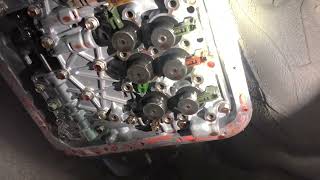
- 2009-2013: The 4EAT used in this generation is the Phase II Version II, which features a valve body with a bank of 6 solenoids grouped under a metal plate. This is consistent across the specified model years. While older 4EATs exist, vehicles in this range share the same fundamental design, making diagnosis and parts consistent.
Diagnostic Flowchart
Other Known Issues on This Vehicle
Issues unrelated to this code that are worth knowing about as an owner of this generation:
- Head Gasket Failure (External Oil/Coolant Leaks) 🔴 High — Very common on the EJ25 engine, typically appearing between 80,000 and 150,000 miles. It often starts as an external oil leak from the lower corner of the gasket.
- Excessive Oil Consumption (FB25 Engine) 🔴 High — Primarily affects the 2011-2013 models with the newer FB25 engine. Can start at any mileage and may require piston ring or short block replacement. (Ref: Subaru TSB 02-157-14R)
- Rear Wheel Bearing Failure 🟠 Medium — A common issue where the rear wheel bearings become noisy (humming/grinding) and fail prematurely. Often requires replacement before 100,000 miles. (Ref: TSB 03-50-02, 05-70-19)
- Catalytic Converter Failure 🟠 Medium — The front catalytic converter can fail, often due to contamination from the engine's oil or coolant leaks, leading to P0420 codes. This is a common issue at higher mileage.
Used vs. New Parts: Buying Guide for This Vehicle
When a used part is the smart pick: A complete, low-mileage used transmission assembly from a reputable salvage yard can be a cost-effective alternative to a full rebuild if the torque converter has failed and sent debris throughout the system. For individual components, used parts are generally not recommended for this repair.
Donor-vehicle mileage cap: roughly under 80000 miles for the part to have meaningful remaining life.
What to inspect on the donor part:
- For a complete transmission, verify the donor vehicle's mileage and ask for a vehicle history report if possible.
- Check the color and smell of the fluid at the donor transmission's cooler lines; it should be reddish and not smell burnt.
- Avoid parts from vehicles that show signs of a major collision near the transmission housing.
OEM-only on this vehicle (don't cheap out):
- Transmission Control Module (TCM) - Due to programming and vehicle-specific matching, a new OEM or professionally refurbished unit is required if the TCM is diagnosed as faulty.
Aftermarket brands forum-validated for this vehicle:
- Rostra (for solenoids)
- Idemitsu (for ATF-HP fluid, as they are an OEM supplier for Subaru)
Brands owners have reported issues with on this vehicle:
- Unnamed, no-brand '6-piece solenoid kits' from online marketplaces can be a gamble. While often successful, quality control can be inconsistent. Stick to brands with a known presence in the transmission parts industry if possible.
Real Owner Stories
Aggregated from forums and TSBs cited above. Mileages and costs reflect what owners reported in those sources.
2010 Subaru Impreza 2.5L (4EAT)
Symptoms: Multiple warning lights including the Check Engine Light, AT Oil Temp, ABS, and Traction Control all illuminated at once.
What fixed it: Replacement of the TCC lock-up solenoid.
Source hint: Reddit r/subaruimpreza: Thread 'Error Code P0741'
2009-2013 Subaru Forester 2.5L
Symptoms: P0741 code and a flashing AT light on the dashboard.
What fixed it: Replacing the lock-up solenoid (part 31939AA191) and changing the transmission fluid.
Source hint: subaruforester.org: Thread titled 'P0741 - Torque Converter Clutch Solenoid'
2004 Subaru Legacy 2.5L
Symptoms: Persistent P0741 code; owner attempted to replace the valve body and TCM but the issue remained.
What fixed it: The torque converter itself was identified as the final remaining cause after all other electronic and hydraulic components were replaced.
Source hint: LegacyGT.com: Thread '2004 Legacy 2.5L P0741 code help'
2005 Subaru Outback 2.5L (4EAT)
Symptoms: Observed the RPM jump when the fault occurred and monitored the lockup duty cycle using a scan tool to confirm the slip.
What fixed it: Diagnosis narrowed the fault down to the torque converter or internal wiring after the solenoid and valve body were tested.
Source hint: Reddit r/Subaru_Outback: Thread '2005 Outback with 4EAT phase 2 automatic and a persistent p0741 Code'
Related OBD-II Codes
Frequently Asked Questions
What does the flashing 'AT OIL TEMP' light on my 2009-2013 Forester mean when P0741 is present?
Is there a specific part number for the solenoid that usually fails on this model?
Does TSB 16-90-13R apply to my P0741 lock-up issue?
Can I fix the P0741 code on my Forester without replacing parts?
How can I verify if the solenoid is electrically dead before I buy a new one?
Why does my engine RPM jump when I'm driving at highway speeds?
Helpful Videos

We Have This Part in Stock


The information in this article is provided for general reference and educational purposes only. Vehicle specifications, procedures, and part compatibility can vary by production date, trim level, and region. Always consult your vehicle's factory service manual and verify part numbers before purchasing or performing repairs. Safety-critical components such as airbags, seat belts, and braking systems should be installed by a qualified professional.
- Subaru Forester:
- 🧭 Diagnostic Flowchart
- 🎬 Helpful Videos
- 🛍️ Shop This Part
- What's Unique About the 2009-2013 Subaru Forester
- Symptoms You May Notice
- Most Likely Causes
- Rare But Worth Checking
- Diagnosis Steps
- Parts You'll Likely Need
- Related Codes That Often Appear With This One
- Technical Service Bulletins (TSBs) & Recalls
- Platform-Specific Known Issues
- Mechanic-Grade Diagnostic Values
- Hidden / Shadow Codes Worth Checking
- Scan Tool Commands That Help
- Real Owner Repair Stories
- "I Checked Everything" — The Actual Cause
- OEM Part Supersession History
- Model Year Variations Within This Range
- Other Known Issues on This Vehicle
- Used vs. New Parts: Buying Guide for This Vehicle
- Real Owner Stories
- 2010 Subaru Impreza 2.5L (4EAT)
- 2009-2013 Subaru Forester 2.5L
- 2004 Subaru Legacy 2.5L
- 2005 Subaru Outback 2.5L (4EAT)
- Related OBD-II Codes
- Frequently Asked Questions
- 🎟️ Get 5% Off