

OBD-II Code P0742: Torque Converter Clutch Circuit Stuck On
The Ultimate Guide to Understanding, Diagnosing, and Fixing P0742
- Code P0742 indicates the torque converter clutch is mechanically stuck in the locked position, forcing the engine to fight the transmission.
- Expect violent shuddering or complete engine stalling when slowing below 10 mph, creating an immediate safety hazard at intersections.
- Dirty transmission fluid and a failed $50-$150 TCC solenoid cause over 70% of P0742 codes, though worn valve bodies are common on high-mileage vehicles.
- Driving with an active P0742 code rapidly overheats the transmission fluid and guarantees catastrophic internal damage exceeding $3,000 if ignored.
- Always test the TCC solenoid's electrical resistance (typically 10-25 ohms) and command it via a bidirectional scanner before dropping the transmission pan.
What Does P0742 Mean?
The Powertrain Control Module (PCM) or Transmission Control Module (TCM) detected the torque converter clutch (TCC) is mechanically stuck in the 'on' or locked position. This clutch locks at steady highway speeds to create a direct mechanical link between the engine and transmission, improving fuel economy. It must disengage when you slow down. When stuck on, it is mechanically identical to stopping a manual transmission car without pressing the clutch pedal, forcing the engine to shudder and stall.
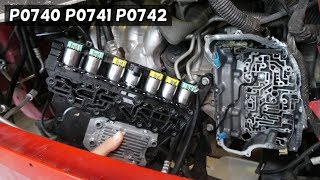
Technical definition: The official SAE/OBD-II definition 🎬 Watch: A quick breakdown of P0742 causes and symptoms. for P0742 is "Torque Converter Clutch (TCC) Circuit Stuck On." The PCM/TCM flags this fault by monitoring the relationship between engine RPM and transmission input shaft speed. If the speed difference (slip) is at or near zero RPM when the module commands the clutch to unlock, it confirms the clutch remains applied and sets P0742.
Can I Drive With P0742?
No, immediate repair advised Do not drive with P0742. The engine will stall when you come to a stop, creating an immediate collision risk at intersections. Continuing to drive forces the transmission to operate under constant load, rapidly overheating the fluid and destroying internal clutches. This turns a $400 solenoid repair into a $4,000 complete transmission replacement.
Common Causes
- Dirty, Burnt, or Low Transmission Fluid (Very Common) — Old, degraded fluid loses its hydraulic properties and carries abrasive metal shavings and clutch material. This debris clogs the microscopic passages in the valve body or causes the TCC solenoid valve to physically jam in the applied position. 🎬 See how to test and replace the TCC solenoid valve.
- Faulty Torque Converter Clutch (TCC) Solenoid (Very Common) — This electro-hydraulic solenoid is the primary actuator for the TCC. It fails electrically (internal short) or mechanically (sticking plunger). A short to power keeps it permanently energized, holding the clutch on.
- Worn or Damaged Transmission Valve Body (Common) — The valve body is the transmission's hydraulic brain. The bore where the TCC control valve resides wears out over time, allowing hydraulic fluid to leak past the seals and keep the clutch applied even when the solenoid commands it off.
- Damaged Wiring or Connectors (Common) — The wiring harness to the transmission is exposed to extreme heat and road debris. Wires fray, corrode, or short to a power source, continuously energizing the TCC solenoid regardless of TCM commands.
- Failing Torque Converter (Less Common) — The lock-up clutch inside the converter itself delaminates, warps, or fails mechanically. This failure creates massive amounts of debris that quickly contaminates the entire system, jamming solenoids and valves.
- Incorrect Transmission Fluid Type (Less Common) — Using a non-specified Automatic Transmission Fluid (ATF) alters frictional and viscosity characteristics. The wrong fluid causes valves to stick or clutches to drag, leading to a P0742 code immediately after a fluid service.
- Faulty Transmission Control Module (TCM) (Rare) — An internal short in the TCM's solenoid driver circuit sends a constant 'on' signal to the transmission. Corrupted software or a failed flash also causes this condition.
Symptoms
- Engine Stalls or Severely Shudders When Stopping — As the vehicle slows below 10 mph, the engine is dragged down by the locked transmission and either stalls completely or chugs violently.
- Check Engine Light is On — The PCM/TCM activates the Malfunction Indicator Lamp (MIL) immediately upon detecting the zero-slip fault.
- Harsh or Abrupt Downshifts — Gear changes feel clunky or harsh as the transmission struggles to match speeds with a locked converter.
- Sluggish Acceleration — At low speeds, the vehicle feels heavy, as if the brakes are partially applied, because the engine fights the direct-drive connection.
- Transmission Overheating — A constantly applied TCC generates excessive friction heat during city driving, triggering a transmission temperature warning light and burning the fluid.
Diagnostic Flowchart
Tap your situation to follow the diagnostic path that matches what you're seeing on this code.
Common Fixes & Costs
- Replace Torque Converter Clutch (TCC) Solenoid
— Parts: $40-$150, Labor: $250-$500, ~2.5 hr book time
(Advanced)
GM (4L60E/4L80E PWM): OEM ACDelco 24227792 (Alt: Rostra 52-0534, Dorman 92436)
Ford (6R80, part of lead frame): OEM Motorcraft AL3Z-7G276-D (Alt: Dorman 609-040, Rostra 55-0040)
Honda (4-speed Lock-up): OEM Honda 28300-PX4-003 (Alt: Standard Motor Products TCS80, WVE 5S5147) - Transmission Fluid and Filter Change — Parts: $60-$150, Labor: $150-$250, ~1.5 hr book time (Intermediate)
- Replace Transmission Valve Body — Parts: $300-$800, Labor: $400-$800, ~4.5 hr book time (Professional)
- Replace Torque Converter — Parts: $300-$800, Labor: $800-$1,500, ~8 hr book time (Professional)
- Repair or Replace Wiring Harness — Parts: $10-$100, Labor: $150-$500, ~2.5 hr book time (Intermediate)
- Replace Transmission Control Module (TCM) — Parts: $400-$1,000, Labor: $150-$500, ~3 hr book time (Professional)
Used vs. New Parts: Buying Guide
When a used part is worth it: A used TCC solenoid from a verified low-mileage (under 60k miles) donor vehicle is a budget-friendly option for an older, high-mileage car.
Donor-vehicle mileage cap: roughly under 60000 miles for the part to have meaningful remaining life.
Donor quality checklist:
- Verify the donor vehicle's VIN to confirm mileage and ensure it wasn't scrapped for a transmission issue.
- Inspect the part for any signs of sludge, debris, or scoring on valve surfaces.
- Ensure the seller offers at least a 30-day warranty on the part.
Decision logic:
- If The part is a simple solenoid and the vehicle is over 150K miles with a tight budget → A used solenoid is a reasonable risk; the cost savings are significant.
- If The part is a complex valve body or a lead frame assembly → Buy a new or professionally remanufactured part. The risk of a used part failing is high, and repeat labor outweighs initial savings.
- If The vehicle is newer or has lower mileage (<100K miles) → Always buy a new OEM or high-quality aftermarket part to ensure longevity.
Warranty tradeoff: Used parts typically come with a 30-day functional warranty. New aftermarket parts offer a 1-year warranty. New OEM parts carry a 1-2 year warranty.
Worst-case if a used part fails: $500-1200 if a used solenoid fails after installation, requiring repeat labor and a second replacement part.
What Happens If You Wait — Timeline
- 0-100 miles: Code P0742 sets. The engine shudders or stalls completely when coming to a stop. Driving is dangerous and unpredictable. (MPG impact: 5-10%% · Added cost: $0)
- 100-500 miles: The constantly engaged clutch generates excessive heat, rapidly degrading the fluid. The transmission shifts harshly. (MPG impact: 10-15%% · Added cost: $200-$500)
- 500-1,000 miles: The torque converter's internal clutch lining disintegrates due to extreme heat and constant drag. Abrasive metallic debris floods the transmission. (MPG impact: 15-20%% · Added cost: $800-$1,500)
- 1,000+ miles: Catastrophic transmission failure. Debris destroys the valve body, solenoids, and clutch packs. The vehicle is disabled. (MPG impact: N/A% · Added cost: $3,000-$7,000+)
Cost of Not Fixing It
- Immediate (0-100 miles): Dangerous stalling at intersections and in traffic. Reduced fuel economy and harsh shifting. (Added cost: Negligible, but high safety risk.)
- Short-Term (100-1,000 miles): Transmission fluid rapidly degrades from excessive heat. The TCC solenoid or valve body suffers permanent damage from debris. (Added cost: $300-$800)
- Long-Term (1,000+ miles): Catastrophic transmission failure. The torque converter self-destructs, sending metal debris throughout the transmission. A complete rebuild is required. (Added cost: $3,000-$7,000+)
Diagnosis Steps
- Check Transmission Fluid Level and Condition
With the engine running and in Park/Neutral, check the dipstick. The fluid must be pink/red and not smell burnt. Brown, black, or glittery fluid indicates severe internal degradation and clutch failure.
Tools: Rag or paper towel (Beginner) - Scan for Codes and Analyze Live Data
Use an OBD-II scanner to monitor 'TCC Solenoid Commanded State' and 'TCC Slip Speed'. While driving, the command status must go from 'On' to 'Off' as you slow to a stop. If the command is 'Off' but slip speed remains at 0 RPM, the clutch is mechanically stuck.
Tools: OBD-II Scanner with Live Data (Beginner) - PRO TIP: Command the Solenoid with a Scan Tool
Use a bidirectional scan tool to directly command the TCC solenoid on and off while the engine idles in park. You must hear an audible click from the transmission pan. If you hear no click, or the engine RPM doesn't change, the solenoid is stuck or electrically dead.
Tools: Bidirectional OBD-II Scanner (Professional) - PRO TIP: Isolate the Fault (GM TSB PIP4290A Method)
With the engine off, disconnect the main electrical connector at the transmission. Start the engine and place it in Drive (brakes applied). If the engine no longer stalls, the fault is external (wiring short to power). If the engine still stalls, the fault is internal (solenoid, valve body, converter).
Tools: Socket set or connector tool (Advanced) - Inspect External Wiring and Connectors
Inspect the wiring harness running to the transmission. Look for chafing, melting on the exhaust, or corrosion in the main connector. A short to a power source on the TCC control wire holds the solenoid on permanently.
Tools: Flashlight, electrical contact cleaner (Intermediate) - Test TCC Solenoid Circuit and Resistance
With the transmission connector unplugged, use a multimeter to check for voltage on the TCC control pin (harness side). There must be 0 volts with the key on; voltage indicates a short to power. Next, measure resistance across the solenoid pins (transmission side). Expected values: GM 4L60E (20-40 Ω), Ford 6R80 (4.8-5.6 Ω), Honda (12-25 Ω). Infinite or zero resistance confirms a failed solenoid.
Tools: Digital Multimeter, wiring diagram (Advanced) - Drop the Transmission Pan
Drain the fluid and remove the pan. Inspect the magnet. A fine layer of gray paste is normal. Large metal shavings, chunks of metal, or thick black clutch material indicate catastrophic failure of the torque converter.
Tools: Socket set, drain pan, gasket scraper, torque wrench (Advanced) - Inspect and Replace Internal Components
Access and replace the TCC solenoid. Inspect the valve body for scoring or stuck valves. If significant debris was found in the pan, the new solenoid will fail again unless the torque converter is replaced and the system flushed.
Tools: Socket set, torque wrench, service manual (Professional)
When This Code Triggers (Freeze-Frame Conditions)
- Engine Coolant Temp: 180-220°F (82-104°C) (The engine must be at full operating temperature. The diagnostic monitor will not run when the fluid is cold.)
- RPM: 1200-2500 RPM (The fault is detected during steady-state cruising or deceleration, not during heavy acceleration.)
- Engine Load: 20-50% (Occurs under light to moderate engine load, consistent with maintaining speed on a level road.)
- Vehicle Speed: 25-55 mph (40-88 km/h) (The computer checks for this fault after the TCC is commanded off as the vehicle slows down.)
Related Codes
- P0741 — The direct opposite of P0742. It means the Torque Converter Clutch is 'Stuck Off' or failing to engage. P0742 has no slip when it should; P0741 has excessive slip when it shouldn't.
- P0740 — A generic code for a 'TCC Circuit Malfunction'. P0740 indicates a general electrical or hydraulic problem, while P0742 specifically confirms the clutch is mechanically stuck on.
- P0743 — Points specifically to an electrical failure in the TCC solenoid circuit, such as an open coil or a short to ground. This prevents solenoid control, leading to the P0742 condition.
- P2769 / P2770 — Highly specific electrical fault codes indicating the TCC solenoid control circuit voltage is stuck low (P2769) or high (P2770). These point directly to a wiring short or a failed solenoid.
- P0744 — Indicates an 'Intermittent' TCC circuit fault. This is a precursor to P0742, happening when a solenoid begins to stick or a wire makes intermittent contact.
Climate & Environmental Factors
- Cold Weather: In cold temperatures, transmission fluid thickens. This puts extra strain on the transmission pump and solenoids on startup, accelerating wear on seals and eventually leading to a 'stuck on' failure.
- High Humidity / Salt Exposure: Humid and salt-heavy environments accelerate corrosion on external wiring harnesses and connectors. A corroded connector shorting to power causes the TCC solenoid to be permanently energized.
How to Talk to a Mechanic About This Code
Say this: "I have a P0742 code, and the car is stalling when I come to a stop. I'd like to schedule a diagnostic. Can you please check the TCC solenoid, the related wiring, and the condition of the transmission fluid? I'd like to start with the least expensive potential causes before assuming it's a major internal failure."
This directs the technician to follow a logical diagnostic path (fluid, electrical, solenoid) rather than immediately quoting a worst-case scenario like a full transmission rebuild.
Avoid saying:
- 'My car is acting weird and the check engine light is on.' (Too vague, invites a wide-ranging and expensive diagnostic).
- 'Just fix the transmission.' (This is interpreted as authorization for the most expensive repair).
- 'I think I need a new torque converter.' (Never suggest the most expensive fix first; let the diagnosis prove it).
Questions to ask before authorizing the repair:
- What were the results of the electrical tests on the TCC solenoid and its wiring harness?
- What did the transmission fluid look and smell like? Was there any debris in the pan?
- Based on the diagnostic, what is the specific part that failed and why are you confident it's the root cause?
- If the solenoid is replaced, what is the warranty on the part and labor if the code comes back?
- Is a transmission fluid flush or just a drain-and-fill recommended with this repair?
Where to Take It: Dealer vs Independent vs Chain
- Dealer:
Best for: Vehicles under powertrain warranty., Vehicles with known, complex issues covered by a Technical Service Bulletin (TSB), like the Ford lead frame problem., Repairs requiring proprietary software for programming a new TCM.
Downsides: Highest labor rates., Defaults to replacing larger, more expensive assemblies (like a full valve body) instead of smaller components (like a single solenoid). (Typical cost: +50% vs. baseline) - Independent Shop:
Best fit for most cases. A good independent transmission specialist handles these issues daily and diagnoses them more efficiently than a general repair shop.
Best for: Out-of-warranty vehicles where cost is a major factor., Diagnosing and replacing common failure parts like TCC solenoids, wiring, or performing fluid services., Shops that specialize in transmission repair have deep expertise.
Downsides: Quality and diagnostic capabilities vary widely. Ensure the shop is ASE-certified., Lacks access to the very latest manufacturer software updates. (Typical cost: +0% vs. baseline) - Chain Shop:
AVOID for diagnosis and repair. P0742 requires specialized transmission knowledge beyond the scope of most chain shops.
Best for: Simple fluid and filter changes ONLY if you are certain there is no underlying mechanical or electrical issue.
Downsides: Technicians are not equipped or trained for in-depth transmission diagnostics or internal repairs., High pressure to upsell services; recommends costly and unnecessary transmission flushes that worsen the problem. (Typical cost: -10% vs. baseline)
When to Walk Away From the Repair
If the estimated repair cost for the P0742 fault exceeds 40-50% of your car's private-party market value, sell or trade in the vehicle.
- Car worth $4000, fix is $2200: Walk away. The repair cost is over 50% of the car's value. A $2,200 repair for a torque converter replacement on a car worth only $4,000 is a poor investment.
- Car worth $15000, fix is $700: Fix it. A $700 repair for a TCC solenoid and fluid change is well below the threshold and restores the vehicle's function and value.
- Car worth $3000, fix is $3500: Walk away immediately. The repair cost exceeds the vehicle's value. The transmission needs a full replacement, which is not economically viable.
What Scan Tool You Need for This Code
Minimum: A scanner that reads and clears transmission-specific codes (TCM) and displays live data for transmission PIDs (Parameter IDs).
A basic $20 code reader only shows the P0742 code. It cannot show critical live data like TCC Slip Speed and TCC Commanded State. Without this data, you are completely blind and guessing at parts.
Budget: BlueDriver Pro (~$100) — Reads transmission codes and graphs live transmission data like TCC slip speed on your phone. Confirms if the clutch is physically stuck on when commanded off.
Mid-range: Foxwell NT604 Elite / Autel AL629 (~$150) — Offers dedicated access to the Transmission module. Provides more stable and detailed live data streaming than Bluetooth apps, making it easier to spot discrepancies.
Professional: Autel MaxiCOM MK808 / XTOOL D7 (~$450-600) — Full bidirectional control. Allows you to actively command the TCC solenoid on and off from the scan tool while the engine idles. You hear the solenoid click and see the RPM change, definitively proving if the solenoid is stuck.
How to Clear the Code After You Fix It
- Use an OBD-II scan tool to clear all diagnostic trouble codes from the PCM/TCM.
- Perform a transmission adaptive pressure/learn reset if specified by the manufacturer.
- Perform the specific drive cycle to allow the readiness monitors to run.
Drive cycle (~20 minutes): Start the engine cold and idle for 3 minutes. Drive in stop-and-go traffic for 10 minutes, including several complete stops. Accelerate to a steady 55 mph for 10 minutes. Safely decelerate to a stop without aggressive braking. Allow the vehicle to cool down completely.
Readiness monitors affected: Comprehensive Component Monitor, Catalyst Monitor, Evaporative System Monitor, Oxygen Sensor Monitor
Before emissions retest: drive at least 50 miles to fully set monitors.
Watch out for:
- Disconnecting the battery clears the light temporarily but does not erase stored freeze frame data in modern vehicles.
- Failing to perform a transmission adaptive learn procedure results in harsh shifting even after replacing the solenoid.
- The code returns immediately if the underlying cause (like a failing torque converter sending debris) is not addressed.
Will This Fail Emissions / State Inspection?
Yes — this code typically fails an OBD-II emissions inspection.
- California: An illuminated Check Engine Light due to P0742 is an automatic failure. A specific drive cycle must be completed to set all OBD-II readiness monitors before a re-test.
- New York: Any active powertrain fault code like P0742 results in an immediate inspection failure.
- Texas: In counties requiring emissions testing, a vehicle with code P0742 fails the OBD-II portion of the state inspection.
Most Commonly Affected Vehicles
- GMC / Chevrolet / Cadillac Sierra, Silverado, Acadia, Traverse, SRX, Escalade (2004-2016) — Extremely common on 4L60-E, 6T70/75, and Allison 1000 transmissions. GM TSB PIP4290A directly addresses stalling and P0742. The cause is often a stuck TCC solenoid or a worn valve in the valve body.
- Ford F-150, Explorer, Mustang, Fusion (2009-2017) — On models with the 6R80 transmission, this code is frequently caused by a failure of the molded plastic lead frame which houses speed sensors and solenoid connections.
- Honda Odyssey, Accord, Pilot (2002-2013) — Known for premature torque converter failure. The internal TCC clutch material degrades, sending debris throughout the transmission, which clogs the TCC solenoid and triggers P0742.
- Chrysler / Dodge / Jeep Grand Caravan, Ram 1500, Grand Cherokee (2005-2017) — On 42RLE and 62TE transmissions, P0742 is caused by a faulty TCC solenoid (often part of a solenoid pack) or debris in the valve body.
- Hyundai / Kia Sonata, Elantra, Optima, Sorento (2010-2018) — Often related to a sticking TCC solenoid or an internal harness issue. The TCM logic is highly sensitive to zero slip conditions.
- Nissan Altima, Maxima, Rogue (2007-2018) — Appears on Nissan automatics due to a sticking TCC solenoid or valve body issues from fluid breakdown. On CVTs, torque converter issues require specialized diagnosis.
- Subaru Outback, Forester, Impreza (2004-2014) — On older 4-speed or 5-speed automatics, P0742 points to a failing TCC solenoid (lock-up duty solenoid) or worn internal seals within the torque converter.
- Toyota Camry, RAV4, Sienna (2007-2014) — Triggered by a sticking TCC solenoid exacerbated by fluid breakdown. A drain-and-fill with Toyota WS fluid resolves the issue if caught early.
Manufacturer-Specific Notes
- General Motors (GM): GM TSB PIP4290A provides a crucial diagnostic step: disconnect the transmission connector to see if the stalling stops. If it does, the fault is external (TCM/wiring); if it doesn't, the fault is internal.
- Ford: On 6R80 transmissions, the 'molded lead frame' is a notorious failure point. A crack in this part is a very common cause of TCC-related codes. Ford issued recall 16S19 for related symptoms.
- Honda: The torque converter itself is the weak link on many 2000s-2010s models. The internal lockup clutch fails, contaminating the transmission with debris. Always use Honda Genuine ATF-DW1 or Z1 fluid.
- Chrysler / Dodge: The TCC solenoid is often part of a larger solenoid pack or block. You cannot replace just the single TCC solenoid; the entire pack must be replaced as a unit.
Real Owner Stories
2007 Chevrolet Silverado, 4L60-E
Vehicle stalled when coming to a stop, with code P0742 present.
What they tried:
- Replaced the TCC solenoid.
- Replaced the valve body.
- Performed a transmission fluid flush.
Outcome: The problem was resolved by replacing the entire torque converter. The internal lock-up clutch within the converter failed mechanically.
Lesson: Replacing cheaper components like the TCC solenoid fails if the actual issue is the torque converter. If a solenoid replacement doesn't fix the issue and the pan contains heavy debris, the converter is the culprit.
1999 Pontiac Grand Prix GTP
Car wouldn't move and showed code P0742. The transmission pan contained a large amount of fine gray dust.
What they tried:
- Owner correctly diagnosed a failed torque converter from the symptoms and debris.
Outcome: The owner replaced the torque converter, all transmission solenoids, and the filter. After cleaning the debris and reassembling, the issue was resolved.
Lesson: Significant metallic dust in the transmission pan is a clear sign of catastrophic internal failure. Replacing a solenoid is useless; the source of the debris must be replaced, and the system flushed.
2012 Ford F-150 EcoBoost, 6R80 Transmission
While driving on cruise control, the truck bucked hard, went into limp mode, and threw code P0742.
What they tried:
- Investigated electrical faults due to a known weak point in the 6R80.
Outcome: The owner replaced the molded lead frame, which houses the solenoid connections and speed sensors. This resolved the electrical short causing the code.
Lesson: On Ford 6R80 transmissions, the molded lead frame is a notorious failure point. Investigate TSBs related to the lead frame before assuming the torque converter failed.
2002 Saturn LW300, 195,000 miles
Intermittent P0742 code. The car kicked into gear harshly, but if left to sit for an hour, the code cleared. Transmission fluid was very old and dark.
What they tried:
- Performed a simple drain-and-fill to introduce fresh detergents without shocking the system.
Outcome: The intermittent fault was a sticking solenoid caused by degraded fluid. The fresh fluid freed the valve after a few drive cycles.
Lesson: Intermittent P0742 issues on high-mileage vehicles often point to a sticking valve. A simple drain-and-fill introduces fresh detergents to clean components without the risk of a high-pressure flush.
How to Prevent This Code From Triggering
- Perform regular transmission fluid and filter changes. (Every 30,000 to 60,000 miles.) — Clean fluid maintains correct hydraulic pressure. Degraded fluid loses detergent properties and carries abrasive debris that clogs solenoid screens and wears out valve bodies.
- Use only the manufacturer-specified Automatic Transmission Fluid (ATF). (Every time fluid is added or changed.) — The wrong fluid type alters frictional properties, causing clutches to drag and solenoids to stick.
- Install an external (auxiliary) transmission cooler. (One-time installation for towing vehicles.) — Heat destroys automatic transmissions. An external cooler reduces fluid operating temperature, slowing breakdown and extending solenoid life.
- Inspect and protect the transmission wiring harness. (Annually.) — Protecting the harness with loom or heat-resistant tape prevents wires from chafing or shorting out, a direct electrical cause of P0742.
Frequently Asked Questions
Can I just clear the P0742 code and keep driving?
You can clear it, but it returns quickly. Ignoring it risks stalling in traffic and destroys the transmission via constant heat and strain. This turns a minor repair into a $3,000+ replacement.
What is the most common misdiagnosis for P0742?
The most costly mistake is replacing the entire $1,500+ torque converter when the actual problem is a $50 TCC solenoid or dirty fluid. Proper live-data diagnosis prevents this unnecessary expense.
Will changing the transmission fluid fix a P0742 code?
A fluid change fixes P0742 only if minor debris is causing a valve to stick. If the solenoid failed electrically or the converter clutch is physically damaged, new fluid will not solve the problem.
Why does my car stall at red lights with a P0742 code?
The torque converter clutch is stuck 'on', keeping the engine physically locked to the wheels. When the wheels stop, the engine cannot spin freely. This forces the engine to stall, identical to stopping a manual transmission car without pressing the clutch pedal.
I just had my transmission fluid flushed and now I have a P0742 code. What happened?
Aggressive flushes on high-mileage transmissions dislodge built-up sludge. This debris travels through the system and clogs the microscopic passages in the valve body and TCC solenoid. This causes the valves to stick open, triggering the code.
Is a P0742 code expensive to fix?
Repair costs range from $150 for a fluid change to $600 for a new TCC solenoid. If the torque converter or entire transmission requires replacement due to internal damage, costs easily exceed $3,000.
What is a TCC solenoid and what does it do?
The TCC solenoid is an electro-hydraulic valve that directs fluid to apply or release the torque converter clutch. The computer energizes it at highway speeds to lock the converter and save fuel. It de-energizes when slowing down to allow smooth idling.
Key Takeaways
- Code P0742 indicates the torque converter clutch is mechanically stuck in the locked position, forcing the engine to fight the transmission.
- Expect violent shuddering or complete engine stalling when slowing below 10 mph, creating an immediate safety hazard at intersections.
- Dirty transmission fluid and a failed $50-$150 TCC solenoid cause over 70% of P0742 codes, though worn valve bodies are common on high-mileage vehicles.
- Driving with an active P0742 code rapidly overheats the transmission fluid and guarantees catastrophic internal damage exceeding $3,000 if ignored.
- Always test the TCC solenoid's electrical resistance (typically 10-25 ohms) and command it via a bidirectional scanner before dropping the transmission pan.
Helpful Videos

Shop the Parts Behind P0742
Below are the parts most often responsible for code P0742, ranked by how frequently each one is the actual culprit (per the diagnosis above). Tap any to see what we have for your vehicle.



The information in this article is provided for general reference and educational purposes only. Vehicle specifications, procedures, and part compatibility can vary by production date, trim level, and region. Always consult your vehicle's factory service manual and verify part numbers before purchasing or performing repairs. Safety-critical components such as airbags, seat belts, and braking systems should be installed by a qualified professional.
- 🧭 Diagnostic Flowchart
- 🎬 Helpful Videos
- 🛍️ Shop This Part
- What Does P0742 Mean?
- Can I Drive With P0742?
- Common Causes
- Symptoms
- Common Fixes & Costs
- Used vs. New Parts: Buying Guide
- What Happens If You Wait — Timeline
- Cost of Not Fixing It
- Diagnosis Steps
- When This Code Triggers (Freeze-Frame Conditions)
- Related Codes
- Climate & Environmental Factors
- How to Talk to a Mechanic About This Code
- Where to Take It: Dealer vs Independent vs Chain
- When to Walk Away From the Repair
- What Scan Tool You Need for This Code
- How to Clear the Code After You Fix It
- Will This Fail Emissions / State Inspection?
- Most Commonly Affected Vehicles
- Manufacturer-Specific Notes
- Real Owner Stories
- 2007 Chevrolet Silverado, 4L60-E
- 1999 Pontiac Grand Prix GTP
- 2012 Ford F-150 EcoBoost, 6R80 Transmission
- 2002 Saturn LW300, 195,000 miles
- How to Prevent This Code From Triggering
- Frequently Asked Questions
- Can I just clear the P0742 code and keep driving?
- What is the most common misdiagnosis for P0742?
- Will changing the transmission fluid fix a P0742 code?
- Why does my car stall at red lights with a P0742 code?
- I just had my transmission fluid flushed and now I have a P0742 code. What happened?
- Is a P0742 code expensive to fix?
- What is a TCC solenoid and what does it do?
- Key Takeaways
- 🎟️ Get 5% Off