

P0751 on 2010-2015 Cadillac CTS: Causes and Fixes for Shift Solenoid 'A' Issues
P0751 on a 2010-2015 Cadillac CTS is most often caused by a sticking shift solenoid inside the transmission, a known issue covered by GM Technical Service Bulletins. The fix typically involves replacing the solenoid or the entire valve body, costing between $400 and $900 at a shop.
- P0751 on your CTS is very likely due to a specific, known issue with a shift solenoid sticking inside the transmission.
- The primary symptoms are poor acceleration from a stop and a feeling of the transmission slipping, as the car may be stuck in a higher gear.
- Do not immediately assume a full transmission replacement is needed. The fix is often a much less expensive solenoid or valve body replacement.
- This is not a beginner-friendly DIY repair. It requires internal transmission work and should be handled by a qualified technician.
- Always use the correct specification of transmission fluid (DEXRON-VI) during the repair to prevent future issues.
What's Unique About the 2010-2015 Cadillac CTS
The 2010-2015 Cadillac CTS, particularly models with the 6L45, 6L50, 6L80, or 6L90 automatic transmissions, has a documented history of this specific issue. General Motors has issued multiple Technical Service Bulletins (TSBs) acknowledging that the Clutch Select Solenoid Valve 2 can stick in its bore. This isn't just a random failure; it's a recognized pattern on this platform, often causing the vehicle to start in a higher gear (like 4th), resulting in very poor acceleration from a stop. Forum discussions among owners of GM vehicles with these transmissions confirm this is a frequent and frustrating problem.
Diagnostic Flowchart
Tap your situation to follow the diagnostic path that matches what you're seeing on this vehicle.
Generation note: This range covers the end of the second generation (2010-2014) and the beginning of the third generation (2014-2015). The TSBs from GM apply to models across these years, indicating the issue is tied to specific 6-speed automatic transmissions (6L45/6L50/6L80/6L90) used in both generations. While mechanically similar, there can be internal variations; for example, some 2015+ 6L80 models use a different valve body separator plate than pre-2014 models.
Symptoms You May Notice
- Reduced acceleration from a stop.
- Transmission feels like it's slipping when launching.
- Vehicle may be stuck in a single gear (limp mode), often starting in 4th gear.
- Harsh or delayed shifting.
- Check Engine Light is on.
- Transmission overheating.
- Decreased fuel economy.
- Complete transmission failure. The symptoms of poor acceleration and slipping can mimic a failed transmission, but the issue is often isolated to a much cheaper solenoid or valve body component.
- Bad Shift Solenoid when the fluid is the real problem. Owners may replace the solenoid pack when a simple fluid and filter change would have resolved the issue caused by contamination.
Most Likely Causes
- Sticking Clutch Select Solenoid Valve 2 🔴 High Probability → Shop Transmission Valve Body This is a known issue documented in GM Technical Service Bulletins #PI1344B and #PI1344C. The valve can develop scratches or stick in its bore, preventing proper function. This can be an intermittent condition that is difficult to duplicate.
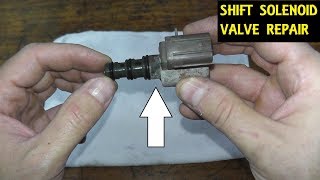
How to confirm: A technician will follow the diagnostic procedure in the TSB, which involves a solenoid performance test using a scan tool 🎬 Watch: How to test and replace these shift solenoids. and shop air at 90-100 psi. Visual inspection of the removed valve for scratches is the definitive confirmation, as the valve may become unstuck once the valve body bolts are loosened.
Typical fix: If the valve is scratched or stuck, the lower valve body assembly is typically replaced as recommended by GM. Some technicians on forums note that simply replacing the solenoid pack can sometimes resolve the issue, but if the valve bore itself is worn, the problem may return.
Est. part cost: $150-$400 - Low or Contaminated Transmission Fluid 🟡 Medium Probability → Shop Transmission Assembly Degraded fluid loses its hydraulic properties and can contain debris that clogs solenoid passages or the solenoid's inlet screen, causing them to stick. Overheating can accelerate fluid breakdown.
How to confirm: Check the transmission fluid level and condition. The fluid should be at the correct level, red in color, and not smell burnt. Dark, dirty, or tarry fluid indicates a problem. Note that many modern transmissions like these do not have a dipstick, requiring a specific procedure to check the level.
Typical fix: Perform a transmission fluid and filter change. If the fluid is heavily contaminated, a full flush may be recommended. Always use the manufacturer-specified fluid, such as DEXRON-VI.
Est. part cost: $75-$150 - Faulty Wiring or Connectors ⚪ Low Probability Wiring to the transmission is exposed to heat and road debris, which can lead to corrosion, shorted wires, or damaged connectors over time.
How to confirm: Visually inspect the wiring harness going to the transmission for any signs of damage, corrosion, or loose connections. A multimeter can be used to test for continuity and proper voltage at the solenoid connector.
Typical fix: Repair the damaged section of wiring or replace the faulty connector. Applying dielectric grease to connectors can help prevent future corrosion.
Est. part cost: $20-$100
Rare But Worth Checking
- Faulty Transmission Control Module (TCM): → Shop Transmission Assembly While rare, the TCM itself can fail, sending incorrect signals or no signal at all to the solenoid. This is usually considered only after all other possibilities (solenoid, fluid, wiring) have been ruled out. Sometimes this is accompanied by other communication-related trouble codes.
- Worn Valve Body Bores: → Shop Transmission Valve Body Even if the solenoid itself is functional, the bore in the valve body where the valve slides can become worn. This allows hydraulic pressure to leak past, preventing proper actuation and triggering a solenoid performance code. In this case, replacing only the solenoid will not fix the issue long-term, and the entire valve body needs replacement or re-sleeving.
Diagnosis Steps
- Check for other stored DTCs. Diagnose and fix any other codes first, especially P0700.
- Check the transmission fluid level and condition. Ensure it is full and the fluid is clean and red, following the proper procedure for vehicles without a dipstick.
- Visually inspect the external transmission wiring harness and connectors for damage or corrosion.
- Using a professional scan tool, command the Shift Solenoid 'A' (specifically PC Solenoid 2, per the TSB) on and off to check for a response. Monitor transmission fluid pressure for expected changes.
- If the solenoid does not respond correctly, drop the transmission oil pan to access the valve body.
- Following GM TSB #PI1344C, remove and inspect the Clutch Select Solenoid Valve 2 for scoring, scratches, or sticking in its bore. The valve may free up once bolts are loosened, so inspection for physical scratches is critical.
- If the valve shows damage, replace the lower valve body or the control solenoid assembly as recommended by GM. If the valve and wiring are okay, the issue may be a clogged passage or worn bore in the valve body itself.
Parts You'll Likely Need
- Transmission Control Solenoid Assembly / Valve Body
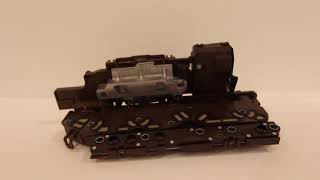
(OEM #24256523 (This is a common TCM/Solenoid assembly for related 6T40/6T45 transmissions, verify exact part for 6L series before purchase))— This is the most common failure point according to GM's own service bulletins. The specific solenoid sticks, and it is often replaced as part of the entire solenoid pack or lower valve body. The part number often refers to the entire Transmission Electro-Hydraulic Control Module (TEHCM) 🎬 Learn more about replacing the TEHCM on 6-speed transmissions. with solenoids attached.
Trusted brands: ACDelco (OEM), Standard Motor Products, Sonnax (offers repair kits)
OEM price range: $250-$450
Aftermarket price range: $150-$350 - Automatic Transmission Fluid and Filter Kit
(OEM #ACDelco 10-9243 (DEXRON-VI Fluid))— This service requires removing the transmission pan, so replacing the fluid and filter is mandatory. Use only the specified fluid (DEXRON-VI for these models) to ensure proper performance and longevity.
Trusted brands: ACDelco, Valvoline, Castrol
OEM price range: $100-$180
Aftermarket price range: $75-$120
Related Codes That Often Appear With This One
- P0700 — P0700 is a generic code that means the Transmission Control Module (TCM) has stored a fault code. It's an informational code that tells you to check for more specific transmission codes, like P0751.
Technical Service Bulletins (TSBs) & Recalls
- PI1344C: Diagnostic tips for reduced acceleration at low speed and/or transmission slipping from a launch, DTC P0751 set.
- PI1344B: Earlier version of the bulletin with the same diagnosis, pointing to a sticking Clutch Select Solenoid Valve 2.
Platform-Specific Known Issues
- GM Technical Service Bulletin PI1344C directly addresses DTC P0751 on 2010-2015 CTS models. It identifies the cause as a sticking Clutch Select Solenoid Valve 2, leading to a 4th gear start.
- The TSB explicitly states that during diagnosis, the solenoid in question is 'PC Solenoid 2' and that other solenoids will not cause this specific condition.
Mechanic-Grade Diagnostic Values
- Shift Solenoid (On/Off type) Resistance — expected: 20-40 Ohms. Failure: A reading outside this range (e.g., open circuit or short) indicates a failed solenoid coil.
- Pressure Control (PWM type) Solenoid Resistance — expected: 3-8 Ohms. Failure: A reading outside this range indicates a failed solenoid coil. The specific solenoid for P0751, Clutch Select Solenoid 2, is a PWM type.
- Shift Solenoid (On/Off type) Current Draw at 12V — expected: 0.3 - 0.7 Amps. Failure: Incorrect amperage suggests a failing solenoid.
- Pressure Control (PWM type) Solenoid Current Draw at 12V — expected: 1.5 - 4.0 Amps. Failure: Incorrect amperage suggests a failing solenoid.
- TCM/TEHCM Solenoid Supply Voltage — expected: 8.3 - 9.3 Volts. Failure: Incorrect voltage from the TCM indicates a problem with the module itself or its power/ground supply.
Scan Tool Commands That Help
- GDS2 / Tech2: Solenoid Performance Test / Automated Solenoid Cleaning — This function electronically cycles the solenoids to confirm electrical operation and can sometimes dislodge minor debris causing an intermittent stick. It is a key step before physically removing parts.
- GDS2 / J2534 Pass-Thru Device: Service Fast Learn Adapts — This procedure is mandatory after replacing the valve body or the entire TEHCM (solenoid/TCM assembly). It resets and relearns the transmission's shift pressure adapts to ensure proper shift quality with the new components.
- GDS2 / J2534 Pass-Thru Device: TEHCM Programming — When a new TEHCM is installed, it must be programmed with the vehicle's specific VIN and the latest software calibration. A 'blank' TEHCM will not function until this is done.
Wiring & Ground Locations
- G103 — On the front of the passenger-side cylinder head.. This is a primary engine-to-chassis ground. Poor contact can cause voltage drops and erratic behavior in electronic modules like the TCM/TEHCM, potentially leading to performance codes.
- G104 — On the rear of the driver-side cylinder head.. Another critical engine ground. Ensuring it is clean and tight is a crucial step when diagnosing any electronic control issues.
- Transmission Connector (X180/X2) — The main 16-pin electrical connector on the side of the transmission case.. This is the interface between the main vehicle harness and the internal transmission harness leading to the TEHCM. It should be inspected for corrosion, moisture, or pushed-out pins, as a bad connection here can mimic an internal failure.
Real Owner Repair Stories
- Forum discussions on GM truck platforms with the same 6L80 transmission (Various GM Trucks/SUVs (e.g., Tahoe, Silverado) with 6L80 transmission, years 2010-2014) — Vehicle stuck in a high gear, no power from a stop, P0751 code stored.
❌ Tried (didn't work) Replacing only the individual solenoid., Performing a fluid and filter change without addressing the hardware.
✅ What actually fixed it Replacement of the entire Transmission Electro-Hydraulic Control Module (TEHCM), which includes the TCM and all solenoids as a single unit, followed by VIN-specific programming. This addresses both the mechanical sticking issue and potential electronic faults within the integrated module.
"I Checked Everything" — The Actual Cause
- In the context of P0751, the equivalent of a 'smoke test clean' scenario is when the shift solenoid passes all electrical tests (resistance, voltage, current draw) but the code persists. As noted in GM's TSBs, the root cause is often not an electrical failure of the solenoid but a mechanical failure of the 'Clutch Select Solenoid Valve 2' sticking in its bore within the valve body. A technician may replace a perfectly good TEHCM/solenoid pack, only for the problem to return because the physical valve bore in the valve body itself is worn, causing pressure loss that the computer interprets as a solenoid performance fault.
OEM Part Supersession History
24256523 (and others like 24252423, 24258562)→24287419, 24256797, 24275868 (and others)— These part numbers refer to the TEHCM (TCM with integrated solenoids). Revisions are common to improve reliability and address known failure modes. However, these parts are for the related 6T40/6T45 FWD transmissions.
Heads up: CRITICAL: The part number 24256523 is for the FWD 6T40/6T45 family, NOT the RWD 6L50 used in the CTS. While the failure mode is similar, the parts are not interchangeable. Always verify the correct TEHCM part number for the 6L50 transmission using the vehicle's VIN. Installing the wrong generation or family of TEHCM can lead to programming failures or persistent shifting problems.
Model Year Variations Within This Range
- 2014 vs 2015+: For the related 6L80 transmission, the valve body separator plate design changed. Pre-2015 models used 7 check balls, while 2015-and-up models use 8. This is important to know if servicing the valve body itself.
- 2010-2015: While the 6L50 transmission was used across these years, GM may have released updated software calibrations to address issues like TCC shudder or shift quality. When replacing a TEHCM, it is critical to program it with the latest available software for the vehicle's VIN to ensure optimal performance.
Helpful Videos

We Have This Part in Stock


The information in this article is provided for general reference and educational purposes only. Vehicle specifications, procedures, and part compatibility can vary by production date, trim level, and region. Always consult your vehicle's factory service manual and verify part numbers before purchasing or performing repairs. Safety-critical components such as airbags, seat belts, and braking systems should be installed by a qualified professional.
- Cadillac CTS:
- 🧭 Diagnostic Flowchart
- 🎬 Helpful Videos
- 🛍️ Shop This Part
- What's Unique About the 2010-2015 Cadillac CTS
- Symptoms You May Notice
- Most Likely Causes
- Rare But Worth Checking
- Diagnosis Steps
- Parts You'll Likely Need
- Related Codes That Often Appear With This One
- Technical Service Bulletins (TSBs) & Recalls
- Platform-Specific Known Issues
- Mechanic-Grade Diagnostic Values
- Scan Tool Commands That Help
- Wiring & Ground Locations
- Real Owner Repair Stories
- "I Checked Everything" — The Actual Cause
- OEM Part Supersession History
- Model Year Variations Within This Range
- 🎟️ Get 5% Off