

P0751 on 2011-2019 Chevrolet Cruze: Shift Solenoid 'A' Stuck Off Causes and Fixes
On a 2011-2019 Chevy Cruze, P0751 usually means the 'Shift Solenoid A' inside the transmission is stuck or failing. This often results in the car being stuck in a single gear (limp mode), causing poor acceleration. The most common fix is to replace the faulty solenoid or the entire solenoid pack/valve body assembly, which requires accessing the transmission's internal components.
- P0751 on a Cruze indicates a serious transmission issue, most often a stuck shift solenoid.
- Do not continue to drive the vehicle, as it is likely in 'limp mode' and can cause further, more expensive damage.
- The first diagnostic step is always to check the transmission fluid level and condition. Low or dirty fluid is a common cause.
- The repair is complex and involves accessing internal transmission components. Professional service is strongly recommended.
- Ensure you or your mechanic uses the correct, VIN-specific parts, as components differ between Cruze generations.
What's Unique About the 2011-2019 Chevrolet Cruze
The Chevrolet Cruze from this era uses the 6T-series (Gen1/Gen2) or 9T50 (Gen2 Diesel) automatic transmissions. While P0751 is a generic code, on these specific GM transmissions, the issue is frequently a mechanical failure of the solenoid sticking in its bore within the valve body, rather than just an electrical fault. This is a similar failure pattern seen in other GM 6-speed transmissions, as documented in service bulletins for other models. Misdiagnosis is common, as owners may replace the wrong generation of parts, which look similar but have different internal specifications and electrical resistance values.
Generation note: This range covers two generations of the Cruze, which used different transmissions and internal components: - First Generation (2011-2016): Used the 6T30 (1.8L) and 6T40 (1.4L Turbo) Gen 1 automatic transmissions. - Second Generation (2016-2019): Used the updated 6T35 (Gen 2) automatic and a 9T50 automatic for diesel models. While the P0751 code applies to both, the specific solenoids and valve bodies are not interchangeable between generations. Gen 1 and Gen 2 solenoids have different resistance values and connectors. It is critical to use VIN-specific parts.
Symptoms You May Notice
- Check Engine Light is illuminated
- Transmission is stuck in one gear (limp mode), often resulting in a 4th gear start from a stop
- Very poor or sluggish acceleration from a stop
- Harsh, erratic, or delayed shifting
- Transmission slipping between gears
- Reduced fuel economy
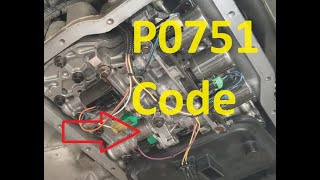
- A whining sound from the transmission area in some cases 🎬 Watch: Understanding the causes and fixes for the P0751 code.
- Replacing only a single solenoid when the valve body bore is scored, leading to a quick return of the P0751 code.
- Installing a valve body or solenoid pack from the wrong vehicle generation (e.g., a Gen 2 part in a Gen 1 Cruze), which will not function correctly due to different resistance specifications.
- Assuming the solenoid is good because it passes an electrical resistance test, when the failure is actually mechanical (sticking).
Most Likely Causes
- Low or Dirty Transmission Fluid 🔴 High Probability → Shop Transmission Assembly The 6T-series transmissions can be sensitive to fluid condition. Over time, fluid breaks down and clutch material contaminates it, which can cause valves and solenoids to stick. These transmissions do not have a dipstick, so fluid level checks are often neglected.
How to confirm: Check the transmission fluid level and condition. This must be done via a check/fill plug on the side of the transmission case while the vehicle is level and the fluid is at a specific operating temperature (typically 185-203°F or 85-95°C). The fluid should be red and clear, not dark brown, black, or smelling burnt.
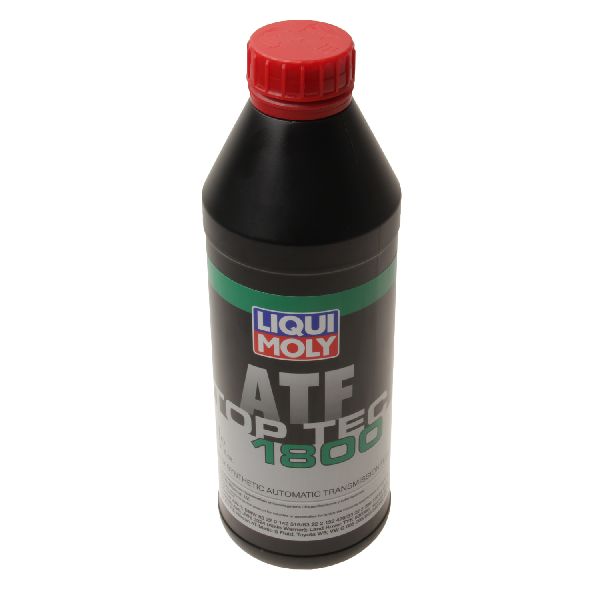
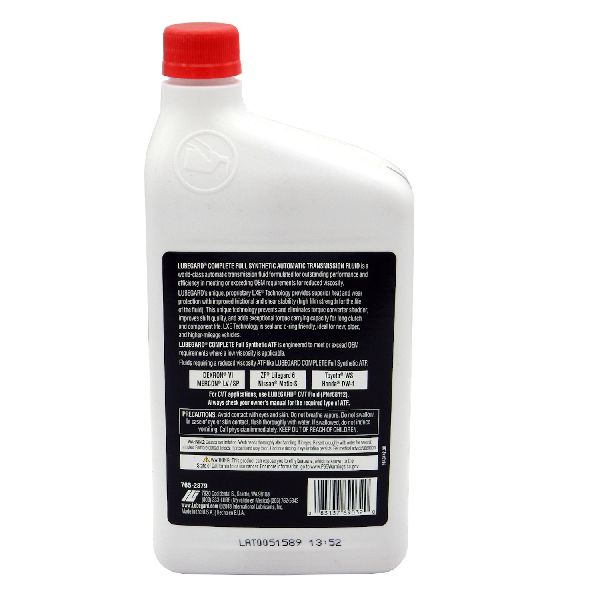
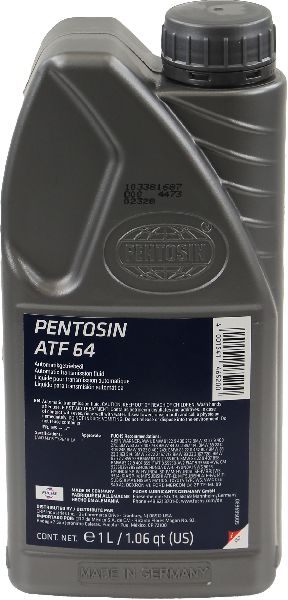
Typical fix: Perform a transmission fluid and filter change using DEXRON-VI specification fluid. If the fluid is heavily contaminated, a more thorough flush may be necessary, though this alone may not free a stuck solenoid.
Est. part cost: $50-$150 - Faulty Shift Solenoid 'A' 🔴 High Probability → Shop Transmission Valve Body The solenoids in the 6T transmissions are known to fail mechanically by sticking or electrically. On many GM 6-speeds, 'Solenoid A' corresponds to 'Clutch Select Solenoid Valve 2'. Debris in the fluid is a primary cause of the solenoid valve sticking in its bore.
How to confirm: After confirming fluid is good, a technician will drop the transmission pan to access the solenoids. The solenoid can be tested for correct resistance with a multimeter (Gen 1 solenoids are typically 5-6 ohms, while some aftermarket solenoids may read 12-25 ohms) or commanded on and off with a bi-directional scan tool to check for an audible click.
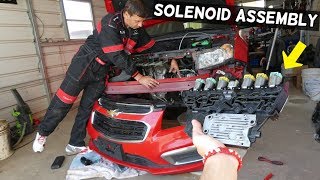
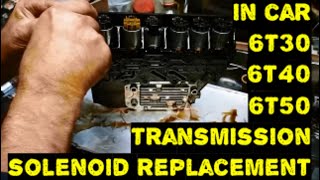
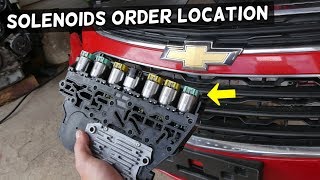
Typical fix: Replace the faulty solenoid. Most shops recommend replacing the entire set of shift solenoids (solenoid pack or kit) at the same time, as they are wear items and the labor to access them is the same. 🎬 See this guide to identify the solenoid location and order.
Est. part cost: $40-$80 for a single solenoid, $150-$300 for a full kit. - Scored or Worn Valve Body 🟡 Medium Probability → Shop Transmission Valve Body Debris in the fluid can cause scoring within the aluminum bores of the valve body where the solenoids operate. This prevents the valve from moving freely, even with a new solenoid. This is a well-documented issue in GM service bulletins.
How to confirm: During solenoid replacement, the valve body bores must be visually inspected for scratches, scoring, or wear marks. A valve that does not slide smoothly in its bore is a clear indicator. This inspection is critical.
Typical fix: If scoring is present, the entire valve body assembly must be replaced. Simply replacing the solenoid will not fix the problem long-term. This is the official GM-recommended repair in many cases.
Est. part cost: $300-$700
Rare But Worth Checking
- Faulty Transmission Control Module (TCM) or Wiring: → Shop Transmission Assembly While less common, the TCM, which is mounted inside the transmission on these models as part of the valve body assembly (often called a TEHCM), can fail. The internal wiring harness can also become damaged. A TCM software update may even be a potential fix in some cases.
Diagnosis Steps
- Scan the vehicle for all diagnostic trouble codes. Note P0751 and any other accompanying codes like P0700.
- Check the transmission fluid level and condition at the correct operating temperature (85-95°C). This is a critical first step. The fluid must be at the correct level and should not be dark or burnt.
- If the fluid is low or dirty, perform a fluid and filter change using DEXRON-VI fluid. Clear codes and test drive to see if the problem is resolved. This is often a temporary fix if components are already sticking.
- If the problem persists, the transmission pan and side cover must be removed to access the internal components (TEHCM - Transmission Electro-Hydraulic Control Module).
- Visually inspect the wiring harness to the solenoids and TCM for any damage.
- Identify and test Shift Solenoid 'A' (Clutch Select Solenoid Valve 2). Check its resistance with a multimeter. A reading outside the manufacturer's specification (approx. 3.42–4.18 Ω for many pressure control solenoids, or 16.2-19.8 Ω for the on/off shift solenoid in Gen 1) or an open circuit indicates a failed solenoid.
- Remove the solenoid and inspect its corresponding bore in the valve body for any visible scratches or scoring.
- If the solenoid tests bad but the bore is clean, replace the solenoid (or the full solenoid pack for preventative maintenance).
- If the valve body bore is scored, the entire valve body assembly must be replaced along with the solenoids for a permanent repair.
Parts You'll Likely Need
- Automatic Transmission Shift Solenoid Kit
(OEM #24256525 (Gen 1 Kit, example))— This is the most probable cause of the failure. Replacing the full set is recommended since the labor to access them is significant. Ensure the kit matches the transmission generation (Gen 1 vs Gen 2).
Trusted brands: ACDelco, Rostra
OEM price range: $200-$350
Aftermarket price range: $120-$250 - Automatic Transmission Valve Body (with TCM)
(OEM #24287426 (Superseded, example for Gen 2))— If the solenoid bore is scored, the valve body must be replaced for a lasting repair. It is often sold as a complete assembly with solenoids and the Transmission Control Module (TCM), and is referred to as a TEHCM.
Trusted brands: ACDelco
OEM price range: $400-$700
Aftermarket price range: $300-$550 - DEXRON-VI Automatic Transmission Fluid
(OEM #10-9395 (ACDelco))— Required for any service. Using the correct fluid is critical for transmission health. A typical pan drop service requires 5-7 quarts.
Trusted brands: ACDelco, Valvoline, Castrol
OEM price range: $8-$12
Related Codes That Often Appear With This One
- P0700 — P0700 is a generic code that simply means the Transmission Control Module (TCM) has stored a fault and requested the main engine computer to turn on the Check Engine Light. It will almost always be present with any specific transmission code like P0751.
- P0756, P0761 — These codes relate to other shift solenoids ('B' and 'C'). If dirty fluid is the cause, it can affect multiple solenoids simultaneously, causing several codes to appear together.
Technical Service Bulletins (TSBs) & Recalls
- GM TSB PI1344C / PIP5025H: While for the 6L-series transmissions, these bulletins are highly relevant as they describe the exact failure pattern seen in the 6T series: DTC P0751 caused by a sticking Clutch Select Solenoid Valve 2, resulting in a 4th gear start. It recommends inspecting the valve for scratches and replacing the lower valve body if damage is found.
- GM TSB PI0604C: This bulletin details the product updates that distinguish Gen 1 and Gen 2 versions of the 6T30/40/45/50 transmissions, underscoring the importance of using the correct generation of parts for repairs.
- Bulletin #PI1344C: This manufacturer bulletin provides diagnostic tips and repair information to address customer concerns of reduced acceleration at low speeds and/or transmission slipping from a launch when DTC P0751 is set.
Mechanic-Grade Diagnostic Values
- Gen 1 (2011-2012) Pressure Control Solenoid Resistance — expected: 3.42–4.18 Ω. Failure: A reading outside this range indicates a faulty solenoid coil.
- Gen 1 (2011-2012) On/Off Shift Solenoid Resistance — expected: 16.2–19.8 Ω. Failure: A reading outside this range indicates a faulty solenoid coil.
- Gen 2 Pressure Control Solenoid Resistance — expected: 3-5 Ω. Failure: A reading outside this range indicates a faulty solenoid coil.
- Gen 2 On/Off Shift Solenoid Resistance — expected: 16-20 Ω. Failure: A reading outside this range indicates a faulty solenoid coil.
- TEHCM Regulated Solenoid/Sensor Operating Voltage — expected: 8.3 - 9.3 Volts. Failure: Incorrect voltage could indicate an internal TEHCM fault, not necessarily a solenoid fault.
Scan Tool Commands That Help
- GM GDS2 / Tech2: Solenoid Valve State Control / Output Control — This bidirectional command allows a technician to manually command Shift Solenoid 'A' ON and OFF to check for an audible click and verify if the solenoid is mechanically stuck or electrically non-responsive.
- GM GDS2: Transmission Adaptive Values Learn / Service Fast Learn — This procedure is mandatory after replacing the valve body, solenoid assembly, or the entire TEHCM. It resets and relearns the clutch apply pressures and shift timing to ensure smooth operation and prevent future codes.
- GM GDS2: Solenoid Automated Cleaning Process — As a preliminary step after dropping the pan, this function can be used to rapidly cycle all solenoids in an attempt to dislodge minor debris and potentially free a sticking valve before component replacement.
Wiring & Ground Locations
- TEHCM (Transmission Electro-Hydraulic Control Module) — Inside the transmission, bolted to the valve body. Requires removal of the transmission side cover for access.. The TEHCM houses the TCM, all shift solenoids, and pressure switches. P0751 is triggered by this module when it detects a fault with the integrated Shift Solenoid 'A'. The fault is internal to this assembly.
- Negative Battery Ground Cable — Connects the negative battery terminal to the chassis and transmission case.. A known issue on some Cruze models is a faulty negative battery cable (P/N 22754271) which can cause poor ground, leading to erratic behavior from various modules, including the TCM. While not a direct cause of P0751, it can create confounding electrical issues.
Real Owner Repair Stories
- CruzeTalk.com forum user (2012 Chevrolet Cruze 1.4L Turbo) — Check engine light with code P0751, car stuck in what felt like 3rd or 4th gear (limp mode), very slow to accelerate from a stop.
❌ Tried (didn't work) The user did not report trying other fixes first.
✅ What actually fixed it The user took the vehicle to a transmission shop. The shop diagnosed a failed solenoid pack and replaced the entire TEHCM (valve body, solenoids, and TCM as one unit). The repair resolved the code and shifting issues.
OEM Part Supersession History
24256524, 24264425, 24275869→Varies, often leads to newer TEHCM assembly numbers like 24296206 or 24268164 depending on generation and year.— Revisions to address solenoid failures, improve durability, and update software logic.
Heads up: A replacement TEHCM must be programmed with the vehicle's specific VIN and the latest GM calibration software to function. Using a used TEHCM from another vehicle without reprogramming will almost certainly fail, as it contains the wrong VIN and adaptive learn data.
Model Year Variations Within This Range
- 2011-2012 (approx.): These are Gen 1 6T40/6T30 transmissions. They use specific solenoids with black connectors and have pressure switches integrated into the TEHCM. The resistance values are unique to this generation.
- 2013-2019 (approx.): These are Gen 2 (and later) 6T35/6T40 transmissions. The TEHCM was updated, and the solenoids (often with yellow or green connectors) have different resistance values and locations on the valve body. Gen 2 units do not have pressure switches. A Gen 1 TEHCM cannot be used in a Gen 2 transmission and vice-versa.
Diagnostic Flowchart
Other Known Issues on This Vehicle
Issues unrelated to this code that are worth knowing about as an owner of this generation:
- PCV System Failure (1.4L Turbo) 🔴 High — Very common. A failed diaphragm in the valve cover or a clogged PCV port in the intake manifold can cause vacuum leaks, high oil consumption, and rough running. (Ref: GM TSB 20-NA-047 (for P1101 code related to PCV))
- Coolant Leaks (1.4L Turbo) 🔴 High — Widespread. Leaks are common from the plastic water pump, thermostat housing, and coolant outlet housing. Neglecting leaks can lead to engine overheating.
- Cracked Pistons (Early Gen 2 1.4L Turbo) 🔴 High — Reported on some 2016-2017 models, leading to misfires (P0300) and loss of compression.
- Oil Cooler Line Leaks (1.4L Turbo) 🟠 Medium — Common. The O-rings on the engine and transmission oil cooler lines degrade over time, causing oil leaks.
- Transmission Failure (Early Gen 1) 🟠 Medium → Shop Transmission Assembly — 2011-2012 models had a higher rate of general transmission complaints, including slipping and complete failure, sometimes unrelated to a specific solenoid code.
- Negative Battery Cable Issues 🟡 Low — A known issue on Gen 1 models where a poor ground at the negative battery terminal can cause a wide range of strange, intermittent electrical problems across the vehicle.
Used vs. New Parts: Buying Guide for This Vehicle
When a used part is the smart pick: For this specific repair involving electronic transmission components, using used parts is strongly discouraged. The main failure component, the TEHCM, is VIN-locked and contains adaptive learn data specific to its original vehicle. While it can be physically installed, it requires specialized tools to reprogram, a service many shops cannot or will not perform on a used part.
Donor-vehicle mileage cap: roughly under 1 miles for the part to have meaningful remaining life.
What to inspect on the donor part:
- Not applicable. Avoid used electronic transmission components for this repair.
OEM-only on this vehicle (don't cheap out):
- Transmission Electro-Hydraulic Control Module (TEHCM)
- Valve Body Assembly
Aftermarket brands forum-validated for this vehicle:
- ACDelco (OEM)
- Sonnax (for rebuild components like pressure switch laminates, not complete assemblies)
- Rostra (for individual solenoids if not replacing the whole TEHCM)
Brands owners have reported issues with on this vehicle:
- Unbranded, no-name TEHCMs or solenoid kits from online marketplaces are a significant gamble due to high failure rates and potential programming issues.
Real Owner Stories
Aggregated from forums and TSBs cited above. Mileages and costs reflect what owners reported in those sources.
2017 Chevrolet Cruze
Symptoms: The vehicle was throwing codes P0700 and P0751 and became stuck in one gear.
What fixed it: The discussion for this specific case pointed toward the replacement of the solenoid or the valve body assembly.
Source hint: https://www.cruzetalk.com/threads/p0700-p0751.239823/
2018 Chevrolet Cruze
Symptoms: Sensor failure within the transmission assembly.
What fixed it: Replacement of the valve body assembly.
Source hint: https://www.reddit.com/r/cruze/comments/1bndw85/crazy_high_price_for_replacing_part_of_valve_body/
2011 Chevrolet Silverado
Symptoms: A loud thud followed by a whining sound and a complete failure to shift.
What fixed it: Replacement of a bad shift solenoid.
Source hint: https://www.chevroletforum.com/forum/silverado-fullsize-pick-ups-21/shifting-problem-w-p0751-code-38936/
Related OBD-II Codes
Frequently Asked Questions
My 2017 Cruze is stuck in one gear and showing P0751; does GM TSB PI1344C apply to my transmission?
I have a 2018 Cruze with a valve body failure; why is the repair estimate so high?
Can I check the transmission fluid level myself on a 2011-2019 Cruze to rule out P0751?
What specific fluid should I use for my 2011-2019 Chevrolet Cruze transmission?
Does GM TSB PI0604C affect how I repair my P0751 code?
Helpful Videos
We Have This Part in Stock

The information in this article is provided for general reference and educational purposes only. Vehicle specifications, procedures, and part compatibility can vary by production date, trim level, and region. Always consult your vehicle's factory service manual and verify part numbers before purchasing or performing repairs. Safety-critical components such as airbags, seat belts, and braking systems should be installed by a qualified professional.
- Chevrolet Cruze:
- 🧭 Diagnostic Flowchart
- 🎬 Helpful Videos
- 🛍️ Shop This Part
- What's Unique About the 2011-2019 Chevrolet Cruze
- Symptoms You May Notice
- Most Likely Causes
- Rare But Worth Checking
- Diagnosis Steps
- Parts You'll Likely Need
- Related Codes That Often Appear With This One
- Technical Service Bulletins (TSBs) & Recalls
- Mechanic-Grade Diagnostic Values
- Scan Tool Commands That Help
- Wiring & Ground Locations
- Real Owner Repair Stories
- OEM Part Supersession History
- Model Year Variations Within This Range
- Other Known Issues on This Vehicle
- Used vs. New Parts: Buying Guide for This Vehicle
- Real Owner Stories
- 2017 Chevrolet Cruze
- 2018 Chevrolet Cruze
- 2011 Chevrolet Silverado
- Related OBD-II Codes
- Frequently Asked Questions
- 🎟️ Get 5% Off