

P0751 on 2009-2014 Ford E-150: Shift Solenoid 'A' Causes and Fixes
For the common 4R75E transmission in these vans, P0751 usually means the shift solenoid pack inside the transmission has failed or the fluid is low/dirty. Replacing the solenoid pack and fluid/filter costs around $150-$250 in parts and is a moderately difficult DIY job. This requires dropping the transmission pan.
- First, verify your transmission fluid level and condition. Low or dirty fluid is a common and simple cause.
- It is crucial to identify your transmission. This guide focuses on the common 4R75E. If you have the heavier-duty TorqShift, refer to TSB 16-0057 for a different, more complex issue.
- For the 4R75E, the most likely mechanical culprit is the dual shift solenoid pack, which is accessible after removing the transmission pan.
- Always use Motorcraft MERCON LV fluid for this vehicle; using older MERCON V or other universal fluids can cause shifting problems or damage.
What's Unique About the 2009-2014 Ford E-150
It is critical to know which transmission your E-150 has. Most 2009-2014 E-150s with the 4.6L or 5.4L V8 engines are equipped with the 4-speed 4R75E transmission. For these vans, P0751 is most often caused by a faulty shift solenoid pack inside the transmission pan. However, some heavier-duty E-Series vans (E-250/350/450) and those with different engines (like the 6.8L V10 or diesels) came with the 5-speed TorqShift (5R110W) transmission. For those specific models, Ford issued Technical Service Bulletin (TSB) 16-0057, which points to a much more serious internal problem with the coast clutch cylinder, requiring a full transmission teardown to fix. Misidentifying the transmission can lead to a significant and costly misdiagnosis.
Diagnostic Flowchart
Tap your situation to follow the diagnostic path that matches what you're seeing on this vehicle.
Symptoms You May Notice
- Check Engine Light is illuminated
- Harsh, delayed, or failed 1-2 shift
- Transmission gets stuck in a single gear (limp mode)
- Transmission slipping between gears
- Vehicle may feel like it's starting in the wrong gear
- Transmission overheating
- Reduced fuel economy
- Replacing the entire transmission when only the accessible shift solenoid pack was faulty.
- Applying the TorqShift TSB repair to a vehicle with the 4R75E transmission, which has a completely different internal design.
- Replacing the shift solenoid when the actual fault is a cracked wire or connector in the internal harness.
Most Likely Causes
- Low or Dirty Transmission Fluid 🔴 High Probability → Shop Transmission Assembly Fluid can become contaminated with clutch material over time, or leaks can lower the level, causing pressure issues that prevent the solenoid from actuating correctly.
How to confirm: Check the transmission fluid dipstick for level and condition. The fluid should be red and clear, not brown, black, or smelling burnt. A burnt smell indicates overheating and fluid degradation.
Typical fix: Perform a transmission fluid and filter change. Use only the specified Motorcraft MERCON LV fluid.
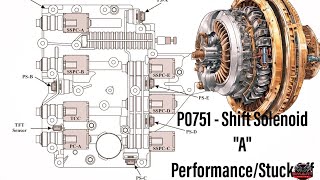
Est. part cost: $80-$120 - Failed Shift Solenoid Pack 🔴 High Probability → Shop Transmission Valve Body The solenoids are electro-mechanical parts that wear out over time. In the 4R75E, shift solenoids 'A' and 'B' are integrated into a single replaceable pack.
How to confirm: After dropping the transmission pan, the solenoid pack can be tested with a multimeter. The resistance for the shift solenoids should be between 10-30 Ohms. A reading of 0 or infinity indicates a failed solenoid. A high-end scan tool can also command the solenoid on/off to listen for a 'click'.
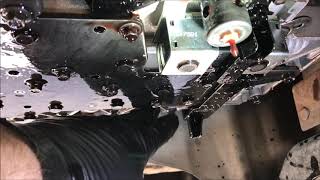
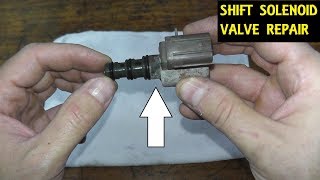
Typical fix: Replace the dual shift solenoid pack located on the valve body. 🎬 See how to access and replace the 4R75E shift solenoid.
Est. part cost: $70-$150 - Damaged Internal Wiring Harness / Lead Frame 🟡 Medium Probability → Shop Transmission Wiring Harness The wiring harness (often part of a 'lead frame' assembly) inside the transmission is submerged in hot fluid and can become brittle, causing connectors to crack or wires to break. This creates an open or shorted circuit to the solenoid.
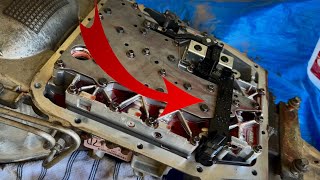
How to confirm: Visually inspect the wiring harness and connectors for cracks, brittleness, or damage after removing the transmission pan. Check for continuity between the solenoid connector and the main transmission connector pins. 🎬 Watch a pro demonstrate how to remove the internal harness.
Typical fix: Replace the internal transmission wiring harness/lead frame assembly.
Est. part cost: $100-$200 - Clogged Valve Body Passages ⚪ Low Probability → Shop Transmission Valve Body Metal shavings or clutch debris can clog the small hydraulic passages in the valve body, preventing fluid from reaching the clutches even when the solenoid activates.
How to confirm: This is difficult to confirm without disassembly. A large amount of metal 'paste' or shavings on the pan magnet is a strong indicator of this issue.
Typical fix: The valve body may need to be removed and professionally cleaned or replaced. In some cases, a full transmission flush can clear minor blockages.
Est. part cost: $300-$700
Rare But Worth Checking
- Faulty Powertrain Control Module (PCM): This is a rare cause. The PCM is the computer that controls the transmission. It should only be considered after all other possibilities, especially wiring and connectors, have been thoroughly ruled out.
Diagnosis Steps
- Check the transmission fluid level and condition using the dipstick. If low, top off and check for leaks. If dark, burnt, or contains debris, a fluid and filter change is necessary as a first step.
- Use an OBD-II scanner to confirm P0751 and check 🎬 Watch this diagnostic guide for a Ford that won't move. for other related transmission codes like P0756 or P0730.
- Safely raise the vehicle and remove the transmission pan to drain the fluid.
- Inspect the magnet in the bottom of the pan. A fine metallic paste is normal, but large metal shavings indicate a severe internal failure requiring a rebuild or replacement.
- Locate the dual shift solenoid pack on the valve body. Visually inspect its connector and the internal wiring harness (lead frame) for any signs of cracks, brittleness, or heat damage.
- Test the suspect solenoid circuit. Disconnect the harness and use a multimeter to check the resistance across the Shift Solenoid 'A' pins. A typical reading for a good solenoid is between 10-30 ohms. An open (infinite resistance) or short (zero resistance) indicates failure.
- Check for voltage at the harness connector. You should have battery voltage (approx. 12V) on the power supply wire.
- If the solenoid tests bad or is inconclusive, replace the dual shift solenoid pack.
- If the solenoid tests good, carefully inspect and test the internal wiring harness for continuity from the solenoid connector to the main case connector. If any wire is open or shorted, replace the harness.
- Install a new transmission filter and pan gasket.
- Reinstall the transmission pan and torque the bolts to specification in a crisscross pattern (typically 120 in-lbs).
- Refill the transmission with the correct amount of Motorcraft MERCON LV fluid. A pan drop service typically requires 5-6 quarts.
- Start the engine, cycle through the gears (P-R-N-D-2-1), and re-check the fluid level with the engine running and transmission warm. Clear the codes and perform a test drive to ensure the issue is resolved.
Parts You'll Likely Need
- Dual Shift Solenoid Pack
(OEM #9L3Z-7G484-A)— This pack contains Shift Solenoid 'A' and 'B' and is the most common electrical failure point for this code on the 4R75E transmission.
Trusted brands: Motorcraft, Rostra
OEM price range: $100-$150
Aftermarket price range: $60-$100 - Transmission Internal Wiring Harness (Lead Frame)
(OEM #9L3Z-7G276-A)— This harness is a common failure point due to heat and fluid exposure, causing brittle wires and cracked connectors that lead to an open circuit for the solenoid.
Trusted brands: Motorcraft, Dorman
OEM price range: $120-$180
Aftermarket price range: $80-$130 - Transmission Filter and Pan Gasket Kit
(OEM #FT-180 (Filter))— Must be replaced whenever the transmission pan is removed for service.
Trusted brands: Motorcraft, ATP, Dorman
OEM price range: $30-$50
Aftermarket price range: $20-$40 - Motorcraft MERCON LV Automatic Transmission Fluid
(OEM #XT-10-QLVC)— This is the manufacturer-specified fluid for the 4R75E transmission from 2009-2014. Using other fluid types can cause damage. A pan drop and filter change requires approximately 5-6 quarts.
Trusted brands: Motorcraft
OEM price range: $10-$15 per quart
Aftermarket price range: $8-$12 per quart
Related Codes That Often Appear With This One
- P0756 — This code is for Shift Solenoid 'B'. Since both solenoids 'A' and 'B' are in the same pack on a 4R75E, a failure of the pack or its wiring often affects both, triggering multiple codes.
- P0730 — This code means 'Incorrect Gear Ratio'. It is often triggered alongside a solenoid code because the solenoid's failure to actuate a shift causes the PCM to detect a mismatch between the commanded gear and the actual gear ratio.
- P2700 — This code for 'Transmission Friction Element Apply Time' can appear with P0751, as noted in TSB 16-0057 for TorqShift models, indicating a clutch application timing issue.
Technical Service Bulletins (TSBs) & Recalls
- TSB 16-0057: Torqshift Transmission - Malfunction indicator lamp (MIL) diagnostic trouble codes (DTCS) P0751, P0730 and/or P2700.
Platform-Specific Known Issues
- TSB for TorqShift Models (5R110W): Ford TSB 16-0057 applies to some E-Series vans with the 5-speed TorqShift transmission, not the more common 4R75E. It notes that P0751, P0730, and/or P2700 can be caused by a damaged coast clutch cylinder, a major internal repair. It is critical to correctly identify the transmission before assuming the cause is an external solenoid.
Mechanic-Grade Diagnostic Values
- Shift Solenoid 'A' Coil Resistance — expected: 10 - 30 Ω. Failure: A reading of 0 Ω (short) or infinite/OL (open circuit) indicates a failed solenoid.
- Voltage at Transmission Harness Connector C1472, Pin 1 — expected: ≈12.6V (Battery Voltage) with Key On, Engine Off.. Failure: Voltage deviation greater than 0.5V from battery voltage indicates excessive resistance in the power supply circuit.
- Scan Tool Live Data: 'Shift Solenoid A Status' — expected: Should toggle between 'On' and 'Off' as gears are commanded by the PCM/TCM during a drive.. Failure: Parameter is stuck 'Off' or shows a significant delay in changing state when a shift is commanded.
- Scan Tool Live Data: 'Transmission Fluid Pressure' (during solenoid activation test) — expected: A noticeable rise of 40-60 psi when Solenoid A is commanded 'On' via a scan tool.. Failure: No significant change in pressure indicates a stuck solenoid valve or a hydraulic blockage in the valve body.
- PCM/TCM Fault Detection Time — expected: The solenoid should respond to a command within 50-200 milliseconds.. Failure: If the module does not see the expected electrical or mechanical response within this timeframe for two consecutive drive cycles, it will log P0751.
Hidden / Shadow Codes Worth Checking
- Solenoid Body Strategy / ID: This is not a fault code, but rather a 16-digit alphanumeric identifier unique to each transmission's solenoid body. The PCM uses this data to precisely control the solenoids. When replacing a solenoid body or the entire transmission, this new ID must be programmed into the PCM/TCM. (see via A dealer-level scan tool like Ford IDS or an advanced aftermarket tool with this capability (like Forscan or certain Snap-on/Autel models) is required to read the existing ID and program the new one.)
Scan Tool Commands That Help
- Ford IDS / Forscan / Advanced Aftermarket (Innova, Autel, Snap-on): Output State Control / Active Test: Shift Solenoid A — This command allows the technician to manually turn Solenoid 'A' on and off while the vehicle is stationary. You should be able to hear a faint 'click' from the transmission pan and see a corresponding change in pressure on live data, confirming the electrical circuit and solenoid coil are functional.
- Ford IDS / Forscan: Transmission Characterization / Solenoid Identification — This function is used to read the existing Solenoid Body ID from the TCM and to write a new one after replacing the solenoid body or transmission. Failure to program the new ID can result in harsh shifting or other performance issues.
- Ford IDS / Advanced Aftermarket: Clear Transmission Adaptive Tables — This should be performed after a repair to reset the transmission's learned shift strategy. However, it should NEVER be used on a transmission that is suspected of slipping, as it can make the condition worse.
Wiring & Ground Locations
- C1472 — The main external vehicle harness connector at the transmission case.. This is the primary connection point for all transmission electronics. A diagnostic test for power involves checking Pin 1 of this connector. Inspecting for corrosion, bent pins, or a loose connection here is a critical step.
- Circuit CBB79 (VT/WH wire) — This Violet/White wire is located at Pin 1 of the C1472 harness connector.. This is the specific power supply circuit for the transmission solenoids. A voltage test should be performed on this wire to confirm that power is reaching the transmission from the PCM.
OEM Part Supersession History
9L3Z-7G276-A (Internal Wiring Harness/Lead Frame)→No direct supersession found.
Heads up: This part has been noted to have supply chain shortages. Be aware that many different harnesses exist for other Ford transmissions (e.g., AL3Z-7G276-D, DG9Z-7G276-B). Using a harness from another application will not work. Extreme care must be taken to source the exact part number for the 4R75E.
Model Year Variations Within This Range
- 2009-2014: Starting in 2009, the 4R75E transmission family switched to a 'soft wire' or 'hard-wire connector' style for the internal solenoids and harness, which differs from the 'plug-in wire' style used on pre-2009 (specifically pre-2008) models. When ordering parts like the solenoid pack or internal harness, it is critical to specify the 2009+ model year to get the correct components.
Helpful Videos
We Have This Part in Stock

The information in this article is provided for general reference and educational purposes only. Vehicle specifications, procedures, and part compatibility can vary by production date, trim level, and region. Always consult your vehicle's factory service manual and verify part numbers before purchasing or performing repairs. Safety-critical components such as airbags, seat belts, and braking systems should be installed by a qualified professional.
- Ford E-150:
- 🧭 Diagnostic Flowchart
- 🎬 Helpful Videos
- 🛍️ Shop This Part
- What's Unique About the 2009-2014 Ford E-150
- Symptoms You May Notice
- Most Likely Causes
- Rare But Worth Checking
- Diagnosis Steps
- Parts You'll Likely Need
- Related Codes That Often Appear With This One
- Technical Service Bulletins (TSBs) & Recalls
- Platform-Specific Known Issues
- Mechanic-Grade Diagnostic Values
- Hidden / Shadow Codes Worth Checking
- Scan Tool Commands That Help
- Wiring & Ground Locations
- OEM Part Supersession History
- Model Year Variations Within This Range
- 🎟️ Get 5% Off