

P0751 on 2011-2012 Ford Fiesta: Shift Solenoid 'A' Causes and Fixes
P0751 on a 2011-2012 Fiesta usually points to a problem within the notorious PowerShift automatic transmission. While the code blames Shift Solenoid 'A', the root cause is often a failing Transmission Control Module (TCM) or internal transmission faults, not just the solenoid itself. This is a complex repair, not a simple DIY fix, and is a well-documented issue covered by extended warranties and class-action lawsuits.
- P0751 on a 2011-2012 Fiesta is a serious code pointing to issues with the notoriously problematic PowerShift transmission.
- The most likely cause is a failed Transmission Control Module (TCM), not the shift solenoid itself.
- Check for eligibility under Ford's extended warranty programs (14M01 for clutch, 14M02 for TCM) before paying for repairs.
- Diagnosis and repair are complex and require professional tools and expertise; this is not a recommended DIY repair.
What's Unique About the 2011-2012 Ford Fiesta
The 2011-2012 Ford Fiesta uses a DPS6 PowerShift dual-clutch automatic transmission, which is known for a high rate of problems. While P0751 is a generic code, on this specific vehicle it is often a symptom of the larger, well-documented issues with this transmission design, frequently related to the Transmission Control Module (TCM) or internal clutch and actuator failures rather than a simple, isolated solenoid fault. These issues were so widespread that Ford initiated multiple Customer Satisfaction Programs and extended warranties.
Symptoms You May Notice
- Check Engine Light or Transmission Warning Light is on.
- Harsh, abrupt, or 'clunking' shifts.
- Delayed gear engagement or hesitation from a stop.
- Transmission gets stuck in one gear (limp mode).
- Vehicle shudders or jerks on acceleration.
- Flashing gear selector lights (PRNDS) on the dashboard.
- Complete loss of power or failure to move.
- Reduced fuel economy.
- Immediately replacing Shift Solenoid 'A' without diagnosing the TCM or checking for TSBs. The solenoid is often a symptom, not the root cause, on this particular vehicle. Owners on forums frequently report replacing the solenoid only for the P0751 code to return, with the eventual fix being a new TCM.
Most Likely Causes
- Faulty Transmission Control Module (TCM) 🔴 High Probability → Shop Transmission Assembly The TCM on the DPS6 transmission is the most common failure point and was subject to warranty extension 14M02. Internal solder joints and electronic components fail due to heat and vibration, causing it to lose communication or fail to command the actuators and solenoids correctly.
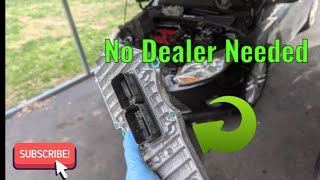
How to confirm: A professional technician will use a diagnostic scan tool to check for communication errors (U-codes like U0100, U0101) and specific TCM-related trouble codes (like P0606). The TCM is located on the side of the transmission, under the battery tray area. 🎬 See this walkthrough on how to replace the TCM.
Typical fix: Replacement of the TCM, which must be programmed to the vehicle using Ford's specific software. Rebuilt units with upgraded components are also available.
Est. part cost: $300-$700 - Internal Transmission Failure (Clutch Forks, Actuators) 🟡 Medium Probability → Shop Transmission Assembly The dual-clutch assembly and the electric motor actuators that move the shift forks are known weak points. Leaking input shaft seals can contaminate the dry clutches, causing shuddering and slipping that generates fault codes. This was addressed by TSB 16-0109 and warranty extension 14M01.
How to confirm: This requires advanced diagnostics, often involving transmission removal and inspection. A technician may perform a clutch shudder test or find codes related to clutch actuator position (e.g., P0902).
Typical fix: Replacement of the dual-clutch pack, input shaft seals, and/or the upper or lower shift actuator motors. This is a major repair.
Est. part cost: $800-$2000+ - Low or Dirty Transmission Fluid ⚪ Low Probability → Shop Transmission Assembly While Ford called the fluid 'lifetime', contamination can still occur. Dirty fluid can cause solenoids and small passages in the valve body to stick. However, on the DPS6, this is a much less common cause than TCM or clutch failure.
How to confirm: Check the transmission fluid level and condition. The DPS6 does not have a traditional dipstick; fluid level must be checked via a fill plug on the side of the transmission case when the vehicle is level. This is best done by a professional.
Typical fix: Perform a transmission fluid drain and fill using the correct specification fluid (Motorcraft XT-11-QDC Dual Clutch Transmission Fluid). This is more complex than a standard automatic transmission service.
Est. part cost: $50-$100 - Failed Shift Solenoid 'A' ⚪ Low Probability → Shop Transmission Valve Body While the code points directly to the solenoid, it's exceptionally rare for the solenoid itself to be the sole point of failure on this transmission compared to the TCM or mechanical parts. The solenoid is almost always a victim of a command failure from the TCM or a symptom of a larger internal issue.
How to confirm: A technician can command the solenoid with a high-level scan tool and monitor its operation. The solenoid's electrical resistance can also be tested with a multimeter.
Typical fix: Replacement of the individual solenoid or the entire solenoid body/valve body. This requires accessing the inside of the transmission and is often performed only to find the problem persists because the TCM was the real cause.
Est. part cost: $50-$250
Rare But Worth Checking
- Wiring Harness Damage: The wiring harness leading to the transmission can become damaged from heat, vibration, or road debris, causing an open or short in the solenoid circuit. A visual inspection of the harness and connectors is a necessary diagnostic step.
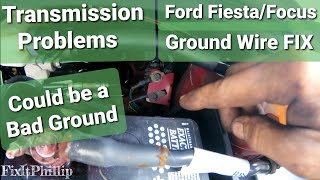
- Poor Chassis Ground Connections: The DPS6 platform is known for having poor ground points on the painted chassis frame rail near the battery. A weak or intermittent ground can cause a wide range of erratic electronic behaviors and fault codes, including those related to the TCM. Cleaning and securing these grounds is a crucial and low-cost diagnostic step.
Diagnosis Steps
- Check for any Technical Service Bulletins (TSBs) or recalls related to the transmission. Specifically, check eligibility for Customer Satisfaction Programs 14M01 (Clutch) and 14M02 (TCM). Ford extended the TCM warranty to 10 years/150,000 miles.
- Use a professional scan tool to check for any other transmission-related codes, especially U-codes (U0100, U0101) and TCM-specific codes (P0606, P0902).
- Inspect and clean the main chassis ground connections near the battery. Ensure a clean metal-to-metal contact.
- Inspect the transmission wiring harness and connectors for any visible damage, corrosion, or loose connections.
- If communication with the TCM is possible, use an advanced scan tool to monitor live data and perform functional tests of the shift solenoids.
- If TCM communication is intermittent or codes like U0100/P0606 are present, the TCM is the primary suspect and should be diagnosed for replacement.
- If diagnostics point away from the TCM, a technician may proceed with checking fluid and inspecting for internal mechanical faults with the clutch pack or shift forks, as outlined in TSB 16-0109.
Parts You'll Likely Need
- Transmission Control Module (TCM)
(OEM #AE8Z-7Z369-F)— This is the most frequent cause of shifting problems and related codes on the 2011-2012 Fiesta. The 'F' revision is the updated part with improved durability.
Trusted brands: Motorcraft (Ford OEM)
OEM price range: $500-$700
Aftermarket price range: $300-$500 (remanufactured) - Clutch and Slave Cylinder Assembly
(OEM #D2FZ-7B546-A (example, verify by VIN))— The second most common failure point, leading to slipping, shudder, and fault codes, often due to contamination from leaking seals.
Trusted brands: Motorcraft, LuK
OEM price range: $600-$900
Aftermarket price range: $400-$600 - Transmission Shift Actuator Motor
(OEM #AE8Z-7C604-A (example, verify by VIN))— These motors control the shift forks and can fail, causing an inability to select gears. Often replaced along with the clutch assembly.
Trusted brands: Motorcraft
OEM price range: $150-$250
Aftermarket price range: $100-$180
Related Codes That Often Appear With This One
- P0902 — Clutch Actuator 'A' Circuit Low. This code often appears with P0751 and points more strongly toward the common clutch and actuator issues in the DPS6 transmission.
- U0100 — Lost Communication With ECM/PCM 'A'. This indicates a network issue, which is a classic symptom of a failing TCM that can no longer communicate with other vehicle modules.
- U0101 — Lost Communication with TCM. This is an even more direct code indicating other modules cannot see the TCM on the network, strongly suggesting TCM failure.
- P0606 — Control Module Processor Error. This is an internal failure code for the TCM itself, often appearing alongside communication codes and confirming the need for TCM replacement.
Technical Service Bulletins (TSBs) & Recalls
- TSB 16-0109: Addresses excessive transmission clutch shudder, potentially caused by leaking input shaft seals contaminating the clutch. Details diagnostic and repair procedures.
- Customer Satisfaction Program 14M01: Extended warranty coverage for the clutch and transmission input shaft seals to 7 years or 100,000 miles to address shudder issues.
- Customer Satisfaction Program 14M02: Extended warranty coverage for the Transmission Control Module (TCM) to 10 years or 150,000 miles. This is the most relevant program for electronic faults like P0751.
- Bulletin #TSB 26-2046: While issued for other models in the lineup, this bulletin notes that P0751 can be associated with harsh or delayed engagement and shifts, often requiring an illuminated malfunction indicator lamp (MIL) investigation.
Platform-Specific Known Issues
- The DPS6 PowerShift transmission in the 2011-2012 Fiesta was the subject of a class-action lawsuit due to its high failure rate of components like the TCM, clutch pack, and actuators. Ford extended the warranty on the TCM to 10 years or 150,000 miles under program 14M02. Engineers were reportedly aware of the transmission's issues before the vehicle's launch.
Mechanic-Grade Diagnostic Values
- Shift Solenoid Resistance — expected: ~3 ohms at room temperature. Failure: A significant deviation from 3 ohms.
- CAN Bus Resistance at DLC — expected: 60 ohms (+/- 2 ohms). Failure: A reading of 120 ohms (indicating an open in the circuit or one of two terminating resistors is offline) or a reading significantly different from 60 ohms, which can indicate a module or wiring issue is bringing down the network.
- TCM Power Supply Pins — expected: 12V+ (Battery Voltage). Failure: Low or no voltage at the TCM power supply pins indicates a wiring or fuse issue upstream of the module.
- TCM Ground Pins Resistance — expected: Near 0 Ohms to chassis ground. Failure: High resistance (greater than 5 ohms) indicates a poor ground connection, a common cause of erratic module behavior.
Hidden / Shadow Codes Worth Checking
- P0606 - Control Module Processor Fault: On this specific platform, Ford issued a software update (related to Customer Satisfaction Program 15B22) that intentionally sets a P0606 code as an early warning of internal TCM failure. While P0751 might be the initial symptom, the presence of P0606 strongly condemns the TCM. (see via A standard OBD-II scanner can read this code, but its significance as a deliberate early-warning flag from Ford is the key detail.)
Scan Tool Commands That Help
- FORScan: TCM Adaptive Learning / Clutch Adaptive Learning — This procedure is mandatory after replacing the TCM or clutch components. It performs a series of tests to learn the clutch engagement points and shift drum positions. Failure to perform this can result in harsh shifting, no-shift conditions, or continued fault codes. The process involves running the engine, holding the brake, and following on-screen prompts.
- Ford IDS (or J2534 equivalent): Module Programming — When a new TCM is installed, it must be programmed with the vehicle's specific VIN and calibration file. A used TCM may also require reprogramming if it's from a vehicle with a different calibration.
- FORScan: Reset All Adaptations — As a preliminary step before running the full adaptive learning, this function clears all learned values from the TCM. This can be useful when troubleshooting intermittent shift quality issues.
Wiring & Ground Locations
- G108 / G109 — In the engine compartment, typically on the chassis frame rail near the battery and under the air filter box.. These are primary ground points for the engine and transmission electronics. Corrosion or looseness at these points is a very common cause of intermittent TCM communication failures, no-start conditions, and a wide range of transmission-related fault codes, including P0751. Cleaning these grounds is a critical first diagnostic step.
- TCM Connector (C1750a, C1750b) — On the Transmission Control Module itself, which is mounted to the side of the transmission case under the battery.. This is the main electrical interface for the transmission. The solenoid circuits, power, and ground all pass through these connectors. They should be inspected for corrosion, pushed-out pins, or evidence of fluid intrusion from a leaking TCM.
Real Owner Repair Stories
- YouTube video comment/demonstration (2011 Ford Fiesta) — TCM and PCM codes present, likely including communication and performance codes.
❌ Tried (didn't work) Initial diagnosis pointed towards replacing the TCM or PCM.
✅ What actually fixed it The owner first replaced a weak battery. Then, they removed, cleaned, and re-secured the main battery ground cable and the two smaller ground wires at the chassis connection point near the battery. This simple, low-cost cleaning of the ground connections resolved the communication codes.
OEM Part Supersession History
AE8Z-7Z369-B, AE8Z-7Z369-D, AE8Z-7Z369-E→AE8Z-7Z369-F— The original TCMs used compliant pin connections that were prone to failure from heat and vibration. The updated 'F' revision and remanufactured units often feature soldered connections for improved durability.
Heads up: While multiple revisions exist, the latest 'F' version is the recommended replacement for all prior versions for this vehicle range.
Model Year Variations Within This Range
- 2011-2018 (Relevant for transmission swaps): The thickness of the shims on the input shaft speed sensors changed between the 2012-2014 and 2015-2018 model years. Early models (like the 2011-2012) use thicker shims (~3.2mm - 3.5mm), while later models use thinner shims (~0.5mm - 2.0mm). This requires a matching TCM calibration. If swapping a transmission from a different year range, the TCM must be programmed with the correct calibration for that transmission's shim setup, or the original TCM from the donor car must be used.
Diagnostic Flowchart
Other Known Issues on This Vehicle
Issues unrelated to this code that are worth knowing about as an owner of this generation:
- HVAC Blend Door Actuator Failure 🟠 Medium — Extremely common. Owners report failure often, sometimes multiple times. Characterized by a loud clicking/ticking sound from the dashboard upon startup.
- Door Latch Failures 🔴 High — Common enough to trigger multiple recalls. The door may not latch securely and could open while driving. (Ref: Multiple recalls issued for this problem.)
- Coolant System Issues (1.0L EcoBoost) 🔴 High — Primarily affects models with the 1.0L EcoBoost engine. Coolant hose failures can lead to rapid overheating and potential engine failure. (Ref: Recalls were issued to address faulty coolant hoses.)
- Starter Motor Failure 🟠 Medium — A widely reported issue leading to a no-start condition, sometimes accompanied by a clicking noise when turning the key.
- Clutch Master/Slave Cylinder (Manual Transmission) 🟠 Medium — On manual transmission models, the clutch pedal connecting clip can fail, or the slave cylinder can fail, causing issues with clutch engagement.
Used vs. New Parts: Buying Guide for This Vehicle
When a used part is the smart pick: For the Transmission Control Module (TCM), a used part can be a cost-effective option if a new OEM part is unavailable or prohibitively expensive. However, it is critical to buy from a reputable source and understand that it may need programming or cloning. Some services specialize in cloning your original module's data onto a used donor module, creating a plug-and-play solution.
Donor-vehicle mileage cap: roughly under 80000 miles for the part to have meaningful remaining life.
What to inspect on the donor part:
- Verify the part number on the used TCM matches your original part number exactly.
- Inspect the connectors for any signs of corrosion, damage, or fluid leakage from inside the module.
- Ask the seller if the donor vehicle's history is known and if the transmission was functional before removal.
- Prefer sellers who offer a short-term warranty or a guarantee that the module is functional and not just a core.
OEM-only on this vehicle (don't cheap out):
- Transmission Control Module (TCM) - While aftermarket/remanufactured units exist, a new OEM part from Ford (AE8Z-7Z369-F) is the most reliable, albeit expensive, option. It has the latest internal revisions.
Aftermarket brands forum-validated for this vehicle:
- Dorman - Offers a remanufactured TCM with upgraded soldered connections, often mentioned as a viable alternative to OEM.
- LuK - A well-regarded OEM supplier for clutch components, their clutch kits are a common choice for replacing the dual-clutch assembly.
Brands owners have reported issues with on this vehicle:
- Unbranded/generic TCMs from online marketplaces (eBay, Amazon) - These are often just used parts that have been spray-painted to look new, with a high rate of being dead-on-arrival or failing quickly. They may be missing connector clips or show signs of being pried open.
Real Owner Stories
Aggregated from forums and TSBs cited above. Mileages and costs reflect what owners reported in those sources.
2011 Ford Focus SE
Symptoms: Owner observed a P0751 code and attempted to fix it by replacing shift solenoid A, the filter, and the fluid.
What fixed it: The repair was unsuccessful; the code returned three weeks later, suggesting the root cause was likely the TCM or valve body wear rather than the solenoid itself.
Source hint: Reddit r/MechanicAdvice - 2011 Ford Focus se p0751 code
2011-2012 Ford Fiesta — 93000 miles
Symptoms: The vehicle triggered a P0751 code, and the owner was quoted for a full transmission replacement by a shop.
What fixed it: While a fluid/filter change was suggested as a starting point, the consensus was that the DPS6 transmission issues are rarely resolved by simple maintenance due to complex internal failures.
Source hint: Ford Forum - P0751 Code, Shop says it needs a replacement Transmission. True?
2011-2012 Ford Fiesta
Symptoms: Transmission getting stuck in gears and generating fault codes for solenoids.
What fixed it: Replacement of the Transmission Control Module (TCM), as the internal solder joints and electronic components fail due to heat and vibration.
Source hint: Reddit r/UpFix - A Complete Guide to Ford DPS6 TCM Failure
NHTSA Reported Incident
Symptoms: An owner reported experiencing issues with engaging or shifting gears. A diagnostic report identified code P0751 for SSA performance stuck on or off, indicating a likely powertrain system fault.
Source hint: NHTSA ODI #11474436
NHTSA Reported Incident
Symptoms: A diagnostic evaluation at a dealership revealed multiple DTCs for internal transmission issues, including P0751/P2700 for a clutch mechanical fault, where the A clutch was dragging.
Source hint: NHTSA ODI #11694940
Related OBD-II Codes
Frequently Asked Questions
Is the P0751 code on my 2011-2012 Fiesta covered under a special warranty?
My Fiesta is shuddering and showing P0751; could this be the input shaft seals?
Can I just replace Shift Solenoid 'A' to fix this code?
What fluid should I use if I want to try a transmission service for P0751?
Why are my gear selector lights (PRNDS) flashing along with the P0751 code?
Does the 2012 Ford Focus have the same P0751 issues as my Fiesta?
Helpful Videos
We Have This Part in Stock

The information in this article is provided for general reference and educational purposes only. Vehicle specifications, procedures, and part compatibility can vary by production date, trim level, and region. Always consult your vehicle's factory service manual and verify part numbers before purchasing or performing repairs. Safety-critical components such as airbags, seat belts, and braking systems should be installed by a qualified professional.
- Ford Fiesta:
- 🧭 Diagnostic Flowchart
- 🎬 Helpful Videos
- 🛍️ Shop This Part
- What's Unique About the 2011-2012 Ford Fiesta
- Symptoms You May Notice
- Most Likely Causes
- Rare But Worth Checking
- Diagnosis Steps
- Parts You'll Likely Need
- Related Codes That Often Appear With This One
- Technical Service Bulletins (TSBs) & Recalls
- Platform-Specific Known Issues
- Mechanic-Grade Diagnostic Values
- Hidden / Shadow Codes Worth Checking
- Scan Tool Commands That Help
- Wiring & Ground Locations
- Real Owner Repair Stories
- OEM Part Supersession History
- Model Year Variations Within This Range
- Other Known Issues on This Vehicle
- Used vs. New Parts: Buying Guide for This Vehicle
- Real Owner Stories
- 2011 Ford Focus SE
- 2011-2012 Ford Fiesta — 93000 miles
- 2011-2012 Ford Fiesta
- NHTSA Reported Incident
- NHTSA Reported Incident
- Related OBD-II Codes
- Frequently Asked Questions
- 🎟️ Get 5% Off