

P0751 on 2018-2023 Ford Mustang: Shift Solenoid 'A' Causes and Fixes
On a 2018-2023 Ford Mustang with the 10R80 10-speed automatic, P0751 usually points to a problem within the transmission's valve body or a deeper mechanical issue like a failed CDF clutch drum. While the code blames Shift Solenoid 'A', the root cause is often a loss of hydraulic pressure from internal leaks. The most common and effective fix is replacing the entire Main Control (Valve Body) Assembly, and in some cases, the CDF drum, as documented in multiple Ford Technical Service Bulletins.
- P0751 on a 2018-2023 Mustang indicates a serious problem with the 10-speed automatic transmission that requires prompt attention.
- The most likely cause is not just a single bad solenoid but a failure within the main control (valve body) assembly.
- The correct repair, as indicated by Ford's TSBs, is often to replace the entire valve body assembly, not just one part.
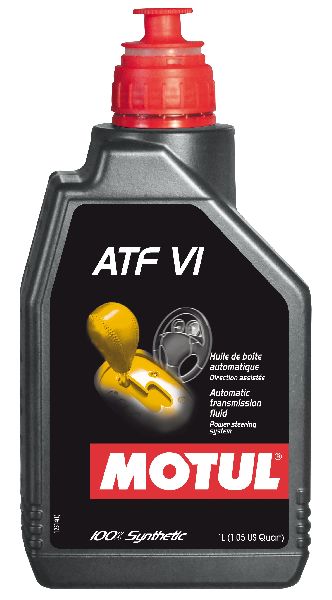
- Always use the specified Motorcraft MERCON® ULV transmission fluid (Part #XT-12-QULV) for any service.
- This is not a DIY-friendly repair; professional diagnosis and service are strongly recommended.
What's Unique About the 2018-2023 Ford MUSTANG
The 2018-2023 Ford Mustang uses the 10R80 10-speed automatic transmission, co-developed with GM, which is known for shifting issues. Ford has issued numerous Technical Service Bulletins (TSBs) that group P0751 with many other transmission codes, all pointing toward common symptoms like harsh or delayed shifts. [TSB 24-2176, TSB 22-2428] This indicates the problem is often not an isolated solenoid failure but a more complex issue. The two primary culprits are the main control unit (valve body) suffering from sticking valves or cross-leaks, and a known mechanical flaw in the CDF (Clutch D/F) drum where an internal sleeve can move, causing a significant loss of hydraulic pressure. The solenoid code P0751 is often triggered because the solenoid is trying to work, but the required hydraulic pressure isn't there due to these internal leaks.
Diagnostic Flowchart
Tap your situation to follow the diagnostic path that matches what you're seeing on this vehicle.
Symptoms You May Notice
- Harsh or delayed gear shifts, sometimes described as feeling like being rear-ended. [TSB 24-2176, TSB 26-2046]
- Harsh or delayed engagement when shifting into Drive or Reverse. [TSB 24-2254]
- Check Engine Light (Malfunction Indicator Lamp) is on. [TSB 24-2176]
- Transmission gets stuck in one gear (limp mode).
- RPMs flare or slip (rise ~500 RPM) between shifts, especially the 3-4, 3-5, or 5-6 shift, followed by a harsh engagement.
- Transmission slipping or seems to neutralize momentarily when accelerating from a stop.
- Reduced fuel economy due to inefficient shifting.
- Replacing only a single shift solenoid when the root cause is a faulty valve body assembly or a leaking CDF drum. This almost never provides a long-term fix.
- Performing only a PCM software update or 'adaptive learning reset' without addressing the underlying mechanical or hydraulic fault. The harsh shifting will almost certainly return.
Most Likely Causes
- Failed Main Control (Valve Body) Assembly 🔴 High Probability → Shop Transmission Valve Body The 10R80 transmission has known issues with its valve body, where valves can stick or internal cross-leaks develop, leading to pressure loss and triggering solenoid performance codes. This is acknowledged by multiple Ford TSBs as a primary cause for shift quality complaints.
How to confirm: A technician will use an advanced scan tool to monitor solenoid commands vs. actual gear state and perform pressure tests. If fluid is clean and wiring is good, the valve body is a primary suspect. A user on Mustang6G.com fixed multiple shifting issues by replacing the valve body.
Typical fix: Replacement of the entire main control (valve body) assembly with an updated part. This is Ford's recommended procedure and often resolves the issue if the CDF drum is not the cause.
Est. part cost: $600-$1200 - CDF Clutch Drum Sleeve Failure 🔴 High Probability → Shop Transmission Clutch Pressure Plate A widely documented design flaw in the 10R80 is the sleeve inside the CDF (Clutch D/F) drum, which can slide out of position, uncovering oil passages and causing a major hydraulic pressure leak. This pressure loss prevents clutches from engaging properly, and the PCM sets solenoid codes like P0751 because it sees a command/result mismatch.
How to confirm: This is a deep internal failure requiring transmission teardown to visually inspect. However, symptoms like severe shift flares, slamming into gear, and multiple solenoid codes (P0751, P0756, etc.) after a valve body replacement strongly point to the CDF drum.
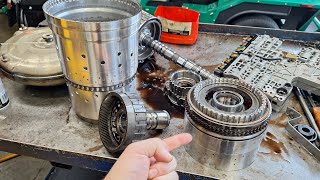
Typical fix: The transmission must be removed and partially disassembled to replace the faulty CDF drum with an updated version (Part No. JL3Z-7H351-B) that has 🎬 Watch: See how the CDF drum bushing fails internally. a machined lip to prevent the sleeve from moving.
Est. part cost: $150-$300 for the drum, but labor is extensive. - Low or Dirty Transmission Fluid 🟡 Medium Probability → Shop Transmission Assembly The 10R80 is very sensitive to fluid level and condition. Degraded or low fluid can cause pressure issues and sludge that clogs solenoid passages, leading to poor performance. Some owners on forums report dealers finding low fluid from the factory.
How to confirm: Check the transmission fluid level and condition using the specific procedure in the owner's manual (it's a complex process without a traditional dipstick). The fluid should be red and clear, not brown, black, or smelling burnt.
Typical fix: Perform a transmission fluid drain-and-fill or a full fluid exchange using only the correct Motorcraft MERCON® ULV fluid.
Est. part cost: $150-$300 - Failed Shift Solenoid 'A' ⚪ Low Probability → Shop Transmission Valve Body While the code directly names the solenoid, it's far more common on the 10R80 for the valve body assembly or CDF drum to be the root cause. An individual solenoid can fail electrically or become clogged, but it's not the typical failure mode for these symptoms. The shift solenoids are also purely mechanical actuators; they do not have fluid passing through them.
How to confirm: A technician can test the solenoid's resistance with a multimeter. The expected resistance for all 10R80 shift solenoids is 5.0-5.4 ohms at 68°F (20°C). However, this won't detect a mechanical restriction or a system-wide pressure loss.
Typical fix: Replace the individual solenoid. Since the solenoids are integral to the valve body, replacing the entire assembly is 🎬 See this walkthrough on replacing the 10R80 valve body. the standard, more reliable repair.
Est. part cost: $50-$150 for a single solenoid, if available separately.
Rare But Worth Checking
- Wiring or Connector Issues: The transmission wiring harness is in a harsh environment and can be damaged by heat and vibration, leading to corrosion or loose connections that can trigger a P0751 code. This should be inspected before condemning internal components.
- Powertrain Control Module (PCM) Failure: This is extremely rare. The PCM should only be considered after all other possibilities, including the valve body, CDF drum, and wiring, have been exhaustively ruled out by a professional.
Diagnosis Steps
- Check and verify the transmission fluid level and condition. This is a critical first step, though complex on the 10R80.
- Use an advanced OBD-II scanner (like FORScan for Fords) to check for any other transmission-related trouble codes. A suite of solenoid or clutch apply codes points away from a single solenoid failure.
- Perform a thorough visual inspection of the transmission wiring harness and connectors for any signs of damage, corrosion, or loose connections.
- With an advanced scan tool, monitor live data for Transmission Fluid Temperature, commanded vs. actual gear, and solenoid status to identify inconsistencies.
- Review all relevant TSBs (e.g., TSB 24-2176, TSB 24-2254) which outline the diagnostic path for these symptoms, often leading to valve body or CDF drum inspection.
- If symptoms are severe (slamming shifts, major flares), the diagnosis should lean heavily towards a mechanical failure like the CDF drum, even with just a P0751 code.
- Based on TSBs and common failures, the next step is typically replacing the main control (valve body) assembly.
- If a valve body replacement does not fix the issue, the transmission must be removed to inspect and replace the CDF drum.
- After any internal repair, clear all codes, and perform the 'Transmission Adaptive Tables Reset' procedure using a Ford-specific scan tool. 🎬 Watch: How to reset transmission adaptive learning tables.
Parts You'll Likely Need
- Transmission Main Control (Valve Body) Assembly
(OEM #HL3Z-7A100-B (replaces HL3Z-7A100-A))— This is the most common and comprehensive fix for shift quality issues and solenoid codes on the 10R80 transmission, as it contains all new solenoids and control valves.
Trusted brands: Motorcraft
OEM price range: $600-$1200
Related Codes That Often Appear With This One
- P0756 — Relates to Shift Solenoid 'B'. When multiple solenoid codes appear together, it strongly suggests a systemic hydraulic failure (valve body or CDF drum) rather than multiple individual solenoid failures. [TSB 24-2176]
- P0761 — Relates to Shift Solenoid 'C'. Often appears with other solenoid codes when there is a wider transmission control problem. [TSB 24-2176]
- P2700-P2705 — These codes relate to transmission friction element apply time/performance. They are often triggered by the hydraulic pressure issues caused by a faulty valve body or CDF drum. [TSB 24-2176]
- P0600 — Serial Communication Link Failure. This can sometimes appear alongside P0751, indicating a possible intermittent electrical issue or a broader control module problem, as seen in a forum post by an F-150 owner.
Technical Service Bulletins (TSBs) & Recalls
- TSB 24-2176: Supersedes previous TSBs, covering 2022-2023 Mustangs. It lists P0751 among a large group of DTCs related to harsh/delayed shifts and points to potential causes being PCM/TCM software, sticking valves in the main control body, or axial movement of the CDF clutch cylinder sleeve.
- TSB 24-2254: Also addresses harsh/delayed engagements and shifts with P0751 and other codes for vehicles with the 10R80 transmission.
- TSB 22-2428: An earlier TSB, now superseded, that covered 2020 models with P0751 and similar shift quality complaints.
- TSB 26-2046: Cited for 2021 models with P0751 and harsh/delayed shifts.
- TSB 25-2018: Cited for 2019 models with P0751 and harsh/delayed shifts.
Platform-Specific Known Issues
- The 10R80 10-speed automatic transmission in 2018-2023 Mustangs is the subject of multiple Ford Technical Service Bulletins (TSBs) for harsh/delayed shifts and engagements. [TSB 24-2176, TSB 22-2428]
- A primary mechanical failure point is the CDF drum, where an internal sleeve can slide and expose hydraulic passages, causing pressure loss that manifests as solenoid performance codes like P0751.
- Valve body cross-leaks and sticking valves are another documented weak point in this transmission design, leading to similar symptoms.
- Many owners on forums like Mustang6G.com report experiencing harsh 3-5 shifts, slipping, or a feeling of being 'rear-ended' which are classic symptoms of the 10R80's internal issues.
Mechanic-Grade Diagnostic Values
- Shift Solenoid A-F Resistance — expected: 5.0 - 5.4 Ohms @ 68°F (20°C). Failure: A reading outside this range indicates an electrical failure in the solenoid coil.
Scan Tool Commands That Help
- FORScan: Transmission Adaptive Tables Reset — This service function should be used after replacing the valve body or other major transmission components. It clears the learned shift data and forces the TCM to recalibrate, which is essential for proper operation after a repair.
Wiring & Ground Locations
- C175T — This is a main connector to the Powertrain Control Module (PCM). On older models, it was the middle connector on the left side of the firewall.. The C175T connector contains the pins for the various transmission shift solenoids, including Shift Solenoid 'A'. A poor connection or damaged wire at this specific connector could cause solenoid performance codes like P0751.
Real Owner Repair Stories
- Mustang6G.com forum member (2021 Ford Mustang GT PP1 with 12k miles) — Initially, extremely rough shifts that felt like being knocked out of the car. Later, clunking on the 3-1 downshift in Sport+ mode and shuttering when accelerating in 10th gear.
❌ Tried (didn't work) Resetting the adaptive learning tables multiple times (provided temporary relief from the worst harsh shifts)., A transmission fluid flush performed by the dealer.
✅ What actually fixed it The owner was advised by other forum members to insist the dealer investigate the CDF drum and valve body, as these were the known root causes. The final resolution was a complete transmission replacement with a fully built Suncoast unit that included an updated CDF Drum, valve body, and torque converter.
OEM Part Supersession History
HL3Z-7A100-A→HL3Z-7A100-B— Updated Main Control (Valve Body) Assembly to address shift quality issues and internal leaks.HL3Z-7H351-A, JL3Z-7H351-A→JL3Z-7H351-B— The updated CDF Clutch Drum (JL3Z-7H351-B) features a machined lip on the inner half of the drum. This lip acts as a positive stop, preventing the internal bushing/sleeve from 'walking' out of position and exposing hydraulic passages, which was the primary failure mode of the original design.
Helpful Videos
We Have This Part in Stock


The information in this article is provided for general reference and educational purposes only. Vehicle specifications, procedures, and part compatibility can vary by production date, trim level, and region. Always consult your vehicle's factory service manual and verify part numbers before purchasing or performing repairs. Safety-critical components such as airbags, seat belts, and braking systems should be installed by a qualified professional.
- Ford MUSTANG:
- 🧭 Diagnostic Flowchart
- 🎬 Helpful Videos
- 🛍️ Shop This Part
- What's Unique About the 2018-2023 Ford MUSTANG
- Symptoms You May Notice
- Most Likely Causes
- Rare But Worth Checking
- Diagnosis Steps
- Parts You'll Likely Need
- Related Codes That Often Appear With This One
- Technical Service Bulletins (TSBs) & Recalls
- Platform-Specific Known Issues
- Mechanic-Grade Diagnostic Values
- Scan Tool Commands That Help
- Wiring & Ground Locations
- Real Owner Repair Stories
- OEM Part Supersession History
- 🎟️ Get 5% Off