

P0751 on 2011-2014 Honda CR-V: Shift Solenoid 'A' Causes and Fixes
Code P0751 on a 2011-2014 Honda CR-V most often points to a problem with Shift Solenoid 'A', typically caused by old, low, or incorrect transmission fluid. The first step is always to check the fluid. If the fluid is fine, the solenoid itself likely needs replacement. This generation uses a conventional 5-speed automatic, not a CVT.
- P0751 on a 2011-2014 CR-V indicates a problem with Shift Solenoid 'A'.
- The most common and first-to-check cause is low, dirty, or incorrect (non-Honda DW-1) transmission fluid.
- If fluid service doesn't fix it, the solenoid itself (Part #28250-R90-003) is the next likely culprit.
- Driving with this code is not recommended as it can cause further transmission damage.
What's Unique About the 2011-2014 Honda CR-V
The 2011-2014 CR-V belongs to the fourth generation and, for North American models, uses a conventional 5-speed automatic transmission, unlike the CVT introduced in the 2015 facelift. Like most Honda transmissions, this model is exceptionally sensitive to the type and condition of its automatic transmission fluid (ATF). Using anything other than genuine Honda ATF-DW1 is a very common trigger for solenoid performance codes like P0751. Unlike some earlier Honda models where solenoids were easier to access, on this CR-V, Shift Solenoid 'A' is located on the top of the transmission, requiring the removal of the battery and battery tray to access it.
🎬 Watch: See exactly where the solenoids are located on this CR-V.Symptoms You May Notice
- Check Engine Light is on
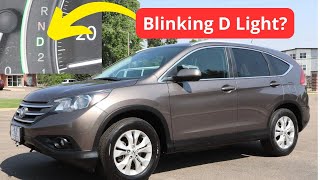
- Flashing 'D' (Drive) indicator light
- Harsh, delayed, or erratic gear shifts
- Transmission getting stuck in a single gear (limp mode)
- Noticeable hesitation or 'clunking' during shifts
- Reduced fuel economy
- Transmission slipping in and out of gear
- Vehicle fails to shift gears at all
- Replacing the solenoid immediately without checking the transmission fluid first. Many P0751 codes are resolved with a simple fluid service.
Most Likely Causes
- Low, Dirty, or Incorrect Transmission Fluid 🔴 High Probability → Shop Transmission Assembly Honda transmissions are notoriously sensitive to fluid type and condition. The use of non-OEM fluid or extending service intervals is a primary cause of solenoid performance issues as debris can clog the small passages within the solenoid.
How to confirm: Check the transmission fluid level and condition using the dipstick. The fluid should be red/pink and clear, not dark brown, black, or smell burnt. Ensure only Honda ATF-DW1 is used.
Typical fix: Perform a transmission fluid drain and fill (or multiple, if very dirty) using only genuine Honda ATF-DW1 fluid. This alone often resolves the code.
Est. part cost: $40-$80 for fluid - Faulty Shift Solenoid 'A' 🟡 Medium Probability → Shop Transmission Valve Body Solenoids are electro-mechanical parts that can fail over time from wear or contamination from dirty fluid.
How to confirm: After ruling out fluid issues, the solenoid can be tested. A mechanic can command the solenoid on and off with a scan tool to listen for a click. It can also be removed and tested for resistance with a multimeter; a typical reading for a good Honda solenoid is between 12 and 25 ohms. Applying 12V power should also cause the internal valve to click audibly.
Typical fix: Replace the Shift Solenoid 'A' assembly.
Est. part cost: $150-$600 - Clogged Transmission Filter or Internal Blockage ⚪ Low Probability → Shop Transmission Assembly If fluid changes are neglected, sludge and debris can build up and clog the internal filter or small passages in the valve body, restricting fluid flow to the solenoid.
How to confirm: This is difficult to confirm without disassembling parts of the transmission. Significant metallic debris found in the transmission pan during a fluid service is a strong indicator of a larger internal problem.
Typical fix: Replace the transmission filter (if accessible) and flush the system. In severe cases, the valve body may need to be cleaned or replaced.
Est. part cost: $50-$200 for filter and fluid
Rare But Worth Checking
- Wiring or Connector Issue: The wiring harness leading to the solenoid can become damaged from heat or vibration, causing an intermittent connection. Check the connector at the solenoid for corrosion, backed-out pins, or frayed wires.
- Faulty Transmission Control Module (TCM): → Shop Transmission Assembly This is very rare. The TCM is the computer that controls the transmission. Before condemning the TCM, all other possibilities (fluid, solenoid, wiring, internal blockages) must be exhaustively ruled out.
Diagnosis Steps
- Check the transmission fluid level and condition. If low, top it off with Honda ATF-DW1 and see if the problem resolves. If the fluid is dark, burnt, or dirty, perform a drain and fill.
- If the fluid is clean and at the correct level, the next step is to inspect the wiring and connector for Shift Solenoid 'A'. On the 2011-2014 CR-V, this requires removing the battery and battery tray to access the top of the transmission.
- Inspect the connector for corrosion, damage, or loose pins.
- If the wiring is okay, test the solenoid. An advanced scan tool can be used to command the solenoid on and off; a 'click' should be heard.
- Alternatively, the solenoid can be removed and its resistance tested with a multimeter. Check between the two pins; the reading should generally be between 12-25 ohms. An open circuit (infinite resistance) or a short (near zero ohms) indicates a failed solenoid.
- You can also apply 12V directly to the solenoid's pins to check for a physical click, confirming the plunger is not seized.
- If the solenoid tests good electrically and mechanically, the issue may be an internal blockage in the valve body or, rarely, a faulty TCM.
Parts You'll Likely Need
- Shift Solenoid 'A' (Linear)
(OEM #28250-R90-003)— This is the component directly identified by the code. If fluid is not the cause, the solenoid itself has likely failed mechanically or electrically. This part number is confirmed for 2012-2014 CR-V models.
Trusted brands: Honda (Genuine), Standard Motor Products, Rostra
OEM price range: $500-$630
Aftermarket price range: $150-$300 - Honda Genuine Automatic Transmission Fluid (ATF-DW1)
(OEM #08200-9008)— Honda transmissions are highly sensitive to fluid type. Using the correct OEM fluid is critical for preventing and resolving shift quality issues and solenoid codes.
Trusted brands: Honda (Genuine)
OEM price range: $10-$15 per quart
Aftermarket price range: N/A
Related Codes That Often Appear With This One
- P0756 — This is for Shift Solenoid 'B'. If both codes appear, it strongly suggests a widespread issue like contaminated fluid or low system pressure rather than two independent solenoid failures.
- P0700 — This is a general transmission fault code that simply indicates the TCM has stored a more specific code, like P0751. It acts as a 'heads-up' from the transmission system.
Technical Service Bulletins (TSBs) & Recalls
- TSB 09-010: Addresses a loud rattle from the engine on cold start-ups, caused by a faulty VTC actuator. This is a common issue on the 2.4L engine in this CR-V.
- TSB 16-011: Pertains to a starter grinding noise at startup. The fix involves rotating the torque converter to a new position relative to the starter gear.
- TSB 15-076: For AWD models, this TSB addresses a vibration felt at highway speeds by replacing the driveshaft and rear differential mounts.
- TSB 14-063: For complaints of low heat from the driver's side vent, this TSB provides a procedure to flush the heater core.
Platform-Specific Known Issues
- Starter Noise After Transmission Work: → Shop Transmission Assembly A user on Reddit reported a persistent starter grinding noise on their 2013 CR-V that began after the transmission was replaced multiple times. A suggested cause was the potential omission of dowel pins during reinstallation, leading to misalignment between the transmission and engine. This highlights the importance of correct reassembly after any major transmission work.
Mechanic-Grade Diagnostic Values
- Shift Solenoid 'A' Resistance — expected: 13.8 - 17.1 Ohms. Failure: A reading of infinite resistance (open circuit) or near-zero resistance (short circuit).
Hidden / Shadow Codes Worth Checking
- OBD Status (FAILED/PASSED): This is not a discrete code but a status reported by the Honda Diagnostic System (HDS). After clearing the DTC, a technician performs a specific test drive procedure. The HDS will report 'FAILED' if the fault condition is reproduced, confirming a hard fault. It will report 'PASSED' if the condition is not met, suggesting an intermittent issue. (see via Requires a Honda Diagnostic System (HDS) or equivalent high-end bidirectional scan tool during a specific verification test drive.)
Scan Tool Commands That Help
- Honda HDS (or equivalent): Solenoid Click Test — Used to verify the basic electrical function and mechanical movement of the solenoid without removing it. The tool commands the solenoid on and off, and the technician listens for an audible 'click' from the solenoid body.
- Honda HDS (or equivalent): DTC Verification Test Drive — After initial checks or a repair, this procedure involves driving the vehicle through all gears while the scan tool monitors the system. It is used to confirm if a fault is still present ('FAILED' status) or if the issue is resolved or intermittent ('PASSED' status).
Wiring & Ground Locations
- G101 — Left rear of the engine compartment.. This is a primary ground point for the PCM and transmission-related components. Corrosion or a loose connection here can cause erratic voltage, leading to incorrect sensor readings and false solenoid fault codes. A visual inspection and voltage drop test at this ground is a critical diagnostic step that is often overlooked.
- Transmission Case Ground — A ground wire from the main negative battery cable harness attaches directly to a stud on the transmission case, often near the starter.. This is the main ground path for the entire transmission assembly. Forum users report this ground point, and its associated thin wires, are highly susceptible to corrosion ('green crusties'), especially in salt-belt regions. A bad ground here can cause a host of transmission electrical issues, including P0751.
OEM Part Supersession History
28250-R90-003→N/A— This part number appears to be stable for the 2011-2014 CR-V and is also used on other Honda models from 2008-2015, including the Accord.
Model Year Variations Within This Range
- 2011 vs 2012-2014: The 2011 model year is the final year of the third-generation CR-V, while 2012-2014 marks the beginning of the fourth generation. However, for the purpose of this P0751 code, the powertrain is functionally identical: both use a 2.4L K-series engine and the same 5-speed automatic transmission. Therefore, diagnosis and repair are the same across the 2011-2014 range.
Diagnostic Flowchart
Other Known Issues on This Vehicle
Issues unrelated to this code that are worth knowing about as an owner of this generation:
- VTC Actuator Rattle on Cold Start 🟠 Medium — Very common. A brief, loud rattle or grinding noise for 1-2 seconds upon starting the engine after it has sat for several hours. (Ref: Honda TSB 09-010.)
- Excessive Oil Consumption 🟠 Medium — Frequently reported by owners, sometimes consuming 1-2 quarts between oil changes. Attributed to low-tension piston rings. (Ref: No specific recall, but Honda has acknowledged the issue in some cases and there was a class-action lawsuit for other models with similar engines.)
- Premature Starter Motor Failure 🟠 Medium — A widely documented issue where the starter fails intermittently (no crank, no start) or makes a grinding noise, sometimes at relatively low mileage. (Ref: Honda TSB 16-011 addresses starter grinding by suggesting a torque converter ring gear adjustment.)
- Vibration at Highway Speeds 🟡 Low — Some owners of AWD models report a noticeable vibration around 40-70 mph. (Ref: Honda TSB 15-076 was issued for 2012-2014 AWD models to address this by replacing the driveshaft and rear differential mounts.)
- Poor Heater Performance (Driver's Side) 🟡 Low — Owners may notice significantly less heat coming from the driver's side vents compared to the passenger side. (Ref: Honda TSB 14-063 describes a procedure for flushing a partially clogged heater core to resolve the issue.)
Used vs. New Parts: Buying Guide for This Vehicle
When a used part is the smart pick: For this specific repair, a used part is generally not recommended. The failure mode is often related to internal clogging from contaminated fluid or mechanical wear of internal seals. A used solenoid from a junkyard carries a high risk of having the same or other hidden problems.
Donor-vehicle mileage cap: roughly under 80000 miles for the part to have meaningful remaining life.
What to inspect on the donor part:
- Verify the donor vehicle had no transmission-related codes.
- Ask for the vehicle's service history if possible; a transmission that had regular fluid changes is a better bet.
- Inspect the solenoid screens for any metallic debris or sludge. If they are not perfectly clean, reject the part.
OEM-only on this vehicle (don't cheap out):
- Shift Solenoid 'A' (Linear)
Aftermarket brands forum-validated for this vehicle:
- Rostra is a commonly cited aftermarket brand that manufactures transmission components, but forum consensus heavily favors Genuine Honda parts for reliability.
Brands owners have reported issues with on this vehicle:
- Unnamed, low-cost 'white box' solenoids from online marketplaces are frequently reported to fail quickly or be dead-on-arrival.
Real Owner Stories
Aggregated from forums and TSBs cited above. Mileages and costs reflect what owners reported in those sources.
2013 Honda CR-V 2.4L
Symptoms: Persistent starter grinding noise that began specifically after the transmission was replaced multiple times.
What fixed it: The issue was attributed to the potential omission of dowel pins during the transmission reinstallation, leading to misalignment between the engine and transmission.
Source hint: Reddit (r/AskAMechanic) thread on a 2013 CR-V with starter noise after transmission replacement
2014 Honda CR-V 2.4L
Symptoms: Significant oil consumption, losing approximately 2 quarts every 2500 miles.
What fixed it: This is a known issue for this generation often attributed to low-tension piston rings; while not a fix for P0751, it is a common concurrent problem for owners of this model year.
Source hint: Reddit (r/crv) user report on 2014 CR-V oil consumption
Related OBD-II Codes
Frequently Asked Questions
What specific transmission fluid should I use for my 2011-2014 Honda CR-V to fix P0751?
Is there a TSB for the grinding noise I hear after my transmission was serviced for P0751?
Can I test Shift Solenoid 'A' myself before replacing it?
Where is Shift Solenoid 'A' located on the 2011-2014 CR-V?
My CR-V has a flashing 'D' indicator and is stuck in one gear. Is this related to P0751?
Does the 2011-2014 CR-V have a transmission filter that could cause this code?
Helpful Videos
We Have This Part in Stock

The information in this article is provided for general reference and educational purposes only. Vehicle specifications, procedures, and part compatibility can vary by production date, trim level, and region. Always consult your vehicle's factory service manual and verify part numbers before purchasing or performing repairs. Safety-critical components such as airbags, seat belts, and braking systems should be installed by a qualified professional.
- Honda CR-V:
- 🧭 Diagnostic Flowchart
- 🎬 Helpful Videos
- 🛍️ Shop This Part
- What's Unique About the 2011-2014 Honda CR-V
- Symptoms You May Notice
- Most Likely Causes
- Rare But Worth Checking
- Diagnosis Steps
- Parts You'll Likely Need
- Related Codes That Often Appear With This One
- Technical Service Bulletins (TSBs) & Recalls
- Platform-Specific Known Issues
- Mechanic-Grade Diagnostic Values
- Hidden / Shadow Codes Worth Checking
- Scan Tool Commands That Help
- Wiring & Ground Locations
- OEM Part Supersession History
- Model Year Variations Within This Range
- Other Known Issues on This Vehicle
- Used vs. New Parts: Buying Guide for This Vehicle
- Real Owner Stories
- 2013 Honda CR-V 2.4L
- 2014 Honda CR-V 2.4L
- Related OBD-II Codes
- Frequently Asked Questions
- 🎟️ Get 5% Off