

P0751 on 2006 Lexus GS300: Shift Solenoid 'A' (S1) Causes and Fixes
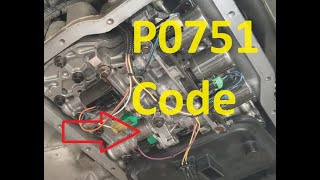
P0751 on a 2006 GS300 usually indicates a problem with the Shift Solenoid 'S1'. While low fluid or a bad solenoid are possible, a very common cause on this platform is a failing Engine Control Module (ECM) that mimics solenoid failure. Diagnosis is key before replacing parts, as many owners have discovered the ECM was the true culprit after replacing transmission components.
- P0751 on a 2006 GS300 refers to a performance issue with Shift Solenoid S1.
- Before replacing any parts, check the transmission fluid level and condition. This is a simple but crucial step.
- Be aware that a faulty Engine Control Module (ECM) is a very common cause of this code on this specific car and can be misdiagnosed as a bad solenoid.
- Due to the complexity and the high likelihood of an ECM issue, professional diagnosis is strongly recommended to avoid costly and unnecessary repairs.
- If other transmission solenoid codes (like P0756, P0761, P2714) are present, it further increases the suspicion of a faulty ECM.
What's Unique About the 2006-2006 Lexus GS300
While P0751 is a generic code, the 2006 Lexus GS300 and its platform-mate, the IS250, have a well-documented history of the Engine Control Module (ECM) failing in a way that specifically causes this code. The driver circuits within the ECM that power the transmission solenoids can degrade or fail due to heat and age, leading to a false P0751. Many owners have replaced solenoids or even entire transmissions only to find the problem was the ECM all along. This makes it critical to test the ECM's function before condemning expensive transmission components. Specialized services exist that specifically repair these faulty Lexus ECMs.
Symptoms You May Notice
- Check Engine Light and 'Check VSC' light are on.
- Transmission fails to shift properly, may get stuck in a single gear (often 3rd or 4th).
- Harsh or delayed shifting, sometimes described as a 'thump' or 'jerk' between gears.
- Vehicle enters 'limp mode', limiting speed and available gears.
- Skipping gears, especially on downshifts (e.g., skipping 2nd gear).
- Hesitation or jerking during acceleration.
- Inability to engage the highest gear (6th gear).
- Replacing the shift solenoid or the entire transmission when the actual fault lies within the Engine Control Module (ECM).
Most Likely Causes
- Failing Engine Control Module (ECM) 🔴 High Probability There is a known, widespread issue with the internal solenoid driver integrated circuits or solder joints failing on the ECM for this vehicle generation. This is often a heat-related failure.
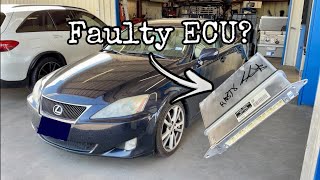
How to confirm: A technician can use a scan tool like Techstream to monitor the command signal from the ECM to the S1 solenoid. If the signal is absent or incorrect despite good wiring, the ECM is likely faulty. This is often a diagnosis of exclusion after other causes are ruled out. A real-world example is an owner replacing the solenoid with no fix, then find the issue was the ECM. 🎬 Watch: How to diagnose and fix common Lexus shifting problems.
Typical fix: The ECM must be repaired by a specialist electronics service or replaced. Replacement requires programming to the vehicle's VIN.
Est. part cost: $200-$500 (for repair service), $1000+ (for a new unit) - Low or Degraded Transmission Fluid 🟡 Medium Probability → Shop Transmission Assembly Lexus marketed the Toyota WS fluid as 'lifetime', leading many owners to skip fluid changes. Over time, the fluid breaks down and becomes contaminated with clutch material, which can clog solenoid passages and affect their mechanical operation.
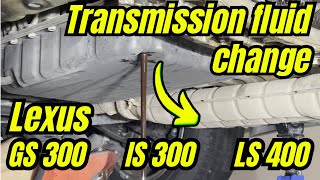
How to confirm: Check the transmission fluid level and condition. This vehicle has no dipstick, so it requires a specific procedure 🎬 See this walkthrough on how to change your transmission fluid. involving a check plug at a specific fluid temperature (typically 104-113°F or 40-45°C). Dark, burnt, or gritty fluid indicates a problem.
Typical fix: Perform a transmission fluid drain and fill, or a full fluid exchange. It's also recommended to drop the pan and replace the filter, especially if the fluid is very dirty.
Est. part cost: $100-$200 (for fluid and filter) - Faulty Shift Solenoid S1 🟡 Medium Probability → Shop Transmission Valve Body While the solenoid itself can fail, it is often incorrectly blamed when the ECM is the real issue.
How to confirm: A technician can test the solenoid's resistance with a multimeter to see if it's within the manufacturer's specification (typically 11-15 ohms for this type). They can also apply 12V power directly to the solenoid to check for an audible 'click', indicating mechanical operation. This requires removing the transmission oil pan.
Typical fix: Replace the faulty Shift Solenoid S1. This is located inside the transmission on the valve body. Given the high rate of misdiagnosis, this should only be done after confirming the solenoid is faulty and the ECM is sending a proper signal.
Est. part cost: $150-$300 - Wiring or Connector Issues ⚪ Low Probability Some forum users have noted that the A/C drain can sometimes drip onto the transmission wiring harness, causing corrosion on the connector pins over time.
How to confirm: Visually inspect the wiring harness running to the transmission for any signs of damage, corrosion, or loose connections, paying attention to the main connector. A multimeter can be used to check for continuity and shorts between the ECM and the transmission connector.
Typical fix: Repair or replace the damaged section of the wiring harness or clean/replace the connector.
Est. part cost: $20-$200
Rare But Worth Checking
- Internal Transmission Mechanical Failure: → Shop Transmission Assembly While possible, this is less common than ECM or solenoid issues. This would typically be accompanied by more severe symptoms like grinding noises, metal debris in the pan, or a complete loss of drive.
Diagnosis Steps
- Scan for and document all stored trouble codes. Address other codes first if present.
- Check the transmission fluid level and condition. This is a critical first step. The procedure requires the vehicle to be level and the fluid to be at a specific temperature (e.g., 104-113°F), checked with a scan tool.
- If the fluid is low, top it off, clear the codes, and test drive. If the fluid is very dirty or burnt, perform a fluid and filter change.
- If the code returns, use a professional scan tool (like Toyota Techstream) to monitor the live data. Observe the ECM's command for Shift Solenoid S1 and compare it to the actual gear position. An absent command signal with the code present strongly suggests an ECM issue.
- Inspect the transmission wiring harness and connector for corrosion, damage, or moisture, particularly where it might be exposed to A/C condensation.
- If the ECM signal appears correct but the shift doesn't happen, remove the transmission oil pan to access the solenoids.
- Test the resistance of the S1 solenoid with a multimeter (should be ~11-15 ohms). Test for shorts to the solenoid body. Apply 12V power to check for a mechanical click.
- If the solenoid and wiring test good, the suspicion falls heavily on the ECM. It should be sent to a specialist for testing and repair or replaced with a pre-programmed unit.
Parts You'll Likely Need
- Engine Control Module (ECM) Repair Service
(OEM #89666-30351, 89666-30355, 89666-30361, etc. (Match part number exactly))— A failing ECM is a highly probable cause for this code on this specific vehicle, often misdiagnosed as a bad solenoid.
Trusted brands: SIA Electronics (Repair Service), G-shift (Repair Service), Flagship One (Remanufactured)
OEM price range: $1000+
Aftermarket price range: $200-$500 (Repair Service) - Shift Control Solenoid (S1)
(OEM #35280-30050)— This is the solenoid directly indicated by the code. It can fail electrically or become clogged with debris, but is often replaced unnecessarily.
Trusted brands: Lexus (OEM), Aisin
OEM price range: $240-$330
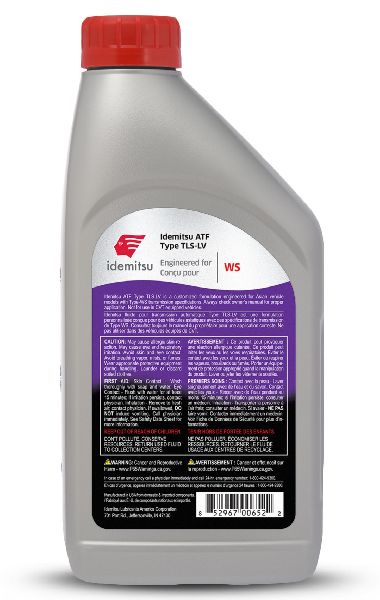
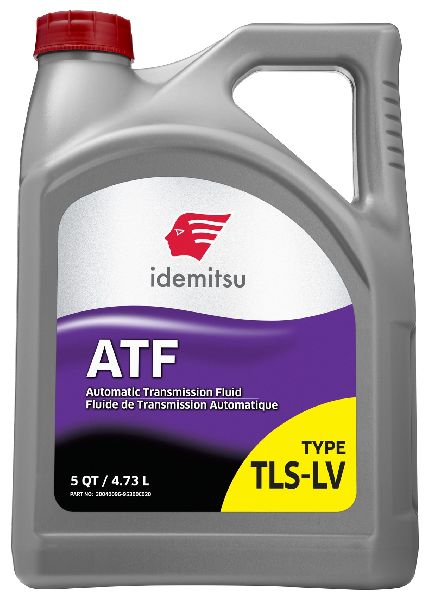
Aftermarket price range: $100-$200 - Automatic Transmission Fluid (Toyota WS)
(OEM #00289-ATFWS)— Old, degraded fluid is a common cause of solenoid performance issues. A fluid change is a primary diagnostic and maintenance step.
Trusted brands: Toyota/Lexus
OEM price range: $10-$15 per quart
Aftermarket price range: $8-$12 per quart - Transmission Filter Kit
(OEM #35330-30090 (Filter))— If dropping the pan to service fluid or solenoids, the filter should always be replaced.
Trusted brands: Wix, ATP, Lexus (OEM)
OEM price range: $50-$80
Aftermarket price range: $30-$50
Related Codes That Often Appear With This One
- P2714 — Pressure Control Solenoid 'D' Performance. This code often shares the same root cause, particularly a failing ECM.
- P0756 — Shift Solenoid 'B' Performance. Another solenoid code that can be triggered by a failing ECM or widespread fluid contamination.
- P0761 — Shift Solenoid 'C' Performance. Like the others, this can point to a systemic issue like the ECM or bad fluid.
Technical Service Bulletins (TSBs) & Recalls
- L-SB-0034-09: A TSB for the 2007 IS250 specifically for code P0751, recommending an ECM software update. While for a different model, it shows Lexus addressed this code via ECM logic.
- Bulletin #L-SB-0008-13: While issued for the LX 570, this Lexus bulletin notes that vehicles may exhibit a MIL "ON" condition with transmission performance DTCs including P0751, P2714, and P0756, often requiring a revised Engine Control Module (ECM).
- TC015-06 / L-TC0001-08: These TSBs address harsh shift
Platform-Specific Known Issues
- A known and widely discussed problem for the 2006 GS300 is the failure of the Engine Control Module (ECM), which can cause various transmission codes, including P0751, even when the transmission itself is mechanically sound.
Mechanic-Grade Diagnostic Values
- Shift Solenoid S1 Resistance (ON/OFF type) — expected: 11 to 15 Ω at 20°C (68°F). Failure: A reading outside this range indicates a faulty solenoid coil. This test is performed on the solenoid itself with the pan removed.
- ECM Internal Circuit Check (for S1) — expected: Resistance should be below 100 kΩ when the solenoid is commanded OFF by the ECM.. Failure: If the ECM detects resistance of 100 kΩ or more, it determines there is an open circuit and sets a code. This is an internal ECM diagnostic parameter.
Scan Tool Commands That Help
- Toyota Techstream: Active Test: 'SHIFT' — This is a critical diagnostic step. Navigate to 'Powertrain / Engine and ECT / Active Test'. While driving below 31 mph (50 km/h), the technician can command specific gear shifts (e.g., 2nd to 3rd). If the command is sent but the shift doesn't occur (or is harsh/delayed), it helps isolate whether the issue is the ECM command, the solenoid's response, or a hydraulic/mechanical issue. Comparing the commanded gear in Techstream to the actual gear is the primary test.
- Toyota Techstream: Data List Monitoring — While performing the 'SHIFT' active test, monitor the 'Shift Status' in the Data List. This shows the gear the ECM is commanding in real-time, which should be compared against the vehicle's actual behavior.
Wiring & Ground Locations
- ECM (Engine Control Module) — Located in the engine compartment, on the left side (driver's side in LHD vehicles).. This is the source of the command signal for the S1 solenoid and the most likely point of failure for this specific code on this vehicle. All electrical diagnosis for the solenoid circuit originates here.
- S1 Solenoid Wire — At the ECM connector. One wiring diagram indicates a Green (GRN) wire at pin 20 of a connector. Another indicates a Black-with-Yellow-stripe (B-Y) wire at pin 2 of a different connector style. Technicians should verify with the specific diagram for the vehicle's VIN. Testing continuity and checking for shorts on this wire between the ECM and the transmission case connector is a key step.. A short or open in this wire can mimic a failed solenoid or a failed ECM.
Real Owner Repair Stories
- ClubLexus Forum User (2006 Lexus GS300) — Hesitation shifting 3-4, jolting on cold starts, and a P0751 code under specific acceleration conditions.
❌ Tried (didn't work) Replaced the S1 shift solenoid with an OEM part., Replaced the transmission filter., Performed a transmission fluid service with OEM fluid.
✅ What actually fixed it The user reported that after replacing the solenoid and fluid, the transmission shifted perfectly, but the P0751 code and Check VSC light returned almost immediately. This strongly indicates the initial repair did not solve the root cause, and the user was advised by the community that the ECM was the next logical and highly probable point of failure. The electrical fault detection in the ECM was triggering the code even with a new, functioning solenoid. - ClubLexus Forum Community Consensus (2006 Lexus GS300) — P0751 and other transmission-related codes.
❌ Tried (didn't work) Replacing solenoids., Replacing the entire transmission.
✅ What actually fixed it Multiple threads confirm that sending the original ECM to a repair service like SIA Electronics is a common and successful fix. The service costs a fraction of a new ECM and addresses the known internal failure of the solenoid driver circuits. - NHTSA ODI #11064741 — An owner reported a transmission failure with error codes P0751, P2757, and C1201 occurring at approximately 40,700 miles.
"I Checked Everything" — The Actual Cause
- The equivalent for this electronic fault is when the solenoid itself tests good. A technician may remove the pan, bench test the S1 solenoid, and find its resistance is within spec (11-15 ohms) and it clicks with 12V applied. The wiring from the transmission connector to the solenoid may also show perfect continuity. The code still returns because the fault is upstream in the ECM's driver circuit, which fails under heat or load in a way that a simple continuity test cannot detect. The ECM's own self-diagnostic is what sets the code.
OEM Part Supersession History
89666-30351, 89666-30355→e.g., 89666-30372— Lexus frequently updates ECM part numbers to address hardware revisions or firmware updates. TSB TC002-05 explicitly notes that part numbers are subject to change and to always check the catalog.
Heads up: It is critical to match the part number exactly when replacing an ECM. Using an ECM from a different model year or with different features (e.g., AWD vs RWD) will cause system malfunctions, even if it physically connects.
Diagnostic Flowchart
Other Known Issues on This Vehicle
Issues unrelated to this code that are worth knowing about as an owner of this generation:
- Intake Valve Carbon Buildup 🔴 High — Extremely common on the direct-injection 3GR-FSE engine. Symptoms like rough idle, misfires, and hesitation often appear after 60,000-80,000 miles. (Ref: Lexus issued a TSIB for this, but it has since expired. The repair involves manually or chemically cleaning the intake valves, often via walnut blasting.)
- Water Pump Failure 🟠 Medium — The water pump is a known weak point and can fail prematurely, often starting as a slow leak. Failures are commonly reported between 70,000 and 100,000 miles.
- Sticky / Melting Dashboard and Interior Panels 🟡 Low — Very common across many Lexus models of this era due to a manufacturing defect in the plastics, exacerbated by heat and humidity. (Ref: Lexus addressed this via a Warranty Enhancement Program (ZLD / ZLZ) to replace affected panels, but these programs have deadlines and may now be expired.)
Used vs. New Parts: Buying Guide for This Vehicle
When a used part is the smart pick: For the Engine Control Module (ECM), which is the most likely cause, a repaired original unit or a used unit is the most practical and cost-effective approach. A new OEM ECM is prohibitively expensive and often unnecessary.
Donor-vehicle mileage cap: roughly under 150000 miles for the part to have meaningful remaining life.
What to inspect on the donor part:
- For a used ECM, the part number MUST match your original ECM exactly.
- Check the donor vehicle's history for flood or fire damage.
- For solenoids, buy from a reputable rebuilder or a low-mileage donor transmission. Avoid single, loose solenoids of unknown origin.
OEM-only on this vehicle (don't cheap out):
- Engine Control Module (use OEM original for repair, or exact-match OEM used part)
- Transmission Fluid (use only Toyota/Lexus World Standard 'WS' fluid)
Aftermarket brands forum-validated for this vehicle:
- SIA Electronics (for ECM repair service)
- Aisin (OEM manufacturer for solenoids)
Brands owners have reported issues with on this vehicle:
- Generic, unbranded solenoid kits from eBay or Amazon are frequently reported as failing prematurely or being dead-on-arrival.
Real Owner Stories
Aggregated from forums and TSBs cited above. Mileages and costs reflect what owners reported in those sources.
2006 Lexus GS300 3.0L V6
Symptoms: The owner replaced the S1 solenoid, filter, and fluid, but the P0751 code returned immediately despite the car shifting perfectly.
What fixed it: The issue was identified as a faulty ECM (Engine Control Module).
Source hint: ClubLexus - 'P0751 and other mysteries' (2022)
2006 Lexus GS300 3.0L V6
Symptoms: The owner was unable to determine which specific solenoid was failing and faced shifting problems.
What fixed it: Replaced the entire transmission with a used unit, which resolved the issue (likely due to dirty fluid and clogged components in the original unit).
Source hint: ClubLexus - 'Transmission problem (code P0751) shift solenoid A' (2018)
2007 Lexus IS250 (Platform Mate)
Symptoms: Vehicle experienced shifting issues and triggered code P0751.
What fixed it: An ECU software update as specified in a Lexus TSB.
Source hint: ClubLexus - '2007 is250, with code p0751' (2022)
Related OBD-II Codes
Frequently Asked Questions
Does TSB L-SB-0034-09 apply to my 2006 GS300?
I replaced the S1 solenoid but the P0751 code came back immediately. Is my new solenoid bad?
How can I check the transmission fluid on my GS300 if there is no dipstick?
Can the A/C system cause transmission codes like P0751 on this Lexus?
Is the P0751 code related to the 'Check VSC' light on my dashboard?
Is the carbon buildup issue on my 3GR-FSE engine related to the transmission code?
Helpful Videos

We Have This Part in Stock



The information in this article is provided for general reference and educational purposes only. Vehicle specifications, procedures, and part compatibility can vary by production date, trim level, and region. Always consult your vehicle's factory service manual and verify part numbers before purchasing or performing repairs. Safety-critical components such as airbags, seat belts, and braking systems should be installed by a qualified professional.
- Lexus GS300:
- 🧭 Diagnostic Flowchart
- 🎬 Helpful Videos
- 🛍️ Shop This Part
- What's Unique About the 2006-2006 Lexus GS300
- Symptoms You May Notice
- Most Likely Causes
- Rare But Worth Checking
- Diagnosis Steps
- Parts You'll Likely Need
- Related Codes That Often Appear With This One
- Technical Service Bulletins (TSBs) & Recalls
- Platform-Specific Known Issues
- Mechanic-Grade Diagnostic Values
- Scan Tool Commands That Help
- Wiring & Ground Locations
- Real Owner Repair Stories
- "I Checked Everything" — The Actual Cause
- OEM Part Supersession History
- Other Known Issues on This Vehicle
- Used vs. New Parts: Buying Guide for This Vehicle
- Real Owner Stories
- 2006 Lexus GS300 3.0L V6
- 2006 Lexus GS300 3.0L V6
- 2007 Lexus IS250 (Platform Mate)
- Related OBD-II Codes
- Frequently Asked Questions
- 🎟️ Get 5% Off