

P0751 on 2020-2023 Lincoln Aviator: Shift Solenoid 'A' Causes and Fixes
On a 2020-2023 Lincoln Aviator, P0751 is rarely a simple solenoid issue. It most often indicates a serious internal problem with the 10R80 transmission, such as a failing valve body or a faulty CDF clutch drum, as documented in multiple manufacturer TSBs. This is a complex repair requiring professional service and often costs thousands of dollars.
- P0751 on a 2020-2023 Aviator is a serious code indicating a significant transmission problem, not just a bad sensor.
- The most likely causes are internal, specifically a faulty valve body or a failed CDF clutch drum, as noted in numerous TSBs.
- Do not continue driving with these symptoms. Seek professional diagnosis from a technician familiar with the Ford 10R80 transmission immediately to prevent further damage.
- A simple solenoid replacement is unlikely to fix the problem permanently.
- Be aware that this is a known issue, and reference the TSBs when speaking with a service center.
What's Unique About the 2020-2023 Lincoln AVIATOR
The 2020-2023 Lincoln Aviator uses the Ford 10R80 10-speed automatic transmission, which is known for specific issues that can trigger a P0751 code. Multiple Technical Service Bulletins (TSBs) for this platform, such as TSB 22-2428, point not to a simple solenoid failure, but to more complex internal issues. A very common root cause is the failure of the CDF clutch drum, where an internal sleeve can move or 'walk' out of position and block fluid passages, causing a significant hydraulic leak. This leak prevents clutches from engaging properly, which the TCM interprets as a solenoid performance issue. This means that simply replacing the solenoid or even the entire valve body might not be a permanent fix if the underlying drum issue is not addressed.
Diagnostic Flowchart
Tap your situation to follow the diagnostic path that matches what you're seeing on this vehicle.
Symptoms You May Notice
- Harsh or abrupt shifts, sometimes described as feeling like being rear-ended.
- Delayed gear engagement from Park to Drive or Reverse. [4, TSB 25-2302, TSB 22-2428, TSB 24-2252, TSB 24-2176]
- Transmission slipping or flaring (engine RPMs increase by ~500 RPM between shifts with no corresponding increase in speed).
- Vehicle gets stuck in one gear (limp mode).
- Illuminated Malfunction Indicator Lamp (Check Engine Light). [TSB 25-2302, TSB 22-2428, TSB 24-2252, TSB 20-2403, TSB 24-2176]
- Delayed shifts. [TSB 25-2302, TSB 22-2428, TSB 24-2252, TSB 24-2176]
- A noticeable 'clunk' or 'shutter', especially during skip shifts (e.g., 1-3 or 3-5).
- Hesitation or buck/jerk at low speeds.
- Replacing only Shift Solenoid 'A' without addressing the underlying valve body or CDF drum issue.
- Replacing the valve body when the root cause is a failed CDF clutch drum, leading to the problem returning.
- Simply clearing the code and performing a transmission adaptive learning reset without a mechanical fix, which can make the harsh shifting feel even worse as the computer is no longer compensating for the pressure loss.
Most Likely Causes
- Internal CDF Clutch Drum Failure 🔴 High Probability → Shop Transmission Clutch Pressure Plate The 10R80 transmission in these model years has a known design flaw where a sleeve inside the CDF clutch drum can 'walk' or move out of position, causing a significant hydraulic pressure leak by uncovering oil passages. This leak prevents clutches from engaging properly, which the TCM interprets as a solenoid performance issue. This is documented in multiple TSBs, including 22-2428 and 24-2252.
How to confirm: This requires a complete transmission teardown to visually inspect the CDF drum and see if the bushing has moved, exposing an oil passage. It is often the last diagnosis after a valve body replacement fails to fix the issue. A newer TSB (25-2018) describes a diagnostic procedure using a pressure transducer to calculate a leakage percentage, which can confirm the failure without a full teardown.
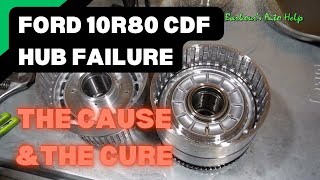
Typical fix: Replacement of the CDF clutch drum with an updated part (OEM Part No. JL3Z-7H351-B) that has a machined lip or 'wall' to prevent the sleeve from moving. 🎬 Watch: See the updated CDF hub design and how it's fixed. This is a major, transmission-out repair, effectively a partial or full rebuild.
Est. part cost: $200-$400 - Faulty Main Control (Valve Body) 🔴 High Probability The valve body can fail due to sticking valves in their bores, internal leaks, or damage from metallic debris created by other failing components (like the CDF drum). Multiple TSBs (e.g., TSB 22-2428) point to the valve body as a common source of shifting issues and recommend its replacement. One technician noted that the bore for solenoid 'A' can become scored, causing the valve to stick.
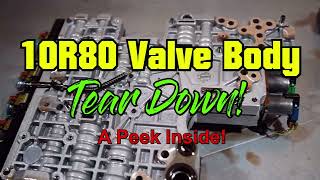
How to confirm: A technician can perform pressure tests and use a high-level scan tool to command solenoids and check for response. Often diagnosed after checking fluid and wiring. Physical inspection may reveal a sticking valve. 🎬 Watch: A detailed look inside the 10R80 valve body components.
Typical fix: Replacement of the entire valve body assembly. This is often done before suspecting a deeper internal failure like the CDF drum. The new valve body's solenoid strategy must be programmed into the TCM/PCM.
Est. part cost: $800-$1500 - Low or Contaminated Transmission Fluid 🟡 Medium Probability → Shop Transmission Assembly Low fluid levels prevent the hydraulic pressure needed for solenoids and clutches to operate. Contaminated fluid (with clutch material or metal shavings) can clog solenoid passages and the valve body, causing them to stick. The correct fluid is critical; this transmission uses Motorcraft MERCON ULV (XT-12-QULV).
How to confirm: Check the transmission fluid level and condition. This transmission has no dipstick; the level must be checked via a fill plug on the transmission while it is at a specific operating temperature (206-215°F or 96-101°C). The fluid should be red and not smell burnt or contain visible debris.
Typical fix: Perform a transmission fluid and filter change using the correct MERCON ULV fluid. If the fluid is heavily contaminated, it may be a sign of a more severe internal failure.
Est. part cost: $150-$300 - Faulty Shift Solenoid 'A' ⚪ Low Probability → Shop Transmission Valve Body While the code points directly to the solenoid, on this platform it's more often a symptom than the root cause. However, the solenoid itself can fail electrically or become mechanically stuck. The shift solenoids in the 10R80 are mechanical, linear force solenoids that actuate a pin rather than passing fluid through themselves.
How to confirm: A technician can test the solenoid's resistance with a multimeter. For the 10R80, shift solenoids should measure between 5.0-5.4 ohms at 68°F (20°C). A scan tool can also command it on and off to check for response.
Typical fix: Replacement of the individual solenoid. This requires removing the transmission pan and valve body to access. Given the high probability of a valve body or drum issue, this is rarely performed as a standalone repair.
Est. part cost: $50-$150
Rare But Worth Checking
- Wiring Harness Issue: The wiring harness leading to the transmission can become damaged from heat or road debris, causing an open or short in the solenoid circuit. This should be checked before condemning internal components.
- Faulty Powertrain Control Module (PCM): While rare, the PCM itself can fail and stop sending the correct signal to the solenoid. This is usually the last item to be considered after all other possibilities have been exhausted.
Diagnosis Steps
- Check and verify the transmission fluid level and condition. Ensure it is clean, full, and does not smell burnt. This requires a specific procedure as there is no dipstick.
- Use a professional scan tool to check for any other transmission-related trouble codes. Multiple codes often point towards a larger internal issue like the valve body or CDF drum.
- Inspect the external transmission wiring harness and connectors for any signs of damage, corrosion, or loose connections.
- If possible, command Shift Solenoid 'A' with the scan tool to check for a response and monitor hydraulic pressure.
- Drop the transmission pan and inspect for excessive metal shavings or debris, which indicates internal mechanical wear.
- Test the resistance of Shift Solenoid 'A' with a multimeter to verify it is within the manufacturer's specifications (5.0-5.4 ohms at 68°F).
- If the solenoid and wiring are good, the next step is to inspect and test the valve body for leaks or sticking valves. Replacement is the common fix per TSBs.
- If a valve body replacement does not solve the issue, a full transmission inspection is necessary to check for a failed CDF clutch drum, as indicated by multiple TSBs.
Parts You'll Likely Need
- Transmission Main Control (Valve Body)
(OEM #ML3Z-7A100-B (verify with VIN, may supersede older numbers like JL3Z-7A100-C))— Often the primary cause of shifting issues and solenoid codes on the 10R80 transmission, as highlighted in TSBs. It contains all the solenoids and hydraulic passages.
Trusted brands: Motorcraft
OEM price range: $800-$1500
Aftermarket price range: $600-$1200 - CDF Clutch Drum
(OEM #JL3Z-7H351-B)— The original drum is prone to a sleeve failure causing hydraulic leaks. The updated part has a machined lip to prevent this. This is the root cause if a valve body replacement doesn't fix the issue.
Trusted brands: Ford
OEM price range: $200-$400
Aftermarket price range: N/A - Transmission Fluid and Filter Kit
(OEM #Motorcraft MERCON ULV (XT-12-QULV))— Required for any internal transmission service. Using the correct ULV fluid is critical for the 10R80 transmission's operation.
Trusted brands: Motorcraft
OEM price range: $200-$300
Aftermarket price range: $120-$200
Related Codes That Often Appear With This One
- P0756, P0761, P0766, P0771 — These are performance codes for other shift solenoids (B, C, D, E). When multiple solenoid codes appear together, it strongly suggests a systemic issue like a bad valve body or major hydraulic leak from the CDF drum, not multiple individual solenoid failures. [TSB 25-2302, 43]
- P0729, P0731, P0732, P0733, etc. — These are gear ratio error codes. They indicate the transmission is slipping, which is a direct consequence of the hydraulic pressure loss caused by the solenoid/valve body/CDF drum issue. [TSB 22-2428, 9]
- P2700, P2701, P2702, etc. — These codes relate to the apply time of transmission friction elements (clutches). They directly point to a clutch pack not engaging correctly, which is a result of the hydraulic problem triggering P0751. [TSB 24-2252, 9]
Technical Service Bulletins (TSBs) & Recalls
- A key TSB for many 2017-2023 Ford/Lincoln models. It directly links harsh/delayed shifts and a host of DTCs (including P0751) to three potential causes: PCM/TCM software, sticking valves in the main control valve body, and/or axial movement of the CDF clutch cylinder sleeve.
- These are later TSBs that supersede previous versions. They continue to group a large number of transmission DTCs, including P0751, P0756, and P2700-series codes, pointing to a common root cause within the transmission, reinforcing the diagnosis of a systemic failure rather than an isolated component fault.
- An earlier TSB that also groups P0751 with numerous other gear ratio and clutch apply codes, indicating that Ford has been aware of this pattern of failure for some time.
Platform-Specific Known Issues
- Multiple Technical Service Bulletins (TSB 25-2302, TSB 22-2428, TSB 24-2252, TSB 20-2403, TSB 24-2176) have been issued for 2020-2023 Lincoln Aviators regarding harsh/delayed shifts and illuminated MIL with code P0751, among many others. These TSBs often point to complex internal transmission faults rather than simple component failures.
- A class-action lawsuit has been filed concerning the 10R80 transmission in various Ford and Lincoln models, alleging defects that cause harsh, erratic shifting, lunging, and hesitation.
Mechanic-Grade Diagnostic Values
- Shift Solenoid 'A' (and all other shift solenoids B-F) Coil Resistance — expected: 5.0 - 5.4 Ohms at 20°C (68°F). Failure: A reading outside this range indicates a failed solenoid coil.
- Transmission Fluid Temperature (TFT) for fluid level check — expected: 206°F - 215°F (96°C - 101°C). Failure: Checking the fluid level outside this temperature range will result in an inaccurate reading.
- Normal operating transmission fluid temperature — expected: Below 210°F during mild driving. Failure: Consistently high temperatures above 210°F suggest internal slipping or converter issues.
Scan Tool Commands That Help
- Ford IDS/FJDS: Transmission Strategy Download — This is mandatory after replacing the transmission or the valve body. It requires entering the 13-digit solenoid body strategy number from the new part's tag to program the PCM/TCM. Failure to do this will cause drivability issues and potential transmission damage.
- Ford IDS/FJDS: Clear Transmission Adaptive Tables — This must be performed after a repair like a valve body or transmission replacement. It resets the learned shift parameters, allowing the TCM to perform a new adaptive learning drive cycle with the new components.
- Ford IDS/FJDS with VCMM and Pressure Transducer Kit: CDF Drum Leakage Test (per TSB 25-2018) — This is an advanced diagnostic procedure to definitively test for a leaking CDF clutch drum without a full teardown. It measures hydraulic pressures under specific conditions, and a calculator determines the leakage percentage, confirming if the drum needs replacement.
Wiring & Ground Locations
- C175T — The main transmission electrical connector on the transmission case. For the 10R80, this is a large, round, bayonet-style connector.. This is the primary interface between the vehicle's wiring harness and the transmission's internal components, including all solenoids. Checking for corrosion, moisture, or pushed-out pins at this connector is a critical first step in diagnosing any electrical fault code for the transmission.
Real Owner Repair Stories
- Reddit user on r/f150 (2018 Ford F-150 EcoBoost, 145k miles) — Crazy shift problems, including floating between gears and then slamming into another. Reported it even tried to shift into first gear at 80mph.
❌ Tried (didn't work) Transmission relearn procedure, Valve body replacement
✅ What actually fixed it The user self-diagnosed the issue as the CDF clutch drum failure after the other repairs didn't work, citing the TSB. The final fix is the replacement of the CDF drum itself. - Reddit user on r/f150 (2021 Ford F-150 Powerboost) — At times shutters or slams into 3rd gear on light throttle. Shift was not harsh on firm/aggressive throttle.
❌ Tried (didn't work) Previous attempts to fix were unsuccessful until a new TSB was applied.
✅ What actually fixed it The dealer applied the updated TSB 22-2428 (updated May 2023) by reprogramming the PCM. The tech noted no DTCs were present but the TSB applied. The owner reported the 1-2-3 and 1-3 shifts became 'almost invisible' and the issue was resolved.
OEM Part Supersession History
HL3Z-7H351-A, JL3Z-7H351-A→JL3Z-7H351-B— The original CDF clutch drum designs allowed an internal bushing/sleeve to 'walk' out of position, uncovering oil passages and causing a major hydraulic leak. The updated JL3Z-7H351-B part features a machined lip that physically prevents the sleeve from moving.
Model Year Variations Within This Range
- 2020 - early 2022: Vehicles built on or before August 15, 2022, are equipped with the earlier design of the CDF clutch drum, which is prone to the internal sleeve walking out of position. Vehicles built after this date are presumed to have the updated drum (Part No. JL3Z-7H351-B) from the factory, making them less susceptible to this specific failure mode.
Helpful Videos


We Have This Part in Stock


The information in this article is provided for general reference and educational purposes only. Vehicle specifications, procedures, and part compatibility can vary by production date, trim level, and region. Always consult your vehicle's factory service manual and verify part numbers before purchasing or performing repairs. Safety-critical components such as airbags, seat belts, and braking systems should be installed by a qualified professional.
- Lincoln AVIATOR:
- 🧭 Diagnostic Flowchart
- 🎬 Helpful Videos
- 🛍️ Shop This Part
- What's Unique About the 2020-2023 Lincoln AVIATOR
- Symptoms You May Notice
- Most Likely Causes
- Rare But Worth Checking
- Diagnosis Steps
- Parts You'll Likely Need
- Related Codes That Often Appear With This One
- Technical Service Bulletins (TSBs) & Recalls
- Platform-Specific Known Issues
- Mechanic-Grade Diagnostic Values
- Scan Tool Commands That Help
- Wiring & Ground Locations
- Real Owner Repair Stories
- OEM Part Supersession History
- Model Year Variations Within This Range
- 🎟️ Get 5% Off