

P0751 on 2018-2023 Lincoln Navigator: Shift Solenoid 'A' Performance Causes and Fixes
On a 2018-2023 Lincoln Navigator, P0751 often points to an internal transmission issue, not just a single bad solenoid. Multiple manufacturer TSBs suggest the problem is frequently with the transmission's main control valve body, often triggered by a deeper mechanical failure in the CDF clutch drum. This is a complex and expensive repair that may require more than just a valve body replacement for a permanent fix.
- P0751 on a 2018-2023 Navigator is a serious code that indicates a problem with Shift Solenoid 'A' and can severely affect drivability.
- Due to multiple manufacturer TSBs, the root cause is very often a faulty transmission main control (valve body), not just a single bad solenoid.
- Do not continue to drive with these symptoms for an extended period, as you risk causing more expensive internal transmission damage.
- Diagnosis and repair are complex and not recommended for DIYers. A professional technician with experience in Ford's 10R80 transmission is your best option.
- Always check for other stored transmission codes, as P0751 rarely appears alone when the valve body is the culprit.
What's Unique About the 2018-2023 Lincoln NAVIGATOR
The 2018-2023 Lincoln Navigator uses the Ford 10R80 10-speed automatic transmission, which has a well-documented design flaw. Code P0751 is frequently a symptom of a deeper issue: axial movement of the CDF clutch cylinder sleeve. This sleeve can walk out of its bore due to premature bushing wear, causing a significant internal hydraulic leak. The TCM throws solenoid performance codes like P0751 because it's trying, and failing, to compensate for this pressure loss. This makes diagnosis critical, as simply replacing Solenoid 'A' or even the entire valve body may not fix the root cause, leading to a recurrence of symptoms.
Diagnostic Flowchart
Tap your situation to follow the diagnostic path that matches what you're seeing on this vehicle.
Symptoms You May Notice
- Harsh or abrupt shifts, sometimes described as feeling like being rear-ended. 🎬 Watch: Why your Navigator slams into gear and how to fix it.
- Delayed gear engagement from Park to Drive or Reverse.
- Transmission gets stuck in one gear (limp mode).
- Check Engine Light is illuminated.
- RPMs flare or slip between shifts, especially on the 3-4 or 3-5 upshift.
- Transmission may slip or overheat.
- Reduced fuel economy.
- Replacing only Shift Solenoid 'A' without addressing the underlying hydraulic or mechanical issue.
- Replacing the main control (valve body) without inspecting the CDF clutch drum for the common sleeve failure, leading to the problem returning.
- Performing a transmission adaptive learning reset without fixing the underlying mechanical fault. This often makes the harsh shifting more violent because the computer is no longer compensating for the internal pressure loss.
Most Likely Causes
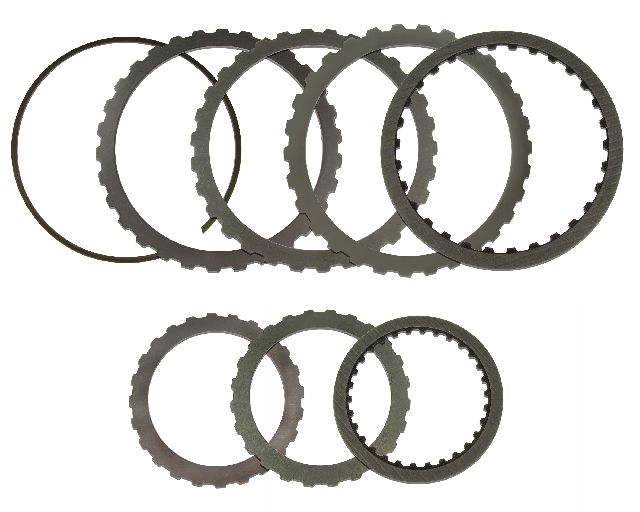
- Internal CDF Clutch Drum Sleeve Failure Very high Probability → Shop Transmission Clutch Pressure Plate This is a widely recognized failure point in the 10R80 transmission. TSBs 24-2254 and 24-2176 directly name 'axial movement of the CDF clutch cylinder (7H351) sleeve' as a primary cause for these symptoms and codes. The bushings wear out, allowing the sleeve to move and create a major hydraulic leak.
How to confirm: This is a complex diagnosis requiring transmission disassembly. A technician may first replace the valve body, but if symptoms persist, the next step is to inspect the CDF drum for a dropped or out-of-place sleeve.
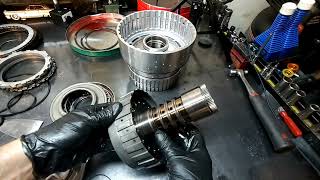
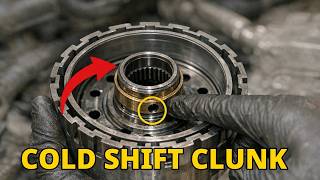
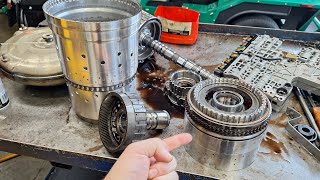
Typical fix: Replacement of the CDF clutch drum with an updated part (JL3Z-7H351-B) that is designed to prevent the sleeve from moving. 🎬 Watch: How the updated CDF bushing fixes harsh shifting issues. This is a transmission-out, teardown-level repair. 🎬 See a full teardown of the 10R80 and the CDF drum failure.
Est. part cost: $200-$400 for the drum itself, but labor is extensive. - Internal Transmission Main Control (Valve Body) Failure 🔴 High Probability → Shop Transmission Assembly The valve body can fail from sticking valves or internal leaks, and it is often the first part replaced when addressing these codes. However, its failure can be induced by the excessive hydraulic demands placed on it from a leaking CDF drum.
How to confirm: A technician will perform advanced diagnostics, including pressure tests and a review of scan tool data. Often confirmed after ruling out simpler causes and before committing to a full transmission teardown.
Typical fix: Replacement of the entire transmission main control (valve body) assembly. This is a complex job requiring specialized tools.
Est. part cost: $800-$1500 - Low or Dirty Transmission Fluid 🟡 Medium Probability → Shop Transmission Assembly
How to confirm: Check the transmission fluid level and condition. The fluid should be at the correct level, red in color, and not smell burnt. Note: The 10R80 does not have a traditional dipstick, requiring a specific lift and fill-plug procedure to check at a specific temperature (96-101°C or 206-215°F).
Typical fix: Perform a transmission fluid drain and fill, or a full fluid exchange with the correct Motorcraft MERCON ULV fluid. Replace the transmission filter.
Est. part cost: $150-$300 - Faulty Shift Solenoid 'A' ⚪ Low Probability → Shop Transmission Valve Body
How to confirm: After accessing the solenoid inside the transmission pan, a mechanic can test its electrical resistance with a multimeter. For the 10R80, all shift solenoids should measure between 5.0-5.4 ohms at 68°F (20°C). A high-end scan tool can also command it on/off.
Typical fix: Replace the individual shift solenoid. However, given the known TSBs for this vehicle, this is often a symptom, not the root cause.
Est. part cost: $50-$150 - Wiring or Connector Issue ⚪ Low Probability
How to confirm: Visually inspect the wiring harness going to the transmission for any signs of damage, corrosion, or loose connections. Test for continuity and proper voltage at the solenoid connector.
Typical fix: Repair the damaged section of the wiring harness or clean/replace the connector.
Est. part cost: $20-$100
Rare But Worth Checking
- Faulty Transmission Control Module (TCM) or Powertrain Control Module (PCM): → Shop Transmission Assembly This is rare and should only be considered after all other possibilities, especially the valve body and CDF drum, have been thoroughly ruled out. A failure here would likely present with other communication codes as well.
- Failed Transmission Oil Pump: → Shop Transmission Assembly A failing oil pump can cause a lack of hydraulic pressure, leading to solenoid and clutch performance codes. This was noted by an owner on a forum as the ultimate cause after initial solenoid codes were thrown.
Diagnosis Steps
- Scan the TCM for all stored trouble codes. Note all codes present, as P0751 is often accompanied by a large group of other transmission codes.
- Check the transmission fluid level and condition. This is a critical first step, though it requires a specific procedure on the 10R80 transmission where the fluid temperature must be between 96-101°C (206-215°F).
- Inspect the transmission wiring harness and connectors for any visible damage, corrosion, or loose pins.
- If fluid and wiring are good, a professional diagnosis is needed. This involves using a scan tool like Ford's IDS to monitor solenoid commands, review live data, and perform bidirectional tests.
- Follow the diagnostic procedure outlined in TSB 24-2176 or newer. This will likely lead to replacing the main control (valve body) as the next step.
- If the valve body is replaced and symptoms return, or for a more thorough diagnosis, the transmission must be removed to inspect for the known 'axial movement of the CDF clutch cylinder (7H351) sleeve'. This is the definitive check for the root cause.
- If all other components test correctly, investigate the rare possibility of a faulty TCM or a failing transmission oil pump.
Parts You'll Likely Need
- Transmission Main Control Valve Body Assembly
(OEM #JL3Z-7A100-B, JL1Z-7A100-A, or superseding part JL3Z-7A100-D)— This is a very common point of failure and the first major component replaced per TSBs. It includes the solenoids.
Trusted brands: Motorcraft
OEM price range: $1000-$1500
Aftermarket price range: $700-$1100 - CDF Clutch Cylinder / Drum Assembly
(OEM #JL3Z-7H351-B (Updated Part))— This is the part needed to fix the root cause of the hydraulic leak. The 'B' version is the redesigned part to prevent future failure.
Trusted brands: Motorcraft
OEM price range: $200-$400 - Automatic Transmission Fluid
(OEM #Motorcraft MERCON ULV (XT-12-QULV))— Required for any repair involving opening the transmission. Low or dirty fluid can be a cause itself. The 10R80 requires this specific fluid.
Trusted brands: Motorcraft
OEM price range: $20-$30 per quart - Shift Solenoid
(OEM #HL3Z-7G383-N (Example))— While it can fail, it's a less likely cause than the valve body or CDF drum. Solenoids are typically included with a new valve body assembly.
Trusted brands: Motorcraft
OEM price range: $70-$120
Aftermarket price range: $40-$80
Related Codes That Often Appear With This One
- P0756, P0761, P0766, P0771 — These relate to Shift Solenoids 'B', 'C', 'D', and 'E' respectively. TSBs show these codes often appear in a large group, pointing to a systemic hydraulic issue like the valve body or CDF drum, not individual solenoid failures.
- P2700, P2701, P2702, P2703, P2704, P2705 — These are friction element apply time/range performance codes. They directly indicate a clutch pack is not engaging correctly, which is the direct result of the hydraulic pressure loss from a failed CDF drum or valve body.
- P0729, P0731, P0732, P0733, P0734, P0735 — These are gear ratio error codes. They indicate the transmission is slipping or failing to achieve the correct gear, a direct consequence of the solenoid/hydraulic issue causing P0751.
Technical Service Bulletins (TSBs) & Recalls
- TSB 24-2176: Addresses harsh/delayed engagement and shifts with a long list of DTCs including P0751. Specifically mentions 'axial movement of the CDF clutch cylinder (7H351) sleeve' as a potential cause.
- TSB 24-2254: Also addresses harsh/delayed shifts and the same group of DTCs, pointing to the CDF clutch cylinder sleeve causing hydraulic leaks.
- TSB 22-2428: An older bulletin mentioning harsh/delayed shifts and possible MIL with DTC P0751.
- TSB 23-2152: Notes harsh/delayed shifts and lists P0751 as a possible diagnostic trouble code.
- TSB 25-2023: Describes harsh/delayed engagement/shifts and an illuminated MIL with DTC P0751.
Platform-Specific Known Issues
- The core issue for the 2018-2023 Lincoln Navigator's 10R80 transmission is a design flaw in the CDF (Clutch D/F) clutch drum. Multiple TSBs (including 24-2176 and 24-2254) describe how the sleeve inside this drum can move out of position due to premature bushing wear. This 'axial movement' creates a significant hydraulic pressure leak. The TCM detects this pressure loss as a failure of the shift solenoids to do their job, triggering codes like P0751. While a valve body replacement is the procedure often attempted first, the problem may return if the underlying CDF drum issue is not corrected with an updated part.
Mechanic-Grade Diagnostic Values
- Shift Solenoid A-F Resistance — expected: 5.0 - 5.4 Ohms at 20°C (68°F). Failure: A reading outside this range indicates a faulty solenoid coil.
Scan Tool Commands That Help
- Ford IDS, FORScan, or equivalent professional scanner: Clear Transmission Adaptive Tables / Reset KAM — This must be performed after replacing the valve body or rebuilding the transmission. It erases the learned hydraulic pressure adjustments. Failure to do this can result in poor shift quality.
- Ford IDS, FORScan, or equivalent professional scanner: Adaptive Learning Drive Cycle — After clearing the adaptive tables, a specific, lengthy drive cycle procedure is required for the TCM to relearn clutch fill times and pressures. It involves a series of light-throttle accelerations and specific shifting patterns. Skipping this can cause continued harsh shifting.
- Ford IDS: PCM - Transmission Accelerated Main Control Break In — Mentioned in TSB 20-2403, this is a dealer-level routine used to address sticking valves in the main control body on low-mileage vehicles by cycling specific clutches while the vehicle is on a lift.
Wiring & Ground Locations
- Main Transmission Case Connector — On the right side of the transmission case.. This is the main electrical interface for all solenoids and sensors. A pinout chart shows which pins correspond to each solenoid, allowing for targeted testing of the wiring harness between the TCM and the transmission.
- Shift Solenoid 'A' (SSA) — Inside the transmission on the valve body. The 10R80 has six shift solenoids in a row; looking at the valve body, the order is A, F, C, B, E, D.. Knowing the physical location is essential for visual inspection or replacement if an individual solenoid is suspected to be faulty, rather than the entire valve body.
Real Owner Repair Stories
- Reddit user on r/f150 (2019 F-150 Lariat 2.7L EcoBoost 4x4) — Initially had harsh upshifts/downshifts. After a reflash, it developed a 2-3 second delay when shifting from Park to Drive/Reverse.
❌ Tried (didn't work) A PCM reflash and swapping some parts per a TSB initially addressed the harsh shifting but led to delayed engagement.
✅ What actually fixed it The delayed engagement was fixed by replacing the CDF drum. However, 900 km later, the truck developed very hard shifts into 3rd gear. The dealer then replaced the valve body assembly, which seemed to resolve the issue after the adaptive learning adjusted.
OEM Part Supersession History
HL3Z-7H351-A, JL3Z-7H351-A→JL3Z-7H351-B— The original CDF clutch drum assembly was prone to the internal sleeve moving, causing a hydraulic leak. The updated 'B' version has a machined lip on the inner drum half to prevent the sleeve from walking out of its bore.JL3Z-7A100-B→JL3Z-7A100-D— General revision and update to the main control valve body assembly.
Heads up: After replacing the main control valve body, the 13-digit solenoid body strategy number must be programmed into the PCM/TCM using a diagnostic scan tool. Failure to do so can result in software incompatibility and may set a P163E code.
Helpful Videos

We Have This Part in Stock


The information in this article is provided for general reference and educational purposes only. Vehicle specifications, procedures, and part compatibility can vary by production date, trim level, and region. Always consult your vehicle's factory service manual and verify part numbers before purchasing or performing repairs. Safety-critical components such as airbags, seat belts, and braking systems should be installed by a qualified professional.
- Lincoln NAVIGATOR:
- 🧭 Diagnostic Flowchart
- 🎬 Helpful Videos
- 🛍️ Shop This Part
- What's Unique About the 2018-2023 Lincoln NAVIGATOR
- Symptoms You May Notice
- Most Likely Causes
- Rare But Worth Checking
- Diagnosis Steps
- Parts You'll Likely Need
- Related Codes That Often Appear With This One
- Technical Service Bulletins (TSBs) & Recalls
- Platform-Specific Known Issues
- Mechanic-Grade Diagnostic Values
- Scan Tool Commands That Help
- Wiring & Ground Locations
- Real Owner Repair Stories
- OEM Part Supersession History
- 🎟️ Get 5% Off