

P0751 on 2003-2009 Toyota 4Runner: Shift Solenoid 'A' Causes and Fixes
On a 2003-2009 4Runner, code P0751 is most often caused by old, dirty transmission fluid or a failed Shift Solenoid 'A' (SL1). Start by checking the fluid; if that doesn't solve it, the solenoid itself likely needs replacement, which is a job inside the transmission pan.
- P0751 on a 4th Gen 4Runner points to a problem with Shift Solenoid 'A', which controls gear changes.
- The most common causes are old/dirty transmission fluid or a failed solenoid; always check the fluid first.
- Driving with this code can lead to poor performance and potentially severe transmission damage.
- The fix involves working inside the transmission pan, which is a complex job best left to experienced DIYers or professionals.
- Using the correct Toyota-specific transmission fluid (T-IV or WS, depending on the transmission) is critical for proper operation.
What's Unique About the 2003-2009 Toyota 4Runner
The 2003-2009 4th Generation 4Runner uses highly reliable Aisin transmissions (A340F, A750E, A750F). While generally robust, they are sensitive to fluid condition and level. P0751 is a common code when the fluid breaks down or becomes contaminated, causing the solenoids to stick. Unlike some vehicles where electrical failure is the primary cause, on this platform, the issue is very frequently mechanical (a sticky solenoid) or hydraulic (dirty fluid) rather than a wiring or computer problem. The ECM logic specifically looks for a discrepancy between the expected gear and the actual gear to set this performance code.
Symptoms You May Notice
- Check Engine Light is on
- Transmission shifts harshly or with a 'clunk'.
- Delayed engagement when shifting from Park to Drive or Reverse.
- Transmission gets stuck in one gear (limp mode), often 3rd or 4th gear.
- Vehicle may not shift into higher gears, or may fail to downshift properly.
- Reduced fuel economy.
- Transmission may slip or feel like it's in neutral between shifts.
- Engine RPMs are higher than usual at a given speed.
- Immediately replacing the solenoid without checking the fluid first. A simple fluid change often resolves the issue for a fraction of the cost.
- Replacing the entire transmission when only a single, relatively inexpensive solenoid has failed.
- Confusing a P0751 (performance) code with a P0750 (electrical circuit) code. While related, P0751 points more towards a mechanical or hydraulic issue with the solenoid's function, not just its electrical integrity.
Most Likely Causes
- Low or Dirty Transmission Fluid 🔴 High Probability → Shop Transmission Assembly The sealed transmission design can discourage fluid checks, leading to extended use of old fluid. Degraded fluid loses its hydraulic properties and viscosity, and suspended debris can cause the fine tolerances in the solenoid valve to stick.
How to confirm: Check the transmission fluid level and condition. The fluid should be bright red and clear, not brown, black, or smell burnt. Note: These are 'sealed' transmissions without a dipstick; checking requires a specific procedure involving an overflow plug and monitoring the transmission fluid temperature with a scan tool or infrared thermometer. 🎬 Watch: How to check fluid levels on sealed transmissions.
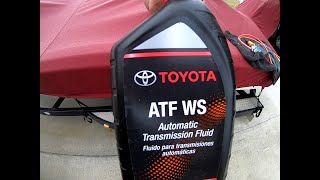
Typical fix: Perform a transmission fluid drain-and-fill or a full fluid exchange. Use only Toyota-spec fluid (Type T-IV for the A340F, WS for the A750E/F). A simple drain and fill is often the first recommended step.
Est. part cost: $60-$150 for fluid - Failed Shift Solenoid 'A' (SL1) 🔴 High Probability → Shop Transmission Valve Body Over time, the mechanical and electrical components of the solenoid can wear out or get clogged with metallic debris and clutch material from the transmission fluid, causing it to stick or respond slowly.
How to confirm: After dropping the transmission pan, the solenoid can be tested. Check its resistance with a multimeter (compare to factory specs, typically 11-15 ohms for this application). You can also apply 12V power to see if it 'clicks' open and closed. A more advanced method uses a scan tool to perform an active test, commanding the solenoid on and off to check its response.
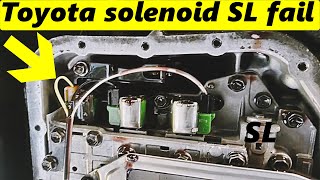
Typical fix: Replace the faulty shift solenoid. This requires draining the fluid, dropping the transmission pan, and removing the solenoid from the valve body. 🎬 See this walkthrough for replacing the SL1 shift solenoid.
Est. part cost: $150-$300 for an OEM solenoid - Clogged Transmission Filter 🟡 Medium Probability → Shop Transmission Assembly The filter traps clutch material and metal shavings. If it becomes clogged, it restricts fluid flow, starving the solenoids and valve body of the pressure needed to operate, which can trigger a performance code.
How to confirm: The filter is only accessible by dropping the transmission pan. If the fluid is very dirty or contains significant debris in the pan, the filter is likely clogged and restricting flow.
Typical fix: Replace the transmission filter and pan gasket. This is always done when replacing a solenoid or servicing the valve body. 🎬 Watch: 4th Gen 4Runner transmission fluid and filter change.
Est. part cost: $30-$60
Rare But Worth Checking
- Wiring Harness Damage: The wiring harness inside the transmission is bathed in hot fluid, and over many years the insulation can become brittle and crack, leading to shorts or open circuits. External wiring can also be damaged by road debris or heat from the exhaust.
- Faulty ECM/TCM: While rare on Toyotas, it's possible for the computer's driver circuit that controls the solenoid to fail. This should only be considered after all other possibilities (fluid, solenoid, wiring) have been exhaustively ruled out.
- Internal Valve Body Issue: → Shop Transmission Valve Body A blockage in the small hydraulic passages of the valve body can prevent fluid from reaching the solenoid or clutches, mimicking a solenoid failure. This can be caused by sludge or debris from degraded fluid.
Diagnosis Steps
- Check and document any other stored trouble codes. Address other transmission codes first, especially circuit codes.
- Check the transmission fluid level and condition. This is the most crucial first step. If the fluid is dark, burnt, or low, address this first by performing a drain and fill.
- If the fluid is clean and full, use a high-end scan tool (like Toyota's Techstream) to monitor live data and command Shift Solenoid 'A' on and off. Listen for a click from the transmission pan area.
- Perform a road test while monitoring the commanded gear vs. the actual gear on the scan tool to confirm the fault.
- If the solenoid doesn't respond or the fault is confirmed, drain the fluid and drop the transmission pan.
- Visually inspect the fluid in the pan for excessive metal shavings or clutch material, which would indicate more severe internal damage.
- Visually inspect the wiring inside the transmission for any signs of damage or brittle insulation.
- Locate Shift Solenoid 'A' (SL1) on the valve body. Disconnect it and test its resistance with a multimeter. Compare the reading to the manufacturer's specification (typically 11-15 Ohms).
- If resistance is out of spec, the solenoid is bad and must be replaced.
- If resistance is within spec, apply 12V directly to the solenoid terminals and listen for a solid 'click'. A weak click or no click indicates a mechanical failure.
- If the solenoid and wiring test good, the issue may be a mechanical blockage in the valve body or, rarely, a faulty ECM.
Parts You'll Likely Need
- Shift Solenoid 'A' (SL1)
(OEM #35240-50030)— This is the specific solenoid identified by the P0751 code and is the most common part to fail after fluid issues are ruled out.
Trusted brands: Toyota (Genuine), Aisin
OEM price range: $200-$310
Aftermarket price range: $100-$180 - Automatic Transmission Fluid — Dirty or low fluid is a primary cause of this code. A fluid and filter change is required for solenoid replacement.
Trusted brands: Toyota Genuine ATF Type T-IV (for A340F), Toyota Genuine ATF WS (World Standard) (for A750E/F)
OEM price range: $10-$15 per quart
Aftermarket price range: $8-$12 per quart - Transmission Filter Kit (Filter and Pan Gasket) — A clogged filter can cause the code, and it must be replaced whenever the pan is dropped for service.
Trusted brands: Toyota (Genuine), Wix, Beck/Arnley
OEM price range: $40-$60
Aftermarket price range: $20-$40
Related Codes That Often Appear With This One
- P0700 — This is a general Transmission Control System Malfunction code that indicates the TCM has stored a specific fault, such as P0751. It often appears alongside any specific transmission code.
- P0756 — This is a performance code for Shift Solenoid 'B'. Seeing P0751 and P0756 together strongly suggests a systemic issue like dirty fluid, low fluid pressure, or a clogged filter affecting multiple solenoids.
- P0761 — This is a similar performance code but for Shift Solenoid 'C'. It's common to see multiple solenoid codes if the root cause is old, contaminated fluid affecting the entire system.
Technical Service Bulletins (TSBs) & Recalls
- While no TSB is directly for P0751 on this model, TSB EG055-07 addresses a transmission shudder issue on some models with the A750 transmission, which can be related to fluid condition and torque converter lock-up, highlighting the transmission's sensitivity to fluid quality.
Platform-Specific Known Issues
- Owner Experience: Solenoid Replacement Fix: A user on the T4R.org forum with a 2005 4Runner V8 experienced the P0751 code along with harsh shifting. After confirming the fluid was clean, they replaced the SL1 solenoid (Part No. 35240-50030), transmission filter, and fluid. The repair completely resolved the shifting issues and cleared the code. This is a common repair story for this platform.
- Importance of Correct Fluid Type: Forum discussions repeatedly emphasize the need to use the correct Toyota-specific fluid. Using a universal or incorrect type of ATF can lead to shifting problems, including solenoid performance codes, even if the fluid is new. The A750E/F transmission is particularly sensitive to fluid properties.
Mechanic-Grade Diagnostic Values
- Shift Solenoid 'A' (SL1) Resistance — expected: 11 - 15 Ω at 20°C (68°F). Failure: A reading outside this range (open circuit or short) indicates a failed solenoid.
- Shift Solenoid 'A' (SL1) Bench Test — expected: An audible 'click' or operating sound should be heard when 12V power is applied to the solenoid's terminal and the body is grounded.. Failure: No sound, or a very weak sound, indicates the internal plunger is stuck or failing.
Scan Tool Commands That Help
- Toyota Techstream: Active Test: Control the Shift Solenoid SL1 — This is a crucial early diagnostic step after checking fluid. It allows the technician to command the solenoid on and off with the engine running (at low speed or stationary) to audibly verify if the solenoid is clicking in the valve body. This can confirm if the solenoid is receiving the command and is mechanically actuating, potentially ruling out a wiring or simple solenoid failure without dropping the pan.
Wiring & Ground Locations
- Engine Harness Ground (Driver Side) — On the driver's side frame rail, secured by a 12mm bolt.. A poor main harness ground can cause erratic voltage and unpredictable behavior in all engine and transmission sensors and actuators, including shift solenoids.
- Engine Block Ground (Driver Side, Rear) — At the back of the engine block, directly down from the driver's side valve cover, secured by a 10mm bolt.. This ground is part of the transmission section of the harness. Corrosion or a loose connection here can directly impact communication and power to the transmission solenoids.
- Engine Block Ground (Passenger Side, Rear) — In an identical location to the driver's side, at the back of the block below the passenger side valve cover, secured by a 10mm bolt.. Provides ground path redundancy. All major ground points should be checked for cleanliness and tightness when diagnosing any electrical fault code.
Real Owner Repair Stories
- YotaTech Forums (Toyota 4Runner with A340F transmission, 139k miles) — After highway driving, coming to a stop, the transmission would go into a neutral state and not engage 1st gear. Manually shifting to 'L' would force it into gear. No trouble codes were ever stored.
❌ Tried (didn't work) Multiple transmission drain and fills., Adding LubeGard additive to free sticking valves (this improved shifting but did not solve the primary issue).
✅ What actually fixed it The final diagnosis from both a Toyota dealer and an independent transmission shop was a failing internal 'shift sprag' (a type of one-way clutch). The owner opted to replace the entire transmission with a used unit (78k miles), which resolved the problem completely.
When the Usual Fixes Don't Work
- In one documented case, a 4Runner with symptoms identical to a P0751 fault (failure to downshift to 1st) never threw a code. After fluid changes failed to fix the issue, the root cause was diagnosed as a mechanical failure of a shift sprag inside the transmission, requiring a full transmission replacement. This highlights that the computer's diagnosis of a 'solenoid performance' issue can sometimes be triggered by a purely mechanical failure that prevents the commanded gear from engaging.
OEM Part Supersession History
35240-50030→35240-50030— No supersession found.
Heads up: This part number appears to be stable for its intended applications. However, always verify fitment with VIN as this solenoid is used across multiple Toyota platforms (Tundra, Land Cruiser) and may have internal differences not visible externally.
Model Year Variations Within This Range
- 2003-2004 V6: These models were equipped with the A340F 4-speed automatic transmission, which uses Toyota Type T-IV fluid. The solenoids and valve body are specific to this transmission and are not interchangeable with the later 5-speed.
- 2003-2004 V8 & 2005-2009 V6/V8: These models use the A750E (2WD) or A750F (4WD) 5-speed automatic transmission. They require Toyota WS (World Standard) fluid. While the A750E and A750F are similar, there can be differences in internal calibration, and using parts from the wrong application may cause shifting issues.
Diagnostic Flowchart
Other Known Issues on This Vehicle
Issues unrelated to this code that are worth knowing about as an owner of this generation:
- Frame Rust/Corrosion 🔴 High — Very common, especially in salt-belt states. Can become structurally unsafe. Affects all years of the generation. (Ref: No official recall for the 4Runner, unlike Tacoma/Tundra. A class-action lawsuit was filed but later dismissed.)
- Cracked Exhaust Manifolds (V8) 🟠 Medium — Extremely common on the 4.7L 2UZ-FE V8. Often described as 'when, not if'. Causes an audible ticking sound, especially when cold. (Ref: A Technical Service Bulletin was issued, but it is not a recall. The common fix is replacing with aftermarket headers.)
- Head Gasket Failure (V6) 🟠 Medium — Primarily affects 2003-2005 models with the 4.0L 1GR-FE V6. Failure rate is estimated at 5-10%, typically occurring between 120k-150k miles. (Ref: No recall. Toyota reportedly updated the gasket design in late 2005/early 2006 models.)
- X-REAS Suspension Leaks 🟡 Low — Common on Sport Edition and Limited trims equipped with the X-REAS system. Shocks and lines tend to leak well before 100k miles. (Ref: None. Replacement is very expensive, so most owners 'delete' the system and install conventional shocks.)
- Cracked/Melting Dashboard 🟡 Low — Common on all models of this generation, especially in hot, humid climates. The dash becomes sticky and can crack, causing glare. (Ref: Toyota had a warranty enhancement program, but it was limited and has since expired.)
Used vs. New Parts: Buying Guide for This Vehicle
When a used part is the smart pick: A complete, low-mileage used transmission assembly is a smart choice if diagnosis confirms a major internal mechanical failure beyond the valve body, such as a bad clutch pack or sprag. For a single solenoid, buying used is not recommended due to the high labor cost of installation versus the unknown remaining lifespan of the part.
Donor-vehicle mileage cap: roughly under 150000 miles for the part to have meaningful remaining life.
What to inspect on the donor part:
- Check the fluid from the donor transmission; it should be reddish and not smell burnt.
- Obtain a vehicle history report for the donor car if possible to check for accidents or maintenance history.
- Look for a seller that offers a parts warranty (e.g., 30-90 days) on the assembly.
OEM-only on this vehicle (don't cheap out):
- Shift Solenoids
Aftermarket brands forum-validated for this vehicle:
- Aisin (Aisin is the Original Equipment Manufacturer for Toyota transmissions and solenoids)
Brands owners have reported issues with on this vehicle:
- Unbranded, generic solenoid 'kits' from online marketplaces are a significant risk and often have incorrect resistance values or high failure rates.
Real Owner Stories
Aggregated from forums and TSBs cited above. Mileages and costs reflect what owners reported in those sources.
2005 Toyota 4Runner V8
Symptoms: Experienced the P0751 code along with harsh shifting.
What fixed it: Replaced the SL1 solenoid (Part No. 35240-50030), transmission filter, and fluid.
Source hint: T4R.org (Toyota 4Runner Forum) user report mentioned in 'Owner Experience: Solenoid Replacement Fix'
2003-2009 Lexus GX 470
Symptoms: Identical symptoms and fixes for P0751 as the 4Runner, tied to the A750F transmission.
What fixed it: Consensus repair path: 1. Check/change fluid. 2. Replace Solenoid 'A' (SL1).
Source hint: ClubLexus Forums
Related OBD-II Codes
Frequently Asked Questions
Does TSB EG055-07 apply to my 4Runner's transmission issues?
What is the specific part number for the solenoid I need to replace on my 2005 4Runner V8?
Can I use any high-quality ATF in my 2003-2009 4Runner transmission?
How do I check the transmission fluid on my 4Runner if there is no dipstick?
Is the P0751 code common on other Toyota vehicles besides the 4Runner?
What should the resistance be for Shift Solenoid 'A' (SL1) when testing with a multimeter?
Helpful Videos


We Have This Part in Stock

The information in this article is provided for general reference and educational purposes only. Vehicle specifications, procedures, and part compatibility can vary by production date, trim level, and region. Always consult your vehicle's factory service manual and verify part numbers before purchasing or performing repairs. Safety-critical components such as airbags, seat belts, and braking systems should be installed by a qualified professional.
- Toyota 4Runner:
- 🧭 Diagnostic Flowchart
- 🎬 Helpful Videos
- 🛍️ Shop This Part
- What's Unique About the 2003-2009 Toyota 4Runner
- Symptoms You May Notice
- Most Likely Causes
- Rare But Worth Checking
- Diagnosis Steps
- Parts You'll Likely Need
- Related Codes That Often Appear With This One
- Technical Service Bulletins (TSBs) & Recalls
- Platform-Specific Known Issues
- Mechanic-Grade Diagnostic Values
- Scan Tool Commands That Help
- Wiring & Ground Locations
- Real Owner Repair Stories
- When the Usual Fixes Don't Work
- OEM Part Supersession History
- Model Year Variations Within This Range
- Other Known Issues on This Vehicle
- Used vs. New Parts: Buying Guide for This Vehicle
- Real Owner Stories
- 2005 Toyota 4Runner V8
- 2003-2009 Lexus GX 470
- Related OBD-II Codes
- Frequently Asked Questions
- 🎟️ Get 5% Off