

P0751 on 2004-2013 Toyota Camry: Shift Solenoid 'A' Performance Causes and Fixes
P0751 on a Toyota Camry indicates a performance issue with Shift Solenoid 'A' (often called S1 or SL1). The most common causes are low/dirty transmission fluid or a failing solenoid. A fluid and filter change may fix it, but often the solenoid itself needs replacement, which is a moderately difficult DIY job. On higher-mileage U660E and U760E transmissions, this can sometimes be a symptom of larger internal wear issues.
- P0751 means the transmission's Shift Solenoid 'A' is not working correctly, often leading to harsh shifting or getting stuck in gear.
- Always start by checking the transmission fluid level and condition. Low or dirty fluid is a very common cause.
- If fluid is okay, the Shift Solenoid 'A' itself has likely failed and needs to be replaced.
- This repair requires dropping the transmission pan. It is critical to use the correct fluid type (Toyota T-IV or WS) for your specific year and model.
- Due to the number of different transmissions used, verify the correct solenoid part number for your Camry's specific transmission (e.g., U241E, U151E, U660E) before ordering parts.
What's Unique About the 2004-2013 Toyota Camry
The 2004-2013 Camry spans three vehicle generations (XV30, XV40, XV50) and used at least five different automatic transmissions (U241E, U151E, U250E, U660E, U760E). While the P0751 code's meaning is consistent, the specific solenoid part number, its location on the valve body, and the fluid type (Toyota T-IV vs. WS) vary significantly. Solenoid failure is a well-documented issue on higher-mileage Toyota transmissions of this era, particularly the U151E and the 6-speed U660E/U760E models which can also suffer from related valve body and torque converter issues.
Generation note: Yes, this range covers three Camry generations: - XV30 (2004-2006): Used the 4-speed U241E (4-cyl) and 5-speed U151E (V6). - XV40 (2007-2011): Used the 5-speed U250E, 6-speed U760E (4-cyl, from 2010), and 6-speed U660E (V6, from 2007). - XV50 (2012-2013): Used the 6-speed U760E (4-cyl) and 6-speed U660E (V6). The specific Shift Solenoid 'A' (S1/SL1) part number and design differs between these transmissions. The 6-speed units (U660E/U760E) are known to be more complex.
Symptoms You May Notice
- Check Engine Light is on
- Harsh, delayed, or 'clunking' shifts between gears.
- Transmission may get stuck in a single gear (often 3rd gear, known as 'limp mode').
- Vehicle may hesitate, shudder, or fail to engage a gear from a stop.
- Reduced fuel economy due to inefficient shifting and being stuck in the wrong gear.
- Transmission may feel like it's slipping.
- Inability to shift into reverse (less common).
- Replacing the entire transmission when only a fluid change or a single solenoid was needed.
- Replacing the wrong solenoid due to the complexity and variation of valve bodies across different Camry transmissions. The solenoids (SL1, SL2, SL3, etc.) have specific locations that must be identified correctly.
- Immediately replacing the solenoid without first checking the fluid condition and level, which is the most common and cheapest fix.
Most Likely Causes
- Low or Dirty Transmission Fluid 🔴 High Probability → Shop Transmission Assembly Many of these transmissions have 'lifetime' fluid that is often neglected. Over time, fluid breaks down, loses its lubricating properties, and collects clutch material, which can clog solenoid passages and interfere with valve movement.
How to confirm: Check the transmission fluid level and condition using the dipstick (if equipped) or check plug. The fluid should be bright red/pink (for T-IV) or reddish-brown (for WS) and not smell burnt. Dark brown or black fluid with a burnt odor indicates a problem requiring a fluid change at minimum.
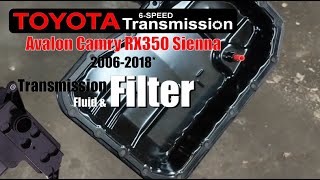
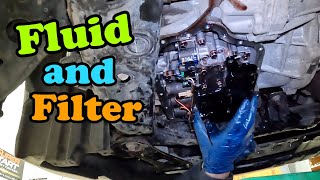
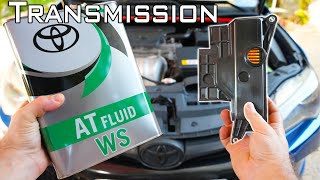
Typical fix: Perform a transmission fluid drain-and-fill or a full fluid exchange, and replace the filter. Use only the correct Toyota-specific fluid 🎬 Watch: Step-by-step 6-speed fluid and filter change guide. (T-IV or WS, depending on the year/model). This is the best first step and may resolve the issue alone.
Est. part cost: $50-$150 - Failed Shift Solenoid 'A' (S1/SL1) 🔴 High Probability → Shop Transmission Valve Body Solenoids are an electro-mechanical part with a finite lifespan and are a known failure point on many Aisin-Warner transmissions used by Toyota, especially after 80,000-150,000 miles. Internal wear or contamination from dirty fluid can cause the solenoid's plunger to stick or the coil to fail.
How to confirm: After dropping the transmission pan, the solenoid can be tested. Check its resistance with a multimeter (for U660E/U760E, SL solenoids are often 5.0-5.6 ohms, but other models can be 11-15 ohms; always verify specs). A more definitive test is to apply 12V directly to the solenoid terminals and listen for a solid 'click'. No click or a weak click indicates a faulty solenoid.
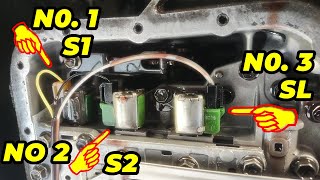
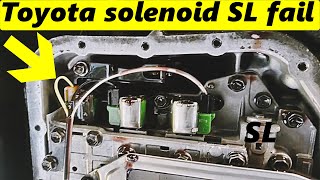
Typical fix: Replace the faulty shift solenoid. 🎬 See this walkthrough on how to replace the solenoid. It is located on the valve body inside the transmission. It is highly recommended to also replace the transmission filter and pan gasket at the same time.
Est. part cost: $80-$250 - Clogged Transmission Filter or Valve Body Passages 🟡 Medium Probability → Shop Transmission Assembly Debris from normal clutch and torque converter wear accumulates in the fluid. If the fluid isn't changed, this material can clog the filter or the small passages within the valve body, restricting fluid flow to and from the solenoid, causing performance codes.
How to confirm: This is usually discovered during the solenoid replacement. The transmission pan will have excessive metallic sludge or clutch material (a small amount of fine grey material is normal). Passages in the valve body may be visibly blocked upon inspection.
Typical fix: Replace the transmission filter and clean the valve body passages with an appropriate solvent while replacing the faulty solenoid. In severe cases, the valve body may need to be removed for a thorough cleaning or replacement.
Est. part cost: $20-$50 (Filter/Gasket Kit)
Rare But Worth Checking
- Faulty Wiring or Connector: The wiring harness leading to the transmission can become damaged from heat, vibration, or road debris, causing an open or short in the solenoid circuit. The internal harness within the transmission can also fail. Check the external connector for corrosion or damage before dropping the pan.
- Failing Transmission Control Module (TCM) or ECM/PCM: → Shop Transmission Assembly While rare, the driver circuit within the control module that controls the solenoid can fail. On U660E models, the TCM is bolted directly to the transmission case and can be susceptible to heat and vibration, leading to failure. This is typically the last item to suspect after all other possibilities have been exhausted.
- Internal Transmission Wear (U660E): → Shop Transmission Assembly On higher-mileage V6 models with the U660E transmission, P0751 can be a symptom of a more serious underlying issue. Wear in the main case bearing bore can lead to metal debris circulating in the fluid, which then causes solenoid and valve body problems. If the pan contains significant metal shavings, a simple solenoid replacement will not be a long-term fix.
Diagnosis Steps
- Check and verify the transmission fluid level and condition. If low or very dirty/burnt, perform a fluid and filter change first, clear the code, and re-test. This simple step solves the problem in many cases.
- Use a professional scan tool to check for other transmission-related trouble codes and to monitor live data from the transmission sensors.
- Inspect the external transmission wiring harness and connector for any signs of damage, corrosion, or loose pins.
- If the fluid is clean and the wiring looks good, the next step is to drain the fluid and remove the transmission pan.
- Visually inspect the fluid in the pan and the magnets for excessive metal shavings or clutch material. A small amount of fine, grey paste is normal, but large flakes or chunks indicate a serious internal failure.
- Locate Shift Solenoid 'A' (S1/SL1) on the valve body. The exact location varies by transmission model; consult a model-specific repair manual or diagram.
- Test the solenoid's resistance with a multimeter. Compare the reading to the manufacturer's specification (e.g., 5.0-5.6 ohms for some U660E/U760E solenoids, 11-15 ohms for others). An out-of-spec or open-circuit reading confirms a bad solenoid.
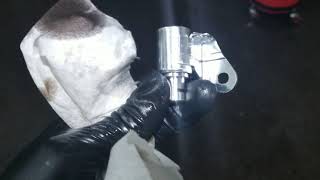
- If resistance is good, you can carefully apply a 12V power source to the solenoid to listen for a distinct click. 🎬 Watch: How to diagnose a stuck S1 shift solenoid. No click means it's mechanically stuck.
- If the solenoid tests good, the issue may be a clogged valve body, a fault in the internal wiring harness, or, in rare cases, the TCM/ECM.
- Replace the solenoid if it fails any test, along with the transmission filter and pan gasket. Ensure you use the correct OEM-spec fluid for refilling.
Parts You'll Likely Need
- Shift Solenoid 'A' (S1/SL1)
(OEM #Varies by transmission. For U660E/U760E, it is often Toyota P/N 35210-33030 or 35210-73010. Always verify with VIN.)— This is the component directly identified
Related Codes That Often Appear With This One
- P0756 — This code indicates a similar performance fault with Shift Solenoid 'B'. When multiple solenoid codes appear (e.g., P0751, P0756, P0761), it often points to a widespread issue like dirty fluid, a clogged filter, a failing valve body, or a wiring harness problem rather than multiple individual solenoids failing at once.
- P0715 — This code relates to the Input/Turbine Speed Sensor. A fault here can prevent the ECM from correctly determining the gear ratio, which can sometimes trigger a performance code like P0751 because the computer cannot verify if the shift commanded by the solenoid actually occurred.
- P2714 — This code is for 'Pressure Control Solenoid 'D' Performance/Stuck Off'. Like other solenoid codes, its presence alongside P0751 points towards a more systemic transmission problem, often fluid or valve body related.
Technical Service Bulletins (TSBs) & Recalls
- While no specific TSB for P0751 on this exact range was found, Toyota has issued numerous TSBs for shifting issues and software updates for the U660E/U760E transmissions. For example, T-SB-0023-12 addresses shift flare on some 2012 Camry models with the U760E, involving a TCM software update. This highlights that drivability issues are sometimes software-related.
Platform-Specific Known Issues
- U660E Transmission Case Wear: → Shop Transmission Assembly On V6 models (2007-2013) equipped with the U660E, a known issue is wear of the counter drive gear bearing bore in the transmission case. This allows the bearing to move, creating fine metal debris that circulates through the transmission. This debris clogs solenoids and valve body passages, leading to codes like P0751 and erratic shifting. If significant metal is found in the pan, a simple solenoid replacement is not a permanent fix; the case may need repair or replacement.
- U660E/U760E Torque Converter Shudder: → Shop Automatic Transmission Torque Converter These 6-speed transmissions are also known for developing a torque converter clutch (TCC) shudder, often felt between 25-50 mph under light throttle. While not directly P0751, the conditions that cause it (worn fluid, valve body issues) are related. Sometimes a fluid exchange with genuine Toyota WS fluid can resolve it.
Mechanic-Grade Diagnostic Values
- Shift Solenoid 'A' (S1/SL1) Resistance — expected: 11 to 15 Ohms at 68°F (20°C) for many Toyota transmissions. However, U660E/U760E SL-type solenoids are lower, around 5.0-5.6 Ohms.. Failure: A reading of 0 ohms (short circuit), infinite/OL (open circuit), or a value significantly outside the specified range indicates a failed solenoid coil.
- Solenoid Power Supply Voltage — expected: Approximately 12V (Battery Voltage) at the solenoid's power supply pin with the key on.. Failure: Voltage below 12V or a reading greater than 0.5V on the ground side suggests a wiring issue, corrosion, or a bad ground, not necessarily a bad solenoid.
Hidden / Shadow Codes Worth Checking
- Mode $06, Test ID: Toyota's 'Check Mode' can be enabled with a scan tool like Techstream. It places the TCM in a high-sensitivity mode where codes that normally require two drive cycles to set will trigger immediately upon fault detection. This is useful for verifying an intermittent fix without extensive road testing. (see via Toyota Techstream or other advanced, bidirectional scan tool with access to manufacturer-specific functions.)
Scan Tool Commands That Help
- Toyota Techstream: Active Test: 'Control the Shift Position' — This allows a technician to command specific gear shifts (e.g., 1-2, 2-3) while driving at low speed (<31 mph) to confirm if the solenoid is physically responding. If the transmission fails to shift when commanded, it points strongly to a mechanical or hydraulic issue with that solenoid's circuit.
- Toyota Techstream: Active Test: 'Solenoid (SL1)' — When the vehicle is stopped, this test directly energizes and de-energizes the target solenoid. The technician should be able to hear a 'click' from the transmission pan. No click confirms a dead solenoid or a complete wiring failure.
- Toyota Techstream / Advanced Scan Tool: Reset Memory / Transmission Adaptation Reset — This function must be performed after replacing a solenoid, valve body, or the transmission. It clears the learned shift pressure and timing values. Failure to do this can result in harsh or erratic shifting with the new parts as the TCM attempts to use old, incorrect data.
Wiring & Ground Locations
- ECM/TCM Connector Pins — At the main Engine Control Module or Transmission Control Module, which can be under the hood or inside the cabin.. For a 2007 Camry with a 2GR-FE (V6/U660E), the SL1+ and SL1- wires can be found at the ECM connector. A wiring diagram for the specific year and engine is critical to test for continuity between the ECM/TCM and the main transmission harness connector to rule out a wiring break.
- Transmission Case Connector — The main electrical connector on the outside of the transmission case.. This is the primary point to test the solenoid circuit without dropping the pan. You can check resistance and voltage for the SL1 circuit here. Corrosion or bent pins at this connector are a common point of failure.
Real Owner Repair Stories
- Toyota Tundra Forum (similar Aisin transmission) (Toyota Tundra with high mileage (241k miles)) — Check engine light with solenoid codes.
✅ What actually fixed it The owner replaced two solenoids (S1 and S4) using aftermarket Rostra parts. This resolved the codes and restored normal shifting. The owner noted the repair was easier than expected and that the aftermarket parts were visually identical to OEM.
OEM Part Supersession History
35210-73010→35210-33030— Part number consolidation and potential design revision for the Clutch Control Solenoid used as SL1 in U660E/U760E transmissions.
Heads up: These parts are generally interchangeable for the specified applications, but it's always critical to verify the correct part for the specific transmission (U660E vs U760E) and year.
Model Year Variations Within This Range
- 2007-2009 (U660E): The U660E transmission used in V6 Camrys from 2007-2009 had a TCM bolted directly to the transmission case, making it susceptible to heat and vibration failures. Later models integrated the TCM functions into the main ECM/PCM inside the vehicle.
- 2010+ (U760E): The U760E was introduced for 4-cylinder models starting in the 2010 model year to replace the 5-speed. While similar to the U660E, it has differences in the valve body and internal components to match the lower torque of the 4-cylinder engine.
Diagnostic Flowchart
Other Known Issues on This Vehicle
Issues unrelated to this code that are worth knowing about as an owner of this generation:
- Excessive Oil Consumption (2AZ-FE Engine) 🔴 High — Very common on 2007-2011 4-cylinder models with the 2AZ-FE engine, often starting around 80k-100k miles. (Ref: Toyota initiated a Warranty Enhancement Program (ZE7) for this issue, but it has since expired. The cause is defective piston ring design.)
- Melting / Sticky Dashboard (XV40 Generation) 🟠 Medium — Widespread on 2007-2011 Camrys, especially in hot, humid climates. The dashboard material degrades, becoming shiny, sticky, and prone to cracking. (Ref: Toyota offered a Warranty Enhancement Program (ZJE) to replace the dashboards, but this program has also expired.)
- U660E Transmission Hesitation/Flare 🟠 Medium → Shop Transmission Assembly — Common on V6 models (2007-2013) as they accumulate mileage. Can manifest as a 'flare' (engine RPMs jump) during the 2-3 or 3-4 shift, or a harsh coasting downshift. (Ref: Various TSBs were released for software updates to address shift quality, but underlying wear is often the cause in higher-mileage vehicles.)
- Head Bolt Thread Stripping (2AZ-FE Engine) 🔴 High — A known, though less frequent than oil consumption, issue on 2004-2008 4-cylinder models. The head bolt threads in the engine block can pull out, leading to a blown head gasket.
Used vs. New Parts: Buying Guide for This Vehicle
When a used part is the smart pick: For this repair, a used part is generally not recommended for the solenoid itself due to its high failure rate and the significant labor involved to access it. A complete, low-mileage used valve body assembly from a reputable salvage yard can be a cost-effective alternative to buying multiple new OEM solenoids, as it often comes with all solenoids included.
Donor-vehicle mileage cap: roughly under 80000 miles for the part to have meaningful remaining life.
What to inspect on the donor part:
- Verify the donor vehicle's mileage and check its history for accidents, especially front-end collisions.
- Ask the seller to drain a small amount of fluid; it should not be black, smell burnt, or contain visible metal flakes.
- Ensure the valve body comes from the exact same transmission model (e.g., U660E and U760E parts are not always interchangeable).
OEM-only on this vehicle (don't cheap out):
- Transmission Fluid (Toyota T-IV or WS)
- Transmission Filter (OEM or OEM-supplier like Aisin is highly recommended)
Aftermarket brands forum-validated for this vehicle:
- Rostra: Frequently mentioned in forums as a reliable and cost-effective alternative to OEM for shift solenoids.
- Aisin: Aisin is the original equipment manufacturer (OEM) for Toyota transmissions, so their parts are equivalent to genuine Toyota parts.
Brands owners have reported issues with on this vehicle:
- Unnamed, no-brand 'white box' solenoids from online marketplaces can have high failure rates and incorrect resistance values, leading to repeat repairs.
Real Owner Stories
Aggregated from forums and TSBs cited above. Mileages and costs reflect what owners reported in those sources.
2007 Toyota Camry V6 — ~120000 miles
Symptoms: Experienced P0751 and P2714 codes simultaneously.
What fixed it: Replaced the SL1 and SL4 solenoids along with a fluid change.
Source hint: ToyotaNation Forum - Thread 'P0751 and P2714 on 2007 Camry V6'
2009 Toyota Camry 4-cylinder — ~100000 miles
Symptoms: Harsh shifting and a P0751 code. A fluid change alone did not resolve the issue.
What fixed it: Replaced the SL1 solenoid.
Source hint: ToyotaNation Forum - Thread '2009 Camry 4cyl Transmission Problem P0751'
Related OBD-II Codes
Frequently Asked Questions
My 2012 Camry has a shift flare; is there a software update for this?
What type of transmission fluid should I use for my 2004-2013 Camry to prevent P0751?
I have a V6 Camry with P0751 and found metal flakes in the pan. Is replacing the solenoid enough?
How often should I change the 'lifetime' fluid in my Camry to avoid solenoid issues?
Can I test the Shift Solenoid 'A' (S1/SL1) myself before buying a new one?
Helpful Videos


The information in this article is provided for general reference and educational purposes only. Vehicle specifications, procedures, and part compatibility can vary by production date, trim level, and region. Always consult your vehicle's factory service manual and verify part numbers before purchasing or performing repairs. Safety-critical components such as airbags, seat belts, and braking systems should be installed by a qualified professional.
- Toyota Camry:
- 🧭 Diagnostic Flowchart
- 🎬 Helpful Videos
- What's Unique About the 2004-2013 Toyota Camry
- Symptoms You May Notice
- Most Likely Causes
- Rare But Worth Checking
- Diagnosis Steps
- Parts You'll Likely Need
- Related Codes That Often Appear With This One
- Technical Service Bulletins (TSBs) & Recalls
- Platform-Specific Known Issues
- Mechanic-Grade Diagnostic Values
- Hidden / Shadow Codes Worth Checking
- Scan Tool Commands That Help
- Wiring & Ground Locations
- Real Owner Repair Stories
- OEM Part Supersession History
- Model Year Variations Within This Range
- Other Known Issues on This Vehicle
- Used vs. New Parts: Buying Guide for This Vehicle
- Real Owner Stories
- 2007 Toyota Camry V6 — ~120000 miles
- 2009 Toyota Camry 4-cylinder — ~100000 miles
- Related OBD-II Codes
- Frequently Asked Questions
- 🎟️ Get 5% Off