

P0752 on 2018-2023 Ford Mustang: Shift Solenoid 'A' Stuck On Causes and Fixes
P0752 on a 2018-2023 Mustang with the 10R80 transmission almost always points to a faulty transmission main control (valve body). This is a well-documented issue covered by multiple Ford TSBs. The solenoids are integrated into the valve body, and sticking valves are a common failure. Expect a professional repair involving a full valve body replacement to cost between $2,500 and $5,800, depending on dealer vs. independent shop rates.
- P0752 on a 2018-2023 Mustang indicates Shift Solenoid 'A' is stuck on.
- The most probable cause is a failure of the entire transmission main control (valve body), a known issue with the 10R80 transmission.
- Symptoms include harsh/delayed shifting, a lit Check Engine Light, and potentially the vehicle entering a limited-power 'limp mode'.
- This is not a DIY-friendly repair. Professional diagnosis and service are strongly recommended.
- Ensure any replacement is with an updated OEM part and that the correct Motorcraft MERCON ULV fluid is used.
What's Unique About the 2018-2023 Ford MUSTANG
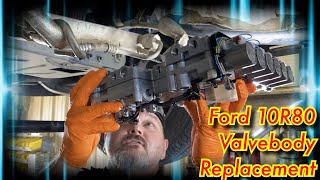
The 2018-2023 Ford Mustang uses the 10-speed 10R80 automatic transmission 🎬 Watch: A Ford technician explains common 10-speed transmission issues., co-developed with GM, which is known to have issues with its main control, commonly called the valve body. Ford has released numerous Technical Service Bulletins (TSBs) acknowledging that vehicles with this transmission may exhibit harsh or delayed shifts accompanied by a host of diagnostic trouble codes, including P0752. 🎬 See this guide on diagnosing and troubleshooting P0752 solenoid errors. The problem is so common that the primary suspect for this code is not just the single solenoid, but the entire valve body assembly it is housed in. TSB 24-2176 specifically points to sticking valves in the main control valve body as a primary cause. Another known issue with the 10R80 is the axial movement of the CDF clutch cylinder sleeve, which can also cause hydraulic leaks and shifting problems.
Diagnostic Flowchart
Tap your situation to follow the diagnostic path that matches what you're seeing on this vehicle.
Symptoms You May Notice
- Harsh or delayed gear shifts. [TSB 24-2176, TSB 26-2046]
- Harsh or delayed engagement when shifting from Park to Drive or Reverse. [TSB 22-2428, TSB 25-2018]
- Illuminated Malfunction Indicator Lamp (Check Engine Light). [TSB 24-2254]
- Transmission getting stuck in a single gear.
- Transmission slipping between shifts.
- Vehicle entering 'limp mode,' limiting engine power and vehicle speed.
- Clunking noises when coming to a stop.
- Increased fuel consumption.
- Replacing only the individual shift solenoid. While the code points to a specific solenoid, the issue on the 10R80 transmission is often with the entire valve body assembly due to sticking spool valves or internal leaks. Replacing just one solenoid is not feasible as they are integrated and will not resolve the underlying problem.
Most Likely Causes
- Defective Transmission Main Control (Valve Body) 🔴 High Probability → Shop Transmission Assembly The 10R80 transmission in this generation of Mustang has a well-documented history of valve body failures, as confirmed by multiple Ford TSBs. The solenoids are integrated into this assembly, and internal passages can become blocked or the spool valves themselves can stick within their bores due to wear or contamination, leading to hydraulic pressure loss.
How to confirm: A technician will use a high-end scan tool (like Ford's IDS/FDRS) to monitor solenoid command data and transmission fluid pressure. A specific diagnostic procedure may involve a "Main Control Valve Body Test" or an air leak test to confirm internal hydraulic leaks. If the solenoid is commanded off but remains on, and the wiring is intact, the valve body is the confirmed culprit.
Typical fix: Replacement of the entire transmission main control (valve body) assembly with an updated part, followed by a fluid fill, software programming, and an adaptive learning drive cycle.
Est. part cost: $500-$1200 - Low or Contaminated Transmission Fluid 🟡 Medium Probability → Shop Transmission Assembly While not specific to this platform, low fluid levels can cause pressure issues, and contaminated fluid (from internal wear or moisture) can cause solenoid valves to stick. The 10R80 is sensitive to fluid condition and level and requires a specific fluid, Motorcraft MERCON ULV.
How to confirm: Check the transmission fluid level and condition. The 10R80 transmission does not have a traditional dipstick, so this must be done by a technician from underneath the vehicle with the vehicle at a specific temperature. The fluid should be clean, red, and free of debris or a burnt smell.
Typical fix: Perform a transmission fluid and filter change using the correct Motorcraft MERCON ULV fluid (Part # XT-12-QULV). If a leak is present, it must be repaired.
Est. part cost: $150-$300 - Wiring or Connector Issue ⚪ Low Probability Not a platform-specific issue, but damage to the transmission wiring harness or corrosion in the connectors can cause a short to power, leading the solenoid to remain powered on when it shouldn't be.
How to confirm: Visually inspect the wiring harness leading to the transmission for any signs of damage, melting, or corrosion. A multimeter is used to check for continuity and shorts in the circuit for Shift Solenoid 'A'.
Typical fix: Repair the damaged section of wiring or replace the faulty connector.
Est. part cost: $50-$300
Rare But Worth Checking
- Powertrain Control Module (PCM) Failure: This is very rare. The PCM's internal driver for the solenoid could fail and continuously send voltage, but all other possibilities, especially the valve body, should be exhausted before considering PCM replacement.
Diagnosis Steps
- Verify the code with a professional OBD-II scanner that can read transmission-specific data.
- Check for any related Technical Service Bulletins (TSBs) for the vehicle's VIN. TSB 24-2176 is a key document for this issue.
- Check the transmission fluid level and condition. This must be done by a qualified technician as there is no dipstick. The fluid must be the correct MERCON ULV type.
- Inspect the transmission wiring harness and connectors for any visible damage, corrosion, or loose connections.
- Use a scan tool to command Shift Solenoid 'A' on and off while monitoring its status to see if it is physically sticking. Monitor related transmission PIDs (Parameter IDs) for solenoid state and gear command vs. actual gear.
- If the fluid and wiring are good but the solenoid is unresponsive or stuck, the primary suspect is the main control (valve body). A hydraulic pressure test or vacuum test of the valve body circuits can provide definitive proof of internal leakage.
- If TSBs point to the CDF clutch cylinder sleeve, further internal transmission diagnosis may be required.
Parts You'll Likely Need
- Transmission Main Control (Valve Body)
(OEM #JL3Z-7A100-C)— This is the most common failure point for this code on the 10R80 transmission, as documented in multiple Ford TSBs. The solenoids are integrated into this unit. This part number supersedes JL3Z-7A100-A.
Trusted brands: Motorcraft
OEM price range: $700-$1100
Aftermarket price range: N/A - Transmission Fluid
(OEM #XT-12-QULV)— The system must be refilled with approximately 8-10 quarts of the correct Motorcraft MERCON ULV fluid after replacing the valve body.
Trusted brands: Motorcraft
OEM price range: $15-$25 per quart
Aftermarket price range: $12-$20 per quart - Transmission Pan Gasket and Filter
(OEM #HL3Z-7A191-B (Gasket), HL3Z-7A098-A (Filter))— These should be replaced any time the transmission pan is removed for service.
Trusted brands: Motorcraft
OEM price range: $100-$150
Aftermarket price range: $60-$100
Related Codes That Often Appear With This One
- P0751 — This code indicates Shift Solenoid 'A' Performance/Stuck Off. It's common to see related codes for the same solenoid or other shift solenoids as the valve body begins to fail.
- P0729, P0731-P0734 — These are incorrect gear ratio codes. They often appear with solenoid codes because a stuck solenoid prevents the transmission from achieving the correct gear, causing a mismatch between expected and actual gear ratios. [TSB 24-2176, 22]
- P2700-P2708 — These codes relate to the timing and performance of various transmission clutch apply elements. A faulty valve body and resulting pressure control issues can trigger these codes alongside P0752. [TSB 22-2428]
- P1744, P0741 — These codes relate to the Torque Converter Clutch (TCC) system. Valve body issues can cause erratic TCC operation and lead to these codes appearing alongside solenoid faults.
Technical Service Bulletins (TSBs) & Recalls
- TSB 24-2176: Supersedes previous TSBs. Mentions harsh/delayed engagement and shifts with a long list of DTCs
Platform-Specific Known Issues
- Ford has issued multiple Technical Service Bulletins (e.g., TSB 24-2176, TSB 22-2428) for 2018-2023 Mustangs with the 10R80 transmission that exhibit harsh/delayed shifts and store DTCs including P0752. The recommended repair often involves replacing the main control (valve body) and performing a specific fluid flush and adaptive learning procedure.
- Some owner experiences on forums like F150Forum.com (for the same transmission) report dealer quotes for valve body and torque converter replacement ranging from $5,000 to over $7,000, though some have negotiated lower prices.
Mechanic-Grade Diagnostic Values
- Shift Solenoid 'A' Resistance — expected: 12 - 28 Ohms. Failure: A reading of 0 Ohms, infinite resistance (OL), or a value outside the specified range indicates a faulty solenoid.
- Wiring Harness Continuity Check — expected: 0 Ohms (or very close to zero). Failure: A high resistance or infinite (OL) reading indicates an open or short in the wiring harness that needs to be repaired.
Hidden / Shadow Codes Worth Checking
- P163E: Transmission Control Module (TCM) Software Incompatibility. This code can appear after replacing the main control valve body. (see via This is a standard DTC that will appear with a check engine light if the new valve body's solenoid strategy file is not programmed correctly into the vehicle's computer. It is often seen after the primary repair for P0752 is attempted. TSB 22-2339 addresses this specific issue.)
Scan Tool Commands That Help
- FORScan, Ford IDS/FDRS: Clear Transmission Adaptive Tables / Reset KAM — This function should be used after any transmission repair, including valve body replacement or fluid changes, to erase the learned shift patterns. It is a prerequisite to performing the adaptive learning drive cycle.
- Ford IDS/FDRS, capable J2534 tools: Solenoid Strategy Programming — This is mandatory when a new main control (valve body) is installed. The technician must input the 13-digit solenoid strategy number (and sometimes a 12-digit ID) from the new part into the PCM/TCM to ensure proper operation. Failure to do so will result in poor shifting and may set other codes like P163E.
- Scan Tool (as part of a procedure): Adaptive Learning Drive Cycle — This is not a single command, but a specific, multi-step driving procedure that must be performed after clearing adaptive tables. It allows the TCM to relearn clutch fill times and shift pressures for smooth operation. The procedure involves a sequence of gentle accelerations, braking, and shifting between gears.
- FORScan: Halt Transmission Adaptive Learning — Some owners use this function to 'lock in' the transmission's learned behavior after it has achieved a period of smooth shifting, preventing it from further adapting in ways that might re-introduce harshness. This is an advanced user function.
Wiring & Ground Locations
- Transmission Main Connector (C175T at PCM) — This is one of the main connectors at the Powertrain Control Module (PCM).. The signals for the shift solenoids originate from the PCM. A poor connection or corrosion at the specific pin for Shift Solenoid 'A' on this connector could cause the fault. A wiring diagram is required to identify the exact pin.
Real Owner Repair Stories
- F150Forum.com user (2018 Ford F-150 (with 10R80 transmission)) — Not specified, but resulted in a valve body replacement.
❌ Tried (didn't work) Initial attempts to program the new valve body's solenoid strategy using both FORScan and the official Ford FJDS software.
✅ What actually fixed it The user was getting a 'Solenoid Not Found' error from Ford's servers during the programming procedure, indicating a data mismatch or server-side issue. The final resolution was not posted, but it highlights a critical potential roadblock in the repair process where the standard fix (valve body replacement and programming) fails due to software/data issues. - YouTube channel 'Zoom Automotive' (2017 Ford F-150 3.5L EcoBoost (with 10R80 transmission)) — Shifting issues and a solenoid 'A' code.
❌ Tried (didn't work) Initial diagnostics pointed towards the solenoid.
✅ What actually fixed it Upon disassembling the valve body, the technician found that the solenoid's mechanical actuator was physically sticking and hanging up inside the valve body. This confirmed the root cause was a mechanical failure within the valve body assembly, not just an electrical issue with the solenoid itself. Replacement of the valve body and successful programming of the new solenoid strategy resolved the issue.
When the Usual Fixes Don't Work
- While the CDF drum is a known failure point, replacing it may not be a silver bullet for all shift quality issues. One owner of a 2020 vehicle reported that even after a CDF drum replacement, they continued to experience firm/jerky shifts, suggesting that other factors (like valve body condition or software calibration) can still cause undesirable symptoms.
OEM Part Supersession History
Unknown (Early 10R80 CDF Drums)→Updated CDF Drum Assembly— The original design allowed an internal sleeve/bushing to walk out of position, causing hydraulic leaks. The updated part has a machined lip on the inner half of the drum to physically prevent the sleeve from moving.
Heads up: This is an internal transmission component requiring a full teardown to replace.
Model Year Variations Within This Range
- 2018-2022: Vehicles produced before mid-August 2022 are more susceptible to the CDF drum sleeve failure. Models produced after this date (primarily 2023 and later) are more likely to have the redesigned CDF drum from the factory, reducing the probability of this specific mechanical failure.
- 2018 vs. later models: Anecdotal evidence from owners suggests that earlier model years (e.g., 2018) of the 10R80 transmission exhibit more harsh and unpredictable shifting behavior compared to later model years, which may be due to progressive software and adaptive learning refinements by Ford.
Helpful Videos

We Have This Part in Stock


The information in this article is provided for general reference and educational purposes only. Vehicle specifications, procedures, and part compatibility can vary by production date, trim level, and region. Always consult your vehicle's factory service manual and verify part numbers before purchasing or performing repairs. Safety-critical components such as airbags, seat belts, and braking systems should be installed by a qualified professional.
- Ford MUSTANG:
- 🧭 Diagnostic Flowchart
- 🎬 Helpful Videos
- 🛍️ Shop This Part
- What's Unique About the 2018-2023 Ford MUSTANG
- Symptoms You May Notice
- Most Likely Causes
- Rare But Worth Checking
- Diagnosis Steps
- Parts You'll Likely Need
- Related Codes That Often Appear With This One
- Technical Service Bulletins (TSBs) & Recalls
- Platform-Specific Known Issues
- Mechanic-Grade Diagnostic Values
- Hidden / Shadow Codes Worth Checking
- Scan Tool Commands That Help
- Wiring & Ground Locations
- Real Owner Repair Stories
- When the Usual Fixes Don't Work
- OEM Part Supersession History
- Model Year Variations Within This Range
- 🎟️ Get 5% Off