

P0756 on 2008-2012 GMC Sierra Denali: Shift Solenoid 'B' Causes and Fixes
On a 2008-2012 GMC Sierra Denali, code P0756 usually points to a problem with the 2-3 shift solenoid 'B' (SS2) or its circuit. Common causes include low/dirty fluid, a faulty solenoid, or a blocked valve body, a known issue highlighted in GMC Technical Service Bulletins where aftermarket filter material clogs passages. [Bulletin #PIP5100A] A solenoid replacement can cost $200-$400, while valve body work is significantly more.
- P0756 on your Sierra Denali indicates a serious transmission problem with the 2-3 shift solenoid 'B' circuit.
- Do not continue to drive the vehicle, as this can lead to severe and expensive transmission damage.
- The most common causes are low/dirty fluid, a faulty solenoid, or a blocked valve body—a known issue documented in GM Technical Service Bulletins.
- Diagnosis should start with the easiest and most common items: checking the transmission fluid level and condition.
- Due to the complexity of internal transmission work, this repair is best left to a professional mechanic.
What's Unique About the 2008-2012 Gmc SIERRA DENALI
The 2008-2012 GMC Sierra Denali uses the GMT900 platform, typically equipped with a 6-speed 6L80 (RPO code MYC) automatic transmission. While the P0756 code is generic, this platform has specific vulnerabilities documented by GM. Technical Service Bulletins (TSBs) like #PIP5100A explicitly warn that fibrous material from aftermarket spin-on transmission filters can break down and clog small orifices in the valve body separator plate, directly causing this code. [Bulletin #PIP5100A] This makes it crucial to look beyond just the solenoid itself and consider the entire hydraulic circuit, as simply replacing the solenoid without cleaning the valve body will not resolve the issue.
Diagnostic Flowchart
Tap your situation to follow the diagnostic path that matches what you're seeing on this vehicle.
Symptoms You May Notice
- Check Engine Light is on
- Transmission stuck in one gear (limp mode), often 2nd or 3rd gear
- Harsh, delayed, or failed shifts, particularly the 1-2 or 2-3 shift
- Vehicle will not move in forward or reverse in severe cases [Bulletin #PIP5100A]
- Transmission slipping between gears
- Reduced fuel economy
- Transmission overheating warning light
- Inability to use manual shift (TAP shift) functions
- Replacing the shift solenoid without checking for a clogged valve body or contaminated fluid. The new solenoid will fail to operate correctly if the underlying hydraulic issue is not resolved, leading to the code returning quickly.
Most Likely Causes
- Low or Dirty Transmission Fluid 🔴 High Probability → Shop Transmission Assembly Fluid is the lifeblood of the transmission. Over time, it breaks down and collects clutch material and metal shavings, which can clog small passages in the valve body or cause solenoids to stick.
How to confirm: Check the transmission fluid level and condition using the dipstick. The fluid should be red and clear, not dark brown, black, or smell burnt.
Typical fix: Perform a transmission fluid and filter change using DEXRON-VI fluid. If the fluid is heavily contaminated, a full flush may be needed, but this can sometimes dislodge more debris and worsen the problem.
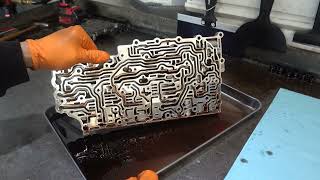
Est. part cost: $50-$150 - Blocked Valve Body Separator Plate Orifices 🔴 High Probability → Shop Transmission Valve Body GMC TSBs #PIP5100 and #PIP5100A specifically mention that debris, sometimes from aftermarket spin-on filters breaking down, can block orifices in the valve body separator plate, leading to P0756 and other codes. [Bulletin #PIP5100A, Bulletin #PIP5100] This prevents proper hydraulic flow.
How to confirm: This requires removing the transmission pan and valve body to physically inspect the separator plate for blockages. A related diagnostic step is to inspect the clutch select valve #3 in the lower valve body for sticking or wear.
Typical fix: Clean or replace the valve body separator plate and remove the source of debris. This often involves a full valve body service and switching to an OEM filter.
Est. part cost: $100-$300 for plates/gaskets - Faulty Shift Solenoid 'B' 🟡 Medium Probability → Shop Transmission Valve Body
How to confirm: After checking the fluid, a mechanic will test the solenoid's resistance with a multimeter (typically should be 10-30 Ω). A scan tool can also be used to command the solenoid on and off to check its response.
Typical fix: Replace the faulty shift solenoid. This is located inside the transmission pan, attached to the valve body. Often, it is part of a larger solenoid block/assembly.
Est. part cost: $50-$150 for a single solenoid, more for an assembly - Wiring or Connector Issues ⚪ Low Probability
How to confirm: Visually inspect the wiring harness leading to the transmission for any signs of damage, corrosion, or loose connections. Test for continuity from the TCM to the solenoid connector.
Typical fix: Repair or replace the damaged section of the wiring harness or clean the connectors.
Est. part cost: $20-$200
Rare But Worth Checking
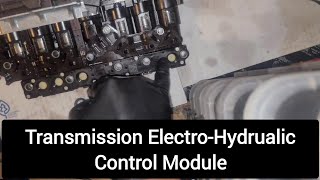
- Faulty Transmission Control Module (TCM): → Shop Transmission Assembly This is rare and should only be considered after all other possibilities have been ruled out. In the 6L80, the TCM is located inside the transmission, mounted to the valve body, and is often replaced as a complete assembly with the solenoids. A faulty TCM often presents with multiple, erratic codes. [Bulletin #PIP4379M]
- Internal Mechanical Failure: Worn clutch packs, a cracked drum, or a damaged transmission pump can create debris that leads to this code or cause pressure losses. This is usually accompanied by more severe symptoms like grinding noises, significant metal in the pan, or total loss of movement.
Diagnosis Steps
- Check for any Technical Service Bulletins (TSBs) related to your vehicle's VIN, specifically #PIP5100A and #PIP4379M.
- Scan the computer for all codes and record freeze frame data to understand the conditions when the fault occurred.
- Check the transmission fluid level and condition. If low or dirty, correct this first, clear the codes, and re-test. Fluid should be bright red and not smell burnt.
- Inspect the transmission wiring harness and connectors for any visible damage, corrosion, or loose pins.
- If the fluid and wiring are good, drop the transmission pan to inspect for excessive metal shavings or debris. A small amount of fine grey material is normal, but large flakes or chunks indicate serious internal problems.
- With the pan off, test the resistance of Shift Solenoid 'B' with a multimeter. Compare the reading to manufacturer specifications (typically 10-30 ohms).
- If solenoid resistance is out of spec, it needs replacement. If it's within spec, the problem is likely mechanical or hydraulic.
- CRITICAL: Remove and inspect the valve body and separator plate for debris and blockages, paying close attention to the small orifices as indicated by GM TSBs. [Bulletin #PIP5100A]
- Inspect the clutch select valve #3 bore in the valve body for scoring or sticking, which can cause this code.
- If all else fails, the issue may lie with the Transmission Control Module (TCM), which is inside the pan on the valve body and requires advanced diagnostics or replacement.
Parts You'll Likely Need
- Transmission Control Module (TCM) / Solenoid Body Assembly
(OEM #24256523)— In many 6L80 transmissions, the TCM and all solenoids are integrated into a single unit on the valve body. Given the high probability of issues beyond a single solenoid, replacing the entire assembly is a common and robust repair. This part number is for the Gen 1 assembly used in early models.
Trusted brands: ACDelco (OEM), Dorman (Remanufactured)
OEM price range: $350-$500
Aftermarket price range: $250-$400 - Transmission Valve Body Separator Plate
(OEM #24272467)— As per GM TSBs, the orifices in this plate can become clogged with debris, causing this code. It may need to be cleaned or replaced during a valve body service.
Trusted brands: ACDelco, TransGo
OEM price range: $60-$120
Aftermarket price range: $40-$80 - Transmission Filter Kit (Internal) — Always replaced during any service that requires dropping the transmission pan. A clogged filter can cause fluid pressure issues. It is critical to use a high-quality OEM or equivalent filter to prevent filter media breakdown.
Trusted brands: ACDelco, Wix, ATP
OEM price range: $40-$70
Aftermarket price range: $20-$40 - DEXRON-VI Automatic Transmission Fluid — The correct fluid is required when dropping the pan or flushing the system. Using the wrong fluid can cause shifting problems and damage the transmission.
Trusted brands: ACDelco, Valvoline, Castrol
OEM price range: $8-$15 per quart
Aftermarket price range: $6-$12 per quart
Related Codes That Often Appear With This One
- P0700 — P0700 is a general Transmission Control System Malfunction code. The TCM sends this code to the ECM to turn on the Check Engine Light when any transmission-specific fault, like P0756, is detected.
- P0751 — This code relates to Shift Solenoid 'A'. It's common to see codes for multiple solenoids if the root cause is widespread, such as dirty fluid, a blocked valve body, or a failing TCM. [Bulletin #PIP4379M]
- P0776 — This code points to a problem with the Pressure Control Solenoid 'B'. Like P0751, its appearance with P0756 suggests a systemic issue within the transmission's hydraulic control system, possibly related to debris or valve body wear. [Bulletin #PIP4379M]
Technical Service Bulletins (TSBs) & Recalls
- PIP4379M: Addresses multiple transmission codes including P0756 related to no reverse or range inhibit.
- PIP5100A: Links P0756 to no-move conditions and points to inspecting the valve body separator plate for blockage from aftermarket filters.
- PIP5100: A similar bulletin to PIP5100A, also pointing to debris in the valve body separator plate orifices.
Platform-Specific Known Issues
- The "Temporary Fix" Cycle: A recurring theme in owner forums is replacing the shift solenoids, which resolves the P0756 code and shifting issues for a short period, often just one drive cycle. The problem then returns once the vehicle cools down and is restarted. This strongly indicates the root cause is not the solenoid itself, but rather debris in the valve body that re-settles and causes the new solenoid to malfunction, or a cracked/worn valve bore.
- Aftermarket Filter Debris: TSB #PIP5100A is frequently validated by owner experiences. Mechanics and DIYers report finding fibrous debris from non-OEM transmission filters clogging the small orifices in the valve body separator plate. [Bulletin #PIP5100A] This blockage prevents correct hydraulic pressure from reaching the shift solenoid's circuit, triggering the P0756 code even if the solenoid is perfectly functional. The fix requires dropping the valve body to clean or replace the plate.
- Stuck in 2nd or 3rd Gear Limp Mode: When P0756 is set on the 6L80 transmission, the TCM often commands a default gear to protect the transmission from further damage. Owners report the truck being stuck in either 2nd or 3rd gear. Manually shifting may not work, and the truck will have very sluggish acceleration from a stop. This is a clear safety and drivability issue requiring immediate attention.
Mechanic-Grade Diagnostic Values
- Shift Solenoid 'B' (SS2) Resistance — expected: 20 - 40 Ω. Failure: A reading outside this range indicates a failed solenoid coil.
- Pressure Control Solenoid (PWM type) Resistance — expected: 3 - 8 Ω. Failure: This applies to other solenoids in the TEHCM; seeing multiple out-of-spec readings points to a failing TEHCM.
- Shift Solenoid 'B' (SS2) Current Draw — expected: 0.3 - 0.7 Amps at 12V. Failure: Incorrect amperage suggests an electrical failure within the solenoid.
- TCM/TEHCM Solenoid Feed Voltage — expected: 8.3 - 9.3 Volts. Failure: Incorrect voltage from the TCM indicates a fault within the control module itself.
- TEHCM Pressure Switch Test (switch depressed) — expected: Continuity or ~10 Ω. Failure: An open circuit (OL) when the switch is manually depressed indicates a faulty switch membrane or contact within the TEHCM.
Scan Tool Commands That Help
- GDS2 / Tech2: Solenoid Cleaning Process — Before replacing the TEHCM for a performance code, this function can be used to cycle all solenoids in an attempt to flush out minor debris that may be causing a valve to stick.
- GDS2 / Tech2 or equivalent: Transmission Adaptive Pressure (TAP) Reset / Fast Relearn — This is mandatory after replacing the TEHCM, valve body, or rebuilding the transmission. It resets all learned shift parameters and forces the TCM to perform a calibration drive cycle to learn clutch fill volumes and ensure smooth shifts.
- GM MDI2 or J2534 Pass-Thru Device: TCM/TEHCM Programming — When installing a new or remanufactured TEHCM, it must be flashed with the correct calibration file for the vehicle's specific VIN. This is done by connecting to GM's service website.
Wiring & Ground Locations
- Transmission Case Connector — The 16-pin connector is located on the passenger side of the transmission case. It is a twist-lock design.. This is the sole electrical interface for the internal TCM/TEHCM. It is commonly not fully seated after service, leading to communication errors or loss of power that can manifest as solenoid codes. It must be twisted until it clicks and the lock is engaged.
- G103 — On the front of the passenger side cylinder head.. This is a primary engine ground point. A loose or corroded connection here can cause unstable voltage and erratic behavior from engine and transmission control modules.
- G104 / G108 — On the rear of the driver's side cylinder head.. This is another critical engine-to-chassis ground point. Poor contact can lead to a variety of difficult-to-diagnose electronic issues, including TCM faults.
- G300 — Under the vehicle on a body mount near the driver's door.. This ground connects the body to the frame. While less direct, ensuring all major grounds are clean and tight is a crucial step in ruling out electrical gremlins that can affect the transmission.
Real Owner Repair Stories
- GMTNation Forum (2005 GMC Envoy (similar 4L60-E logic, but relevant)) — Sluggish performance in first gear, throwing code P0756.
❌ Tried (didn't work) Replaced both shift solenoids (A and B)., Changed transmission fluid and filter., Cleared codes by disconnecting the battery.
✅ What actually fixed it The user did not post a final resolution, but expert advice on the forum pointed directly to the next step: inspecting the valve body for stuck valves (shift valve, shuttle valve) or blocked passages, which is consistent with TSBs for the 6L80. This highlights the common misdiagnosis of replacing solenoids when the issue is hydraulic.
OEM Part Supersession History
24256523→24256797, 24287421, among others.— Standard component revisions and updates by the manufacturer.
Heads up: Part number 24256523 is a 'Gen 1' TEHCM used in early 6L80/6L90 models, identifiable by its black solenoids. It is not compatible with 'Gen 2' systems. Any replacement TEHCM must be programmed with the vehicle's VIN to function.Unknown (Pre-2010 1-2-3-4 Clutch Piston)→24258159— The original piston was prone to cracking. The updated part has a 22% larger rib area for increased strength.24246916 (Early Separator Plate)→24245720— Design update by GM.
Heads up: Using the wrong separator plate for the valve body casting can cause significant hydraulic leaks and shifting problems.
Model Year Variations Within This Range
- 2008 - Mid-2010: These models are more susceptible to the 1-2-3-4 clutch piston cracking. Models built after June 2010 received an updated, more durable piston from the factory.
- 2008-2012: All vehicles in this range use a valve body with seven check balls. In 2014, GM introduced a new valve body and separator plate design that uses eight check balls to address a clunking sensation. This later design is not relevant to this vehicle range but is important context for parts identification.
Helpful Videos

We Have This Part in Stock


The information in this article is provided for general reference and educational purposes only. Vehicle specifications, procedures, and part compatibility can vary by production date, trim level, and region. Always consult your vehicle's factory service manual and verify part numbers before purchasing or performing repairs. Safety-critical components such as airbags, seat belts, and braking systems should be installed by a qualified professional.
- Gmc SIERRA DENALI:
- 🧭 Diagnostic Flowchart
- 🎬 Helpful Videos
- 🛍️ Shop This Part
- What's Unique About the 2008-2012 Gmc SIERRA DENALI
- Symptoms You May Notice
- Most Likely Causes
- Rare But Worth Checking
- Diagnosis Steps
- Parts You'll Likely Need
- Related Codes That Often Appear With This One
- Technical Service Bulletins (TSBs) & Recalls
- Platform-Specific Known Issues
- Mechanic-Grade Diagnostic Values
- Scan Tool Commands That Help
- Wiring & Ground Locations
- Real Owner Repair Stories
- OEM Part Supersession History
- Model Year Variations Within This Range
- 🎟️ Get 5% Off