

P0757 on 2012-2013 Mazda 3: Shift Solenoid B Stuck On Causes and Fixes
On a 2012-2013 Mazda 3 with a SKYACTIV engine, code P0757 often indicates a known issue with the transmission valve body, a repair covered by a Technical Service Bulletin (TSB). For non-SKYACTIV models, the cause is more likely low fluid or a faulty individual solenoid. Valve body replacement is a complex repair that can cost over $1,500.
- For a 2012-2013 Mazda 3 with a SKYACTIV engine, P0757 strongly suggests a known valve body issue that requires replacement, not just a single solenoid.
- Always check your VIN against TSB #05-003-14-2898A if you have a SKYACTIV model.
- For all models, the first and cheapest diagnostic step is to check the transmission fluid's level and condition.
- If you have a non-SKYACTIV (MZR) engine, the problem is more likely to be a bad solenoid or low fluid, which is a less expensive repair.
- This is not a DIY-friendly repair for most people, and professional diagnosis is highly recommended to avoid unnecessary costs.
What's Unique About the 2012-2013 Mazda MAZDA3
For the 2012-2013 Mazda 3, the meaning of P0757 heavily depends on which engine and transmission you have. If your car has the 2.0L SKYACTIV engine with the 6-speed automatic (FW6A-EL), this code is a well-documented symptom of a larger problem. Mazda issued a Technical Service Bulletin (TSB 05-003-14-2898A) acknowledging that codes like P0757 are often triggered by an internal malfunction of the transmission's valve body. In this specific case, the code doesn't just point to a single bad solenoid, but to a known hardware failure in the valve body assembly, which includes the integrated TCM. For models with the standard 2.0L or 2.5L MZR engine and 5-speed automatic (FS5A-EL), the diagnostic approach is more traditional, focusing on fluid condition and the individual solenoid.
Diagnostic Flowchart
Tap your situation to follow the diagnostic path that matches what you're seeing on this vehicle.
Symptoms You May Notice
- Check Engine Light and/or the 'AT' (Automatic Transaxle) warning light is on
- Harsh, jerky, or delayed gear shifts, especially between 1-2 and 2-3.
- Transmission gets stuck in a single gear (often 3rd gear, known as 'limp mode').
- Inability to shift into or out of certain gears.
- Vehicle hesitates or engine revs high without accelerating (transmission slipping).
- Reduced fuel economy.
- Engine may stall when coming to a stop.
- Transmission overheating.
- Replacing only Shift Solenoid 'B' on a SKYACTIV model without addressing the underlying valve body issue. The TSB indicates the problem is broader than a single solenoid, and the code will likely return. The solenoids are calibrated to the specific valve body and TCM.
- Replacing the transmission. While a full replacement would fix the issue, it is often unnecessary when the documented fix is a valve body replacement, which is less expensive.
- Performing a fluid flush on a high-mileage transmission that has not been regularly serviced. In some cases, this can dislodge debris that causes new problems in the valve body.
Most Likely Causes
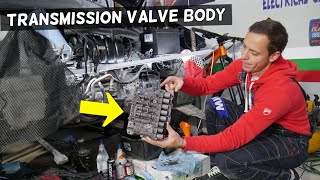
- Faulty Control Valve Body (SKYACTIV Models) 🔴 High Probability → Shop Transmission Valve Body Mazda TSB #05-003-14-2898A specifically identifies an internal malfunction in the valve body as the root cause for this and other codes on 2012-2013 Mazda 3s with the SKYACTIV 2.0L engine and 6-speed automatic transmission. The issue is often caused by wear in the aluminum valve body bores or contamination causing internal pressure switches and solenoids to stick. The valve body is a mechatronic unit that includes the solenoids and the TCM, so a failure often requires replacing the entire assembly.
How to confirm: A professional technician should confirm the vehicle's VIN falls within the range specified in the TSB (for 2012-13 Mazda3, this is JM1BL**500001 - 733727) and check for related codes like P0780 and P1738. Diagnosis involves verifying that the issue is not related to fluid or external wiring before condemning the valve body.
Typical fix: Replace the entire control valve body assembly with the updated, pre-programmed part specified by Mazda. After installation, an 'Initial Learning Procedure' must be performed using a Mazda-specific scan tool.
Est. part cost: $900-$1300 - Low, Dirty, or Incorrect Transmission Fluid 🟡 Medium Probability → Shop Transmission Assembly This is a universal cause for most transmission issues. The SKYACTIV transmission is particularly sensitive to fluid type and condition. Degraded or low fluid cannot provide the necessary hydraulic pressure for the direct linear solenoids and valves to operate correctly, causing them to stick or respond slowly.
How to confirm: Check the transmission fluid level and condition. For the SKYACTIV (FW6A-EL), this is done via a check plug, as there is no dipstick. 🎬 Watch: How to perform a Skyactiv transmission fluid dump and fill. The fluid should be at the correct level, be bright red (Mazda ATF-FZ is blue, but can turn red/brown with use), and not smell burnt. For the MZR (FS5A-EL), use the dipstick.
Typical fix: Perform a transmission fluid drain-and-fill or a complete fluid exchange with the correct Mazda-specific ATF (Type FZ for SKYACTIV, Type M-V for 5-speed MZR). If the fluid is very dirty, replacing the transmission filter is also recommended.
Est. part cost: $60-$250 - Failed Shift Solenoid 'B' (Primarily MZR Models) 🟡 Medium Probability → Shop Transmission Valve Body On the 5-speed automatic transmission (FS5A-EL) paired with MZR engines, which is not covered by the valve body TSB, an individual solenoid failure is a more probable cause. The solenoid can fail electrically (open or shorted coil) or mechanically (stuck plunger).
How to confirm: A technician can test the solenoid's resistance with a multimeter (compare to spec, typically 1.0-4.2 ohms for this model) and check for proper operation using a bi-directional scan tool to command it on and off. The solenoid is located on the valve body, accessible after removing the transmission oil pan.
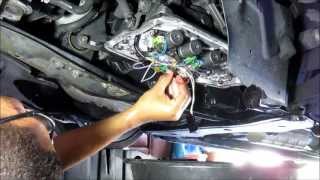
Typical fix: Remove the transmission oil pan to access and replace the faulty shift solenoid 'B'. It is often recommended to replace both A and B solenoids at the same time. 🎬 Watch: A guide to replacing transmission shift solenoids on your Mazda.
Est. part cost: $40-$100 - Faulty Transmission Control Module (TCM) or Wiring ⚪ Low Probability → Shop Transmission Assembly On SKYACTIV models, the TCM is integrated into the valve body, making it part of that common failure. On MZR models, the TCM is a separate unit that can fail independently, though it's less common than a solenoid. Wiring issues are a possibility on any vehicle due to heat, vibration, or damage, particularly at the main transmission connector or ground points.
How to confirm: Inspect the wiring harness between the TCM and the transmission for any damage, corrosion, or loose connections. A diagnostic scan may show communication errors (U-codes) if the TCM is failing. A technician can also back-probe the TCM connector to check for correct voltage signals to the solenoid.
Typical fix: Repair the damaged wiring or replace the Transmission Control Module. Replacement TCMs often require programming to the vehicle.
Est. part cost: $500-$900
Diagnosis Steps
- Scan the vehicle for all stored trouble codes. Note if P0757 appears with P0780 or P1738, which strongly suggests the TSB applies.
- Identify the engine and transmission. If it is a 2.0L SKYACTIV with the FW6A-EL 6-speed automatic, check the VIN against TSB #05-003-14-2898A (VINs JM1BL**500001 to 733727).
- Check the transmission fluid level and condition. If the fluid is low, dark, or smells burnt, address this first. A fluid and filter change may resolve the issue, especially on MZR models.
- If the vehicle is a SKYACTIV model covered by the TSB, the most likely cause is the valve body. A professional diagnosis is needed to confirm before ordering parts.
- If the vehicle is a non-SKYACTIV (MZR) model, inspect the wiring and connectors for the transmission solenoids for any visible damage, corrosion, or chafing.
- Test the resistance of Shift Solenoid 'B' and its circuit using a multimeter. Compare the reading to the manufacturer's specifications (1.0-4.2 ohms).
- Use a bi-directional scan tool to command the solenoid on and off while monitoring the circuit's voltage to confirm mechanical and electrical response.
- If the solenoid and wiring test good on an MZR model, the issue may be a more complex internal problem or a failing TCM, requiring advanced diagnostics.
Parts You'll Likely Need
- Control Valve Body Assembly
(OEM #PEY0-21-C00)— This is the official Mazda-recommended fix for 2012-2013 SKYACTIV models experiencing this code, as per TSB #05-003-14-2898A. It is a mechatronic unit including the TCM and solenoids.
Trusted brands: Mazda (OEM)
OEM price range: $900-$1300
Aftermarket price range: $700-$1000 - Automatic Transmission Fluid (ATF)
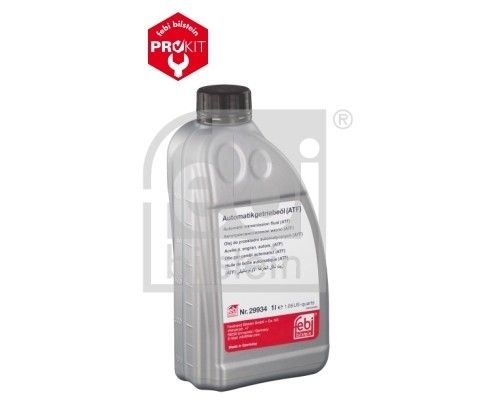
(OEM #0000-FZ-113E-01 (Type FZ for SKYACTIV), 0000-77-114E-01 (Type M-V for MZR))— Required for any repair involving opening the transmission, such as replacing the valve body or solenoids. Using the correct fluid type is critical for transmission health.
Related Codes That Often Appear With This One
- P0780 — This code for 'Gear Shifting Malfunction' is explicitly mentioned in TSB #05-003-14-2898A as a primary code that appears with P0757, pointing directly to the valve body issue on SKYACTIV models.
- P1738 — Meaning 'Automatic Transaxle Internal Malfunction', this is another primary code cited in the same TSB that confirms a serious internal transmission fault, usually the valve body.
- P0700 — This is a generic code indicating that the Transmission Control Module (TCM) has stored a fault code. It acts as a general alert and will always be present when a specific transmission code like P0757 is logged.
Technical Service Bulletins (TSBs) & Recalls
- 05-003-14-2898A / 05-005/16: Main TSB for SKYACTIV models identifying the valve body as the cause for P0757 and other related codes. Specifies VIN ranges and repair procedures.
- 05-005/14: Bulletin concerning various DTCs including those related to oil pressure switches on the valve body for SKYACTIV models.
- 05-004/14: Bulletin addressing a whining noise from the automatic transaxle in SKYACTIV models, which can sometimes be related to internal hydraulic issues.
Platform-Specific Known Issues
- A significant number of 2012-2013 Mazda 3 vehicles with the 2.0L SKYACTIV-G engine and 6-speed automatic transmission were subject to Technical Service Bulletin #05-003-14-2898A. This TSB applies to vehicles with VINs lower than JM1BL**733728 (produced before September 28, 2012). It states that when codes like P0757, P0780, or P1738 are stored, the cause is an internal malfunction of the control valve body, and the prescribed fix is to replace the assembly.
Mechanic-Grade Diagnostic Values
- Shift Solenoid 'B' (SSA) Resistance (for MZR FS5A-EL transmission) — expected: 1.0–4.2 Ohms. Failure: A reading outside this range (open circuit or short) indicates a failed solenoid coil.
- Shift Solenoid 'D' and 'E' Resistance (for MZR FS5A-EL transmission) — expected: 10.9–26.2 Ohms. Failure: These solenoids have a different resistance specification than A, B, and C. Comparing a reading to the wrong spec can lead to misdiagnosis.
- ATF Temperature for Initial Learning (SKYACTIV FW6A-EL) — expected: 40–110 °C {72–198 °F}. Failure: Attempting the initial learning procedure when the fluid is outside this temperature range will cause the process to abort or fail.
Hidden / Shadow Codes Worth Checking
- P0757:00: The ':00' is a component identifier suffix visible on Mazda's diagnostic scanner (M-MDS). While not a separate code, it confirms the fault type relates to a general circuit malfunction for that component, as referenced in the TSB. (see via Mazda M-MDS or equivalent advanced, manufacturer-specific scan tool.)
Scan Tool Commands That Help
- Mazda M-MDS (or equivalent): Initial Learning Procedure — This must be performed after replacing the valve body or transmission on SKYACTIV models. It resets and relearns clutch application points and hydraulic pressures. The procedure involves warming the ATF, clearing codes, then shifting from Park to Drive, then to Manual mode within 10 seconds to initiate the relearn, which is confirmed by a rise in engine idle speed.
- Manual Procedure (No Scan Tool): Initial Learning Procedure / Shift Adapt Reset — If a dealer scan tool is unavailable, this manual sequence can be used to clear shift adapts on SKYACTIV transmissions. It involves a complex sequence of shifting between P, N, and M(+/-) with the engine on and off, while firmly holding the brake pedal. It is critical the ATF is at operating temperature (140-230°F) for it to work.
- Bi-directional Scan Tool: Shift Solenoid B - On/Off Command — This is a primary diagnostic step for MZR models to determine if the solenoid is mechanically stuck or if the fault is electrical. The technician can command the solenoid on and off while monitoring voltage to see if the solenoid clicks and if the circuit responds as commanded.
Wiring & Ground Locations
- Transmission Case Grounds — There are typically multiple ground wires bolted directly to the transmission case, often near the mounting points or on top of the trans.. The solenoids are often grounded internally through the transmission case. A poor or corroded main ground connection from the case to the chassis can cause erratic solenoid operation and trigger various codes, including P0757.
- Passenger-Side Engine Mount Ground — A key chassis ground point is often located on or near the passenger-side engine mount.. This serves as a primary grounding point for the engine and transmission assembly to the vehicle's body. Verifying it is clean and tight is a crucial step in diagnosing any electrical issue.
- TCM/PCM Connector Grounds — Within the main harness connectors for the TCM (MZR) or PCM (SKYACTIV), there are specific pins designated as grounds (typically black wires).. A fault at the ground pin within the connector itself can cause the control module to misinterpret signals or for solenoid driver circuits to malfunction.
Real Owner Repair Stories
- YouTube channel 'p0757 #shiftsolenoid' (2012 Mazda 6 (Uses a similar MZR-family engine and 5-speed automatic)) — Transmission would not shift past 40 mph, stuck in gear, P0757 code present.
❌ Tried (didn't work) The owner considered immediately replacing the solenoid and filter.
✅ What actually fixed it The owner first performed a simple transmission fluid drain and fill. The old fluid was extremely dirty. After replacing the fluid, the car was able to shift through all gears properly and the issue was resolved without replacing any parts. - Mazdas247 Forum (2007 Mazda 3s (MZR engine with FS5A-EL 5-speed automatic)) — AT and Check Engine lights on, code P0757, transmission stuck in 3rd gear.
❌ Tried (didn't work) Replaced all transmission solenoids, the wiring harness, and changed the fluid. The problem persisted.
✅ What actually fixed it The final resolution was not posted, but the next diagnostic step suggested by other forum members was to replace the Transmission Control Module (TCM), indicating the problem was with the control unit itself, not the solenoids that were replaced.
OEM Part Supersession History
PEY0-21-C00B→PEY0-21-C00C— Mazda issued updated, pre-programmed valve bodies to correct the internal malfunctions outlined in TSB 05-003/14. The newer part numbers represent revised and more reliable versions.
Heads up: The TSB specifies using the new part. Using an older or used valve body may result in the same failure returning.
Model Year Variations Within This Range
- 2012-2013 (SKYACTIV models): A Mazda TSB indicates different TCM software file names for vehicles produced before and after March 31, 2013. Vehicles made before this date use file PEY0-21-PS1-A, while later models use PE08-21-PS1-N. This is critical if a technician needs to perform a software update, as using the wrong file could cause issues.
- 2013: The 2013 model year introduced several feature upgrades not available on most 2012 models, including a 5.8" touchscreen infotainment system with navigation, Pandora integration, and advanced keyless entry for the i Grand Touring trim. While not directly related to code P0757, it helps differentiate the model years.
Helpful Videos



We Have This Part in Stock

The information in this article is provided for general reference and educational purposes only. Vehicle specifications, procedures, and part compatibility can vary by production date, trim level, and region. Always consult your vehicle's factory service manual and verify part numbers before purchasing or performing repairs. Safety-critical components such as airbags, seat belts, and braking systems should be installed by a qualified professional.
- Mazda MAZDA3:
- 🧭 Diagnostic Flowchart
- 🎬 Helpful Videos
- 🛍️ Shop This Part
- What's Unique About the 2012-2013 Mazda MAZDA3
- Symptoms You May Notice
- Most Likely Causes
- Diagnosis Steps
- Parts You'll Likely Need
- Related Codes That Often Appear With This One
- Technical Service Bulletins (TSBs) & Recalls
- Platform-Specific Known Issues
- Mechanic-Grade Diagnostic Values
- Hidden / Shadow Codes Worth Checking
- Scan Tool Commands That Help
- Wiring & Ground Locations
- Real Owner Repair Stories
- OEM Part Supersession History
- Model Year Variations Within This Range
- 🎟️ Get 5% Off