

P0758 on 2011-2014 Kia Sedona: Shift Solenoid 'B' Electrical Fault Causes and Fixes
On a 2011-2014 Kia Sedona, code P0758 almost always means the 'B' shift solenoid has failed. This is a known issue confirmed by Kia TSB #TSBTRA051R1. The fix is to replace the individual solenoid inside the transmission, not the entire unit. Expect parts to cost between $50 and $150.
- P0758 on your Sedona almost certainly points to a failed Shift Solenoid 'B'.
- This is a known issue, and Kia has issued a service bulletin (TSBTRA051R1) about it.
- Do NOT let a shop replace the entire transmission; the official fix is to replace the single solenoid.
- The repair is moderately difficult for a DIYer but can save hundreds of dollars in labor.
- Many other Kia and Hyundai vehicles with the same 6-speed automatic transmission share this exact problem.
What's Unique About the 2011-2014 Kia SEDONA
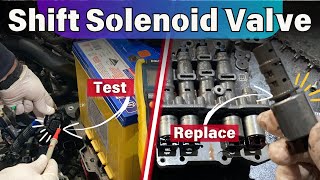
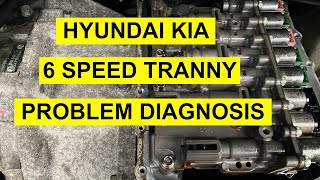
The 2011-2014 Kia Sedona uses a 6-speed automatic transmission (part of the A6MF/A6LF family) that is known to have issues with its shift solenoids. Kia acknowledged this by issuing Technical Service Bulletin #TSBTRA051R1, which covers a wide range of solenoid codes 🎬 Watch: How to diagnose and test solenoids on these models including P0758, P0741, P0743, P0748, P0753, P0763, and others. The bulletin specifically advises technicians to replace the faulty solenoids rather than the entire transaxle, a crucial distinction that saves owners significant money. This issue is common across many Kia and Hyundai vehicles from this era that share the same transmission design, such as the Sorento, Optima, and Santa Fe.
Diagnostic Flowchart
Tap your situation to follow the diagnostic path that matches what you're seeing on this vehicle.
Symptoms You May Notice
- Check Engine Light is on
- Transmission gets stuck in one gear (limp mode, often 3rd gear)
- Harsh, jerky, or delayed shifts
- Inability to shift into certain gears, particularly 2nd and 6th
- Poor acceleration from a stop, feeling very sluggish
- Decreased fuel efficiency
- Sudden lurch or 'clunk' during shifts
- Replacing the entire transmission. The official TSB from Kia (TSBTRA051R1) explicitly advises against this, stating that replacing the individual solenoid is the correct repair for this code.
Most Likely Causes
- Failed Shift Solenoid 'B' 🔴 High Probability → Shop Transmission Valve Body This is a well-documented weak point on this platform's 6-speed automatic transmission, as confirmed by Kia's own Technical Service Bulletin (TSBTRA051R1). The internal coil of the solenoid can burn out, creating an open or short circuit.
How to confirm: After accessing the valve body, disconnect the solenoid and test its resistance with a multimeter. The reading should be within the manufacturer's specification, which is approximately 10-11 Ohms for this on/off type solenoid. 🎬 Watch: Step-by-step solenoid cleaning and resistance testing An open circuit (infinite resistance) or a short (zero resistance) confirms failure. An advanced scan tool can also command the solenoid on and off to check for a response current, which should be around 850mA when activated.
Typical fix: Replace the faulty shift solenoid. This involves draining the transmission fluid, removing the oil pan, and accessing the valve body to swap the part.
Est. part cost: $50-$150 - Damaged Wiring or Connectors 🟡 Medium Probability The internal transmission wiring harness is subjected to constant heat and immersion in fluid, which can make the insulation brittle and prone to cracking over time, leading to a short circuit. External connectors can also suffer from corrosion or damage.
How to confirm: Visually inspect the external transmission harness for damage. For the internal harness, check for continuity between the main transmission connector and the solenoid's connector on the valve body after removing the oil pan. Specifically for Solenoid 'B', test for continuity between pins 5 (power) and 11 (control) on the main external connector.
Typical fix: Repair any damaged sections of the external wiring. If the internal harness is faulty, it should be replaced. Many technicians recommend replacing the internal harness (OEM Part # 46307-3B650) as a preventative measure whenever a solenoid is replaced.
Est. part cost: $70-$120 for an internal harness - Low or Contaminated Transmission Fluid ⚪ Low Probability → Shop Transmission Assembly
How to confirm: Check the transmission fluid level and condition. The fluid should be at the correct level and reddish in color, not dark brown, black, or smelling burnt. While low or dirty fluid won't directly cause an electrical code, it can cause shifting problems and accelerate wear on components like solenoids.
Typical fix: Top off the fluid if low. If the fluid is dirty or degraded, perform a transmission fluid and filter change. Use only Kia-specified SP-IV fluid.
Est. part cost: $50-$150 for fluid and filter
Rare But Worth Checking
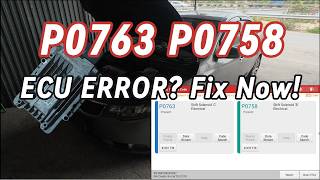
- Faulty Powertrain Control Module (PCM) or Transmission Control Module (TCM): → Shop Transmission Assembly This is the least likely cause. The PCM/TCM should only be considered after all other possibilities, including solenoids and wiring, have been thoroughly tested and ruled out. In some documented cases, the driver IC for the solenoid fails on the TCM circuit board, which is a complex electronic repair. 🎬 See this guide on repairing the TCU/ECU circuit board
Diagnosis Steps
- Check the transmission fluid level and condition. Address if low or dirty.
- Use an OBD-II scanner to confirm P0758 is the primary code and check for any other transmission-related codes.
- Inspect the external transmission wiring harness and main connector for any visible signs of damage, corrosion, or loose connections.
- If possible, use an advanced scan tool to command Shift Solenoid 'B' on and off to see if it responds electrically. Monitor the current; it should switch between ~50mA (off) and ~850mA (on).
- Test the solenoid's resistance from the external transmission connector pins to quickly check for an electrical failure without removing the pan. For Solenoid 'B', test between pins 5 and 11. The reading should be 10-11 Ohms.
- If the external test fails or is inconclusive, drain the transmission fluid and remove the oil pan to access the valve body.
- Visually inspect the internal wiring harness for brittle or broken wires.
- Disconnect the suspect solenoid and measure its resistance directly with a multimeter. Compare the reading to the 10-11 Ohm specification.
- If the solenoid and wiring test good, the fault may lie with the TCM, but this is rare.
Parts You'll Likely Need
- Shift Solenoid 'B' (2-6 Brake Solenoid)
(OEM #46313-3B030)— This is the most common point of failure for code P0758 on this vehicle, as documented by Kia's TSB. This part number supersedes the older 46313-3B020.
Trusted brands: Kia (OEM), Hyundai (OEM), Rostra, Standard Motor Products (SMP)
OEM price range: $80-$150
Aftermarket price range: $50-$100 - Internal Transmission Wiring Harness
(OEM #46307-3B650)— The internal harness can become brittle and fail, causing an identical electrical fault. It is often replaced preventatively during a solenoid repair. The updated harness has an integrated temperature sensor.
Trusted brands: Kia (OEM), Hyundai (OEM)
OEM price range: $70-$120
Aftermarket price range: $60-$100 - Transmission Fluid (SP-IV) — The transmission must be drained to perform the repair, requiring a fluid refill. Using the manufacturer-specified fluid is critical for transmission longevity.
Trusted brands: Kia/Hyundai (OEM), Idemitsu, Valvoline MaxLife
OEM price range: $15-$25 per quart
Aftermarket price range: $8-$15 per quart
Related Codes That Often Appear With This One
- P0700 — P0700 is a general code indicating the Transmission Control Module (TCM) has stored a fault. It acts as a 'heads-up' that a more specific code, like P0758, is present.
- P0763 — This code is for an electrical fault in Shift Solenoid 'C'. Seeing multiple solenoid codes together can point to a common problem, like a damaged wiring harness, a power/ground issue affecting several solenoids, or a failing TCM.
Technical Service Bulletins (TSBs) & Recalls
- TSBTRA051R1: Advises on the replacement of various shift solenoids for DTCs P0741, P0743, P0748, P0753, P0758, P0763, P0768, P0773, P1778 and P2709 on 6-speed automatic transaxles. It specifies not to replace the entire transaxle for these issues.
Platform-Specific Known Issues
- Kia issued Technical Service Bulletin #TSBTRA051R1 for multiple solenoid-related DTCs, including P0758, on its 6-speed automatic transaxles. The bulletin directs technicians to replace the individual solenoids and explicitly states not to replace the entire transaxle for this issue.
- Real-World Repair Story: An owner of a 2011 Kia Sedona on a popular forum experienced the classic P0758 symptoms: the check engine light came on and the transmission went into limp mode, stuck in 3rd gear. After confirming the code, he dropped the transmission pan, identified the 2-6 brake solenoid (Solenoid 'B'), and tested its resistance, which read as an open circuit (failed). He replaced the single solenoid, refilled with new fluid, and the problem was resolved. This owner's experience confirms the common failure pattern and the viability of a DIY repair for those with mechanical aptitude.
Mechanic-Grade Diagnostic Values
- Shift Solenoid 'B' (On/Off type) internal resistance — expected: 10 - 11 Ohms. Failure: A reading of infinity (open circuit) or near-zero (short circuit).
- Voltage at transmission main connector Pin 5 (Solenoid Power Supply) — expected: ~12V (Battery Voltage) with ignition on. Failure: Low or no voltage points to a wiring or fuse issue upstream of the transmission.
- Scan tool live data for Solenoid 'B' current — expected: Switches from ~50mA (off) to ~850mA (on) during shifts. Failure: Current does not change or is out of spec, indicating a control circuit or solenoid issue.
Scan Tool Commands That Help
- Kia GDS (Global Diagnostic System): Actuation Test / Active Test for Shift Solenoid 'B' — This function allows a technician to command the solenoid on and off with the engine off (key on). It is used to listen for an audible 'click' from the solenoid, which helps verify the integrity of the wiring, the TCM driver circuit, and the mechanical function of the solenoid itself without having to drive the vehicle.
Wiring & Ground Locations
- Transmission Main Connector — On the top or side of the transmission case, where the main vehicle harness connects.. This is the primary external test point. Testing between Pin 5 (Solenoid Power) and Pin 11 (Solenoid 'B' Control) allows a technician to measure the solenoid's resistance without removing the transmission oil pan.
- Transmission Case Ground — A grounding point is typically located on one of the bolts that mounts the transmission to the engine block.. A poor or corroded transmission ground can cause a variety of electrical issues, including erratic solenoid operation and fault codes. While not a primary cause, it should be checked for integrity.
Real Owner Repair Stories
- YouTube Channel 'TCU/ECU Repair Guide' (Kia Forte with the same A6MF transmission family) — Harsh shifting, jerking, and fault codes P0758 (Solenoid B) and P0763 (Solenoid C).
❌ Tried (didn't work) Testing the solenoids (they were confirmed to be good)., Checking the wiring between the TCM and the transmission (it was normal).
✅ What actually fixed it The root cause was the failure of two power driver Integrated Circuits (ICs) on the Transmission Control Module (TCM) circuit board that control solenoids 'B' and 'C'. The fix required desoldering and replacing the specific ICs on the board.
OEM Part Supersession History
46313-3B020→46313-3B030— Part revision and update by the manufacturer.46307-3B610, 46307-3B620→46307-3B650— Part revision for the internal wiring harness, likely for improved durability.
Helpful Videos


We Have This Part in Stock




The information in this article is provided for general reference and educational purposes only. Vehicle specifications, procedures, and part compatibility can vary by production date, trim level, and region. Always consult your vehicle's factory service manual and verify part numbers before purchasing or performing repairs. Safety-critical components such as airbags, seat belts, and braking systems should be installed by a qualified professional.
- Kia SEDONA:
- 🧭 Diagnostic Flowchart
- 🎬 Helpful Videos
- 🛍️ Shop This Part
- What's Unique About the 2011-2014 Kia SEDONA
- Symptoms You May Notice
- Most Likely Causes
- Rare But Worth Checking
- Diagnosis Steps
- Parts You'll Likely Need
- Related Codes That Often Appear With This One
- Technical Service Bulletins (TSBs) & Recalls
- Platform-Specific Known Issues
- Mechanic-Grade Diagnostic Values
- Scan Tool Commands That Help
- Wiring & Ground Locations
- Real Owner Repair Stories
- OEM Part Supersession History
- 🎟️ Get 5% Off