

P0761 on 2011-2016 Toyota Sienna: Shift Solenoid 'C' Causes and Fixes
On a 2011-2016 Toyota Sienna, code P0761 most often points to a failed Shift Solenoid 'C' (SL3) or low/dirty transmission fluid. Expect to pay $190-$275 for an OEM solenoid and 3-4 hours of labor for the replacement. Addressing fluid quality is critical for a long-term fix.
- P0761 on a 2011-2016 Sienna points to a problem with Shift Solenoid 'C' (SL3) in the U660E transmission.
- Always check the transmission fluid level and condition first. Use only Toyota ATF WS fluid.
- The most likely fix is replacing the SL3 solenoid, which requires removing the transmission valve body.
- Due to the complexity of the repair and the specific fluid fill procedure, this job is highly recommended for a professional mechanic.
- Do not immediately assume the entire transmission needs replacement; a targeted solenoid or valve body repair is often sufficient.
What's Unique About the 2011-2016 Toyota Sienna
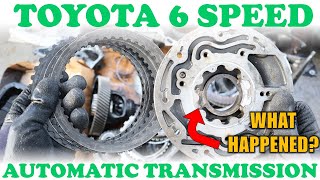
The 2011-2016 Sienna uses the U660E 6-speed automatic transmission, a unit shared with many other V6-powered Toyota and Lexus models like the Camry, Avalon, and ES350. While generally reliable, these transmissions are known to be sensitive to fluid condition and mileage. The P0761 code is often not an isolated electronic failure but a symptom of degraded Toyota WS (World Standard) fluid causing the solenoid to stick. Furthermore, the U660E can be prone to case wear at the counter drive gear bearing, which introduces fine metal debris into the fluid, leading to sticking valves and scored valve body bores. Simply replacing the solenoid without addressing potential fluid contamination or valve body wear may not provide a long-term fix. Some owners on forums report needing a valve body replacement or rebuild to finally resolve the issue after a solenoid swap fails to work.
Symptoms You May Notice
- Check Engine Light is on
- Transmission-related warning on the dash
- Harsh, delayed, or erratic shifting, especially 2-3 or 3-4 shifts
- Transmission slipping between gears or flaring (engine RPMs rise without acceleration)
- Vehicle stuck in one gear (limp mode)
- Poor acceleration and loss of power
- Decreased fuel economy
- Replacing the entire transmission when only a single solenoid or the valve body was faulty.
- Replacing the solenoid without first checking the quality and level of the transmission fluid, which is a more common and simpler fix.
- Replacing the solenoid when the root cause is a worn valve body bore, leading to the code returning shortly after the repair.
Most Likely Causes
- Low or Dirty Transmission Fluid 🔴 High Probability → Shop Transmission Assembly The U660E is sensitive to fluid condition. Toyota's 'lifetime' fluid (WS ATF) can degrade significantly over 100,000+ miles, losing its lubricating properties and accumulating clutch material and metal debris. This contamination can cause solenoid plungers to stick and clog fine passages in the valve body.
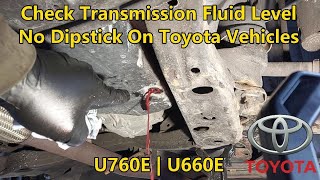
How to confirm: Check the transmission fluid level and condition via the overflow procedure. 🎬 Watch: How to check transmission fluid level without a dipstick The fluid should be bright red and not smell burnt. Dark, brown, or sludgy fluid indicates a problem. This is a complex check on a 'sealed' transmission and is best left to a professional.
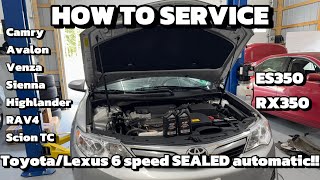
Typical fix: Perform a transmission fluid drain-and-fill using only Toyota Genuine ATF WS 🎬 See: Step-by-step Toyota 6-speed transmission fluid change (World Standard) fluid. A full flush is generally not recommended by Toyota for high-mileage transmissions as it can dislodge debris and cause more issues.
Est. part cost: $80-$140 for 4-5 quarts of fluid - Failed Shift Solenoid 'C' (SL3) 🔴 High Probability → Shop Transmission Valve Body Solenoids are electro-mechanical parts that wear out over time. Internal windings can fail electrically, or the internal plunger can become mechanically stuck from debris in the fluid. The plastic bodies of these solenoids can also become brittle and crack from heat cycles.
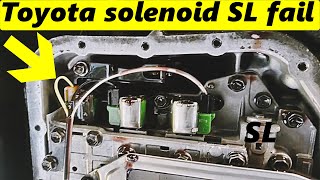
How to confirm: After dropping the transmission pan and valve body, locate the SL3 solenoid (typically a large body with a brown connector). Test its resistance with a multimeter; it should be between 5.0-5.6 ohms at 68°F (20°C). A reading outside this range indicates failure. Also, you can apply 12V directly to the solenoid and listen for a distinct 'click' to check for mechanical operation.
Typical fix: Replace the faulty solenoid. It is often recommended to replace the full set of on/off shift solenoids (SL1, SL2, SL3, SL4) while the valve body is out, as they have all experienced the same conditions.
Est. part cost: $190-$275 for a single OEM solenoid, aftermarket kits with multiple solenoids are available. - Worn or Blocked Valve Body 🟡 Medium Probability → Shop Transmission Valve Body Debris from normal wear, and especially from the known case bearing wear issue, can create blockages in the small passages of the aluminum valve body. Additionally, the bores that the solenoid plungers and valve spools slide in can wear over time, causing hydraulic pressure to leak past, which can trigger a performance code even with a good solenoid.
How to confirm: This is difficult to confirm without specialized equipment. A visual inspection of the valve body after removal may show scoring or debris. Transmission shops can test the valve body, and companies like Sonnax sell tools to vacuum test individual bores for wear.
Typical fix: The valve body can be professionally cleaned and rebuilt with oversized valves and reamed bores (e.g., using a Sonnax Zip Kit U660E-ZIP), or replaced entirely with a remanufactured or new unit.
Est. part cost: $500-$1200 for a remanufactured valve body
Rare But Worth Checking
- Damaged Wiring Harness: The wiring harness inside the transmission can become brittle from heat cycles. Check the wires leading to the SL3 solenoid for any breaks, corrosion, or loose pins at the connector when the valve body is removed.
- Faulty Transmission Control Module (TCM): → Shop Transmission Assembly While rare, the TCM itself can fail. On the U660E, the TCM is bolted directly to the transmission case, exposing it to heat and vibration. This is usually the last item to suspect after all other possibilities (fluid, solenoid, valve body, wiring) have been thoroughly ruled out. This often presents with multiple, erratic codes, not just a single solenoid code.
Diagnosis Steps
- Verify the code with a quality OBD-II scanner. Note any other pending or active transmission codes and review freeze-frame data.
- Check the transmission fluid level and condition. This requires the vehicle to be level and the fluid at a specific temperature (typically 104-113°F or 40-45°C), checking for a trickle from the overflow plug. This is best done by a professional.
- If fluid is low, top it off with Toyota ATF WS, clear codes, and test drive. If fluid is dark, burnt, or contains excessive metal particles, perform a drain-and-fill and inspect the pan magnet for debris.
- If the code returns, the transmission pan must be dropped to access the valve body.
- Disconnect the battery. Remove the transmission pan and filter, draining the remaining fluid. Inspect the pan for clutch material (a fine black sludge is normal, chunks are not) or excessive metal shavings.
- Carefully disconnect the wiring harness and remove the valve body assembly.
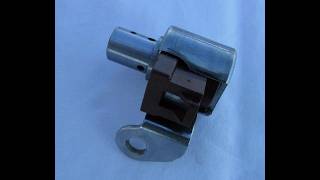
- Identify Shift Solenoid 'C' (SL3). It is typically a large on/off solenoid with a brown electrical connector. 🎬 Watch: How to replace a Toyota transmission shift solenoid
- Test the solenoid's resistance with a multimeter. A healthy solenoid should measure between 5.0 and 5.6 ohms at 68°F. An open circuit (infinite resistance) or short (near-zero resistance) confirms the solenoid is electrically bad.
- Test the solenoid's mechanical function by applying 12V power and ground to its pins. You should hear a solid 'click'. No click or a weak click indicates it is mechanically stuck.
- If the solenoid tests good, the problem is likely a blockage or wear within the valve body, or a wiring issue. Inspect the harness for damage. Consider having the valve body professionally tested.
- If the solenoid is bad, replace it. Reinstall the valve body, new filter, and pan with a new gasket.
- Refill the transmission with the correct amount of Toyota ATF WS using the proper overflow procedure.
- Reconnect the battery, clear the codes, and perform a test drive to allow the transmission to relearn shift points. A TCM memory reset using a tool like Toyota Techstream is recommended.
Parts You'll Likely Need
- Shift Solenoid 'C' (SL3)
(OEM #35210-33030)— This is the component directly identified by the code as malfunctioning. It is a common failure point. The OEM part number may be superseded by 35210-73010.
Trusted brands: Toyota (Genuine), Aisin (OEM Supplier), Rostra, Standard Motor Products
OEM price range: $190-$275
Aftermarket price range: $60-$150 - Toyota Automatic Transmission Fluid WS
(OEM #00289-ATFWS)— This is the only fluid specified for the U660E transmission. A drain and fill requires approximately 4-5 quarts. Using any other fluid can cause shift quality issues and damage.
Trusted brands: Toyota (Genuine)
OEM price range: $15-$25 per quart
Aftermarket price range: N/A - Transmission Pan Gasket
(OEM #35168-08010)— The gasket must be replaced anytime the transmission pan is removed to prevent leaks. Some technicians prefer using FIPG (Form-in-Place Gasket) sealant like Toyota Black FIPG.
Trusted brands: Toyota (Genuine), Fel-Pro, Mahle
OEM price range: $30-$50
Aftermarket price range: $15-$25 - Transmission Filter (Strainer)
(OEM #35330-48020)— The filter should always be replaced when the pan is dropped for service. It traps debris that could otherwise damage the valve body and solenoids.
Trusted brands: Toyota (Genuine), Wix, ATP
OEM price range: $50-$70
Aftermarket price range: $20-$40
Related Codes That Often Appear With This One
- P0798 — This is the electrical fault code for Shift Solenoid 'C' (Pressure Control Solenoid C Electrical). If the computer detects an open or short in the solenoid's circuit, P0798 will be set. P0761 is the performance code, meaning the circuit may be fine but the expected mechanical action did not occur. They can appear together if an electrical fault causes a performance issue.
- P2714 — This code relates to Pressure Control Solenoid 'D' (SLT/Line Pressure). Fluid degradation or valve body issues that cause P0761 can often affect other solenoids, and P2714 is a common companion code on Toyota transmissions of this era, often indicating widespread hydraulic control issues.
- P0015 — Camshaft Position 'B' Timing Over-Retarded (Bank 1). While seemingly unrelated, issues with the VVT-i system, which is oil-pressure driven, can sometimes occur alongside transmission problems if engine oil maintenance is also neglected, pointing to a broader pattern of fluid-related maintenance issues.
Technical Service Bulletins (TSBs) & Recalls
- T-SB-0141-18: Details the repair procedure for separated power sliding door cables, a common issue on this platform.
- Customer Support Program ZKD: Extends warranty coverage for power sliding door cable failures for 10 years, regardless of mileage.
- Warranty Enhancement Program ZH1 / ZLD: Extends warranty for torque converter shudder on U660E/U760E transmissions, a related drivability issue.
- T-SB-0020-11: Addresses oil seepage from engine oil cooler pipes on models with the tow package.
Mechanic-Grade Diagnostic Values
- Shift Solenoid 'C' (SL3) Resistance — expected: 5.0 - 5.6 Ω at 68°F (20°C). Failure: A reading of 0 Ω (short) or infinite Ω (open circuit) indicates a failed solenoid.
- Shift Solenoids SL1, SL2, SL4, SLT, SLU Resistance — expected: 5.0 - 5.6 Ω at 68°F (20°C). Failure: Readings outside this range indicate a faulty solenoid.
- Shift Solenoid SL Resistance — expected: 11 - 15 Ω at 68°F (20°C). Failure: Readings outside this range indicate a faulty solenoid. Note: This is a different solenoid from SL1-SL4.
- Solenoid circuit to ground — expected: 10 kΩ or higher. Failure: Resistance below 10 kΩ indicates a short to ground in the solenoid or wiring.
Scan Tool Commands That Help
- Toyota Techstream: Active Test: Control the Shift Position — Allows a technician to command specific gear shifts while driving (under 30 mph) to confirm if the solenoid is mechanically responding. Comparing the commanded gear to the actual gear helps isolate the fault.
- Toyota Techstream: Utility: Reset Memory — This function should be used after replacing the valve body or solenoids to clear the transmission's adaptive learning values. This forces the TCM to relearn shift points with the new components.
- Toyota Techstream: Utility: A/T Code Reset — Used to reprogram the TCM with the transaxle compensation code (a 60-digit code on the transmission case) after major repairs like a transmission or TCM replacement. Failure to do this can cause harsh shifting.
Wiring & Ground Locations
- SL3 Solenoid Connector — Inside the transmission, on the valve body. It is typically a large body solenoid with a brown connector.. This is the direct electrical connection for the solenoid in question. Testing for power, ground, and signal must be done at this connector's pins or the corresponding pins at the main transmission case connector.
- Ground Points EB, EC — On a similar model (2007 Sienna), ground points EB and EC are noted as primary grounds for the transmission system. Their exact location can vary but are typically on the engine block or chassis near the transmission.. A poor ground connection at these points can cause a voltage drop, leading to erratic solenoid operation and performance codes like P0761 even if the solenoid itself is good.
OEM Part Supersession History
35240-33030→35240-33030 (current)— This is the established OEM part number for the 'Solenoid Assy, Automatic Transmission 3Way', which corresponds to the SL solenoid group that includes SL3.
Heads up: While this part number is listed for the U-series transmissions, it's critical to verify by VIN. Some sources list this as the lock-up solenoid, while service literature identifies SL3 as a clutch control solenoid. Always cross-reference with the dealer.
Diagnostic Flowchart
Other Known Issues on This Vehicle
Issues unrelated to this code that are worth knowing about as an owner of this generation:
- Power Sliding Door Failure 🟠 Medium — Very common. The door cable is known to fray and snap, causing the power function to fail. The door may also fail to latch, potentially opening while driving. (Ref: NHTSA Recall 16V-858. Toyota also issued Customer Support Program ZKD extending warranty coverage. TSB T-SB-0141-18 provides repair instructions.)
- Rupturing VVT-i Oil Line (Rubber Section) 🔴 High — Common on earlier 2GR-FE engines (approx. 2007-2010), but can affect 2011+ models if the part was never updated. A rupture causes rapid, catastrophic oil loss and engine seizure. (Ref: Toyota issued a TSB and a Limited Service Campaign (LSC-90K) to replace the rubber hose section with an all-metal line (Part No. 15772-31030).)
- Torque Converter Shudder 🟠 Medium → Shop Automatic Transmission Torque Converter — Common issue on U660E/U760E transmissions. Owners report a shudder or vibration under light throttle between 25-50 mph. (Ref: Toyota issued Warranty Enhancement Programs (ZH1, ZLD) extending coverage for torque converter replacement and a software update to address the issue.)
- Leaking Engine Oil Cooler Lines (Tow Package) 🔴 High — Affects vehicles equipped with the factory tow package. The original rubber hoses for the external engine oil cooler are prone to leaking or bursting, leading to rapid oil loss. (Ref: TSB T-SB-0201-11 recommends replacing the rubber hoses with an all-metal pipe assembly (Part No. 15767-31020).)
- Cracking Dashboard 🟡 Low — Reported by some owners, where the dashboard material becomes sticky and cracks or melts in high heat and sun exposure. (Ref: Toyota had a warranty enhancement program for this on other models like the Camry, but Sienna owner reports are more scattered.)
Used vs. New Parts: Buying Guide for This Vehicle
When a used part is the smart pick: A complete used valve body assembly from a low-mileage donor vehicle can be a cost-effective alternative to buying a new one, especially if multiple solenoids or the valve body itself is suspected. Individual used solenoids are a gamble but can be a cheap fix if tested before purchase.
Donor-vehicle mileage cap: roughly under 75000 miles for the part to have meaningful remaining life.
What to inspect on the donor part:
- Verify the donor vehicle's mileage and ensure it had no reported transmission issues.
- Inspect the transmission fluid from the donor car if possible. It should be reddish and not smell burnt.
- When buying a valve body, look for any signs of scoring, heavy sludge, or damage to the connectors.
- If buying a single solenoid, test its resistance with a multimeter before purchase. It must be within the 5.0-5.6 ohm specification.
OEM-only on this vehicle (don't cheap out):
- Transmission Control Module (TCM): Used TCMs can have incompatible software and may not program correctly to your vehicle's VIN.
Aftermarket brands forum-validated for this vehicle:
- Sonnax: For valve body repair kits (e.g., U660E-ZIP) that address known wear points and often exceed OEM specifications.
- TransGo: Offers shift kits (e.g., SK U660E) that can improve shift quality and address hydraulic issues.
- Rostra: A common aftermarket manufacturer for individual solenoids and wiring harnesses.
Brands owners have reported issues with on this vehicle:
- Unbranded, no-name solenoid kits from online marketplaces. These often have high failure rates, incorrect resistance values, and can cause more issues than they solve.
Real Owner Stories
Aggregated from forums and TSBs cited above. Mileages and costs reflect what owners reported in those sources.
2011 Toyota Sienna XLE 3.5L V6
Symptoms: The vehicle experienced a shudder when maintaining speed. The transmission fluid was described as 'thin sludge.'
What fixed it: The owner underwent a diagnostic journey that eventually required a transmission rebuild, valve body replacement, and torque converter replacement.
Source hint: Reddit r/MechanicAdvice: 2011 Toyota Sienna XLE Shudder When Maintaining Speed
2007 Lexus ES350 3.5L V6 (U660E)
Symptoms: Shift flares and poor shift quality.
What fixed it: Application of TSBs (such as TC007-07) aimed at correcting shift quality through software or mechanical adjustments.
Source hint: ClubLexus Forum: Newest U660E transmission TSIB
Related OBD-II Codes
Frequently Asked Questions
Is there a Toyota warranty extension that covers the transmission shudder I'm feeling on my 2011 Sienna?
My 2011 Sienna has a P0761 code and the fluid looks like 'thin sludge.' Should I do a full flush?
Which specific solenoid is associated with the P0761 code on the U660E transmission?
What should the resistance be for the SL3 solenoid if I test it with a multimeter?
Can I use any transmission fluid to top off my Sienna to see if the P0761 code clears?
Is there a TSB for the power sliding door cables on my 2011-2016 Sienna?
Helpful Videos


We Have This Part in Stock

The information in this article is provided for general reference and educational purposes only. Vehicle specifications, procedures, and part compatibility can vary by production date, trim level, and region. Always consult your vehicle's factory service manual and verify part numbers before purchasing or performing repairs. Safety-critical components such as airbags, seat belts, and braking systems should be installed by a qualified professional.
- Toyota Sienna:
- 🧭 Diagnostic Flowchart
- 🎬 Helpful Videos
- 🛍️ Shop This Part
- What's Unique About the 2011-2016 Toyota Sienna
- Symptoms You May Notice
- Most Likely Causes
- Rare But Worth Checking
- Diagnosis Steps
- Parts You'll Likely Need
- Related Codes That Often Appear With This One
- Technical Service Bulletins (TSBs) & Recalls
- Mechanic-Grade Diagnostic Values
- Scan Tool Commands That Help
- Wiring & Ground Locations
- OEM Part Supersession History
- Other Known Issues on This Vehicle
- Used vs. New Parts: Buying Guide for This Vehicle
- Real Owner Stories
- 2011 Toyota Sienna XLE 3.5L V6
- 2007 Lexus ES350 3.5L V6 (U660E)
- Related OBD-II Codes
- Frequently Asked Questions
- 🎟️ Get 5% Off