

P0766 on 2020-2023 Ford TRANSIT: Shift Solenoid 'D' Causes and Fixes
P0766 on a 2020-2023 Ford Transit almost always points to a known issue with the 10R80 transmission's internal components, specifically the main control valve body or the CDF clutch cylinder. This is not a simple solenoid swap; it often requires significant internal transmission repair as outlined in multiple Ford Technical Service Bulletins. The root cause is frequently a design flaw in the CDF clutch cylinder sleeve that allows it to move and cause hydraulic leaks.
- P0766 on a 2020-2023 Transit is a serious code indicating a likely internal mechanical failure in the 10R80 transmission.
- The most probable cause is a known issue with the CDF clutch cylinder or the main valve body, as documented in Ford TSBs.
- This is not a DIY-friendly repair. It requires professional diagnosis with specialized tools and significant labor.
- Simply replacing the 'D' shift solenoid is unlikely to fix the problem.
- When seeking repairs, reference TSB 24-2254 to ensure the technician is aware of the specific, documented cause.
What's Unique About the 2020-2023 Ford TRANSIT
The 2020-2023 Ford Transit uses the 10R80 10-speed automatic transmission, which is known for specific mechanical issues that trigger a wide range of trouble codes, including P0766. Ford has issued numerous Technical Service Bulletins (TSBs) that link this code to internal hydraulic leaks caused by a faulty CDF clutch cylinder sleeve or problems within the main valve body. The original design of the CDF drum allowed an internal sleeve to 'walk' or move axially, which uncovers fluid ports and causes a pressure loss to multiple clutch packs. Unlike many other vehicles where P0766 might be a simple solenoid failure, on the Transit, it's often a symptom of this more complex, well-documented mechanical problem inside the transmission.
Diagnostic Flowchart
Tap your situation to follow the diagnostic path that matches what you're seeing on this vehicle.
Symptoms You May Notice
- Harsh or delayed shifts, sometimes described as a 'bump' or 'lurch'.
- Delayed engagement when shifting into Drive or Reverse.
- Illuminated Malfunction Indicator Lamp (Check Engine Light).
- Transmission may enter 'limp mode', stuck in one gear. 🎬 See: Common failures and problems with the 10R80 transmission.
- Vehicle may not shift out of Park, or may have no forward or reverse movement at all.
- Slipping between gears, where engine RPMs rise without an increase in speed.
- Noticeable issues with specific shifts, such as the 3-4-5 gear changes which are controlled by the CDF drum.
- Replacing only the 'D' shift solenoid. While the code points to this solenoid, the root cause on this platform is often a hydraulic leak or valve body issue that starves the solenoid circuit of pressure, not a failure of the solenoid itself.
Most Likely Causes
- Internal Hydraulic Leak (CDF Clutch Cylinder) 🔴 High Probability As documented in Ford TSB 24-2254, the CDF clutch cylinder sleeve can move axially ('walk'), uncovering hydraulic circuit ports and causing leaks that prevent proper clutch engagement. This is a known design or manufacturing issue with the 10R80 transmission in this year range, affecting multiple clutches and triggering a variety of codes including P0766.
How to confirm: A technician must perform a specialized hydraulic leak test on the transmission circuits as detailed in TSB 24-2254. This requires specific tools like a Pressure Vacuum Transducer Kit (Rotunda 164-R9833) to measure pressure loss in the affected circuits.
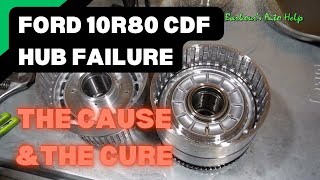
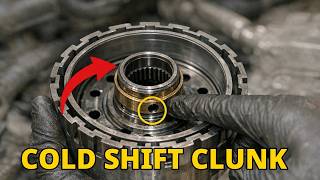
Typical fix: Replacement of the CDF clutch cylinder assembly with the updated part (OEM Part # JL3Z-7H351-B), which features a lip to prevent the sleeve from moving. 🎬 Watch: See the CDF hub failure and the updated design. Some aftermarket companies, like Sonnax, also offer a 'drum saver kit' (129910-01K) that installs a new sleeve with a locking mechanism.
Est. part cost: $140-$210 for the OEM clutch cylinder assembly. - Faulty Main Control Valve Body 🟡 Medium Probability → Shop Transmission Valve Body The valve body houses the shift solenoids and is a common failure point in the 10R80 transmission, leading to sticking valves or internal cross-leaks that cause erratic shifting. Debris from other failing components (like the torque converter or CDF drum) can contaminate the valve body and cause solenoids to stick.
How to confirm: After confirming fluid level and quality, a technician will command solenoids with a scan tool and check for response. If hydraulic tests for the CDF drum pass, the valve body is the next likely suspect. It may need to be removed for inspection or testing.
Typical fix: Replacement of the entire main control valve body assembly. Ford has several part numbers depending on the specific vehicle build, such as L1MZ-7A100-K.
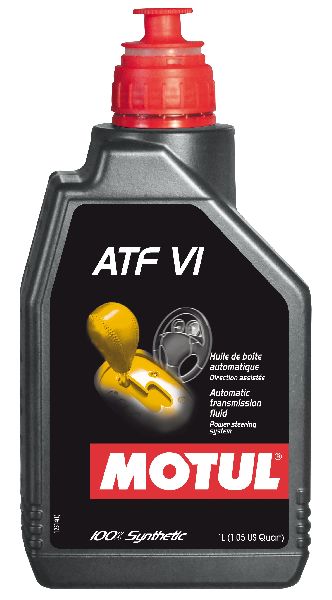
Est. part cost: $800-$1500 for a new Motorcraft valve body assembly. - Low or Contaminated Transmission Fluid ⚪ Low Probability → Shop Transmission Assembly While less likely to be the root cause given the known TSBs, low or dirty fluid can cause erratic hydraulic pressure and shifting problems in any automatic transmission. The 10R80 is particularly sensitive to fluid type and condition, requiring only Motorcraft MERCON ULV.
How to confirm: Check the transmission fluid level and condition. The fluid should be at the correct level and not appear dark, burnt, or contain excessive metal shavings. This is often the first step in any transmission diagnosis.
Typical fix: Perform a transmission fluid and filter change using the correct Motorcraft ULV fluid. If the fluid is heavily contaminated, this often indicates a larger mechanical failure requiring a full teardown and flush.
Est. part cost: $150-$300 for fluid and filter.
Rare But Worth Checking
- Damaged Valve Body to Oil Pump Seal: → Shop Transmission Valve Body A specific seal between the main control valve body and the oil pump can become dislodged, crushed, or torn, especially during a previous repair. This causes a massive hydraulic pressure loss, resulting in a no-move condition (no forward or reverse) and codes like P0766 and P0756. Technicians on forums note this is a common mistake made during reassembly.
- Faulty Transmission Control Module (TCM) or Software: → Shop Transmission Assembly While possible, a faulty module is less common than the mechanical failures documented in TSBs. Sometimes, a software update (re-flash) can correct shifting logic before hardware is replaced, but it will not fix the underlying mechanical flaws like the CDF drum issue.
- Wiring Harness Damage: An open or short in the wiring to shift solenoid 'D' can trigger this code. This is worth inspecting, especially the main connector at the transmission case for corrosion or damage.
Diagnosis Steps
- Verify the code with a professional OBD-II scanner that can read transmission-specific data.
- Check for any applicable Technical Service Bulletins (TSBs) for your vehicle's VIN. TSB 24-2254 is the most critical diagnostic guide for this issue.
- Check the transmission fluid level and condition. Ensure it is clean, full, and does not smell burnt. The correct fluid is Motorcraft MERCON ULV.
- Follow the diagnostic procedure outlined in Ford TSB 24-2254, which involves using a Pressure Vacuum Transducer Kit (Rotunda 164-R9833) to perform a hydraulic circuit leak test to pinpoint leaks in the CDF clutch circuit.
- If the hydraulic test points to a leak, the CDF clutch cylinder must be replaced.
- If the hydraulic test passes, inspect the transmission wiring harness and connectors for any signs of damage, corrosion, or loose connections.
- If wiring is good, further diagnosis of the main control valve body is required. This may involve commanding solenoids with a scan tool and monitoring pressure responses. 🎬 Watch: A professional walkthrough of the 10R80 diagnostic process.
- As a last resort, if all mechanical and electrical components test good, the issue may lie within the Transmission Control Module (TCM) itself.
Parts You'll Likely Need
- CDF Clutch Cylinder (Hub Assembly)
(OEM #JL3Z-7H351-B (supersedes HL3Z-7H351-A and JL3Z-7H351-A))— This is the specific component identified in Ford TSB 24-2254 as the cause of hydraulic leaks. The updated 'B' version has a revised design with a lip to prevent the internal sleeve from walking out of position.
Trusted brands: Motorcraft
OEM price range: $140-$210 - Main Control Valve Body Assembly
(OEM #L1MZ-7A100-K (example, part varies by build))— Often replaced as a complete unit to resolve sticking solenoids or internal leaks that cause harsh and delayed shifting associated with P0766, especially if the CDF drum tests okay.
Trusted brands: Motorcraft
OEM price range: $800-$1500
Aftermarket price range: $600-$1200 - Automatic Transmission Fluid (Motorcraft MERCON ULV)
(OEM #XT-12-QULV)— Required for any repair that involves opening the transmission. The 10R80 is extremely sensitive to fluid type and condition.
Trusted brands: Motorcraft
OEM price range: $10-$15 per quart
Related Codes That Often Appear With This One
- P0751, P0756, P0761, P2700-P2708, etc. — These codes are all related to other shift solenoids and clutch performance. Ford lists them together in TSBs because the underlying hydraulic leak in the CDF clutch cylinder or a faulty valve body affects multiple circuits simultaneously.
Technical Service Bulletins (TSBs) & Recalls
- TSB 24-2254: The primary and most current TSB. It explicitly identifies the cause as a hydraulic leak from the 'axially moved' CDF clutch cylinder sleeve and provides the specific hydraulic testing procedure for diagnosis. It covers the Transit, F-150, Mustang, and others.
- TSB 26-2046: A newer TSB from Feb 2026 that also lists P0766 among a large group of codes related to harsh and delayed shifts in the 10R80, indicating the problem's persistence.
- TSB 22-2428: An earlier, now superseded, TSB that also listed P0766 with other transmission codes for similar symptoms.
- TSB 24-2176: A superseded TSB that also covered harsh/delayed shift issues and was temporarily recommended if a dealer lacked the tools for TSB 24-2254.
Platform-Specific Known Issues
- Multiple Ford Technical Service Bulletins (TSBs) have been issued for the 10R80 transmission. TSB 24-2254 specifically identifies that harsh/delayed shifts and a host of DTCs, including P0766, may be due to axial movement of the CDF clutch cylinder sleeve causing hydraulic leaks. This TSB supersedes several previous bulletins that addressed the same symptoms.
Mechanic-Grade Diagnostic Values
- Shift Solenoid 'D' (SSD) resistance — expected: 16 - 45 Ohms. Failure: A reading outside this range indicates a faulty solenoid coil.
Scan Tool Commands That Help
- Ford IDS (or equivalent like FORScan): Clear Transmission Adaptive Tables — This must be performed after replacing the valve body or CDF drum. It erases the TCM's learned shift patterns, forcing it to relearn the characteristics of the new components.
- Ford IDS: PCM – Transmission Strategy Download — This is required when a new main control valve body is installed. The technician must input the 13-digit solenoid body strategy number from the new part into the PCM/TCM to ensure software compatibility.
- N/A (Procedure): Adaptive Learning Drive Cycle — Immediately after clearing the adaptive tables, a specific drive cycle must be performed to allow the TCM to learn shift timing and pressures. It involves a series of gentle accelerations through gears 1-10 and specific shifting sequences between Neutral, Reverse, and Drive.
Wiring & Ground Locations
- PCM Connector C175T, Pin 45 — The Powertrain Control Module (PCM) is typically located in the engine bay, often on the firewall. C175T is one of the main connectors to the PCM.. According to wiring diagrams for some Ford 10-speed applications, Pin 45 on connector C175T is the control circuit for Shift Solenoid D. A technician can test for continuity and voltage at this pin to diagnose wiring issues between the PCM and the transmission.
- Main Transmission Case Connector — On the side of the 10R80 transmission case.. This is the single point of electrical connection for all internal transmission components, including all shift solenoids. It is a critical place to inspect for corrosion, moisture intrusion, or pushed/damaged pins that could cause an open or short in the Shift Solenoid 'D' circuit.
Real Owner Repair Stories
- Reddit user on r/f150 (2019 Ford F-150 Lariat 2.7L (10R80 Transmission)) — Delayed engagement (2-3 seconds) when shifting from Park to Drive or Reverse, and between Drive and Reverse.
❌ Tried (didn't work) A previous reflash and parts swap per a TSB for harsh up/downshifts did not prevent this new issue from developing.
✅ What actually fixed it The delayed engagement was fixed by replacing the CDF drum. However, this introduced a new symptom of very hard shifts into 3rd gear. The hard shifting was then resolved by replacing the main valve body assembly. This highlights that multiple components (drum and valve body) can fail and require replacement.
OEM Part Supersession History
HL3Z-7H351-A, JL3Z-7H351-A→JL3Z-7H351-B— The original design allowed an internal sleeve/bushing to 'walk' or slide out of position, uncovering hydraulic ports and causing pressure loss. The updated 'B' version incorporates a machined lip on the drum that physically prevents the sleeve from moving, providing a permanent fix to the root cause of the failure.
Model Year Variations Within This Range
- 2020-2022 (and some early 2023): TSB 24-2254, which details the CDF drum failure, applies to Ford Transits built on or before August 15, 2022. Vehicles built after this date are more likely to have the updated CDF clutch cylinder (JL3Z-7H351-B) installed from the factory, making them less prone to this specific, common cause of P0766.
Helpful Videos


We Have This Part in Stock


The information in this article is provided for general reference and educational purposes only. Vehicle specifications, procedures, and part compatibility can vary by production date, trim level, and region. Always consult your vehicle's factory service manual and verify part numbers before purchasing or performing repairs. Safety-critical components such as airbags, seat belts, and braking systems should be installed by a qualified professional.
- Ford TRANSIT:
- 🧭 Diagnostic Flowchart
- 🎬 Helpful Videos
- 🛍️ Shop This Part
- What's Unique About the 2020-2023 Ford TRANSIT
- Symptoms You May Notice
- Most Likely Causes
- Rare But Worth Checking
- Diagnosis Steps
- Parts You'll Likely Need
- Related Codes That Often Appear With This One
- Technical Service Bulletins (TSBs) & Recalls
- Platform-Specific Known Issues
- Mechanic-Grade Diagnostic Values
- Scan Tool Commands That Help
- Wiring & Ground Locations
- Real Owner Repair Stories
- OEM Part Supersession History
- Model Year Variations Within This Range
- 🎟️ Get 5% Off