

P0766 on 2020-2023 Lincoln Aviator: Shift Solenoid 'D' Performance Causes and Fixes
On a 2020-2023 Aviator, code P0766 almost always indicates a serious internal issue with the 10R80 transmission, not just a bad solenoid. The most likely causes are sticking valves in the main control valve body or a failure of the CDF clutch drum. Both are well-documented issues covered by Ford/Lincoln TSBs. This is a complex, expensive repair requiring immediate professional service to prevent catastrophic transmission damage.
- P0766 on a 2020-2023 Aviator is a serious code indicating a significant internal transmission problem, not just a cheap solenoid failure.
- The most likely causes are a faulty main control valve body or a failed CDF clutch drum, both of which are known issues covered by manufacturer TSBs.
- Do not continue to drive the vehicle. You risk your safety and could cause further, more expensive damage to the transmission.
- This is not a DIY repair. Seek a reputable transmission shop or dealership that is familiar with the specific issues of the Ford 10R80 transmission.
- Mention TSBs like 24-2046 to your service advisor to ensure they are following the latest diagnostic procedures.
What's Unique About the 2020-2023 Lincoln Aviator
For the 2020-2023 Lincoln Aviator with the 10R80 transmission, P0766 is rarely an isolated, simple solenoid failure. This code is a well-documented symptom of larger internal transmission problems. Ford/Lincoln has issued multiple Technical Service Bulletins (TSBs) that point to two primary culprits: sticking valves within the main control valve body or a design flaw in the CDF clutch drum where a sleeve can move out of place, causing a major hydraulic leak. These issues are so prevalent that they are the primary focus of diagnostic procedures for a wide range of shift-related codes.
Symptoms You May Notice
- Harsh or delayed shifts, particularly during deceleration or when shifting into Drive/Reverse.
- Transmission getting stuck in one gear (limp mode).
- Feeling of being rear-ended or a clunking sound during shifts.
- Failure to engage gears or a no-move condition.
- Illuminated Check Engine Light.
- Increased fuel consumption.
- Transmission overheating.
- Replacing only the 'D' shift solenoid. The code points to the solenoid, but the root cause is almost always systemic, like the valve body or CDF drum. Replacing a single solenoid will not fix the underlying hydraulic issue.
Most Likely Causes
- Sticking Valves in the Main Control Valve Body 🔴 High Probability → Shop Transmission Valve Body This is a well-documented failure point on the 10R80 transmission. Multiple Ford TSBs (e.g., TSB 24-2046, TSB 23-2250) point to sticking valves as a primary cause for a group of solenoid codes, including P0766. Debris from normal wear or other failing components can contaminate the fluid and cause the ultra-precise spool valves to bind.
How to confirm: A technician will follow the diagnostic path in the relevant TSB, which may involve a scan tool routine to break in the main control. If that fails, the valve body must be inspected or replaced.
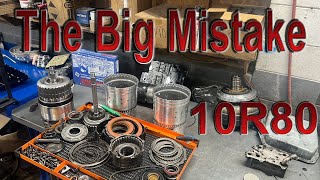
Typical fix: Overhaul or, more commonly, complete replacement of the main control valve body assembly, followed by an adaptive learning procedure. 🎬 See this walkthrough of a 10R80 valve body replacement.
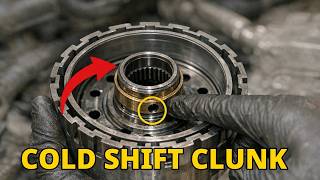
Est. part cost: $800-$1500 - Internal Failure of the CDF Clutch Drum 🟡 Medium Probability → Shop Transmission Clutch Pressure Plate A known design flaw on 10R80 transmissions involves a bushing/sleeve in the CDF drum 'walking' or sliding out of place. This uncovers oil passages, causing a major hydraulic leak that starves clutches of pressure and triggers various solenoid performance codes like P0766. Ford has released an updated drum with a machined lip to prevent this movement.
How to confirm: This requires transmission disassembly to visually inspect the CDF drum. A technician may first perform specialized hydraulic leak tests as detailed in related TSBs. The failure is often visible as an exposed fluid passage where the sleeve has shifted.
Typical fix: The transmission must be removed and rebuilt with an updated CDF drum assembly. The updated OEM part number is JL3Z-7H351-B, which supersedes previous versions.
Est. part cost: $200-$600 for the updated drum itself, but labor 🎬 Watch: See how the CDF drum failure occurs internally. for the rebuild is extensive. - Low or Contaminated Transmission Fluid ⚪ Low Probability → Shop Transmission Assembly While possible, this is rarely the root cause for a P0766 code on this platform unless there is a significant external leak. More often, the fluid is contaminated with debris from one of the other common failures, like the CDF drum, making it a symptom rather than the cause.
How to confirm: Check the transmission fluid level and condition. The fluid should be at the correct level and reddish (MERCON ULV), not dark brown or black, and should not smell burnt.
Typical fix: Perform a transmission fluid and filter change using only Motorcraft MERCON ULV. However, this is unlikely to solve the problem if internal damage has already occurred.
Est. part cost: $150-$300
Rare But Worth Checking
- Damaged Valve Body to Oil Pump Seal: → Shop Transmission Valve Body According to transmission technicians, this issue is almost always the result of a mistake during a previous repair. A crushed, dislodged, or missing seal between the valve body and oil pump can cause a no-move condition and set codes P0756 and P0766.
- Wiring Harness or Connector Issues: Damage to the transmission wiring harness or corrosion in the main connector can interrupt signals to the solenoids. This should be inspected before condemning internal components, though it is less common than the valve body or drum failure.
Diagnosis Steps
- Verify the code with a professional OBD-II scan tool that can read transmission-specific data.
- Check for any Technical Service Bulletins (TSBs) related to P0766 or transmission shifting issues for your vehicle's VIN. TSBs like 24-2046 and 23-2250 are highly relevant and list P0766 specifically.
- Check the transmission fluid level and condition. Dark, burnt, or glittery fluid indicates a serious internal mechanical problem.
- Inspect the transmission wiring harness and connectors for any visible damage, corrosion, or loose connections.
- Using an advanced scan tool, a technician will monitor solenoid commands versus their actual states and perform hydraulic pressure tests as outlined in the TSBs.
- If indicated by the TSB, a 'Transmission Accelerated Main Control Break In' procedure may be attempted to free sticking valves.
- If other tests are inconclusive, the valve body will be removed for inspection or replacement.
- If a major hydraulic leak is suspected (especially on transmissions built before mid-August 2022), the transmission will need to be removed from the vehicle for disassembly and inspection of the CDF clutch drum and other internal components.
Parts You'll Likely Need
- Main Control Valve Body Assembly
(OEM #JL1Z-7A100-B (Verify with VIN))— This is the most common cause of P0766, as sticking internal valves disrupt hydraulic control. Replacement is the standard fix recommended by TSBs.
Trusted brands: Motorcraft
OEM price range: $800-$1500
Aftermarket price range: $600-$1200 - CDF Clutch Drum Assembly (Updated)
(OEM #JL3Z-7H351-B)— A known design flaw can cause a sleeve to move, creating a major internal hydraulic leak that triggers this code. This requires a full transmission rebuild to replace with the updated part that has a machined lip to prevent movement.
Trusted brands: Motorcraft
OEM price range: $200-$600 - Motorcraft MERCON ULV Automatic Transmission Fluid
(OEM #XT-12-QULV)— This is the only specified fluid for the 10R80 transmission. Any major repair like a valve body or drum replacement will require a fluid change.
Trusted brands: Motorcraft
OEM price range: $12-$20 per quart
Related Codes That Often Appear With This One
- P0751, P0756, P0761, P2700-P2705, etc. — Codes for other shift solenoids (A, B, C, E, F) and friction elements often appear with P0766. TSBs 23-2250 and 24-2046 list a large group of codes caused by the same valve body/CDF drum issue, strongly indicating a systemic problem rather than multiple individual solenoid failures.
- P0729, P0731, P0732, P0733, P0734, P0735, P0736 — These are gear ratio error codes. They often accompany solenoid codes because if a solenoid fails to actuate a clutch pack correctly, the TCM detects that the resulting gear ratio is incorrect. These codes are also explicitly mentioned in the relevant TSBs.
Technical Service Bulletins (TSBs) & Recalls
- TSB 24-2046: Supersedes previous TSBs, addresses harsh/delayed shifts and numerous DTCs including P0766, P0751, P0756, and many others. It points to the solenoid ID strategy, sticking valves in the main control, or axial movement of the CDF clutch cylinder sleeve as potential causes.
- TSB 23-2250: Specifically links a long list of DTCs including P0766 to sticking valves in the main control valve body and/or movement of the CDF clutch cylinder sleeve for transmissions built on or before August 15, 2022.
Platform-Specific Known Issues
- The 10R80 transmission is subject to multiple TSBs for harsh shifting and solenoid codes. TSB 23-2250 and TSB 24-2046 directly link P0766 to "sticking valves in the main control valve body" and/or "axial movement of the CDF clutch cylinder sleeve."
- Owners on forums like Blue Oval Forums and Reddit's r/lincolnmotorco have documented numerous transmission-related complaints, from harsh shifting to complete failure requiring replacement, sometimes even at relatively low mileage.
Mechanic-Grade Diagnostic Values
- Shift Solenoid (A-F) Coil Resistance — expected: 4.5 - 5.5 Ohms. Failure: A reading outside of this range indicates a faulty solenoid coil. However, solenoids can test good electrically but still be mechanically stuck or affected by a hydraulic issue.
- Line Pressure at Idle (in any range) — expected: Approximately 90 psi according to charts, but 72-75 psi observed in real-world testing.. Failure: Significantly lower pressure can indicate a leak in the CDF drum, a faulty pump, or a major valve body issue. Higher than commanded pressure can indicate a stuck regulator valve.
- Line Pressure Control (LPC) Solenoid Current — expected: Inversely proportional; high current (e.g., 850 mA) results in low line pressure, while low current (e.g., 50 mA) results in high line pressure.. Failure: Current readings that don't correspond with the commanded state can indicate a wiring or TCM driver issue.
Hidden / Shadow Codes Worth Checking
- P163E: Transmission Control Module (TCM) Solenoid Body Malfunction (see via This code may appear after a valve body replacement if the Solenoid Strategy Download procedure is performed incorrectly. Specifically, it can be set if the 12-digit solenoid body ID is entered instead of only the 13-digit solenoid body strategy.)
Scan Tool Commands That Help
- Ford IDS, FDRS, or equivalent J2534 device with FORScan: Transmission Strategy Download — This is a mandatory procedure after replacing the main control valve body. The 13-digit solenoid body strategy number from the new part's tag must be programmed into the PCM/TCM. Failure to do this will result in severe shifting problems and likely set additional codes.
- Ford IDS, FDRS: Transmission Accelerated Main Control Break In — This is a diagnostic step outlined in Ford TSBs for shift quality concerns. The scan tool commands the solenoids to cycle rapidly to attempt to free up sticking valves within the main control. If this procedure resolves the issue, it confirms the problem is in the valve body.
- Ford IDS, FDRS, or equivalent: Clear Transmission Adaptive Tables — This must be performed after any major transmission repair, such as valve body or clutch replacement. It erases the learned shift parameters, forcing the TCM to start a new learning process. This is followed by a specific 'Adaptive Learning Drive Cycle'.
Real Owner Repair Stories
- Reddit user on r/f150 (2018 Ford F-150 with 10R80 (shared transmission)) — Not specified, but diagnosed as the common 'CDF failure'.
❌ Tried (didn't work) Not specified, likely went straight to dealer diagnosis.
✅ What actually fixed it A complete, factory remanufactured transmission replacement. The user noted this new transmission included the updated CDF drum design. The repair took 2.5 months due to parts/labor backlog but resulted in perfect shifting. - F150online Forums user (2019 F-150 3.5L EcoBoost with 10R80, at 65,400 miles) — Wrench light came on while towing. Truck over-revved when shifting from 1-3 and 7-8. No DTCs were present initially.
❌ Tried (didn't work) Initial diagnosis was difficult due to the lack of codes.
✅ What actually fixed it A full transmission and valve body overhaul. The technician found the fluid was low, burnt, and contained friction material, confirming internal failure. The final cost was over $4500, just outside the 60,000-mile powertrain warranty.
OEM Part Supersession History
HL3Z-7H351-A, JL3Z-7H351-A→JL3Z-7H351-B— The original CDF clutch drum design had a sleeve that could 'walk' or move out of position, causing a major internal hydraulic leak. The updated 'B' version features a machined lip that physically prevents the sleeve from moving, permanently correcting the design flaw.
Heads up: When rebuilding a pre-2022 transmission, it is critical to use the updated JL3Z-7H351-B part. Using an older new-old-stock part will lead to a repeat failure.JL1Z-7A100-A→JL1Z-7A100-B, JL1Z-7A100-C (and likely others)— Ford frequently revises the main control valve body assembly to address sticking valves, cross-leaks, and improve shift logic. Later revisions are generally considered more robust.
Heads up: Always verify the correct part number for your vehicle's specific VIN and build date using a dealer's catalog. Using the wrong valve body can lead to communication errors or incorrect shift behavior.
Model Year Variations Within This Range
- 2020 - mid-2022: Vehicles built on or before August 15, 2022, were equipped with the original CDF clutch drum design that is prone to sleeve migration. TSB 23-2250 specifically targets these vehicles for diagnosis and potential CDF drum replacement. Vehicles built after this date received the updated drum from the factory and are less likely to experience this specific failure mode, though valve body issues can still occur.
Diagnostic Flowchart
Other Known Issues on This Vehicle
Issues unrelated to this code that are worth knowing about as an owner of this generation:
- 360-Degree Camera Failure (Blue Screen) 🟠 Medium — Widespread issue affecting 2020-2023 models, leading to multiple recalls. (Ref: Recall 23V598, 23V022.)
- Electrical System Glitches 🟠 Medium — Common owner complaints include infotainment system freezing/crashing, phantom alerts, and issues with power locks.
- Powertrain and Drivability Concerns (Non-P0766) 🔴 High — Owners report rough idling, hesitation on acceleration, and sudden loss of power. One Reddit user reported a full transmission replacement at 50k miles for rough downshifting.
- Seat Belt Chime Malfunction 🟡 Low — Affects vehicles with the Revel Audio System, where the unbuckled warning chime may be too short. Addressed by a recall. (Ref: Recall 22C35.)
- Detaching Exterior Trim 🟡 Low — Insufficient adhesive on rear door window bars and C-pillar trim can cause them to detach. (Ref: Recall 25S66.)
Used vs. New Parts: Buying Guide for This Vehicle
When a used part is the smart pick: For this specific transmission, a used part is almost never a smart choice. Given the high rate of known defects with the valve body and CDF drum, purchasing a used assembly from a junkyard is highly likely to result in buying the same problem you are trying to fix. The only potential exception is a complete, low-mileage (under 30k) transmission from a 2023 or newer donor vehicle that is confirmed to have the updated parts, and even then it carries significant risk.
Donor-vehicle mileage cap: roughly under 30000 miles for the part to have meaningful remaining life.
What to inspect on the donor part:
- Verify the donor vehicle's build date is after August 2022 to increase the chance of getting updated components.
- If possible, get a video of the donor vehicle running and shifting to check for obvious issues.
- Insist on a warranty of at least 90 days from the salvage yard.
- Avoid any transmission that shows signs of external damage, leaks, or has dark, burnt-smelling fluid.
OEM-only on this vehicle (don't cheap out):
- Main Control Valve Body Assembly
- CDF Clutch Drum Assembly
Aftermarket brands forum-validated for this vehicle:
- For these specific internal failures, there are no widely trusted aftermarket brands that manufacture complete new replacement valve bodies or drums. 'Aftermarket' options are typically remanufactured OEM units of unknown quality. Sticking with new Motorcraft parts is the most reliable path.
Brands owners have reported issues with on this vehicle:
- Any unbranded or white-box 'remanufactured' valve body or drum from online marketplaces. The tolerances and programming requirements for the 10R80 are too specific to trust to no-name rebuilders.
Real Owner Stories
Aggregated from forums and TSBs cited above. Mileages and costs reflect what owners reported in those sources.
2020 Aviator Black Label PHEV — 50000 miles
Symptoms: rough downshifting
What fixed it: The dealer replaced the transmission with a new one.
Source hint: r/lincolnmotorco on Reddit: In a thread titled 'Any common issues with 2020+ Lincoln aviators?'
Related OBD-II Codes
Frequently Asked Questions
My 2022 Lincoln Aviator is showing code P0766. Are there any specific TSBs I should know about?
What are the most likely mechanical failures causing a P0766 code on the 10R80 transmission in my Aviator?
The dealership mentioned replacing the CDF drum. Is there an improved part available?
Can I just get a transmission fluid and filter change to fix the harsh shifting and P0766 code?
Is the 'Transmission Accelerated Main Control Break In' procedure a legitimate diagnostic step for this problem?
Are other vehicles like the Ford F-150 or Expedition having this same 10-speed transmission problem?
Helpful Videos
We Have This Part in Stock


The information in this article is provided for general reference and educational purposes only. Vehicle specifications, procedures, and part compatibility can vary by production date, trim level, and region. Always consult your vehicle's factory service manual and verify part numbers before purchasing or performing repairs. Safety-critical components such as airbags, seat belts, and braking systems should be installed by a qualified professional.
- Lincoln Aviator:
- 🧭 Diagnostic Flowchart
- 🎬 Helpful Videos
- 🛍️ Shop This Part
- What's Unique About the 2020-2023 Lincoln Aviator
- Symptoms You May Notice
- Most Likely Causes
- Rare But Worth Checking
- Diagnosis Steps
- Parts You'll Likely Need
- Related Codes That Often Appear With This One
- Technical Service Bulletins (TSBs) & Recalls
- Platform-Specific Known Issues
- Mechanic-Grade Diagnostic Values
- Hidden / Shadow Codes Worth Checking
- Scan Tool Commands That Help
- Real Owner Repair Stories
- OEM Part Supersession History
- Model Year Variations Within This Range
- Other Known Issues on This Vehicle
- Used vs. New Parts: Buying Guide for This Vehicle
- Real Owner Stories
- 2020 Aviator Black Label PHEV — 50000 miles
- Related OBD-II Codes
- Frequently Asked Questions
- 🎟️ Get 5% Off