

P0766 on 2012-2013 Mazda MAZDA3: Shift Solenoid 'D' Causes and Fixes
On a 2012-2013 Mazda3, code P0766 often points to more than just a single bad solenoid. Due to a known issue covered by Mazda TSBs, the cause is frequently a faulty transmission valve body or control module. The underlying problem is often contamination in the fluid causing internal components of the valve body to stick. Always start by checking fluid level and condition, but be prepared for a more complex repair involving the valve body.
- P0766 on a 2012-2013 Mazda3 is a serious code that indicates a problem with the transmission's ability to shift gears correctly.
- Always check the transmission fluid level and condition first; it's the simplest and cheapest first step.
- Be aware that Mazda has issued TSBs indicating this code is often part of a larger problem involving the valve body or TCM, not just one bad solenoid.
- Due to the complexity of internal transmission work and the known issues with this model, professional diagnosis is highly recommended to avoid replacing the wrong parts.
What's Unique About the 2012-2013 Mazda MAZDA3
For the 2012-2013 Mazda3, particularly those with the then-new SKYACTIV-Drive automatic transmission (model FW6A-EL), P0766 is often not an isolated failure. Mazda issued Technical Service Bulletins (TSBs) that group P0766 with over a dozen other transmission codes. This indicates a known underlying issue, frequently traced to the transmission's valve body or the control module itself. The TSBs suggest the root cause is often contamination in the transmission fluid that causes internal oil pressure switches and plungers in the valve body to stick, disrupting hydraulic circuits. Owners should be aware that this code is often a symptom of this wider, documented platform issue.
Diagnostic Flowchart
Tap your situation to follow the diagnostic path that matches what you're seeing on this vehicle.
Symptoms You May Notice
- Check Engine Light and/or AT (Automatic Transmission) warning light is on.
- Harsh, erratic, or delayed shifting.
- Transmission fails to shift into or out of a specific gear.
- Vehicle enters "limp mode," getting stuck in a single gear (often 3rd).
- Noticeable increase in fuel consumption.
- Slipping, where the engine RPMs increase but the vehicle doesn't accelerate accordingly.
- Transmission overheating.
- Replacing only the 'D' shift solenoid without investigating further. On this vehicle, the code is often a symptom of a larger valve body problem. A Reddit user reported that after replacing the solenoid and fluid, their car still slipped out of gear and clunked, indicating the root cause was not addressed.
Most Likely Causes
- Low or Dirty Transmission Fluid 🔴 High Probability → Shop Transmission Assembly Fluid is the lifeblood of the transmission; if it's low or degraded, it can't create the hydraulic pressure needed for solenoids to function. A forum user with this code noted their fluid was 'black as night and smells really burnt,' indicating a severe condition that likely caused further component damage. Contaminated fluid is the primary cause of sticking components in the valve body, as noted in Mazda TSBs.
How to confirm: Check the transmission fluid dipstick (if equipped) or inspection plug for level and color. The fluid should be bright red and clear, not dark brown/black or smelling burnt.
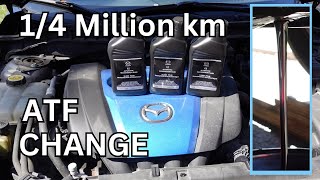
Typical fix: Perform a transmission fluid drain-and-fill or a full fluid exchange. Use only Mazda-specific fluid (e.g., FZ or M-V). 🎬 Watch: Step-by-step guide for a Mazda 3 transmission fluid change. This is often the first step before more expensive repairs.
Est. part cost: $50-$150 - Faulty Transmission Valve Body 🔴 High Probability → Shop Transmission Valve Body Mazda TSBs #05-003-14-2898A and others point to P0766 as a symptom of a systemic issue within the valve body. Transmission specialists note that on the FW6A-EL transmission, abrasive particles in aging fluid wear down the anodized coating on internal valve plungers after 60,000-90,000 miles, causing them to stick and disrupt hydraulic pressure.
How to confirm: This is difficult to confirm without professional diagnostics. A technician will test solenoid circuits and pressures. If multiple circuits show issues or if individual solenoids test okay, the valve body is suspect. Advanced diagnosis may involve vacuum testing the valve body channels to check for internal leaks.
Typical fix: Replacement of the entire transmission valve body assembly. In some cases, a specialist may be able to rebuild the existing valve body with oversized plungers and replacement oil pressure switches.
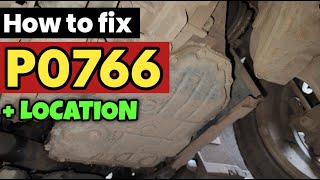
Est. part cost: $500-$1200 - Faulty Shift Solenoid 'D' 🟡 Medium Probability → Shop Transmission Valve Body Solenoids can fail electrically (coil burns out) or mechanically (plunger gets stuck). While possible, on this vehicle it is critical to rule out the larger, documented valve body issue first, as a single solenoid replacement often fails to correct the problem. 🎬 Watch: Understanding the P0766 shift solenoid D performance code.
How to confirm: A technician can test the solenoid's resistance with a multimeter to check for an open or shorted coil (a good solenoid is often 4-6 Ω). A professional scan tool can also attempt to command the solenoid on and off to observe its response.
Typical fix: Remove the transmission pan to access and replace the individual solenoid.
Est. part cost: $50-$150 - Faulty Transmission Control Module (TCM) or Wiring ⚪ Low Probability → Shop Transmission Assembly While less common, the TCM can fail, or the wiring between the TCM and the transmission can become damaged, corroded, or shorted. The TSB repair path includes potentially reprogramming the TCM with updated logic to prevent false codes.
How to confirm: Inspect the wiring harness for visible damage. A technician will perform continuity and voltage drop tests on the solenoid circuit to isolate the fault between the TCM and the solenoid.
Typical fix: Repair the damaged wiring or replace the TCM. A replacement TCM will require programming to the vehicle. 🎬 See how to identify and fix a dodgy control module.
Est. part cost: $50-$800
Diagnosis Steps
- Check the transmission fluid level and condition. If low, top it off. If dark, burnt, or contaminated, a fluid change is the first step, though it may not solve an existing mechanical issue.
- Use an OBD-II scanner to check for any other pending or active trouble codes. Note all codes present, as P0766 is often accompanied by others on this platform.
- Using a professional-grade scan tool, monitor the commanded state versus the actual state of Shift Solenoid 'D' during operation.
- Inspect the transmission wiring harness and connectors for any signs of damage, corrosion, or loose connections.
- If accessible, perform a resistance test on Shift Solenoid 'D' to check for an electrical fault. Compare the reading to the manufacturer's specification (typically around 4-6 Ω).
- If the solenoid and wiring test good, the problem likely lies within the transmission valve body or the TCM, as suggested by Mazda's TSBs.
- Consult Mazda Technical Service Bulletin #05-003-14-2898A or its successors. The diagnostic path may lead to replacing oil pressure switches within the valve body or reprogramming the TCM.
Parts You'll Likely Need
- Transmission Valve Body
(OEM #FZ2121100J, FZ2121100H (often sold as assembly FW6A-EL))— Given the TSBs for this model, a faulty valve body is a highly probable root cause when P0766 appears, especially with other codes.
Trusted brands: Mazda (OEM)
OEM price range: $800-$1200
Aftermarket price range: $500-$900 - Automatic Transmission Shift Solenoid — If the issue is isolated to a single solenoid failure, this part will be needed. It is a common failure point on many automatic transmissions, but may not be the root cause on this platform.
Trusted brands: Rostra, Hitachi, Mazda (OEM)
OEM price range: $100-$200
Aftermarket price range: $40-$100 - Mazda Automatic Transmission Fluid (Type FZ)
(OEM #0000-FZ-113E-01)— Any repair involving the valve body or solenoids will require draining and refilling the transmission with the correct OEM-spec fluid.
Trusted brands: Mazda (OEM)
OEM price range: $15-$25 per quart
Related Codes That Often Appear With This One
- P0715 — This code for the Input/Turbine Speed Sensor often appears with solenoid codes when there's a major hydraulic or control issue, as reported by owners.
- P0751, P0756, P0761, etc. — The official Mazda TSBs show P0766 as part of a large family of other shift solenoid performance codes, indicating a systemic problem affecting multiple hydraulic circuits, not just solenoid 'D'.
- P0842, P0847, P0872, P0877 — These codes, for various oil pressure switches, are frequently cited in the same TSBs as the root cause of the shifting complaints, caused by contamination within the valve body.
Technical Service Bulletins (TSBs) & Recalls
- 05-003-14-2898A: Lists P0766 as one of many potential DTCs related to a known transmission issue.
- 05-003-14-2898: The preceding version of the same bulletin
Platform-Specific Known Issues
- Mazda Technical Service Bulletins like #05-003-14-2898A identify a condition where P0766 is stored with numerous other DTCs. Related TSBs clarify the cause is often contamination in the fluid causing oil pressure switches (A and/or B) in the control valve body to stick. The recommended repair procedure can involve replacing these specific switches and their O-rings, rather than the entire valve body, or reprogramming the TCM with updated diagnostic logic.
Mechanic-Grade Diagnostic Values
- On/Off Solenoid Resistance — expected: 11-14 Ω. Failure: A reading outside this range (e.g., infinite for an open circuit or near zero for a short) indicates a faulty solenoid coil.
- Pressure Control Solenoid Resistance — expected: 5-7 Ω. Failure: A reading outside this range indicates a faulty solenoid coil.
- ATF Temperature for Fluid Level Check — expected: 50° C (122° F). Failure: Checking the fluid at a significantly different temperature will result in an inaccurate level reading.
Scan Tool Commands That Help
- Mazda IDS or equivalent professional scan tool: Solenoid Command and Feedback PID Monitoring — Use this to diagnose if the TCM is sending a command and if the solenoid circuit is reporting a response. A command with no feedback points towards a solenoid or wiring issue, while no command suggests a TCM problem.
- Mazda IDS or equivalent professional scan tool: Solenoid Active Command (Bidirectional Test) — This function allows a technician to manually command a specific solenoid on and off while the vehicle is stationary to listen for the solenoid's 'click' and observe pressure changes, confirming mechanical operation.
Wiring & Ground Locations
- TCM Connector Grounds — On a 2012 Mazda 3 sedan, the TCM connector has two ground wires. On one connector, they are the 5th pin from the edge on the top and middle rows.. A poor ground connection at the TCM can cause erratic behavior, incorrect sensor readings, and false solenoid fault codes. Verifying these grounds is a critical step before condemning the expensive TCM.
- Transmission Housing Grounds — There are multiple ground points on the transmission itself, including one on the top of the transmission and two on the front of the case. Another common grounding point is a bolt on the transmission bell housing.. The solenoids are housed within the transmission, and a solid ground connection for the entire unit is essential for the proper operation of all internal electronics. Corrosion or looseness at these points can cause widespread electrical issues.
OEM Part Supersession History
FZ21-21-100H (and others)→FZ21-21-100J— Likely an updated design to address reliability issues found in earlier versions.
Heads up: While FZ21-21-100J is listed for later models, it is often referenced for repairs on earlier SKYACTIV transmissions. Always confirm compatibility with the vehicle's VIN before ordering, as there may be programming or minor physical differences.
Model Year Variations Within This Range
- 2012-2013: The P0766 code and its associated TSBs are primarily relevant to the 2012-2013 Mazda3 models equipped with the 2.0L SKYACTIV-G engine and the new-for-2012 FW6A-EL SKYACTIV-Drive 6-speed automatic transmission. Models from the same years with the 2.5L MZR engine used a different, non-SKYACTIV transmission to which this specific pattern of failure does not apply.
Helpful Videos


We Have This Part in Stock

The information in this article is provided for general reference and educational purposes only. Vehicle specifications, procedures, and part compatibility can vary by production date, trim level, and region. Always consult your vehicle's factory service manual and verify part numbers before purchasing or performing repairs. Safety-critical components such as airbags, seat belts, and braking systems should be installed by a qualified professional.
- Mazda MAZDA3:
- 🧭 Diagnostic Flowchart
- 🎬 Helpful Videos
- 🛍️ Shop This Part
- What's Unique About the 2012-2013 Mazda MAZDA3
- Symptoms You May Notice
- Most Likely Causes
- Diagnosis Steps
- Parts You'll Likely Need
- Related Codes That Often Appear With This One
- Technical Service Bulletins (TSBs) & Recalls
- Platform-Specific Known Issues
- Mechanic-Grade Diagnostic Values
- Scan Tool Commands That Help
- Wiring & Ground Locations
- OEM Part Supersession History
- Model Year Variations Within This Range
- 🎟️ Get 5% Off