

P0768 on 2011-2014 Kia Optima Hybrid: Shift Solenoid 'D' Causes and Fixes
On a 2011-2014 Kia Optima Hybrid, code P0768 almost always indicates a failed Shift Solenoid 'D' inside the A6MF2H 6-speed automatic transmission. This is a well-known issue confirmed by Kia Technical Service Bulletin (TSB) #TSBTRA051R1. The correct and most cost-effective fix is to replace the individual solenoid, not the entire transmission assembly.
- P0768 on your Optima Hybrid means there's an electrical problem with Shift Solenoid 'D', which controls the overdrive clutch.
- This is a known issue confirmed by Kia TSB #TSBTRA051R1.
- The correct fix is to replace the individual solenoid (Part #46313-3B762), not the whole transmission.
- The repair involves dropping the transmission pan and is best for a professional.
- Always use Kia SP-IV transmission fluid when refilling.
What's Unique About the 2011-2014 Kia OPTIMA HYBRID
The 6-speed automatic transmission (designated A6MF1/A6MF2) used in this generation of Kia Optima Hybrid is known for a pattern of shift solenoid failures. Kia acknowledged this by issuing Technical Service Bulletin #TSBTRA051R1. The bulletin specifically lists P0768 and advises technicians to replace the individual faulty solenoid rather than the entire, much more expensive, transaxle assembly. This makes the diagnosis more straightforward than on other vehicles where the cause might be more ambiguous, as the TSB points directly to the most probable cause.
Diagnostic Flowchart
Tap your situation to follow the diagnostic path that matches what you're seeing on this vehicle.
Symptoms You May Notice
- Check Engine Light is on
- Harsh, jerky, or delayed gear shifts
- Transmission gets stuck in one gear (limp mode)
- Transmission warning light may be illuminated
- Reduced fuel economy
- Failure to shift into certain gears, particularly overdrive gears
- Sensation of the transmission slipping or a brief loss of power
- Replacing the entire transmission assembly. A specific Kia TSB (#TSBTRA051R1) advises against this, stating that the issue can be resolved by replacing only the faulty solenoid, saving significant time and money.
Most Likely Causes
- Failed Shift Solenoid 'D' 🔴 High Probability → Shop Transmission Valve Body This is a well-documented failure point for the A6MF family of transmissions, as confirmed by Kia's own Technical Service Bulletin (TSBTRA051R1). The solenoids are considered a wear item and can fail electrically after 80,000 miles.
How to confirm: After dropping the transmission pan, a technician can test the solenoid's electrical resistance with a multimeter. An open circuit (infinite resistance) or a shorted circuit (very low resistance) confirms failure. The reading should be compared to the manufacturer's specification. For the VFS (Variable Force Solenoid) used in this application, the resistance should be approximately 5.1 ohms. A technician can also use a 9-volt battery or a power probe to listen for an audible click, though an out-of-spec resistance reading is the definitive test.
Typical fix: Replace the faulty shift solenoid inside the transmission valve body. The solenoids are sold individually. 🎬 See this walkthrough for removing and replacing the solenoid. Given the labor involved, some owners and shops elect to replace the entire solenoid pack as a preventative measure.
Est. part cost: $70-$200 - Low or Contaminated Transmission Fluid 🟡 Medium Probability → Shop Transmission Assembly
How to confirm: Check the transmission fluid level and condition via the service port, as these transmissions do not have a traditional dipstick. The fluid should be at the correct level, pink/red in color, and not smell burnt. Dark, dirty, or sludgy fluid can clog solenoid passages and cause shifting issues.
Typical fix: Perform a transmission fluid drain-and-fill or a full fluid exchange if the fluid is heavily contaminated. Always use the manufacturer-specified fluid, which is Kia SP-IV. It is also best practice to replace the transmission filter at the same time.
Est. part cost: $60-$150 - Wiring or Connector Issues ⚪ Low Probability
How to confirm: Visually inspect the main wiring harness connector on the exterior of the transmission case for corrosion, moisture intrusion, or pushed-out pins. A continuity test can be performed from the TCM connector to the transmission connector to check for breaks or shorts in the wire. Also inspect the internal harness for damage once the pan is removed.
Typical fix: Clean the corroded connector terminals or repair the damaged section of the wiring harness. If the internal harness is damaged, it can be replaced separately from the solenoids.
Est. part cost: $5-$100
Rare But Worth Checking
- Faulty Transmission Control Module (TCM): → Shop Transmission Assembly This is rare and should only be considered after the solenoid and wiring have been thoroughly tested and ruled out. A faulty TCM driver circuit can mimic a failed solenoid.
Diagnosis Steps
- Check the transmission fluid level and condition. Top off or replace if low or dirty, using only Kia SP-IV fluid.
- Use an OBD-II scanner to confirm P0768 is present and check for any other related transmission codes.
- Inspect the main transmission wiring harness connector for any signs of damage, corrosion, or moisture.
- If external checks are clear, drain the transmission fluid and remove the transmission oil pan.
- Visually inspect the internal wiring harness leading to the solenoids for any obvious damage.
- Locate Shift Solenoid 'D' (Overdrive Clutch Solenoid) on the valve body.
- Disconnect the solenoid and measure its electrical resistance with a multimeter. Compare the reading to the factory specification of approximately 5.1 ohms. An out-of-spec reading (open or shorted) confirms a failed solenoid. 🎬 Watch: How to test the solenoid with a multimeter.
- If the solenoid tests good, the fault lies in the wiring between the TCM and the solenoid, or, in rare cases, the TCM itself.
Parts You'll Likely Need
- Automatic Transmission Shift Solenoid 'D'
(OEM #46313-3B762)— This is the component that has failed electrically, as identified by the code and confirmed by a Kia TSB. This specific part number is listed for Overdrive Clutch control.
Trusted brands: Genuine Kia, Rostra, Standard Motor Products (TCS289)
OEM price range: $85-$125
Aftermarket price range: $70-$150 - Automatic Transmission Fluid (Kia SP-IV)
(OEM #00232-19045)— The transmission fluid must be drained to access the solenoid and should be replaced with the correct type of fluid to ensure proper operation. A drain and fill requires approximately 5 quarts.
Trusted brands: Kia, Idemitsu, ENEOS
OEM price range: $15-$25 per quart
Aftermarket price range: $10-$18 per quart - Transmission Pan Gasket and Filter Kit — The pan gasket must be replaced when the pan is removed to prevent leaks, and it is best practice to replace the filter at the same time.
Trusted brands: Wix, ATP, Genuine Kia
OEM price range: $40-$70
Aftermarket price range: $25-$50
Related Codes That Often Appear With This One
- P0753 — This is the code for Shift Solenoid 'A' Electrical. Seeing multiple solenoid codes together strengthens the diagnosis of a common solenoid pack failure or a widespread wiring/connector issue, all covered by the same TSB.
- P0758 — This is the code for Shift Solenoid 'B' Electrical. Like P0753, its presence points to a pattern of failure covered by TSB #TSBTRA051R1.
- P0741 — This code for the Torque Converter Clutch Solenoid is also listed in TSB #TSBTRA051R1, indicating it's part of the same family of potential solenoid failures.
Technical Service Bulletins (TSBs) & Recalls
- TSBTRA051R1: Addresses multiple solenoid-related DTCs including P0768, P0741, P0753, P0758, etc., on 6-speed automatic transaxles. It advises replacing individual solenoids if current or history codes are present, and explicitly states 'DO NOT REPLACE THE TRANSAXLE'.
Platform-Specific Known Issues
- A Kia Technical Service Bulletin (TSBTRA051R1), issued June 1, 2015, addresses a pattern of solenoid failures in the 6-speed automatic transaxle (A6MF family) used in this vehicle. The bulletin explicitly lists P0768 and instructs technicians to replace the individual solenoids and not the entire transaxle assembly to save on repair time and cost.
Mechanic-Grade Diagnostic Values
- Shift Solenoid 'D' (VFS Type) Resistance — expected: 5.0 - 5.6 Ohms (Target ~5.1 Ohms). Failure: An open circuit (infinite resistance) or short circuit (near-zero resistance) confirms solenoid failure.
- Voltage at Solenoid 'D' Reference Line — expected: Steady 12 Volts with key on, engine off.. Failure: A voltage drop below 9V or no voltage indicates a problem with the power supply or wiring, not necessarily the solenoid itself.
- Wiring Harness Continuity — expected: < 0.1 Ohms. Failure: Resistance higher than 0.1 Ohms suggests corrosion or a damaged wire in the circuit between the TCM and the solenoid connector.
- ATF Temperature for Fluid Level Check — expected: 122°F - 140°F (50°C - 60°C). Failure: Checking the fluid level when the fluid is too cold or too hot will result in an inaccurate reading, potentially leading to an underfill or overfill condition.
Scan Tool Commands That Help
- Kia GDS (Global Diagnostic System) / KDS: Actuation Test > Solenoid Valve — This is a bidirectional control used to command the TCM to activate a specific solenoid. A technician can listen for an audible 'click' with a stethoscope to confirm mechanical function without removing the transmission pan. The TSB for this issue specifically calls out using this test.
- Kia GDS (Global Diagnostic System) / KDS: Vehicle S/W Management > Reset Adaptive Values — After replacing a solenoid or performing other transmission repairs, this function should be used to clear the learned shift adaptations from the TCM, allowing it to relearn shift points with the new components.
Wiring & Ground Locations
- Main Transmission Connector (Case Connector) — On the exterior of the transmission case, where the main vehicle wiring harness plugs in.. This is the primary external test point. A technician can check the resistance of Shift Solenoid 'D' (Overdrive) across pins 10 and 7 of this connector to diagnose the solenoid and internal harness without removing the oil pan.
- Main Chassis Ground Point — A common grounding bolt for multiple circuits is often located on the body chassis to the right of the interior fuse panel/kick panel area.. While not specific to the P0768 circuit, a loose or corroded main ground can cause a variety of intermittent and difficult-to-diagnose electrical faults. It's a good practice to check this ground's integrity when troubleshooting any electrical DTC.
Real Owner Repair Stories
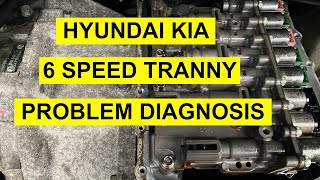
- YouTube Channel 'Auto Repair Guys' (2013 Hyundai Sonata (Uses the same A6MF transmission family as the Optima Hybrid)) — Harsh shifting, slipping, or getting stuck in gear.
❌ Tried (didn't work) The video focuses on correct diagnosis rather than failed attempts, warning against unnecessarily replacing the entire transmission.
✅ What actually fixed it The video identifies the location of all eight solenoids on the valve body, including the Overdrive (OD) solenoid which corresponds to 'D'. The fix is to test the specific solenoid for correct resistance and replace only the failed component.
Model Year Variations Within This Range
- Later models within the 2011-2014 range: Later production vehicles may use a rubber molded valve body cover gasket. This gasket is known to sometimes leak after service if the cover itself has warped. It is a mechanic's best practice to check the valve body cover for flatness with a straight edge before re-installing it with a new gasket to prevent future leaks.
Helpful Videos


We Have This Part in Stock

The information in this article is provided for general reference and educational purposes only. Vehicle specifications, procedures, and part compatibility can vary by production date, trim level, and region. Always consult your vehicle's factory service manual and verify part numbers before purchasing or performing repairs. Safety-critical components such as airbags, seat belts, and braking systems should be installed by a qualified professional.
- Kia OPTIMA HYBRID:
- 🧭 Diagnostic Flowchart
- 🎬 Helpful Videos
- 🛍️ Shop This Part
- What's Unique About the 2011-2014 Kia OPTIMA HYBRID
- Symptoms You May Notice
- Most Likely Causes
- Rare But Worth Checking
- Diagnosis Steps
- Parts You'll Likely Need
- Related Codes That Often Appear With This One
- Technical Service Bulletins (TSBs) & Recalls
- Platform-Specific Known Issues
- Mechanic-Grade Diagnostic Values
- Scan Tool Commands That Help
- Wiring & Ground Locations
- Real Owner Repair Stories
- Model Year Variations Within This Range
- 🎟️ Get 5% Off