

P0771 on 2018-2023 Ford Mustang: Shift Solenoid 'E' Causes and Fixes
On a 2018-2023 Mustang with the 10-speed 10R80 automatic, code P0771 usually points to a problem with the transmission's main control valve body, not just a single solenoid. The most common fix is replacing the entire valve body assembly, a complex repair that can cost between $1,500 and $3,500 at a shop. This issue is well-documented by Ford in multiple Technical Service Bulletins.
- P0771 on a 2018-2023 Mustang almost always points to an issue with the 10R80 10-speed automatic transmission.
- The most frequent cause is a faulty main control valve body, not just a single bad solenoid. This is a known issue covered by multiple Ford TSBs.
- The first diagnostic step should always be to check the transmission fluid level and condition.
- Repair is complex and expensive, typically requiring the replacement of the entire valve body assembly by a professional.
- Do not ignore this code, as continued driving can lead to more severe and costly internal transmission damage.
What's Unique About the 2018-2023 Ford MUSTANG
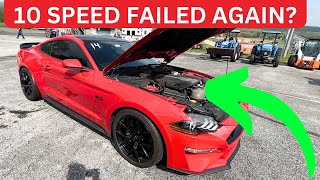
The 2018-2023 Mustang uses the Ford-GM co-developed 10R80 10-speed automatic transmission. This transmission is known for issues related to its main control valve body and, in earlier models (approx. 2018-2022), a problematic CDF drum bushing. As a result, 🎬 Watch: A Mustang owner's experience with common 10R80 transmission issues. a P0771 code is frequently not an isolated failure of Solenoid 'E' but a symptom of a larger, well-documented problem within the valve body assembly, such as sticking valves or internal cross-leaks. This has prompted Ford to issue multiple superseding Technical Service Bulletins (TSBs), with TSB 24-2176 being one of the most recent, which often recommends valve body replacement as the primary repair.
Diagnostic Flowchart
Tap your situation to follow the diagnostic path that matches what you're seeing on this vehicle.
Symptoms You May Notice
- Harsh or delayed shifts between gears, especially the 3-5 shift.
- Abrupt or jerky engagement when shifting from Park to Drive or Reverse.
- Transmission may get stuck in a single gear (limp mode).
- Check Engine Light or Wrench Light is illuminated.
- Vehicle may feel like it neutralizes or loses power momentarily between shifts.
- Reduced fuel economy due to inefficient shifting.
- In some cases, the transmission may seem to slip, where engine RPMs flare up without an increase in vehicle speed.
- Replacing only the 'E' shift solenoid without inspecting the rest of the valve body. If the valve body has sticking valves or clogged passages, the new solenoid will not fix the problem and the code will likely return.
- Performing a fluid change without addressing the root cause. If the valve body is faulty or the CDF drum is shedding material, a fluid change is only a very temporary solution.
Most Likely Causes
- Faulty Main Control Valve Body Assembly 🔴 High Probability → Shop Transmission Valve Body The 10R80 transmission has known issues with sticking valves and cross-leaks within the valve body, as acknowledged by multiple Ford TSBs (e.g., 24-2176, 23-2250). Debris from other internal parts, like the CDF drum bushing, can also contaminate the valve body and cause solenoids to malfunction.
How to confirm: A technician will use a high-level scan tool to monitor solenoid commands and performance. If the solenoid tests bad and wiring is intact, the valve body is the likely culprit. A pressure test of the transmission can also confirm internal leaks. The pan may be dropped to check for debris.
Typical fix: Replacement of the entire main control valve body assembly with an updated unit, followed by a fluid refill and a solenoid strategy relearn procedure. The latest OEM part number often supersedes previous versions.
Est. part cost: $700-$1500 - Low or Contaminated Transmission Fluid 🟡 Medium Probability → Shop Transmission Assembly
How to confirm: Check the transmission fluid level and condition. The fluid should be at the correct level and have a reddish color, not dark brown or black, and should not smell burnt. The presence of excessive metallic particles indicates a more severe internal failure.
Typical fix: Perform a transmission fluid and filter change using the correct Motorcraft MERCON ULV fluid. If the fluid is very dark or contains metal particles, further internal inspection is required as this is likely a symptom of a larger problem like CDF drum failure.
Est. part cost: $150-$300 - Failed Shift Solenoid 'E' ⚪ Low Probability → Shop Transmission Valve Body While the code directly points to this solenoid, it's more common for the entire valve body to be the source of the problem on the 10R80 transmission rather than a single solenoid failing on its own. The solenoids are integrated into the valve body, making a full assembly replacement the standard repair.
How to confirm: After dropping the transmission pan, a technician can test the solenoid's electrical resistance with a multimeter. However, the failure is often mechanical (sticking) rather than electrical.
Typical fix: Replace the individual solenoid. However, this is often a temporary fix if the root cause is contamination or a faulty valve body, and most shops will replace the entire valve body assembly.
Est. part cost: $50-$150 - Wiring or Connector Issue ⚪ Low Probability
How to confirm: Visually inspect the transmission wiring harness and the main connector at the transmission case for any signs of damage, corrosion, or loose pins. Water intrusion into the main vehicle battery junction box (BJB) has also been noted to cause various electrical issues.
Typical fix: Repair the damaged section of the harness or clean/replace the faulty connector.
Est. part cost: $20-$100
Rare But Worth Checking
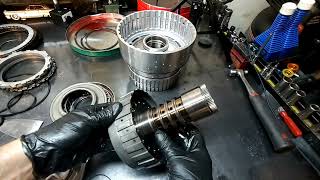
- Internal Mechanical Failure (CDF Drum): In earlier 10R80 models (approx. 2018-2022), a bushing in the CDF (Clutch F) drum could walk out of place, causing a seal to fail and sending metallic debris throughout the transmission. This debris can clog the valve body and cause solenoid codes like P0771. Ford has since released an updated CDF drum assembly to correct this design flaw. 🎬 See a detailed breakdown of the CDF drum failure.
- Faulty Transmission Control Module (TCM): → Shop Transmission Assembly While rare, the TCM itself can fail, sending incorrect signals or failing to properly detect the solenoid's operation. This is usually diagnosed only after all other possibilities, especially the valve body, have been ruled out.
Diagnosis Steps
- Check and verify the transmission fluid level and condition. Ensure it is clean, full, and does not smell burnt. The fluid should be Motorcraft MERCON ULV.
- Use an OBD-II scanner to check for any other pending or stored transmission codes. Multiple solenoid or gear ratio codes point towards a valve body issue.
- With an advanced scan tool, monitor the live data for Shift Solenoid 'E' (SS-E) command and feedback PIDs while driving. Attempt to command the solenoid on and off to check for a response.
- Inspect the external transmission wiring harness and the main electrical connector for any visible damage, corrosion, or loose connections.
- If external checks are inconclusive, drop the transmission oil pan and inspect for excessive metal debris or clutch material. A significant amount of debris points to a severe internal failure, likely the CDF drum.
- With the pan removed, visually inspect the valve body and solenoids.
- Test the resistance of Shift Solenoid 'E' with a multimeter to check for an electrical fault within the solenoid coil, though mechanical failure is more common.
- Given the high probability of valve body issues on this platform, if fluid and wiring are good, replacement of the valve body assembly is the most likely next step, as recommended in multiple TSBs.
Parts You'll Likely Need
- Main Control Valve Body Assembly
(OEM #JL3Z-7A100-C)— This is the most common root cause for solenoid performance codes on the 10R80 transmission. This part number is an updated version that supersedes previous ones like JL3Z-7A100-A.
Trusted brands: Motorcraft
OEM price range: $700-$1200
Aftermarket price range: $600-$1000 - Automatic Transmission Fluid
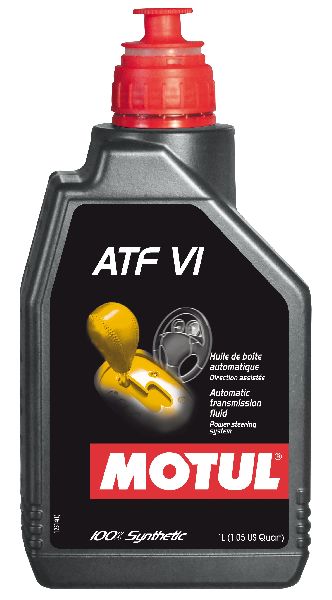
(OEM #Motorcraft XT-12-QULV (MERCON ULV))— The transmission must be refilled with approximately 8-10 quarts of the correct fluid after replacing the valve body. Using the wrong fluid type can cause shifting problems and damage.
Trusted brands: Motorcraft
OEM price range: $10-$15 per quart - Transmission Filter and Pan Gasket
(OEM #FT215 (Filter Kit))— These are standard replacement items whenever the transmission pan is removed for service.
Trusted brands: Motorcraft
OEM price range: $50-$100
Aftermarket price range: $30-$70
Related Codes That Often Appear With This One
- P0751, P0756, P0761, P0766 — These are codes for other shift solenoids ('A', 'B', 'C', 'D'). When multiple solenoid codes appear together, it strongly indicates a systemic problem like a faulty valve body or low fluid pressure, rather than multiple individual solenoid failures.
- P0729, P0731-P0736 — These are gear ratio error codes. They often accompany solenoid codes because if a solenoid is stuck, the transmission cannot achieve the correct gear ratio, leading the TCM to log a gear ratio fault.
- P2700-P2705, P2704 — These codes relate to transmission friction element apply time. A faulty solenoid affects the timing of clutch engagement, which can trigger these codes alongside P0771.
Technical Service Bulletins (TSBs) & Recalls
- TSB 24-2176: Supersedes previous TSBs, addresses harsh/delayed shifts and numerous DTCs including P0771 for 2022-2023 Mustangs. Points to software, valve body, or CDF drum sleeve issues.
- TSB 23-2250: Supersedes TSB 22-2428, covers 2018-2023 Mustangs for similar issues, also pointing to valve body and CDF drum sleeve as potential causes.
- TSB 22-2428: Specifically mentions axial movement of the CDF clutch cylinder sleeve as a cause for hydraulic leaks and various DTCs on 2021-2022 Mustangs among others.
- TSB 21-2357: An earlier TSB for 2018-2021 Mustangs that recommended overhauling the main control valve body or performing an adaptive learning drive cycle.
Platform-Specific Known Issues
- The 2018-2023 Ford Mustang with the 10R80 transmission is covered by
Mechanic-Grade Diagnostic Values
- Shift Solenoid Electrical Resistance — expected: 5.0-5.4 ohms at 68°F (20°C). Failure: A reading outside this range indicates a faulty solenoid coil.
- Shift Solenoid 'E' (SR) Electrical Resistance (alternative spec) — expected: 11 to 15 Ω at 68°F (20°C). Failure: Resistance outside this range points to an electrical fault in the solenoid.
- Scan Tool Live Data PID - Solenoid 'E' Command vs. Feedback — expected: Feedback voltage/status should mirror the commanded state from the TCM during shifts.. Failure: A commanded 'ON' state with a feedback of 'OFF' (or no voltage) points to a failure in the solenoid, wiring, or valve body.
Hidden / Shadow Codes Worth Checking
- P163E: Transmission Control Module (TCM) Programming Error - This code can appear after replacing the main control valve body if the new solenoid strategy file is incompatible with the existing PCM/TCM software. (see via This code is stored in the PCM or TCM and is visible with a standard OBD-II scanner, but its context is explained in Ford TSB 22-2339.)
Scan Tool Commands That Help
- Ford IDS (Integrated Diagnostic System) or equivalent J2534 tool with FJDS/ForScan: Transmission Strategy Download (under Module Programming > Programmable Parameters > Transmission) — This function is mandatory after replacing the transmission or the main control valve body. It is used to write the new 13-digit solenoid body strategy from the tag on the new part into the TCM/PCM for correct operation.
- Ford IDS or capable scan tool: Clear Transmission Adaptive Tables — This should be performed after any transmission repair, especially a valve body or full transmission replacement, to force the TCM to relearn the transmission's characteristics and shift points.
- Ford IDS or capable scan tool: Adaptive Learning Drive Cycle — After clearing the adaptive tables, a specific drive cycle must be performed to allow the TCM to relearn shift pressures and timing. Failure to do this can result in erratic shifting even after a successful hardware repair.
Wiring & Ground Locations
- C175T — This is a primary connector for the Powertrain Control Module (PCM). While its exact location varies by specific engine and model year, it is part of the main engine harness connecting to the PCM.. This connector contains the circuits for the transmission shift solenoids. While a full pinout for the 2018-2023 Mustang's 10R80 was not found, older Ford pinouts show shift solenoid circuits running through this connector, making it a key area to check for corrosion or damage when diagnosing electrical faults for solenoid codes.
Real Owner Repair Stories
- Mustang6G.com forum member (2018 Mustang GT with a 30,000-mile 10R80 transmission, rebuilt for high horsepower (900rwhp).) — After installing the rebuilt transmission, the car immediately threw code P0771.
❌ Tried (didn't work) The transmission builder sent a new valve body. The owner replaced it, entered the new strategy, and cleared adaptives. The problem persisted and was then accompanied by code P0721 (Output Shaft Speed Sensor Circuit). Replacing the sensor did not fix the P0721 code.
✅ What actually fixed it The story was posted recently and is ongoing. The initial P0771 pointed to a bad valve body even on a freshly rebuilt unit. The subsequent P0721 code and metal shavings on the sensor suggest a deeper internal mechanical failure occurred after the valve body replacement, requiring professional shop diagnosis. This highlights that even new/rebuilt parts can be faulty. - F150forum.com member (shared 10R80 transmission) (2018 Ford F-150 with 122,000 miles.) — Violent shift between 1st and 3rd on light acceleration, intermittent neutral-out condition.
❌ Tried (didn't work) Initial diagnosis was uncertain due to the intermittent nature of the problem.
✅ What actually fixed it The shop replaced the entire main control valve body assembly. After programming and a test drive, the shifting issues were resolved. The shop noted this was becoming a common repair ('gravy job') on high-mileage 10R80s.
OEM Part Supersession History
JL3Z-7A100-A→JL3Z-7A100-C— Part revisions are common to address internal issues like sticking valves, cross-leaks, or to improve durability and performance. The -C version is the later, updated part.
Heads up: Using an older part number is not recommended. Always use the latest superseded part number for repairs. The new part requires specific programming (solenoid strategy download) to function correctly.
Model Year Variations Within This Range
- Approx. 2018 - Mid-2022: Vehicles built on or before August 15, 2022, may be equipped with the original CDF drum design, which is prone to a bushing failure that contaminates the entire transmission and can cause solenoid codes like P0771. Vehicles built after this date should have an updated CDF drum assembly, reducing the likelihood of this specific failure mode.
Helpful Videos


We Have This Part in Stock


The information in this article is provided for general reference and educational purposes only. Vehicle specifications, procedures, and part compatibility can vary by production date, trim level, and region. Always consult your vehicle's factory service manual and verify part numbers before purchasing or performing repairs. Safety-critical components such as airbags, seat belts, and braking systems should be installed by a qualified professional.
- Ford MUSTANG:
- 🧭 Diagnostic Flowchart
- 🎬 Helpful Videos
- 🛍️ Shop This Part
- What's Unique About the 2018-2023 Ford MUSTANG
- Symptoms You May Notice
- Most Likely Causes
- Rare But Worth Checking
- Diagnosis Steps
- Parts You'll Likely Need
- Related Codes That Often Appear With This One
- Technical Service Bulletins (TSBs) & Recalls
- Platform-Specific Known Issues
- Mechanic-Grade Diagnostic Values
- Hidden / Shadow Codes Worth Checking
- Scan Tool Commands That Help
- Wiring & Ground Locations
- Real Owner Repair Stories
- OEM Part Supersession History
- Model Year Variations Within This Range
- 🎟️ Get 5% Off