

P0771 on 2013-2018 Hyundai Santa Fe: Shift Solenoid 'E' Causes and Fixes
On a 2013-2018 Santa Fe, code P0771 almost always points to a failed shift solenoid 'E' and a faulty internal transmission wiring harness. The most reliable fix, backed by Hyundai Technical Service Bulletins, is to replace both parts at the same time, which requires dropping the transmission pan.
- P0771 on your Santa Fe indicates a problem with Shift Solenoid 'E', which controls gear changes.
- The most common cause is a combination of a failed solenoid and a brittle internal wiring harness; replace both for a reliable fix.
- Do not continue to drive the vehicle, as you risk severe, expensive damage to the transmission.
- Be aware that your vehicle may store this fault as code P0773, but the problem and the solution are the same.
- Always use Hyundai-specific SP4-M transmission fluid when performing this repair.
What's Unique About the 2013-2018 Hyundai Santa Fe
While P0771 is a generic code, Hyundai has issued Technical Service Bulletins (TSBs) for this issue that point to a specific pattern of failure. The problem is often not just the solenoid itself, but also the internal transmission wiring harness, which can become brittle from heat and age, causing poor electrical connections. Furthermore, while a generic scanner reads P0771 (performance issue), a Hyundai dealer tool may log it as P0773 (electrical fault), but the root cause and repair—replacing both the solenoid and the harness—are the same.
Generation note: The 2013-2018 model years cover the third generation (DM) of the Hyundai Santa Fe. This includes the shorter wheelbase 'Santa Fe Sport' (2.4L and 2.0T engines) and the long-wheelbase 'Santa Fe' (3.3L V6 engine). All models in this range use a 6-speed automatic transmission (A6MF or A6LF family), and this issue is common across them. TSBs specifically mention the 2.4L and 2.0T engines, but the underlying transmission architecture is similar.
Symptoms You May Notice
- Check Engine Light is on.
- Harsh, delayed, or failed shifts between gears.
- Transmission is stuck in one gear (often 2nd or 3rd), also known as 'limp mode'.
- Vehicle feels sluggish or has poor acceleration.
- Reduced fuel economy.
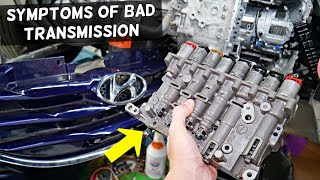
- Transmission may seem to slip or overheat. 🎬 Watch: Symptoms of a bad Hyundai transmission
- Replacing only the shift solenoid 'E' without replacing the internal wiring harness. The TSBs suggest these parts often fail together, and replacing only the solenoid may lead to the code returning.
Most Likely Causes
- Faulty Internal Transmission Wiring Harness and Shift Solenoid 'E' 🔴 High Probability → Shop Transmission Valve Body Hyundai has released multiple Technical Service Bulletins (TSBs 18-AT-007, 22-AT-005H) indicating that the internal valve body harness becomes brittle and fails, causing an open or short circuit. The recommended fix is to replace both parts together.
How to confirm: After dropping the transmission pan, visually inspect the wiring harness for signs of cracking, brittleness, or damaged connectors. The solenoid's electrical resistance can be tested with a multimeter. An on/off type solenoid should measure 10-11 Ω, while a variable force solenoid (VFS) should measure approximately 5.1-5.3 Ω. An open circuit (infinite resistance) or a direct short (zero resistance) confirms failure.
Typical fix: Replace both the 'E' shift solenoid and the internal valve body wiring harness (Part No. 46307-3B650).
Est. part cost: $150-$250 - Low or Dirty Transmission Fluid 🟡 Medium Probability → Shop Transmission Assembly
How to confirm: Check the transmission fluid level and condition via the service plug (this transmission has no dipstick). The fluid should be at the correct level, pinkish-red, and not smell burnt or contain debris. Dark or contaminated fluid can clog solenoid passages.
Typical fix: Perform a transmission fluid drain-and-fill using Hyundai-specific fluid (e.g., SP4-M). If the fluid is very dirty, a full flush may be needed, but this is sometimes debated by technicians.
Est. part cost: $70-$150 - Faulty Transmission Valve Body ⚪ Low Probability → Shop Transmission Valve Body
How to confirm: This is typically diagnosed after replacing the solenoid and harness does not resolve the issue. Debris or sludge can clog the fine passages within the valve body, preventing proper fluid flow. This requires professional diagnosis.
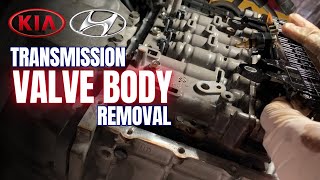
Typical fix: The valve body may need to be professionally cleaned, rebuilt, or replaced.
Est. part cost: $500-$1000
Rare But Worth Checking
- Faulty Transmission Control Module (TCM): → Shop Transmission Assembly A failing TCM is rare but possible. It would typically be suspected if the code returns immediately after replacing the solenoid and harness, and all wiring tests correctly.
Diagnosis Steps
- Check the transmission fluid level and condition. Ensure it is full and clean. Burnt-smelling or dark fluid can indicate a larger internal problem.
- Use an OBD-II scanner to check for other transmission-related codes, such as P0700 or P0773.
- Inspect the external transmission wiring harness and connectors for any visible damage, corrosion, or loose connections.
- If external checks are clear, the next step is internal. Safely lift the vehicle, drain the transmission fluid, and remove the oil pan.
- Locate Shift Solenoid 'E' on the valve body. Visually inspect the internal wiring harness connected to it for cracks, brittleness, or discoloration from heat.
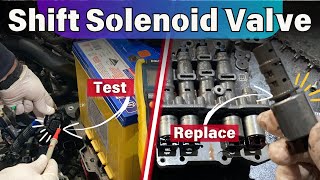
- Test the resistance of the solenoid with a multimeter. Compare the reading to the manufacturer's specification (typically 5.1-5.3 ohms for a VFS solenoid or 10-11 ohms for an on/off solenoid). An out-of-spec reading confirms a failed solenoid. 🎬 Watch: How to test and clean Hyundai transmission solenoids
- Based on Hyundai TSBs, the recommended procedure is to replace both the faulty solenoid and the internal wiring harness at the same time to ensure a lasting repair.
- Install a new transmission pan gasket, reinstall the pan, and refill with the correct type and amount of Hyundai-specific transmission fluid (SP4-M).
- Clear the trouble codes and perform a test drive, allowing the transmission to shift through all gears to confirm the repair.
Parts You'll Likely Need
- Transmission Internal Wire Harness
(OEM #46307-3B650)— This harness becomes brittle and fails, causing electrical issues for the solenoids. Hyundai TSBs recommend replacing it with the solenoid. It supersedes older part numbers 46307-3B610 and 46307-3B620.
Trusted brands: Hyundai Genuine
OEM price range: $100-$150
Aftermarket price range: $60-$100 - Shift Solenoid 'E' — This is the solenoid identified by the P0771/P0773 code. It fails electrically or mechanically, getting stuck 'off'. The specific part number can vary, so it's best to confirm with a dealer using the VIN.
Trusted brands: Hyundai Genuine, Rostra, Standard Motor Products (SMP)
OEM price range: $80-$120
Aftermarket price range: $40-$70 - Automatic Transmission Fluid (ATF)
(OEM #SP4-M)— A fluid change is required for this repair. Using the correct OEM-specific fluid (SP4-M) is critical for transmission health and performance.
Trusted brands: Hyundai/Kia SP4-M
OEM price range: $15-$25 per quart
Aftermarket price range: $10-$18 per quart - Transmission Oil Pan Gasket — The gasket must be replaced when the oil pan is removed to prevent leaks. Some models may use RTV sealant instead of a pre-formed gasket.
Trusted brands: Hyundai Genuine, Fel-Pro
OEM price range: $20-$40
Aftermarket price range: $15-$25
Related Codes That Often Appear With This One
- P0700 — P0700 is a generic code that means the Transmission Control Module (TCM) has stored a fault. It acts as a 'check engine light' for the transmission and will almost always appear alongside a specific transmission code like P0771.
- P0773 — On Hyundai vehicles, this 'Electrical' fault code for solenoid 'E' is often logged instead of the 'Performance' code P0771, even for the same mechanical/performance issue. TSBs like 18-AT-007 group them together, and the diagnosis and repair are identical.
Technical Service Bulletins (TSBs) & Recalls
- TSB 22-AT-005H: Addresses various solenoid DTCs, including P0773 (Shift Solenoid E), for 2019+ Santa Fe models, recommending replacement of the solenoid and valve body harness. This shows the pattern of failure continues in later models.
- TSB 18-AT-007: Supersedes an earlier TSB to include the 2017-18 Santa Fe Sport 2.4L. It explicitly lists DTC P077300 (Shift solenoid E) and instructs technicians to replace the related solenoid and the oil pressure harness, reinforcing the 'replace both' strategy.
- NHTSA Document 10089947 (related to Hyundai TSB 16-AT-015): Addresses solenoid DTCs, including P0773, for the 2017 Santa Fe Sport, recommending solenoid and harness replacement.
Platform-Specific Known Issues
- Owner Experience with Dealer Diagnosis: A Reddit user with a 2020 Santa Fe (143,000 miles) reported a P0741 code (related to the torque converter clutch solenoid) and harsh shifting. The dealer quoted $1300 to replace the solenoid or over $5000 for a full transmission replacement, illustrating the significant cost difference and diagnostic uncertainty owners can face.
Mechanic-Grade Diagnostic Values
- Resistance of On/Off type shift solenoids (e.g., SSA, SSB) — expected: 10 - 11 Ω. Failure: A reading of infinite resistance (open circuit) or near-zero resistance (short circuit).
- Resistance of Variable Force Solenoids (VFS) — expected: 5.1 - 5.3 Ω. Failure: A reading significantly outside this range, or one that is open or shorted.
Scan Tool Commands That Help
- Hyundai GDS (Global Diagnostic System): Actuation Test — After connecting the GDS, a technician can navigate to the transmission control module and select 'Actuation Test' for individual solenoids. This allows them to command Solenoid 'E' on and off while the vehicle is stationary to see if it responds electrically and audibly (a click can often be heard). This helps confirm if the solenoid is capable of functioning before removing the transmission pan.
- Hyundai GDS (Global Diagnostic System): Reset Adaptive Values — After replacing solenoids or the valve body, the transmission's learned shift points may be incorrect for the new components. Using the GDS to perform a 'Reset Adaptive Values' function clears this memory, forcing the TCM to relearn shift pressures and timing, which can resolve harsh shifting after a repair.
Wiring & Ground Locations
- TCM Location — On some models in this generation, the Transmission Control Module (TCM) is integrated into the main Powertrain Control Module (PCM). On others, it is a separate module. For second-generation (pre-2013) models, it was located under the battery tray. For the 2013-2018 generation, it's crucial to verify with a dealer or service manual, as its location and integration can vary.. If electrical tests on the harness and solenoid pass, the fault could lie with the TCM itself or its power/ground circuits. Knowing its location is essential for advanced diagnosis.
- TCM Ground — For models with a separate TCM located under the battery tray, the primary ground point is typically on the chassis frame rail directly below the battery and air cleaner assembly.. A corroded or loose ground connection at this point can cause a wide range of erratic transmission behavior and fault codes, including solenoid performance issues. This should be checked before condemning the TCM.
Real Owner Repair Stories
- Hyundai Technical Service Bulletin (TSB) 20-AT-017H (2013-2018 Hyundai Santa Fe Sport (and other models with A6MF1 transmission)) — Check Engine Light with DTC P0880 (TCM Power Input Signal). While not P0771, this TSB addresses the same core component failure.
❌ Tried (didn't work) Replacing the entire transmission, Replacing the Transmission Control Module (TCM)
✅ What actually fixed it The TSB explicitly states to inspect and replace the internal transmission valve body wiring harness (Part No. 46307-3B650), as an internal open/short in the flexible portion of the harness is the root cause. This reinforces the 'harness first' diagnostic approach for many Hyundai transmission electrical codes. - Reddit MechanicAdvice Forum User (2014 Hyundai Santa Fe, 3.3L GDI, AWD, 130k miles) — Hesitation and hard shifting when downshifting from 3-2 and 2-1. Upshifts were smooth.
❌ Tried (didn't work) A transmission shop performed diagnostics, checked fluid, and found the transmission was operating exactly as the computer commanded, with no internal faults detected.
✅ What actually fixed it The user's story ends with the dealer recommending a full transmission replacement without further diagnosis. This story is included not for its resolution, but as a real-world example of the diagnostic challenge where a transmission may be mechanically sound but electronically misbehaving, often leading to a premature and expensive replacement recommendation.
OEM Part Supersession History
46307-3B610, 46307-3B620→46307-3B650— The original internal transmission wiring harnesses were prone to becoming brittle from heat and fluid exposure, leading to electrical failures. The updated 46307-3B650 part features improved materials to increase durability and prevent repeat failures.
Heads up: While this harness fits a wide range of Hyundai/Kia 6-speed transmissions, always verify the part number with the vehicle's VIN. Visually similar harnesses from other models (e.g., diesel variants) may not be electrically compatible.
Model Year Variations Within This Range
- 2013-2018: While the A6MF/A6LF transmission family is used throughout this period, there can be minor variations in valve body and solenoid design. Some sources note differences in valve body compatibility between early (e.g., 2012-2014) and later (2015-2018) models in the same vehicle line, requiring careful matching of part numbers or TCM software. It is critical to verify part numbers with the VIN when ordering a valve body or solenoid pack.
Diagnostic Flowchart
Other Known Issues on This Vehicle
Issues unrelated to this code that are worth knowing about as an owner of this generation:
- Theta II Engine Failure 🔴 High — Widespread across 2.0T and 2.4L engines. Can occur at various mileages, often before 100,000 miles. Subject to class-action lawsuits and massive recall campaigns. (Ref: Multiple recalls (e.g., NHTSA 17V226000, 18V934000) and warranty extensions.)
- Steering Coupler Degradation 🟠 Medium — Extremely common. Owners often notice a clicking or clunking sound in the steering column when turning, typically starting after 50,000 miles. (Ref: Hyundai extended the warranty for this component (Campaign TXX). The OEM replacement part is 56315-2K000-FFF.)
- ABS Module Fire Risk 🔴 High — Affects a significant number of vehicles, leading to a recommendation to park outdoors away from structures. (Ref: Multiple recalls issued, including NHTSA 22V056000 and 21V303000, for potential electrical shorts within the ABS module.)
- Peeling Paint 🟡 Low — Commonly reported, especially on white and other light-colored vehicles. The paint can delaminate and peel off in large sections. (Ref: No specific recall, but Hyundai has extended paint warranties for certain models and colors in response to customer complaints.)
- Excessive Oil Consumption 🟠 Medium — Often a precursor or related symptom of the larger Theta II engine issues. Many owners report needing to add oil between changes. (Ref: Related to the broader engine recalls and service campaigns.)
Used vs. New Parts: Buying Guide for This Vehicle
When a used part is the smart pick: A complete, used valve body assembly with solenoids from a low-mileage donor vehicle can be a cost-effective alternative to buying individual new solenoids, especially if multiple solenoids are suspected to be faulty. However, this carries a risk of incompatibility.
Donor-vehicle mileage cap: roughly under 75000 miles for the part to have meaningful remaining life.
What to inspect on the donor part:
- Verify the donor vehicle's VIN to confirm it had the exact same engine and transmission (A6MF vs. A6LF).
- Ask for the mileage of the donor vehicle; lower is always better.
- Inspect the electrical connectors on the used part for any signs of corrosion, bent pins, or damage.
- If possible, check the color of the transmission fluid from the donor car; dark, burnt fluid is a major red flag for the transmission's overall health.
OEM-only on this vehicle (don't cheap out):
- Internal Transmission Wiring Harness (46307-3B650): Given that this is a known failure point due to material degradation, using a new, genuine OEM part with the latest revisions is the only way to ensure a long-lasting repair.
- Transmission Fluid (SP4-M): Using the exact OEM-specified fluid is critical for the performance and longevity of Hyundai automatic transmissions. Do not use universal or 'multi-vehicle' fluids.
Aftermarket brands forum-validated for this vehicle:
- Rostra (Solenoids)
- Standard Motor Products (Solenoids)
- TransGo (Valve body repair kits)
Brands owners have reported issues with on this vehicle:
- Unbranded, no-name solenoid kits or valve bodies from online marketplaces. Compatibility issues are very common with these transmissions, and a part that 'looks' identical may not work due to subtle differences in internal programming or hydraulic passages.
Real Owner Stories
Aggregated from forums and TSBs cited above. Mileages and costs reflect what owners reported in those sources.
2020 Hyundai Santa Fe — 143000 miles
Symptoms: Harsh shifting and a P0741 code related to the torque converter clutch solenoid.
What fixed it: The dealer provided a choice between replacing the solenoid for $1300 or a full transmission replacement for over $5000.
Cost: $1300-$5000
Source hint: Reddit - 2020 Santa Fe Transmission issue-solenoid vs full transmission replacement?
Related OBD-II Codes
Frequently Asked Questions
Does TSB 18-AT-007 apply to my 2017 Santa Fe Sport with the 2.4L engine?
My 2019 Santa Fe is showing solenoid codes; is there a specific TSB for newer models?
What specific part number do I need for the internal wiring harness repair?
Can I check the transmission fluid level on my 2013-2018 Santa Fe with a dipstick?
Is the P0771 code related to the widespread Theta II engine failures in these models?
What should the electrical resistance be for a Shift Solenoid 'E' on this vehicle?
Helpful Videos


We Have This Part in Stock





The information in this article is provided for general reference and educational purposes only. Vehicle specifications, procedures, and part compatibility can vary by production date, trim level, and region. Always consult your vehicle's factory service manual and verify part numbers before purchasing or performing repairs. Safety-critical components such as airbags, seat belts, and braking systems should be installed by a qualified professional.
- Hyundai Santa Fe:
- 🧭 Diagnostic Flowchart
- 🎬 Helpful Videos
- 🛍️ Shop This Part
- What's Unique About the 2013-2018 Hyundai Santa Fe
- Symptoms You May Notice
- Most Likely Causes
- Rare But Worth Checking
- Diagnosis Steps
- Parts You'll Likely Need
- Related Codes That Often Appear With This One
- Technical Service Bulletins (TSBs) & Recalls
- Platform-Specific Known Issues
- Mechanic-Grade Diagnostic Values
- Scan Tool Commands That Help
- Wiring & Ground Locations
- Real Owner Repair Stories
- OEM Part Supersession History
- Model Year Variations Within This Range
- Other Known Issues on This Vehicle
- Used vs. New Parts: Buying Guide for This Vehicle
- Real Owner Stories
- 2020 Hyundai Santa Fe — 143000 miles
- Related OBD-II Codes
- Frequently Asked Questions
- 🎟️ Get 5% Off