

OBD-II Code P0772: Shift Solenoid 'E' Stuck On
The Ultimate Guide to Diagnosing and Fixing P0772
- Code P0772 indicates Shift Solenoid 'E' is stuck on, locking the transmission in the wrong gear and creating an immediate safety hazard.
- In over 70% of cases, the root cause is a mechanically failing valve body or contaminated transmission fluid, not a defective solenoid.
- For 2017-2023 Ford and GM 10-speed vehicles, P0772 almost guarantees a faulty main control valve body requiring a $1,500 to $3,000 replacement.
- Driving with an active P0772 code destroys internal clutch packs within weeks, escalating a $300 fluid fix into a $5,000+ transmission rebuild.
What Does P0772 Mean?

The Transmission Control Module (TCM) detected Shift Solenoid 'E' is stuck in the 'on' position. This solenoid is a computer-controlled valve that directs transmission fluid to engage specific gear clutches. When it remains on, it keeps a hydraulic circuit pressurized incorrectly, causing a mismatch between the commanded gear and the actual gear.
Technical definition: The SAE/OBD-II definition for P0772 is "Shift Solenoid 'E' Stuck On". The TCM detects that the hydraulic circuit for shift solenoid 'E' remained pressurized when commanded to depressurize. The TCM triggers this fault after observing a persistent discrepancy between engine speed, vehicle speed, and the calculated gear ratio.
Can I Drive With P0772?
Yes, But With Caution. Do not drive the vehicle normally. Limp it directly to a repair shop. Continued operation locks the transmission in gear, creating an immediate safety hazard. Ignoring P0772 escalates a $1,500 valve body repair into a $5,000+ catastrophic transmission rebuild.
Common Causes

- Faulty Transmission Valve Body (Very Common) — The primary cause in modern Ford and GM 10-speed transmissions. The valve body's internal spool valves wear or stick from debris, causing pressure losses that prevent the solenoid from operating correctly.
- Low or Dirty Transmission Fluid (Very Common) — Low fluid starves the system of hydraulic pressure. Contaminated fluid containing clutch material and metal shavings clogs fine passages within the valve body and solenoids, causing mechanical binding.
- Failed Shift Solenoid 'E' (Common) — The solenoid fails electrically (internal coil shorts) or mechanically (plunger sticks). Misdiagnosing this is common; mechanics often replace the solenoid when the root cause is the valve body.
- Wiring or Connector Issues (Less Common) — The wiring harness or solenoid connector frays, corrodes, or shorts to power. This sends a continuous voltage signal to the solenoid, forcing it to stay on.
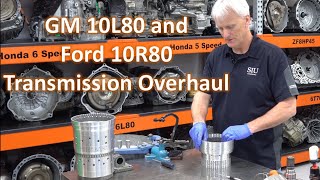
- Internal Transmission Mechanical Failure (Less Common) — A severe underlying issue, such as a failed CDF clutch drum in Ford's 10R80 transmission where a bushing walks out of place. This requires a complete transmission teardown. 🎬 See this walkthrough of a full 10-speed transmission overhaul.
- Incorrect Transmission Fluid Type (Rare) — Using the wrong automatic transmission fluid (ATF) alters friction properties and viscosity, causing overheating and sticking valves.
- Faulty Transmission Control Module (TCM) (Rare) — The transmission's computer fails, causing its internal driver to short and send a constant 'on' signal to the solenoid. Rule out all mechanical and electrical possibilities before replacing the TCM.
Symptoms

- Harsh, Delayed, or Erratic Shifting — The vehicle slams into gear, hesitates between shifts, or shifts at incorrect times. Drivers often feel a loud thud resembling a rear-end collision.
- Transmission Stuck in Gear ('Limp Mode') — The TCM locks the transmission in a single gear (often 2nd or 3rd) to prevent catastrophic damage, severely limiting vehicle speed.
- Check Engine Light and Warning Lights On — The Check Engine Light and a dedicated transmission warning light illuminate on the dashboard.
- Transmission Overheating — Slipping clutches and incorrect hydraulic pressures generate excessive heat, triggering an overheat warning and a burnt fluid smell.
- Engine Stalling When Stopping — The transmission fails to downshift correctly when stopping, causing the engine to lug and stall.
- Loss of Reverse Gear — A failed valve body associated with P0772 completely disables the reverse gear, particularly in Ford 10R80 transmissions.
- Decreased Fuel Economy (also visible on scanner) — The engine runs at higher RPMs because the transmission cannot shift into optimal overdrive gears, slashing fuel economy.
Diagnostic Flowchart
Tap your situation to follow the diagnostic path that matches what you're seeing on this code.
Common Fixes & Costs
- Replace Transmission Valve Body
— Parts: $400-$1,200, Labor: $400-$1,000, ~5.2 hr book time
(Professional)
Ford F-150 (10R80): OEM HL3Z-7A100-B or ML3Z-7A100-B (Alt: Remanufactured units from specialty shops ($450-$900))
Subaru Outback/Forester (TR580): OEM 31705AA683 (Alt: SAYFUT or similar brands ($230-$350)) - Transmission Fluid and Filter Change — Parts: $50-$120, Labor: $125-$250, ~1.5 hr book time (Intermediate)
- Replace Shift Solenoid 'E'
— Parts: $25-$100, Labor: $200-$450, ~2.5 hr book time
(Intermediate)
Honda/Acura (5-Speed): OEM 28250-P7W-003 (Alt: Standard Motor Products TCS67, Rostra 52-0530) - Perform Transmission Accelerated Main Control Break-in Routine — Parts: $0, Labor: $100-$200, ~1 hr book time (Professional)
- Full Transmission Rebuild or Replacement — Parts: $2,500-$5,000+, Labor: $1,000-$2,500, ~22 hr book time (Professional)
Used vs. New Parts: Buying Guide
When a used part is worth it: A used valve body from a low-mileage donor vehicle makes sense only for older, low-value cars where a new part exceeds the vehicle's worth.
Donor-vehicle mileage cap: roughly under 60000 miles for the part to have meaningful remaining life.
Donor quality checklist:
- Verify the donor vehicle was scrapped for non-transmission reasons (e.g., rear-end collision).
- Match the part number and calibration codes exactly.
- Reject parts with any signs of fluid contamination, corrosion, or physical damage.
Decision logic:
- If The vehicle is a 2017+ Ford/GM with a 10-speed transmission → Buy a new or professionally remanufactured valve body. Used units carry the same inherent factory flaws.
- If The part is a simple, external solenoid (e.g., older Honda) → Buy a new aftermarket part. They are inexpensive ($50-$100) and reliable, making used parts an unnecessary risk.
- If The vehicle is older and budget is the primary concern → A used part is acceptable but carries a high risk of premature failure.
Warranty tradeoff: Used parts offer 30-90 day warranties. Remanufactured units offer 1-year to lifetime warranties. New OEM parts carry 1-2 year manufacturer warranties.
Worst-case if a used part fails: $500 - $1,500. If a used valve body fails, you pay the labor cost to remove and replace it a second time.
What Happens If You Wait — Timeline
- 0-1 Month: Check Engine Light illuminates. You notice occasional harsh shifts or hesitation. The transmission operates outside commanded parameters. (MPG impact: 3-5%% · Added cost: $0-$50 in wasted fuel.)
- 1-3 Months: Shifting becomes consistently harsh. The stuck solenoid causes clutch slippage, generating excessive heat that breaks down the transmission fluid. (MPG impact: 5-10%% · Added cost: $200-$400. A simple fluid change is no longer enough. Accelerated wear on clutch packs begins.)
- 3-6 Months: Burnt fluid circulates debris, scoring valve body bores and causing other valves to stick. The transmission frequently enters 'limp mode'. (MPG impact: 10-15%% · Added cost: $1,500-$3,000. The valve body is damaged beyond repair and requires replacement.)
- 6+ Months: Catastrophic internal failure. Debris clogs the filter, starves the pump, and destroys clutch packs and the torque converter. (MPG impact: 15-25%+% · Added cost: $3,500-$8,000+. The transmission requires a full rebuild or replacement.)
Cost of Not Fixing It
- 0-1 Month: Decreases fuel economy by 5-15%, causes harsh shifting, and forces the vehicle into 'limp mode'. The vehicle is unsafe to drive. (Added cost: $0 - $50 in wasted fuel.)
- 1-6 Months: Continued driving burns transmission fluid and destroys internal seals. Excessive friction and heat damage the valve body beyond repair. (Added cost: $1,500 - $3,000. A simple fluid or solenoid issue now requires a full valve body replacement.)
- 6+ Months: Catastrophic internal transmission failure. Heat and debris destroy clutches, gears, and the torque converter. The transmission requires a full rebuild. (Added cost: $3,500 - $8,000+. Ignoring the initial problem guarantees the most expensive possible outcome.)
Diagnosis Steps

- Check Technical Service Bulletins (TSBs)
Search for TSBs for your specific vehicle. Ford has multiple TSBs (e.g., 24-2046, 23-2250) for the 10R80 transmission linking P0772 directly to valve body or CDF drum failures.
Tools: Internet access, Vehicle Information (Beginner) - Scan for Codes and Review Freeze Frame Data
Use an OBD-II scanner to confirm P0772 and check for related codes. P2704 indicates a systemic valve body issue. Multiple solenoid codes suggest fluid problems, not multiple failed solenoids.
Tools: OBD-II Scanner (Beginner) - Check Transmission Fluid Level and Condition
Check fluid level and condition. Bright red fluid is healthy. Dark brown, black, or burnt-smelling fluid indicates internal wear. Metallic shavings confirm catastrophic mechanical damage.
Tools: Rag, Gloves, Infrared Thermometer, Vehicle-specific instructions (Beginner) - Command the Solenoid with a Bi-Directional Scan Tool
Use a professional scan tool to command Shift Solenoid 'E' on and off. If the tool commands it off but the live data shows 'On', the solenoid is mechanically stuck.
Tools: Advanced Bi-Directional Scan Tool (Advanced) - Inspect External Wiring and Connectors
Visually inspect the main transmission wiring harness and case connector. Look for chafed wires, corroded pins, or fluid intrusion causing a short to power.
Tools: Flashlight, Mirror (Intermediate) - Test Solenoid Resistance with a Multimeter
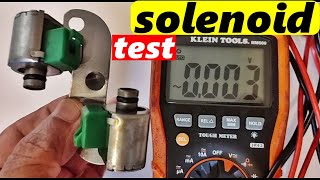
Drop the transmission pan, disconnect the solenoid, and measure internal resistance across the pins. An open circuit or direct short indicates a failed coil. (Ford 10R80 spec: 5.0-5.4 ohms).
Tools: Socket set, Drain pan, Digital Multimeter, Repair manual (Advanced) - Test Solenoid Circuit Voltage
Check for voltage and ground at the solenoid connector with the key on. A constant 12V on both sides when commanded off indicates a short to power or a failed TCM driver.
Tools: Digital Multimeter, Wiring diagram, Probing kit (Advanced) - Inspect the Valve Body and Internal Components
Inspect the valve body for scoring, sludge, or stuck spool valves. On Ford/GM 10-speeds, this is the primary culprit. Significant metal debris requires further disassembly.
Tools: Flashlight, Torque wrench, Repair manual (Professional) - Perform a Transmission Line Pressure Test
Connect a pressure gauge to the transmission test port. Low pressure at idle (Ford 10R80 spec: ~90 psi) indicates a failing pump, clogged filter, or major internal leak.
Tools: Transmission Pressure Gauge Kit, Repair manual (Professional) - Analyze the Solenoid Command with a Lab Scope
Back-probe the command wire at the TCM with an oscilloscope. A clean square wave confirms the TCM works correctly, isolating the fault to the transmission's internal mechanics.
Tools: Lab Scope (Oscilloscope), Probes, Wiring diagram (Professional)
When This Code Triggers (Freeze-Frame Conditions)
- Engine Coolant Temp: 180-215°F (The engine and transmission are fully warmed up to normal operating temperature.)
- RPM: 1200-2500 RPM (During steady-state cruising or light acceleration when a gear change is commanded.)
- Engine Load: 20-50% (The engine is under moderate load, requiring efficient gear shifting.)
- Vehicle Speed: 30-60 mph (Occurs at cruising speeds when the transmission attempts to shift into or out of an overdrive gear.)
Related Codes
- P0700 — A generic Transmission Control System Malfunction code. It tells the main engine computer (PCM) that a transmission-specific fault, like P0772, has been stored.
- P0770, P0771, P0773, P0774 — These relate to Shift Solenoid 'E'. P0771 ('Stuck Off') is the opposite of P0772; having both stored intermittently strongly suggests a mechanical valve body issue, not a single stuck solenoid.
- P2704 — Indicates 'Friction Element E Apply Time Range/Performance'. Seeing this alongside P0772 on Ford/GM 10-speeds is a definitive indicator of a valve body or internal hydraulic problem.
- P0984, P0985, P0986 — These point specifically to an electrical problem in the control circuit for Shift Solenoid 'E', such as a short to ground (Low) or a short to power (High).
Climate & Environmental Factors
- Cold Weather: Extreme cold thickens transmission fluid, increasing hydraulic pressure and slowing valve movement. This exacerbates sticky valves, making harsh shifting more noticeable on cold starts.
- High Heat and Humidity: Sustained high temperatures accelerate fluid breakdown, reducing lubrication. High humidity introduces moisture through aging seals, contaminating fluid and corroding internal valves.
- High Altitude: High altitude reduces engine power, forcing the transmission to shift more frequently to maintain speed. This increased cycling accelerates wear on solenoids and clutches.
How to Talk to a Mechanic About This Code
Say this: "I have a P0772 code and harsh shifting. Please check for relevant TSBs, inspect the fluid condition, and quote the diagnostic fee before starting repairs. If it's a Ford 10-speed, I am aware of the valve body issues."
This signals you are an informed consumer. It directs the shop toward the most likely causes, mentions known issues, and establishes clear boundaries for authorizing work.
Avoid saying:
- 'My car is shifting weird, can you fix it?' (This is too vague and invites costly, open-ended diagnostics.)
- 'Just replace the shift solenoid.' (This guarantees you pay for an unnecessary repair when the valve body is the actual culprit.)
- 'I got a low quote over the phone from another shop.' (This invites a bait-and-switch where a shop gives a low initial quote and 'finds' more problems later.)
Questions to ask before authorizing the repair:
- What was the condition of the transmission fluid? Was there any debris in the pan?
- Did you check the solenoid resistance and wiring, or did you go straight to recommending a larger component?
- Is this repair based on a Technical Service Bulletin (TSB) for my vehicle?
- What is the warranty on the parts and labor for this specific repair?
- Does this repair require any special programming or a relearn procedure afterward?
Where to Take It: Dealer vs Independent vs Chain
- Dealer:
Best for: Vehicles under powertrain warranty., Modern vehicles (Ford/GM 10-speeds) where the fix involves a known TSB and requires proprietary software for programming the new valve body.
Downsides: Highest labor rates., May only offer a full transmission replacement when a valve body repair is viable at an independent shop. (Typical cost: +50% vs. baseline) - Independent Shop:
Best fit for most out-of-warranty cases, BUT only if it is a dedicated transmission specialist.
Best for: Out-of-warranty vehicles where cost is a major factor., Getting a second opinion if a dealer recommended a full transmission replacement., Older vehicles (Honda or Subaru) with straightforward, well-known repairs.
Downsides: Quality varies greatly. Must be a reputable shop specializing in transmissions., May lack the latest manufacturer-specific tools for programming modern TCMs. (Typical cost: +0% vs. baseline) - Chain Shop:
AVOID. P0772 requires specialized transmission knowledge not found at chain repair shops. The risk of misdiagnosis is extremely high.
Best for: Simple jobs like oil changes or brakes, not complex diagnostics.
Downsides: Technicians lack specialized training for internal transmission work., High pressure to upsell services; may misdiagnose the issue or recommend an unnecessary transmission flush., Often install poorly remanufactured transmissions with questionable warranties. (Typical cost: -10% vs. baseline)
When to Walk Away From the Repair
If the estimated repair cost exceeds 50% of the car's private-party value, sell the vehicle. A major transmission failure signals other expensive, age-related repairs are imminent.
- Car worth $5000, fix is $3000: Walk away. The repair is 60% of the car's value. Sell as a 'mechanic's special' or trade it in.
- Car worth $25000, fix is $4000: Fix it. The repair is 16% of the vehicle's value and restores significant functionality and resale value.
- Car worth $8000, fix is $3500: Borderline. At 44% of the car's value, get a second opinion. If other repairs are needed, walk away.
What Scan Tool You Need for This Code
Minimum: A scanner that reads manufacturer-specific transmission codes and views live data for transmission sensors.
A basic $20 code reader only shows the P0772 code. It cannot access the TCM to see solenoid command status or fluid temperature, making real diagnosis impossible.
Budget: XTOOL A30 / KINGBOLEN S608 (~$90) — These smartphone-based tools offer full system diagnostics, allowing you to read transmission-specific codes and view live data.
Mid-range: Foxwell NT510 Elite / Xtool D7 (~$150) — Offers bi-directional control to command the 'E' solenoid on and off, isolating a bad solenoid from a valve body issue. Performs transmission relearn procedures.
Professional: Autel MaxiCOM MK808S / Topdon ArtiDiag900BT (~$450-600) — Provides full bi-directional control and performs the critical 'Solenoid Body Strategy' programming required when replacing a valve body on modern Ford/GM 10-speed transmissions.
How to Clear the Code After You Fix It
- Use an OBD-II scan tool to clear all diagnostic trouble codes.
- Use a professional scan tool to reset the transmission adaptive learning tables.
- Perform a complete drive cycle to set the vehicle's readiness monitors to 'Ready'.
Drive cycle (~30 minutes): Start the vehicle cold and idle for 3 minutes. Drive in stop-and-go city traffic (25-35 mph) for 10 minutes. Accelerate smoothly to highway speeds (55-60 mph) and hold for 10 minutes. Return to city driving for 5 minutes before shutting down.
Readiness monitors affected: Comprehensive Component Monitor, Catalyst Monitor, Evaporative System Monitor
Before emissions retest: drive at least 100 miles to fully set monitors.
Watch out for:
- Disconnecting the battery clears the code but resets all readiness monitors, guaranteeing an emissions test failure.
- The code returns immediately if the underlying mechanical or electrical fault remains unfixed.
- Failing to reset the transmission's adaptive memory causes continued poor shifting even after replacing the faulty part.
Will This Fail Emissions / State Inspection?
Yes — this code typically fails an OBD-II emissions inspection.
- California: An active Check Engine Light from P0772 is an automatic failure. A full drive cycle must be completed post-repair to set readiness monitors before retesting.
- New York: The NYS DMV inspection includes an OBD-II scan. Any fault code illuminating the Check Engine Light results in immediate failure.
- Texas: In emissions-testing counties, an illuminated Check Engine Light is an automatic fail. You must drive 50-100 miles post-repair to set readiness monitors.
Most Commonly Affected Vehicles
- Ford F-150, Mustang, Ranger, Expedition (2017-2023) — Extremely common on the 10R80 10-speed transmission. The cause is almost always a faulty main control valve body or failed CDF clutch drum sleeve, covered by multiple TSBs.
- Chevrolet / GMC Silverado, Sierra, Camaro, Tahoe, Suburban (2018-2023) — These models use the 10L80/10L90 transmission co-developed with Ford and suffer from identical valve body failures.
- Ford Transit, Explorer (2020-2023) — Equipped with the 10R80 or 10R60 transmission. TSB 20-2226 specifically links P0772 on the 2020 Transit to sticking valves in the main control valve body.
- Subaru Outback, Legacy, Forester, Impreza (2010-2019) — Solenoid failure within the TR580/TR690 CVT valve body is highly common. Individual solenoids are replaceable, though dealers often push for full valve body replacements.
- Honda Accord, Odyssey, Pilot (2000-2015) — Older 5-speed automatics are known for solenoid issues. Solenoids are externally accessible on the transmission case, simplifying replacement and reducing labor costs.
- Toyota Camry, RAV4, Sienna (2002-2014) — Appears due to solenoid failure or fluid degradation. Toyota transmissions are highly sensitive to fluid condition; always start with a fluid check.
- Nissan Altima, Maxima, Rogue (2007-2018) — Susceptible to solenoid and valve body issues in CVT models. Neglecting fluid changes accelerates wear rapidly.
- Mazda 3, 6, CX-5 (2004-2013) — Occurs due to solenoid failure or internal valve body issues. Mazda provides specific diagnostic flow charts to test circuits before condemning the transaxle.
Manufacturer-Specific Notes
- Ford / GM: On 10-speed (10Rxx/10Lxx) transmissions, P0772 is almost never a simple solenoid failure. It is a hallmark symptom of a faulty main control valve body due to sticking spool valves.
- Honda / Acura: On many older 5-speed automatics, shift solenoids are mounted externally on the transmission case. This turns a potentially 5-hour internal job into a 1-hour external job.
- Subaru: For CVT models (TR580/TR690), dealerships quote $800+ for a full valve body replacement. However, individual aftermarket solenoids are available, allowing independent shops to repair it for a fraction of the cost.
- Mazda: Mazda workshop manuals provide highly detailed diagnostic flow charts that guide technicians through line pressure and circuit tests before recommending major component replacement.
Real Owner Stories
2018 Ford F-150 5.0L at 66K miles
Owner experienced increasingly harsh shifts. The transmission got stuck in 7th gear and the Check Engine Light illuminated with codes P0772 and P2704.
What they tried:
- A software update and transmission relearn procedure were attempted first, but symptoms returned.
Outcome: Following Ford TSB 22-2428, the dealer diagnosed a faulty main control valve body. The valve body was replaced for $2,800, resolving the shifting issues.
Lesson: On a Ford/GM 10-speed transmission, P0772 is a classic sign of valve body failure. Referencing the latest TSBs is the most direct path to a correct diagnosis.
2012 Subaru Outback 2.5i at 150K miles
Vehicle jerked when accelerating between 20-30 mph. The Check Engine Light and AT Oil Temp light illuminated with codes P0700 and P2762.
What they tried:
- A transmission fluid change did not fix the issue.
- The dealership quoted $2,800 for a used transmission replacement.
Outcome: An independent transmission specialist determined the issue was a failed lock-up duty solenoid within the valve body. The valve body was replaced for under $1,500.
Lesson: For Subaru CVTs, dealers default to full transmission replacements. Always get a second opinion from an independent shop for a repairable valve body issue.
2005 Honda Odyssey at 125K miles
The 'D' drive indicator flashed, and the Check Engine Light came on with code P0772. The transmission shifted harshly from 2nd to 3rd gear.
What they tried:
- Checked the transmission fluid, which was dark and slightly low.
Outcome: The owner performed a fluid drain-and-fill, but the code returned. The owner then replaced the externally mounted Shift Solenoid 'E' with a $65 aftermarket part. The total repair cost under $120 and fixed the issue.
Lesson: On older Honda/Acura vehicles, shift solenoids are inexpensive and externally accessible. Testing resistance and replacing the solenoid is a simple, low-cost DIY fix.
How to Prevent This Code From Triggering
- Perform regular transmission fluid and filter changes (Every 30,000 to 60,000 miles.) — Removes abrasive metal particles and clutch material that clog fine passages in solenoids and the valve body, preventing them from sticking.
- Use only the manufacturer-specified transmission fluid (Every time fluid is added or changed.) — Modern fluids have specific viscosity and friction properties. Incorrect fluid causes overheating, damages seals, and leads to improper hydraulic pressure.
- Install an auxiliary transmission fluid cooler (Once, especially if you tow or live in a hot climate.) — Overheating breaks down fluid and destroys solenoids. An external cooler keeps fluid temperatures stable under load, extending component life.
- Check for and install TCM/PCM software updates (During regular service visits to a dealer.) — Software updates refine shift logic and pressure control, reducing harshness and preventing unnecessary wear on solenoids and clutches.
- Avoid aggressive driving habits (Daily habit.) — Hard acceleration and heavy towing put immense thermal stress on the transmission. Smoother driving reduces heat and preserves solenoids.
Frequently Asked Questions
What is a shift solenoid?
A shift solenoid is an electronically controlled valve that directs transmission fluid to apply clutches and change gears. The TCM activates these solenoids in sequence to ensure smooth acceleration.
What is the most common misdiagnosis for P0772?
The biggest mistake is replacing only Shift Solenoid 'E' without a complete diagnosis. On modern transmissions, the solenoid is usually functioning but is forced to stick by a contaminated or faulty valve body. Replacing just the solenoid wastes time and money.
Can I just replace one solenoid if it's bad?
On older Hondas or Subarus, yes. On modern transmissions like the Ford 10R80, solenoids are integral to the valve body and cannot be serviced separately. If multiple solenoid codes are present, it indicates a systemic valve body failure.
How much does it really cost to fix P0772?
Costs range from $175 for a fluid change to $600 for a single solenoid. However, modern trucks often require a $1,500-$3,000 valve body replacement. Ignoring the issue leads to a full transmission rebuild costing $3,500-$8,000+.
Will clearing the P0772 code fix the problem?
No. Clearing the code only turns off the check engine light temporarily. The TCM re-runs its diagnostic tests as soon as you drive, and the fault will return immediately.
What's the difference between P0772 (Stuck On) and P0771 (Stuck Off)?
P0772 means the solenoid keeps a hydraulic circuit pressurized, while P0771 means it fails to pressurize the circuit. Both are frequently caused by the same sticking valve in the valve body.
What is a TSB and why is it important for P0772?
A Technical Service Bulletin (TSB) is a manufacturer document detailing a known problem and specific repair procedure. For P0772 on Ford/GM vehicles, TSBs bypass guesswork and point directly to the faulty valve body.
Key Takeaways
- Code P0772 indicates Shift Solenoid 'E' is stuck on, locking the transmission in the wrong gear and creating an immediate safety hazard.
- In over 70% of cases, the root cause is a mechanically failing valve body or contaminated transmission fluid, not a defective solenoid.
- For 2017-2023 Ford and GM 10-speed vehicles, P0772 almost guarantees a faulty main control valve body requiring a $1,500 to $3,000 replacement.
- Driving with an active P0772 code destroys internal clutch packs within weeks, escalating a $300 fluid fix into a $5,000+ transmission rebuild.
Helpful Videos
Shop the Parts Behind P0772
Below are the parts most often responsible for code P0772, ranked by how frequently each one is the actual culprit (per the diagnosis above). Tap any to see what we have for your vehicle.




The information in this article is provided for general reference and educational purposes only. Vehicle specifications, procedures, and part compatibility can vary by production date, trim level, and region. Always consult your vehicle's factory service manual and verify part numbers before purchasing or performing repairs. Safety-critical components such as airbags, seat belts, and braking systems should be installed by a qualified professional.
- 🧭 Diagnostic Flowchart
- 🎬 Helpful Videos
- 🛍️ Shop This Part
- What Does P0772 Mean?
- Can I Drive With P0772?
- Common Causes
- Symptoms
- Common Fixes & Costs
- Used vs. New Parts: Buying Guide
- What Happens If You Wait — Timeline
- Cost of Not Fixing It
- Diagnosis Steps
- When This Code Triggers (Freeze-Frame Conditions)
- Related Codes
- Climate & Environmental Factors
- How to Talk to a Mechanic About This Code
- Where to Take It: Dealer vs Independent vs Chain
- When to Walk Away From the Repair
- What Scan Tool You Need for This Code
- How to Clear the Code After You Fix It
- Will This Fail Emissions / State Inspection?
- Most Commonly Affected Vehicles
- Manufacturer-Specific Notes
- Real Owner Stories
- 2018 Ford F-150 5.0L at 66K miles
- 2012 Subaru Outback 2.5i at 150K miles
- 2005 Honda Odyssey at 125K miles
- How to Prevent This Code From Triggering
- Frequently Asked Questions
- What is a shift solenoid?
- What is the most common misdiagnosis for P0772?
- Can I just replace one solenoid if it's bad?
- How much does it really cost to fix P0772?
- Will clearing the P0772 code fix the problem?
- What's the difference between P0772 (Stuck On) and P0771 (Stuck Off)?
- What is a TSB and why is it important for P0772?
- Key Takeaways
- 🎟️ Get 5% Off