

P0772 on 2019-2023 Ford Ranger: Shift Solenoid 'E' Stuck On Causes and Fixes
On a 2019-2023 Ford Ranger, code P0772 is almost always a symptom of a larger issue with the 10R80 transmission, not just a single bad solenoid. The most common fixes are replacing the main control valve body or, in more severe cases, repairing or replacing the transmission's internal CDF clutch drum. This is not a simple DIY fix.
- P0772 on a 2019-2023 Ranger is a serious code that points to significant internal transmission problems.
- The cause is very likely a faulty main control valve body or a failed CDF clutch drum, not just a single bad solenoid.
- This is not a DIY-friendly repair. It requires a professional technician with experience on the Ford 10R80 transmission.
- Referencing Ford TSBs (like 24-2046) is critical for a correct diagnosis and repair.
- Do not delay repair, as continued driving can cause catastrophic transmission failure.
What's Unique About the 2019-2023 Ford RANGER
The 2019-2023 Ford Ranger uses the 10-speed 10R80 automatic transmission. While P0772 points to a specific solenoid, on this platform it's rarely an isolated solenoid failure. The code is a very common symptom of two well-documented, widespread issues with the 10R80: sticking valves within the main control valve body assembly, and internal failure of the CDF (Clutch D/F) drum. Ford has issued multiple Technical Service Bulletins (TSBs) that group P0772 with dozens of other codes, all pointing back to these two root causes, making a broader diagnosis essential.
🎬 Watch: A breakdown of common 10R80 gearbox issues and fixes.Diagnostic Flowchart
Tap your situation to follow the diagnostic path that matches what you're seeing on this vehicle.
Symptoms You May Notice
- Illuminated Malfunction Indicator Lamp (Check Engine Light)
- Harsh, jerky, or delayed shifts, especially when cold.
- Delayed engagement when shifting from Park to Drive or Reverse.
- Transmission slipping or flaring between gears.
- Vehicle may feel stuck in a higher gear or enter 'limp mode'.
- Loud thud or clunk during shifting, sometimes described as feeling 'rear-ended'.
- Replacing only the 'E' shift solenoid. On the 10R80, the solenoids are part of the valve body assembly and are rarely the individual point of failure. The problem is typically the valves they control or a deeper mechanical issue.
- Clearing the code and hoping it goes away. This code indicates a mechanical or hydraulic problem that will not resolve on its own and will likely worsen.
- Performing a fluid flush without addressing the root cause. While fresh fluid can temporarily improve symptoms, it will not fix a sticking valve or a failed CDF drum.
Most Likely Causes
- Sticking Valves in Main Control Valve Body 🔴 High Probability → Shop Transmission Valve Body This is a widely documented issue with the 10R80 transmission. Ford TSBs 24-2046 and 22-2428 explicitly list 'sticking valves in the main control valve body' as a primary cause for a host of transmission codes, including P0772. Some technicians believe early valve bodies were poorly designed or susceptible to debris.
How to confirm: A technician will follow the diagnostic steps outlined in the relevant TSB. This involves checking for a specific group of DTCs and may involve a scan tool routine called 'transmission accelerated main control break-in'. If the symptoms persist after software-based procedures, the valve body is the presumed culprit.
Typical fix: Replacement of the entire main control valve body assembly. The solenoids are integral to this unit and are not serviced separately.
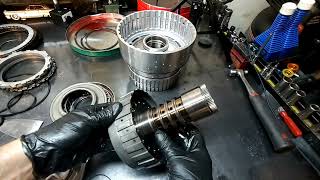
Est. part cost: $800-$1500 - CDF Clutch Drum Failure 🔴 High Probability → Shop Transmission Clutch Pressure Plate Early versions of the 10R80 had a design flaw where a bushing in the CDF drum could 'walk' or migrate out of position. This uncovers hydraulic passages, causing a critical loss of pressure to the C, D, and F clutch packs. The updated Ford part features a machined lip to physically prevent the bushing from moving. 🎬 See how the CDF drum fails and what to look for.
How to confirm: This requires transmission disassembly to inspect the drum. It's usually diagnosed after a valve body replacement fails to fix the issue. Metal shavings in the transmission pan are a strong indicator of this or other internal damage. A technician may also identify it by the specific pattern of clutch application failures.
Typical fix: The transmission must be removed and disassembled to replace the CDF drum with an updated part (Part No. JL3Z-7H351-B). This is a major repair, often leading to a full transmission rebuild or replacement.
Est. part cost: $200-$400 for the drum, but labor is extensive (8-12+ hours). - Low or Contaminated Transmission Fluid 🟡 Medium Probability → Shop Transmission Assembly There are anecdotal reports from technicians and owners of these trucks leaving the factory with low transmission fluid levels, which can exacerbate wear and shifting issues. The 10R80 is also very sensitive to fluid type and condition.
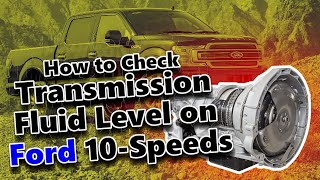
How to confirm: Check the transmission fluid level and condition. The fluid should be bright red and not smell burnt. The 10R80 does not have a traditional dipstick; the level must be checked via a plug on the transmission case at a specific temperature (typically 190-210°F), making it a non-trivial task. 🎬 Watch: How to check the fluid level using the short stick.
Typical fix: Perform a transmission fluid and filter change using the correct Motorcraft MERCON ULV fluid. If the fluid is heavily contaminated with clutch material or metal, it indicates a more severe internal failure like the CDF drum.
Est. part cost: $150-$300 for fluid and filter.
Rare But Worth Checking
- Wiring Harness Damage: Damage to the transmission wiring harness or connector could cause an electrical fault for the solenoid. This is less common than internal mechanical or hydraulic issues but should be checked, especially for any signs of corrosion or physical damage to the harness.
- Powertrain Control Module (PCM) Failure: It is extremely rare for the PCM to fail in a way that isolates only this solenoid. TSBs suggest reprogramming the PCM/TCM as a first step, but outright hardware failure is a last-resort diagnosis after all other possibilities have been exhaustively ruled out.
Diagnosis Steps
- Verify the code with a professional OBD-II scan tool that can read transmission-specific data.
- Check for all other stored DTCs. The presence of other codes from the TSB list is a strong indicator of the root cause.
- Check the transmission fluid level and condition. This must be done at operating temperature (190-210°F) by a qualified technician.
- Inspect the transmission wiring harness and connectors for any visible damage, corrosion, or loose connections.
- Consult Ford TSBs 24-2046 and 22-2428. The diagnostic path will likely follow the steps outlined in these documents, which may start with a PCM/TCM reprogram and adaptive learning reset.
- If diagnostics point to the valve body, it will be replaced.
- If a new valve body does not resolve the issue, or if there is significant debris in the pan, the next step is to remove and disassemble the transmission to inspect the CDF drum and other internal components.
Parts You'll Likely Need
- Main Control Valve Body Assembly
(OEM #L1MZ-7A100-K (supersedes L1MZ-7A100-A, L1MZ-7A100-E))— This is the most common repair for P0772 and related codes on the 10R80, as recommended by multiple Ford TSBs.
Trusted brands: Motorcraft
OEM price range: $900-$1500 (Part cost may be lower, but often includes a significant core charge)
Aftermarket price range: N/A - CDF Clutch Drum (Hub Assembly)
(OEM #JL3Z-7H351-B (updated design))— This is the second most common major failure point. The updated part has a machined lip to prevent the internal bushing from migrating, which is the root cause of the failure.
Trusted brands: Motorcraft
OEM price range: $200-$400 - Automatic Transmission Fluid
(OEM #Motorcraft MERCON ULV (XT-12-QULV))— Required for any repair involving opening the transmission, such as replacing the valve body or filter. A full fill is typically 13 quarts, but a valve body job may require 6-8 quarts.
Trusted brands: Motorcraft
OEM price range: $8-$12 per quart
Related Codes That Often Appear With This One
- P0751, P0756, P0761, P0766, etc. — Any code for another shift solenoid (A, B, C, D, etc.) often appears with P0772 because the root cause (valve body or CDF drum) affects multiple hydraulic circuits. TSB 24-2046 lists over a dozen shift solenoid codes that point to the same fix.
- P0729, P0731, P0732, P0733, etc. — These are gear ratio error codes. They are triggered when the transmission fails to achieve the correct gear, a direct consequence of the hydraulic issues causing P0772. These are also listed in the main TSBs.
- P2700, P2701, P2702, P2703, P2704, etc. — These codes relate to transmission friction element apply time. They are also listed in the TSBs and point to the same underlying valve body or clutch drum problems.
Technical Service Bulletins (TSBs) & Recalls
- TSB 24-2046: Supersedes previous TSBs. Explicitly lists P0772 and identifies the cause as 'sticking valves in the main control valve body' and/or 'axial movement of the CDF clutch cylinder sleeve'.
- TSB 22-2428: Also lists P0772 among a large group of DTCs related to harsh/delayed shifts caused by software, valve body, or CDF clutch cylinder issues.
- TSB 20-2226: An earlier TSB for the 2020 Transit (also with the 10R80) that specifically calls out P0772 as being caused by sticking valves in the main control valve body.
Platform-Specific Known Issues
- Multiple TSBs (24-2046, 22-2428) have been issued by Ford for the 10R80 transmission, covering harsh/delayed shifts and a long list of DTCs including P0772. The primary causes are cited as sticking valves in the main control body and/or axial movement of the CDF clutch cylinder sleeve.
Mechanic-Grade Diagnostic Values
- Shift Solenoid Resistance — expected: 5.0 - 5.4 Ohms at 68°F (20°C). Failure: A reading outside this range indicates a faulty solenoid coil.
Scan Tool Commands That Help
- Ford IDS, FORScan, or equivalent high-level scanner: Clear Transmission Adaptive Tables / Reset KAM — This is a required step after replacing a valve body or the entire transmission. It is also used as a diagnostic step to see if clearing learned values temporarily resolves shift quality issues.
- Ford IDS or equivalent: Transmission Accelerated Main Control Break-in — This is a specific service routine mentioned in Ford TSBs to address potential sticking valves in the main control body before resorting to replacement. It is typically performed multiple times.
- Ford IDS or equivalent: Transmission Characterization/Solenoid IDN — This procedure is required after installing a new main control valve body. It programs the unique 13-digit solenoid strategy number from the new part into the TCM. Failure to do this will result in poor shifting and may set other DTCs like P163E.
- Ford IDS, FORScan: Adaptive Learning Drive Cycle — After clearing the adaptive tables, a specific, multi-step drive cycle must be performed to allow the TCM to relearn the clutch fill times and shift points. This involves a series of light-throttle accelerations, stops, and gear selections on a level surface.
Wiring & Ground Locations
- Main Transmission Harness Connector — On the passenger side of the 10R80 transmission case. It is a large, rectangular connector with a lever-lock mechanism.. This is the primary electrical interface for all transmission solenoids and sensors. Any corrosion, pin damage, or looseness at this connector can cause erratic solenoid behavior, including the fault that triggers P0772.
- C175T — This is one of the main connectors at the Powertrain Control Module (PCM), often located in the engine bay.. The control wires for the transmission shift solenoids run from the PCM to the transmission through this connector. A fault here, while less likely than at the transmission itself, could interrupt the signal to Shift Solenoid E.
Real Owner Repair Stories
- Reddit user in /r/f150 (2019 Ford F-150 (shares 10R80 transmission with Ranger)) — Clunks, jerks on downshift, every downshift felt while slowing down.
❌ Tried (didn't work) Reset shift tables, Software update, Reset tables again, Valve body replacement
✅ What actually fixed it The TSB procedure for the CDF drum was performed, which finally improved the shifting. This confirms the diagnostic path where if a valve body replacement doesn't work, the CDF drum is the next likely culprit.
OEM Part Supersession History
L1MZ-7A100-A, L1MZ-7A100-E→L1MZ-7A100-K— Updated main control valve body assembly to address issues with sticking valves.HL3Z-7H351-A, JL3Z-7H351-A→JL3Z-7H351-B— The updated CDF clutch drum (hub assembly) adds a machined lip to prevent the internal bushing from migrating out of place, which was a primary failure mode causing pressure loss.
Model Year Variations Within This Range
- 2019-2022 (approx.): Earlier models within this range are more susceptible to the original CDF clutch drum failure due to the bushing migration issue. While not a guarantee, models built after late 2022 are more likely to have the updated drum from the factory.
Helpful Videos


We Have This Part in Stock


The information in this article is provided for general reference and educational purposes only. Vehicle specifications, procedures, and part compatibility can vary by production date, trim level, and region. Always consult your vehicle's factory service manual and verify part numbers before purchasing or performing repairs. Safety-critical components such as airbags, seat belts, and braking systems should be installed by a qualified professional.
- Ford RANGER:
- 🧭 Diagnostic Flowchart
- 🎬 Helpful Videos
- 🛍️ Shop This Part
- What's Unique About the 2019-2023 Ford RANGER
- Symptoms You May Notice
- Most Likely Causes
- Rare But Worth Checking
- Diagnosis Steps
- Parts You'll Likely Need
- Related Codes That Often Appear With This One
- Technical Service Bulletins (TSBs) & Recalls
- Platform-Specific Known Issues
- Mechanic-Grade Diagnostic Values
- Scan Tool Commands That Help
- Wiring & Ground Locations
- Real Owner Repair Stories
- OEM Part Supersession History
- Model Year Variations Within This Range
- 🎟️ Get 5% Off