

P0776 on 2001-2008 Chevrolet Silverado 3500: Causes and Fixes for Pressure Control Solenoid 'B'
On a 2001-2008 Silverado 3500, code P0776 usually points to a failing Pressure Control Solenoid 'B' (PCS 'B' or Trim Solenoid) inside the transmission. The most common fix is a transmission service including fluid, filter, and solenoid replacement, costing $350-$900. However, this code is a notorious warning for serious internal damage like burnt C2/C3 clutches, especially in Allison transmissions, which can necessitate a full rebuild.
- P0776 means the Pressure Control Solenoid 'B' is not working correctly, leading to poor shifting.
- Always start by checking the transmission fluid level and condition; low or dirty fluid is a common cause.
- On these heavy-duty trucks, especially with Allison transmissions, P0776 can be a serious warning of internal clutch failure, not just a bad solenoid.
- Repair almost always involves dropping the transmission pan and is best left to a professional due to the complexity.
- Do not ignore this code; continued driving can quickly lead to catastrophic transmission failure and much more expensive repairs.
What's Unique About the 2001-2008 Chevrolet SILVERADO 3500
For the Silverado 3500, particularly those equipped with the heavy-duty Allison 1000 transmission, P0776 is a code with a dual personality. While it can indicate a straightforward solenoid failure, it's also a well-documented early warning sign of more severe internal mechanical failure, such as burned C2 or C3 clutches. The TCM will attempt to compensate for clutch wear by increasing pressure, but once it reaches its maximum limit and slippage still occurs (often during the 3-4 shift), it sets this code. Furthermore, the Automatic Transmission Service Group (ATSG) warns that on these units, P0776 can also be caused by a restricted or incorrect aftermarket spin-on filter, or even a chipped tooth on an internal speed sensor tone wheel, making diagnosis more complex than on lighter-duty vehicles.
Diagnostic Flowchart
Tap your situation to follow the diagnostic path that matches what you're seeing on this vehicle.
Generation note: This year range covers the end of the first generation (GMT800, 2001-2007 'Classic') and the beginning of the second generation (GMT900, 2007.5-2008). Both generations often used Allison 1000 transmissions in the 3500 models. The key difference is the switch from a 5-speed Allison (2001-2005) to a 6-speed Allison (2006-2008), which use different part numbers for the 'B' solenoid. The fundamental causes (solenoid vs. clutches) are identical across both versions.
Symptoms You May Notice
- Harsh, jerky, or delayed shifts, especially during the 3-4 upshift.
- Transmission slipping, causing a flare in RPMs before dropping back into 3rd gear.
- Vehicle enters "limp mode," getting stuck in 3rd gear and requiring a restart to temporarily fix.
- Inability to shift into higher gears (4th and 5th/6th).
- Check Engine Light or Transmission Warning Light is illuminated.
- No reverse gear engagement (in severe cases, as noted in TSB #PIP4379M).
- Transmission overheating.
- Replacing only the solenoid when the root cause is a failing clutch pack. The code will return quickly, and the transmission will continue to degrade.
- Assuming the transmission is bad and replacing it, when the only issue was a simple wiring fault or a clogged/incorrect spin-on filter.
- Replacing the valve body when the pan is full of clutch material. This is a waste of money as the core problem is the failing clutches, not the hydraulics.
Most Likely Causes
- Failed Pressure Control Solenoid 'B' 🔴 High Probability → Shop Transmission Valve Body Also known as a 'B' Trim Solenoid, this is an electro-hydraulic part operating in a high-heat environment. It is subject to wear and tear, eventually failing electrically or mechanically (sticking).
How to confirm: A mechanic can command the solenoid with a bi-directional scan tool and monitor pressure. A simpler method is to test the solenoid's resistance with a multimeter after dropping the pan. The solenoid should click when 12V is applied.
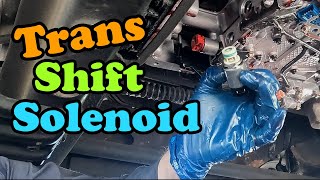
Typical fix: Replace the faulty pressure control solenoid. This is typically done as part of a larger service that includes a new pan gasket, internal filter, and fluid. 🎬 Watch: Step-by-step DIY guide for replacing the Allison shift solenoid.
Est. part cost: $45-$180 - Internal Mechanical Failure (Burned C2/C3 Clutches) 🔴 High Probability On Allison transmissions, P0776 is a known symptom of failing C2/C3 clutches. The TCM sets the code when it can no longer compensate for the clutch slippage by maxing out adaptive pressure. This is common after a fluid loss event (like a leaking cooler line) or on higher-mileage/tuned trucks.
How to confirm: Finding excessive clutch material (black, chunky, gritty debris) in the transmission pan and filter is a definitive sign. A transmission specialist will need to perform pressure tests and an internal inspection to confirm.
Typical fix: Complete transmission rebuild or replacement. This is a major and expensive repair.
Est. part cost: $2000-$5000+ - Low, Dirty, or Contaminated Transmission Fluid 🟡 Medium Probability → Shop Transmission Assembly Heavy-duty use accelerates fluid breakdown. A leaking transmission cooler line, a known issue, can cause rapid fluid loss, starving the pump, burning clutches, and triggering this code.
How to confirm: Check the transmission fluid level and condition. The fluid should be bright red and clear, not dark, brown, or have a burnt smell. Look for metal shavings or clutch material on the dipstick or in the pan.
Typical fix: Perform a transmission fluid and filter change using Allison-approved fluid (e.g., TES-295 spec). If the fluid is very contaminated, a rebuild is likely needed.
Est. part cost: $75-$200 - Debris in the Valve Body or Incorrect Filter 🟡 Medium Probability → Shop Transmission Valve Body GM TSB #PIP4831E advises technicians to look for debris in the valve body for this code. Additionally, ATSG warns that using a substandard aftermarket spin-on filter can restrict flow and trigger P0776 on Allison transmissions.
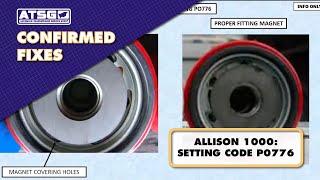
How to confirm: Requires visual inspection of the valve body after removing the transmission pan. Debris can block small hydraulic passages. Check the brand of the external spin-on filter; use only OEM Allison or equivalent with a wide-radius flow design. 🎬 See this ATSG technical breakdown of why P0776 sets.
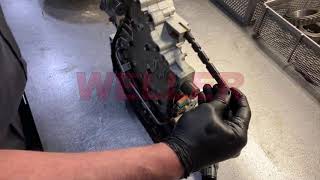
Typical fix: Clean the valve body thoroughly. If passages are blocked or the valve body is warped, it may need replacement. 🎬 Watch: How to remove and install the Allison valve body. Always use a high-quality spin-on filter.
Est. part cost: $200-$700 for a replacement valve body
Rare But Worth Checking
- Faulty Transmission Control Module (TCM): → Shop Transmission Assembly While less common, a faulty TCM can send incorrect signals or have a failed driver circuit for the solenoid. TSB #PIP4831E suggests reviewing the date code on the TCM, hinting at potential issues with certain batches. A common failure point is pins backing out of the TCM connector due to harness tension.
- Damaged Wiring or Connectors: The wiring harness to the transmission can be damaged by heat, debris, or corrosion, causing an open or short in the solenoid circuit. A technician may need to overlay a new wire from the TCM to the transmission connector to rule this out.
Diagnosis Steps
- Check and document any other stored trouble codes with an OBD-II scanner.
- Inspect the transmission fluid level and condition on a level surface with the transmission at operating temperature. Note the color, clarity, and smell.
- Visually inspect the transmission wiring harness and the main round connector for any signs of damage, corrosion, or loose connections.
- If fluid is low or dirty, perform a fluid and filter change (including the external spin-on filter on Allison models). Use only OEM-spec filters and fluid. Clear codes and test drive.
- If the code returns, drop the transmission pan.
- Inspect the pan and internal filter magnet for debris. A small amount of fine metallic dust is normal. A thick layer of black, gritty clutch material or metal chunks indicates severe internal damage requiring a rebuild.
- If the pan is relatively clean, test the resistance of the Pressure Control Solenoid 'B' with a multimeter and compare it to the manufacturer's specifications. Also, test for a click by applying a 12V source.
- Visually inspect the valve body for debris as recommended by TSB #PIP4831E.
- If the solenoid tests bad or significant debris is found in a clean pan, replace the solenoid and clean the valve body.
- If the solenoid tests good but there was excessive clutch material in the pan, the transmission requires a rebuild by a specialist.
Parts You'll Likely Need
- Pressure Control Solenoid 'B' (Trim Solenoid)
(OEM #29533075 (for 5-Speed Allison 2001-2005); 29541896 (for 6-Speed Allison 2006-2008))— This solenoid is the most direct cause of the P0776 code when it fails electrically or becomes stuck.
Trusted brands: ACDelco, Allison, Bosch
OEM price range: $80-$180
Aftermarket price range: $40-$90 - Transmission Filter and Gasket Kit — Required for any job that involves dropping the transmission pan, such as replacing a solenoid. Allison transmissions also have an external spin-on filter that should be changed.
Trusted brands: ACDelco, Wix, Allison
OEM price range: $40-$80
Aftermarket price range: $20-$50
Related Codes That Often Appear With This One
- P0700 — This is a general transmission fault code, essentially the TCM telling the main engine computer that a fault exists. It's an 'umbrella' code that is almost always present with P0776.
- P0751, P0756, P2714, P2723 — TSB #PIP4831E and #PIP4379M list P0776 with a group of other solenoid and pressure switch codes. Seeing them together can point to a widespread electrical issue, a problem with the valve body, low fluid affecting multiple circuits, or a failing TCM.
Technical Service Bulletins (TSBs) & Recalls
- PIP4831E: Advises looking for debris in the valve body and checking the TCM date code for a group of solenoid-related codes including P0776.
- PIP4379M: Lists P0776 as one of many codes that can occur with symptoms like no reverse, pointing to a potential internal transmission problem.
Platform-Specific Known Issues
- TSB #PIP4831E points to debris in the valve body as a specific issue to check for on GM vehicles with this code.
- TSB #PIP4379M groups P0776 with many other codes that can be triggered by internal transmission issues leading to no reverse or range inhibit conditions.
- On models with the Allison transmission, this code is frequently a precursor to a full rebuild due to burned C2/C3 clutches.
Mechanic-Grade Diagnostic Values
- Pressure Control Solenoid 'B' (Trim Solenoid 'B') Resistance — expected: 5.5 - 8.0 Ω (Ohms). Failure: A reading outside this range indicates a faulty solenoid coil.
- TCM Commanded Voltage to Solenoid 'B' — expected: Pulse from 0V (off) to ~12V (fully on). Failure: Absence of voltage when a higher gear is requested points to a TCM or wiring issue.
Scan Tool Commands That Help
- Tech II / GDS2 or equivalent professional scan tool: Fast Learn — This procedure is required after replacing the transmission, valve body, solenoids, or TCM. It allows the TCM to learn the hydraulic characteristics of the new components to ensure proper shift quality. Failure to perform this can result in harsh shifting even after the repair.
- Tech II / GDS2 or equivalent professional scan tool: Clutch Test (Stall Test) — Used to diagnose internal clutch failure. The scan tool monitors turbine speed while each clutch is commanded on. If the turbine speed does not drop to zero when a specific clutch is applied (e.g., the 4th gear clutch), it indicates slippage and internal failure, confirming that a solenoid replacement alone will not fix the issue.
Wiring & Ground Locations
- TCM Red Connector (5-Speed) — On the Transmission Control Module, typically mounted on the driver's side fan shroud.. For 5-speed models, the PC Solenoid 'B' high signal is Pin 24 (PNK/BLK wire) and the low signal is Pin 25 (BRN/WHT wire). The pins in these connectors are known to back out due to harness tension, causing intermittent connections and codes like P0776.
- Main Transmission Connector (Round 20-pin) — On the driver's side of the transmission case.. This is the main interface between the vehicle harness and the transmission's internal harness. Corrosion or damage here can interrupt the signal to any solenoid. For a 2006 6-speed, the PC Solenoid 'B' circuit can be tested at this connector.
Real Owner Repair Stories
- DuramaxDiesels.com forum user (2009 GMC Sierra 3500 LMM (6-speed Allison), 120k miles) — A transmission cooler line burst, leading to fluid loss. After repair and refill, the truck developed recurring P0776 and P2724 codes, got stuck in 3rd gear, and had hard shifting.
❌ Tried (didn't work) Repairing the cooler line and refilling with fluid. The problem persisted.
✅ What actually fixed it The user dropped the transmission pan and found burnt fluid with 'chunky' friction material in the filter. The consensus from other experienced members was that the fluid loss from the line failure had caused internal clutch damage, and a complete transmission rebuild or replacement was necessary, not just a valve body or solenoid replacement.
Model Year Variations Within This Range
- 2001-2005: These models use the 5-speed Allison 1000. The TCM has two large 32-pin connectors (one clear, one red). The wiring for PC Solenoid 'B' is at pins 24 and 25 of the red connector. These TCM connectors are known for pins backing out.
- 2006-2008: These models use the 6-speed Allison 1000. The C1/C2 clutch housing and pump were updated from the 5-speed models. The TCM and its connectors are different. A 'Fast Learn' procedure using a scan tool is critical after repairs to ensure proper shifting.
Helpful Videos
We Have This Part in Stock

The information in this article is provided for general reference and educational purposes only. Vehicle specifications, procedures, and part compatibility can vary by production date, trim level, and region. Always consult your vehicle's factory service manual and verify part numbers before purchasing or performing repairs. Safety-critical components such as airbags, seat belts, and braking systems should be installed by a qualified professional.
- Chevrolet SILVERADO 3500:
- 🧭 Diagnostic Flowchart
- 🎬 Helpful Videos
- 🛍️ Shop This Part
- What's Unique About the 2001-2008 Chevrolet SILVERADO 3500
- Symptoms You May Notice
- Most Likely Causes
- Rare But Worth Checking
- Diagnosis Steps
- Parts You'll Likely Need
- Related Codes That Often Appear With This One
- Technical Service Bulletins (TSBs) & Recalls
- Platform-Specific Known Issues
- Mechanic-Grade Diagnostic Values
- Scan Tool Commands That Help
- Wiring & Ground Locations
- Real Owner Repair Stories
- Model Year Variations Within This Range
- 🎟️ Get 5% Off