

P0776 on 2016-2022 Honda Pilot: Pressure Control Solenoid 'B' Fixes
On a 2016-2022 Honda Pilot, code P0776 is most often caused by low or degraded transmission fluid. A simple fluid drain-and-fill is the first step. If that doesn't work, the issue is likely a faulty pressure control solenoid. The location and repair differ significantly between the Honda-built 6-speed (external solenoid pack) and the ZF-sourced 9-speed (internal individual solenoid) transmissions used in this generation.
- First, identify whether your Pilot has the 6-speed or 9-speed automatic transmission, as this dictates the entire repair path.
- Always start your diagnosis by checking the transmission fluid. Low, old, or incorrect fluid is the most common cause for P0776.
- For 6-speed models, the problem is very often the external dual-linear solenoid pack, which is a moderately difficult DIY replacement.
- For 9-speed models, the repair is more complex, likely involving removing the transmission pan to access the internal valve body and solenoids, and professional service is highly recommended.
What's Unique About the 2016-2022 Honda Pilot
The 2016-2022 Honda Pilot is unique because it was equipped with two different automatic transmissions, which significantly changes the diagnosis and repair for a P0776 code. 🎬 Watch: Diagnostic overview of the P0776 code on this Honda Pilot Lower trims (LX, EX, EX-L through 2020) used a Honda-built 6-speed automatic, where the solenoids are typically part of an externally accessible pack. Higher trims (Touring, Elite) and all 2021-2022 models used a ZF-sourced 9-speed automatic (ZF 9HP). On the 9-speed, the individual solenoids are located inside the transmission on the valve body, making them much harder to service. The ZF 9-speed transmission has also been the subject of class-action lawsuits alleging defects in its control software calibration, leading to erratic shifting behavior.
Symptoms You May Notice
- Check Engine Light is on
- Harsh, jerky, or delayed shifts
- Transmission slipping between gears
- Vehicle stuck in one gear (limp mode)
- Inability to shift into higher gears
- Decreased fuel economy
- Unusual grinding or clunking noises from the transmission
- Surging and juddering while driving (as reported in NHTSA ODI #11625643)
- Replacing the entire transmission without first checking the fluid and testing the external solenoids (on 6-speed models).
- Replacing internal components when the issue is simply old, degraded transmission fluid.
- On 9-speed models, confusing a software calibration issue for a hard part failure.
Most Likely Causes
- Low, Dirty, or Incorrect Transmission Fluid 🔴 High Probability → Shop Transmission Assembly Honda transmissions are known to be sensitive to fluid condition and type. Old, contaminated fluid can cause solenoids to stick or malfunction. Insufficient fluid can also cause pressure issues that mimic a solenoid failure.
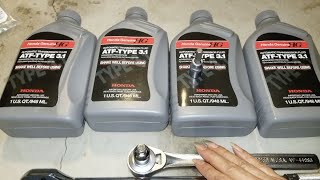
How to confirm: Check the transmission fluid dipstick (if equipped) or service plug. The fluid should be at the correct level, translucent red, and not smell burnt. For the 6-speed, use only Honda ATF DW-1. 🎬 See: Step-by-step 6-speed transmission fluid change video For the 9-speed, use ATF Type 3.1.
Typical fix: Perform a transmission fluid drain-and-fill. A '3x drain-and-fill' (draining, refilling, driving briefly, and repeating twice more) is often recommended to replace the majority of the old fluid.
Est. part cost: $60-$180 - Faulty Pressure Control Solenoid 'B' 🟡 Medium Probability → Shop Transmission Valve Body Solenoids can fail electrically or mechanically over time, often due to contamination from old fluid.
How to confirm: After confirming fluid is good, a technician can use a scan tool to command the solenoid on and off while monitoring pressure. The solenoid's electrical resistance can also be tested with a multimeter.
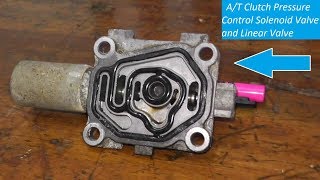
Typical fix: Replace the faulty solenoid. On 6-speed models, Solenoids 'A' and 'B' are often part of a single external dual-linear solenoid pack. On 9-speed models, the solenoid is an individual component on the internal valve body, requiring removal of the transmission pan.
Est. part cost: $150-$400 - Clogged Transmission Filter or Valve Body Passages ⚪ Low Probability → Shop Transmission Assembly Fine metallic debris from normal wear can accumulate and clog the small filter screens on the solenoids or passages within the valve body, restricting fluid flow.
How to confirm: This is typically discovered during solenoid or valve body replacement. Draining the fluid through a strainer and finding significant metallic debris points to this issue.
Typical fix: On 6-speed models, replacing the external solenoid pack includes new screens. On 9-speed models, the valve body may need to be removed, cleaned, or replaced.
Est. part cost: $200-$1200
Rare But Worth Checking
- Faulty Transmission Control Module (TCM) or Software: → Shop Transmission Assembly Especially on the ZF 9-speed transmission, software glitches can cause shifting issues. Honda has issued TSBs for similar problems on other models, and a class-action lawsuit alleges software calibration issues with the Pilot's 9-speed. A faulty TCM is rare but possible.
- Damaged Wiring or Connectors: Damage to the wiring harness leading to the transmission can cause a loss of signal to the solenoid. This is less common but should be inspected, especially if the vehicle has been in an accident or has underbody damage.
Diagnosis Steps
- Check Transmission Fluid: Verify the fluid level and condition. If it's low, top it off. If it's dark, burnt, or has debris, perform a drain-and-fill (a 3x cycle is recommended). Use only the correct Honda-specific fluid for your transmission type (DW-1 for 6-speed, Type 3.1 for 9-speed).
- Scan for Other Codes: Check for other related transmission codes that could provide more context, such as codes for other solenoids or general communication faults. In some cases, P0776 may appear alongside P0777 (Pressure Control Solenoid 'B' Stuck On), as documented in NHTSA ODI #11645682.
- Inspect Wiring: Visually inspect the wiring harness and connectors going to the transmission for any signs of damage, corrosion, or loose connections.
- Check for TSBs: Have a dealer check if any software updates or Technical Service Bulletins apply to your vehicle's VIN, especially for 9-speed models which have known software-related shift quality issues.
- Test the Solenoid: Using a professional scan tool, a technician can command the solenoid to activate and monitor the transmission pressure sensors to see if it responds. The solenoid's internal resistance can also be checked with a multimeter.
- Inspect Valve Body (9-Speed Models): If the fluid is clean and the solenoid tests inconclusive, the next step for the 9-speed transmission is to remove the transmission pan and inspect the valve body and the individual solenoid.
- Replace the Solenoid/Solenoid Pack: If the solenoid is confirmed to be faulty, replace it. For 6-speed models, this is typically the external dual-linear solenoid pack. For 9-speed models, this is the individual solenoid on the internal valve body.
Parts You'll Likely Need
- Automatic Transmission Fluid (6-Speed)
(OEM #08200-9008 (ATF DW-1))— Low or degraded fluid is the most common cause of this code. Using the correct OEM fluid is critical for Honda transmissions.
Trusted brands: Honda Genuine
OEM price range: $12-$20 per quart
Aftermarket price range: N/A - Automatic Transmission Fluid (9-Speed)
(OEM #08200-9017A (ATF Type 3.1))— The ZF 9-speed transmission requires a specific fluid. Using the wrong type will cause damage.
Trusted brands: Honda Genuine
OEM price range: $25-$40 per quart
Aftermarket price range: N/A - Dual-Linear Solenoid Assembly (6-Speed)
(OEM #28250-R97-004)— This is the most common hard part to fail on the 6-speed transmission that causes solenoid performance codes. Note: Part number fitment may vary, verify with VIN. Some sources indicate this part is for older models, but it is commonly associated with this code on 6-speeds.
Trusted brands: Honda Genuine, Rostra, WVE/NTK
OEM price range: $250-$400
Aftermarket price range: $150-$250 - Pressure Control Solenoid (9-Speed) — For the 9-speed ZF transmission, if the solenoid itself fails, it must be replaced individually. This requires internal access. Part number must be verified by VIN.
Trusted brands: Honda Genuine, ZF
OEM price range: $100-$200
Aftermarket price range: $70-$150
Related Codes That Often Appear With This One
- P0700 — This is a general transmission fault code that simply indicates the TCM has stored a more specific code, like P0776.
- P0777 — This code is for 'Pressure Control Solenoid 'B' Stuck On'. If the solenoid is failing intermittently or has an electrical issue, it could trigger either a 'Stuck Off' or 'Stuck On' code.
- P0746 / P0747 — These codes relate to Pressure Control Solenoid 'A'. On 6-speed models, solenoids A and B are part of the same assembly, so a failure in the unit can trigger codes for both.
Technical Service Bulletins (TSBs) & Recalls
- While no TSB directly addresses P0776 on the Pilot, TSBs 15-086 and 17-040 were issued for other Honda models for transmission judder and vibration, with the fix being a software update and fluid change, and in some cases, torque converter replacement. This highlights Honda's use of software updates to fix transmission complaints.
Platform-Specific Known Issues
- The 2016-2022 Pilot uses two different transmissions. The 6-speed automatic is found on LX, EX, and EX-L trims (2016-2020). The ZF 9-speed automatic is on Touring and Elite trims (2016-2020) and all trims for 2021-2022. The repair procedure and parts are completely different for each.
- The ZF 9-speed transmission has a reputation for jerky or hesitant shifting, which may not always be related to a hard fault like P0776. A class-action lawsuit was filed alleging these issues stem from poor software calibration by Honda.
Mechanic-Grade Diagnostic Values
- Resistance of Pressure Control Solenoid 'B' (6-Speed Transmission) — expected: 5.0 to 5.6 Ω at 20°C (68°F). Failure: A reading outside this range indicates a faulty solenoid coil.
- Resistance of Proportional Solenoid (Clutches B, C, D, E) (ZF 9-Speed Transmission) — expected: Approximately 5.3 Ω. Failure: A significant deviation from this value suggests an electrical fault in the solenoid.
Scan Tool Commands That Help
- Honda Diagnostic System (HDS): Clutch Pressure Control Linear Solenoid Valve B Test — This is a specific bidirectional test used after checking fluid and wiring. The HDS can command the solenoid to operate, allowing a technician to monitor its real-time response and confirm if it is functioning electrically and hydraulically without having to remove it from the transmission.
Wiring & Ground Locations
- Main Chassis Ground — On the chassis frame, often near the battery tray and under the air intake ducting.. Some owners have discovered the main vehicle ground connection is bolted to a painted surface from the factory. A poor ground can cause a variety of electrical issues, including erratic sensor and solenoid behavior. Ensuring a clean, metal-to-metal contact at this point is a crucial, often overlooked, step in diagnosing electronic faults.
- Transmission Ground Strap — Typically a braided strap connecting the transmission case to the vehicle's chassis or subframe.. A corroded or broken transmission ground strap can lead to incorrect voltage readings and improper operation of electronic components like solenoids. While the TCM is the primary control, a solid ground is essential for the entire system to function as designed.
Real Owner Repair Stories
- Piloteers.org forum user (2016 Honda Pilot EX-L (6-speed), ~100,000 miles) — Check engine light on with P0776, transmission seemed to be shifting harshly and felt like it was slipping.
❌ Tried (didn't work) A single drain-and-fill of the transmission fluid.
✅ What actually fixed it Performing a full '3x drain-and-fill' procedure with genuine Honda ATF DW-1 fluid. The user reported that the first drain yielded very dark fluid, and it took the full three cycles to get the fluid back to a clean, red condition, at which point the code was cleared and did not return. - NHTSA ODI #11625643 — An owner reported that after a dealership diagnosed DTC P0776 and performed a repair costing $426.10, the surging, juddering, and warning lights persisted, indicating the initial fix was unsuccessful.
- NHTSA ODI #11645682 — One owner noted that a transmission fluid flush and software update costing $500 failed to resolve stored codes P0776 and P0777, with the dealership subsequently recommending a rebuilt transmission.
- NHTSA ODI #11270344 — A vehicle owner was informed by a service representative that computer code P0776 (Pressure Control Solenoid B Performance or Stuck Off) was present during a service visit that also involved fuel injector cleaning procedures.
OEM Part Supersession History
28250-R97-003→28250-R97-004— Standard part revision by the manufacturer, likely for improved reliability or material changes.
Heads up: The new part number (28250-R97-004) is the correct replacement for the original.
Diagnostic Flowchart
Other Known Issues on This Vehicle
Issues unrelated to this code that are worth knowing about as an owner of this generation:
- Fuel Injector Failures 🔴 High — Widespread enough to prompt a warranty extension from Honda to 10 years/150,000 miles for certain VINs. Symptoms include misfires (P030x codes) and A/F ratio codes (P219A/B). (Ref: Warranty Extension (Service Bulletins 20-100, 21-010))
- Infotainment System Glitches (Popping/Cracking Audio) 🟠 Medium — Common on 2019-2022 models. Caused by a loose connection in the MOST bus network. (Ref: Recall and TSB exist to replace faulty FAKRA connectors.)
- Auto Start/Stop System Malfunction 🟡 Low — Common complaint where the system deactivates and displays a warning message, often due to battery state of charge or other sensor inputs.
- Connecting Rod Bearing Wear (Engine Seizure) 🔴 High — Affects a specific subset of 2016-2019 models due to an engine manufacturing error. While the recall affected a large number of vehicles, Honda estimated only 1% had the defect. (Ref: NHTSA Recall 23V-751)
- ZF 9-Speed Transmission Behavior 🟠 Medium → Shop Transmission Assembly — Very common owner complaint of rough/delayed shifting and harsh engagement, even when no trouble codes are present. This led to a class-action lawsuit.
Used vs. New Parts: Buying Guide for This Vehicle
When a used part is the smart pick: For the external dual-linear solenoid assembly on the 6-speed transmission, a used part from a low-mileage donor vehicle can be a cost-effective option. Given it's an external part, replacement is straightforward if the used part fails prematurely. For internal 9-speed solenoids, the high labor cost of access makes a used part a significant gamble; new is strongly recommended.
Donor-vehicle mileage cap: roughly under 75000 miles for the part to have meaningful remaining life.
What to inspect on the donor part:
- Verify the donor vehicle's mileage.
- Ask for photos of the transmission fluid from the donor car; avoid parts from vehicles with dark, burnt, or glittery fluid.
- Inspect the electrical connector pins for any signs of corrosion or damage.
- Ensure the part comes with a short warranty (e.g., 30-90 days) from the salvage yard.
OEM-only on this vehicle (don't cheap out):
- Transmission Control Module (TCM)
- Internal transmission components for the ZF 9-speed (valve body, individual solenoids)
Aftermarket brands forum-validated for this vehicle:
- Rostra (for 6-speed solenoid assemblies)
- WVE/NTK (for 6-speed solenoid assemblies)
Brands owners have reported issues with on this vehicle:
- Unbranded, no-name solenoids from online marketplaces are a high risk for premature failure.
Real Owner Stories
Aggregated from forums and TSBs cited above. Mileages and costs reflect what owners reported in those sources.
2017 Honda Pilot EX-L — 95000 miles
Symptoms: After a fluid change at the dealership, the transmission started downshifting and upshifting hard. For speeds 45 mph and up, the RPMs would ramp up 1000 to 2000 RPMs before shifting.
What fixed it: The context indicates the dealership refused further service, but the recommended fix for these symptoms and code is a 3x drain-and-fill or solenoid pack replacement.
Source hint: r/hondapilot
2014 Acura MDX (Platform Mate)
Symptoms: Owner reported code P0776 accompanied by harsh shifting.
What fixed it: The context mentions this platform mate shares the same powertrain and experienced the same solenoid performance issues.
Source hint: AcuraZine (Acura MDX, platform mate) thread titled 'p0776-pressure-control-solenoid-b-997789/'
2012 Acura TL (6-speed)
Symptoms: Experienced code P0776 and harsh shifting symptoms identical to the Pilot's 6-speed unit.
What fixed it: Replacing the entire solenoid pack assembly.
Source hint: AcuraZine (Acura MDX, platform mate) thread titled 'p0776-pressure-control-solenoid-b-997789/'
Related OBD-II Codes
Frequently Asked Questions
Which transmission fluid should I use for my 2017 Honda Pilot EX-L to avoid P0776?
My 2022 Pilot is shifting jerky but has no codes; is this related to P0776?
Does TSB 15-086 or 17-040 apply to the P0776 code on my Pilot?
Is the Pressure Control Solenoid 'B' an external part on the 9-speed Touring model?
Can I just change the fluid once to fix a P0776 'stuck off' condition?
Are there any recalls for the engine or transmission that I should check while fixing this?
Helpful Videos
We Have This Part in Stock



The information in this article is provided for general reference and educational purposes only. Vehicle specifications, procedures, and part compatibility can vary by production date, trim level, and region. Always consult your vehicle's factory service manual and verify part numbers before purchasing or performing repairs. Safety-critical components such as airbags, seat belts, and braking systems should be installed by a qualified professional.
- Honda Pilot:
- 🧭 Diagnostic Flowchart
- 🎬 Helpful Videos
- 🛍️ Shop This Part
- What's Unique About the 2016-2022 Honda Pilot
- Symptoms You May Notice
- Most Likely Causes
- Rare But Worth Checking
- Diagnosis Steps
- Parts You'll Likely Need
- Related Codes That Often Appear With This One
- Technical Service Bulletins (TSBs) & Recalls
- Platform-Specific Known Issues
- Mechanic-Grade Diagnostic Values
- Scan Tool Commands That Help
- Wiring & Ground Locations
- Real Owner Repair Stories
- OEM Part Supersession History
- Other Known Issues on This Vehicle
- Used vs. New Parts: Buying Guide for This Vehicle
- Real Owner Stories
- 2017 Honda Pilot EX-L — 95000 miles
- 2014 Acura MDX (Platform Mate)
- 2012 Acura TL (6-speed)
- Related OBD-II Codes
- Frequently Asked Questions
- 🎟️ Get 5% Off