

P0843 on 2013-2015 GMC Sierra Denali: Transmission Pressure Sensor Circuit Fixes
On a 2013-2015 Sierra Denali, P0843 almost always means the internal transmission pressure switch has failed. This switch is part of the Transmission Electro-Hydraulic Control Module (TEHCM) inside the oil pan. The fix requires replacing the entire TEHCM assembly, which costs $800-$1500 at a shop. This is a very common failure on the GM 6L80 transmission.
- P0843 on a 2013-2015 Sierra Denali points directly to a known failure point: the Transmission Electro-Hydraulic Control Module (TEHCM).
- This is not a simple external sensor replacement. The repair is internal to the transmission and requires dropping the oil pan.
- The replacement TEHCM must be programmed to your truck's VIN to function correctly, making this a job best left to a professional repair shop.
- Do not continue to drive with these symptoms, as you risk getting stranded or causing more expensive damage to the transmission's mechanical parts.
What's Unique About the 2013-2015 Gmc SIERRA DENALI
On the 6L80 6-speed automatic transmission used in this generation of Sierra, the pressure switches are not simple, individual sensors you can unscrew from the outside. Instead, they are integrated into the Transmission Electro-Hydraulic Control Module (TEHCM), which is a complex assembly mounted to the valve body inside the transmission. This makes the repair more involved than on other vehicles, as it requires removing the transmission oil pan to access and replace the entire module. Crucially, the new TEHCM must be programmed to your truck's VIN using a specialized J2534 pass-thru device and GM's TIS2Web software before the vehicle is driven.
Diagnostic Flowchart
Tap your situation to follow the diagnostic path that matches what you're seeing on this vehicle.
Generation note: This range covers two Sierra generations: the GMT900 (2013) and the K2XX (2014-2015). However, both generations used the 6L80 6-speed automatic transmission, and the cause of P0843—a failing TEHCM—is the same for both. The repair procedure is consistent across these years.
Symptoms You May Notice
- Check Engine Light is on
- Harsh or erratic shifting
- Transmission stuck in one gear (limp mode)
- Loss of reverse gear
- "Range Inhibit" or "Service Transmission" message on the dash
- Delayed engagement when shifting from Park to Drive or Reverse
- Feeling a 'rumble strip' vibration during light acceleration, which can be a sign of a related torque converter issue common to the 6L80
- Replacing the entire transmission. P0843 is most often an electrical fault with a single component (the TEHCM), not a catastrophic mechanical failure requiring a full rebuild or replacement.
- Replacing individual shift solenoids. While the solenoids are part of the same valve body assembly, P0843 specifically points to the pressure switch circuit, which is part of the TEHCM's electronics. Replacing solenoids will not fix a pressure switch fault.
Most Likely Causes
- Failed Transmission Electro-Hydraulic Control Module (TEHCM) 🔴 High Probability → Shop Transmission Assembly The pressure switches integrated into the TEHCM are a well-documented failure point on the GM 6L80 transmission. The internal rubber diaphragms of the switches are exposed to constant heat and pressure cycles, causing them to crack, rupture, or have their seals fail. This creates an open circuit, resulting in the 'Circuit High' fault. This issue is noted in GM Technical Service Bulletin #PIP4379M.
How to confirm: A mechanic with a professional scan tool can monitor live data from the transmission pressure switches. The switch corresponding to circuit 'A' will show a constant high or open circuit reading (often stuck at 5.0V) that does not change as gears are commanded. This is a definitive sign of internal TEHCM failure.
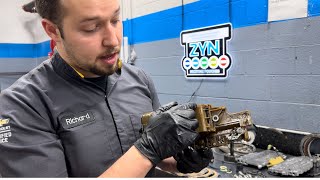
Typical fix: The transmission pan is removed, and the entire TEHCM/valve body assembly is replaced with a new or remanufactured unit. The new module must be programmed to the vehicle's VIN before operation. Some specialists may offer to repair the switch laminate disc, but a full TEHCM replacement is the most common and reliable repair. 🎬 Watch: Why a professional mechanic recommends replacing the entire TEHCM
Est. part cost: $400-$700 - Low or Dirty Transmission Fluid ⚪ Low Probability → Shop Transmission Assembly
How to confirm: Check the transmission fluid level and condition. If the fluid is very low, burnt, or full of debris, it can cause erratic behavior. However, this usually triggers other codes (like P0868 for low pressure) alongside P0843 and is rarely the sole cause for a 'Circuit High' fault.
Typical fix: Perform a transmission fluid and filter change. This is done as part of the TEHCM replacement anyway.
Est. part cost: $100-$150 - Damaged Wiring or Connectors ⚪ Low Probability
How to confirm: Inspect the main transmission wiring harness connector for corrosion, pushed-out pins, or damage. A visual inspection of the external harness should be performed, but since the pressure switches are internal to the transmission, an external wiring issue for this specific code is uncommon.
Typical fix: Repair the damaged section of the wiring harness or clean/replace the connector.
Est. part cost: $20-$100
Rare But Worth Checking
- Faulty Ignition Switch:
Diagnosis Steps
- Scan for all diagnostic trouble codes. Note if P0700 or other transmission codes are present with P0843.
- Check the transmission fluid level and condition. Ensure it is at the correct level and does not smell burnt or contain excessive debris.
- Using a professional scan tool (like a GM Tech-2 or equivalent), access the live transmission data to observe the state of all transmission fluid pressure switches (TFP 1-5).
- Command gear changes with the scan tool and verify if the reading for pressure switch 'A' is stuck in a 'High' or 'Open' state. If it is, the TEHCM is faulty.
- If the scan tool test is inconclusive, inspect the main transmission electrical connector for any signs of damage, corrosion, or loose pins.
- If the external wiring is confirmed to be good and the switch data is stuck high, the diagnosis is a failed TEHCM requiring replacement.
- As a final, less likely check, verify the ignition switch is providing stable voltage to the TCM.
Parts You'll Likely Need
- Transmission Electro-Hydraulic Control Module (TEHCM)
(OEM #24256861, 24275873 (Part numbers are often superseded; always verify with VIN))— This is the assembly that contains the failing pressure switch. The official GM repair is to replace this entire module, which includes the TCM, solenoids, and pressure switches. Note: This part MUST be programmed to the vehicle's VIN.
Trusted brands: ACDelco (GM OE), Dorman (Remanufactured), Sonnax (Remanufactured)
OEM price range: $550-$750
Aftermarket price range: $400-$600 - Automatic Transmission Filter Kit — The filter must be replaced any time the transmission pan is removed for service.
Trusted brands: ACDelco, Wix
OEM price range: $30-$50
Aftermarket price range: $20-$40 - DEXRON-VI Automatic Transmission Fluid — The correct fluid is required to refill the transmission after dropping the pan. A pan drop and fill typically requires 6-8 quarts.
Trusted brands: ACDelco, Valvoline, Mobil 1
OEM price range: $10-$15 per quart
Aftermarket price range: $8-$12 per quart
Related Codes That Often Appear With This One
- P0700 — This is a generic code indicating the TCM has stored a fault. P0843 is the specific fault that caused the P0700 to be logged.
- P0751, P0756, P0776 — These are shift solenoid performance codes. Since the solenoids, pressure switches, and control module are all part of the TEHCM, a single internal failure in the module can trigger multiple circuit and performance faults.
- P0842, P0848, P0873, P0877 — These are other transmission fluid pressure switch circuit codes (for switches B, C, D, etc.). Seeing multiple pressure switch codes strongly points to a failure of the TEHCM where all the switches are housed, or a failure of the laminate disc they are mounted on.
Technical Service Bulletins (TSBs) & Recalls
- PIP4379M: Addresses multiple transmission codes, including P0843, related to internal TEHCM failure causing symptoms like no reverse or range inhibit.
- 16-NA-019: Informational bulletin about transmission adaptive functions and correcting harsh shifts
Platform-Specific Known Issues
- A known issue with the TEHCM is documented in GM Technical Service Bulletin #PIP4379M, which lists P0843 among a host of other codes related to internal TEHCM failures that cause symptoms like no reverse and range inhibit.
- Another potentially relevant TSB is 16-NA-019, which addresses harsh shifts and flares on GM transmissions, although it primarily concerns adaptive learning functions on 8-speed models, the principles can be related.
Mechanic-Grade Diagnostic Values
- TEHCM Pressure Switch Resistance (Bench Test) — expected: With no pressure applied, the meter should read close to OL (Open Line). With light pressure from a pencil eraser, it should read approximately 10 ohms.. Failure: Readings that are non-existent, do not change with pressure, or are significantly different from 10 ohms under pressure indicate a failed switch.
- Transmission Fluid Pressure (Live Data) — expected: Approximately 45-80 PSI at idle in gear. Can rise towards 300 PSI at wide-open throttle.. Failure: This value helps assess overall hydraulic health but does not directly diagnose the P0843 electrical fault. However, readings that are wildly out of spec could indicate a larger issue.
- TFP Sensor 'A' Circuit Voltage — expected: A variable voltage signal typically between 0.5V and 4.5V.. Failure: A sustained reading above 4.5V triggers the P0843 code, indicating an open or short to power.
Scan Tool Commands That Help
- GDS2 / Tech 2: Solenoid Valve State Control / Output Control — To manually command gear shifts while observing the live data for TFP Switch 'A'. If the switch state remains 'High' or 'Open' regardless of the commanded gear, it confirms the switch inside the TEHCM is faulty.
- GM SPS (Service Programming System) via TIS2Web/Techline Connect: TEHCM Programming / Module Reprogramming — This is a mandatory procedure after installing a new TEHCM. It programs the vehicle's VIN and correct software calibrations into the new module. Failure to perform this step will result in a no-start or immediate limp mode.
Wiring & Ground Locations
- Main Transmission Connector (16-pin) — The main external electrical connector on the transmission case, where the vehicle harness connects to the transmission.. This is the primary point for testing the external circuits. A technician can check for stable power on Pin 4 (Battery +) and Pin 12 (Run-crank power+), and a solid ground on Pin 5. Problems here can mimic an internal TEHCM failure.
- G218 — Under the driver's side dashboard, behind the kick panel.. This is a known problematic ground location on 2014+ GM trucks that can cause a wide range of bizarre electrical issues, including erratic module behavior. A poor ground here can affect the TCM's reference voltage, potentially causing false codes.
- Engine Block to Chassis/Frame Ground Strap — Typically runs from the rear of the engine block (passenger side) to the frame rail.. This is a primary ground path for the powertrain. It is exposed to the elements and is known to corrode or break, leading to unstable voltage and current flow for all engine and transmission electronics.
Real Owner Repair Stories
- Reddit user on r/AskAMechanic (2014 GMC Sierra 5.3L with 6L80 transmission) — Needed to replace the TEHCM.
❌ Tried (didn't work) Installed a remanufactured TEHCM from an aftermarket supplier (Transtar) which was Dead On Arrival (DOA). The scan tool could not establish communication to perform the required initial programming.
✅ What actually fixed it The technician was planning to get a genuine AC Delco (GM OE) part next. The key takeaway is that aftermarket TEHCMs can be unreliable, and it's a valuable diagnostic tip to plug in the new module and check for communication *before* fully installing it and filling with fluid, to avoid wasted labor on a bad part.
"I Checked Everything" — The Actual Cause
- While a smoke test is not used for this electrical code, a similar pattern exists where standard circuit checks point to a bad TEHCM, but the actual cause is a faulty ground. A technician may test the sensor circuit and find it open, but this can be a misleading result if the TCM itself has an unstable ground reference from a corroded chassis ground like G218 or the main engine-to-frame strap. This causes the module to misinterpret the sensor's voltage, when the module's own ground is the problem.
OEM Part Supersession History
24256861→Multiple revisions exist. This part number was common on 2010-2013 models.— Improvements to solenoids and pressure manifold gaskets over earlier Gen 1 TEHCMs.
Heads up: While physically similar, TEHCMs have different internal logic and software compatibility. A module from a different year range may not accept the required programming for your vehicle.24257213, 24041874→24275873— Updated logic, improved pressure switches with better thermal tolerance, and other internal revisions.
Heads up: Using an older part number in a newer truck (or vice-versa) will likely lead to a programming failure or operational faults. Always verify the correct part number for your specific VIN.
Model Year Variations Within This Range
- 2014-2015: The K2XX generation trucks (2014+) were equipped with a transmission fluid thermostat designed to raise operating temperatures to around 196°F to improve fuel economy. The earlier GMT900 (2013) trucks run cooler. This higher sustained temperature in the 2014-2015 models is widely believed to accelerate the failure of internal components, including the TEHCM pressure switch diaphragms and torque converter clutches.
Helpful Videos
We Have This Part in Stock

The information in this article is provided for general reference and educational purposes only. Vehicle specifications, procedures, and part compatibility can vary by production date, trim level, and region. Always consult your vehicle's factory service manual and verify part numbers before purchasing or performing repairs. Safety-critical components such as airbags, seat belts, and braking systems should be installed by a qualified professional.
- Gmc SIERRA DENALI:
- 🧭 Diagnostic Flowchart
- 🎬 Helpful Videos
- 🛍️ Shop This Part
- What's Unique About the 2013-2015 Gmc SIERRA DENALI
- Symptoms You May Notice
- Most Likely Causes
- Rare But Worth Checking
- Diagnosis Steps
- Parts You'll Likely Need
- Related Codes That Often Appear With This One
- Technical Service Bulletins (TSBs) & Recalls
- Platform-Specific Known Issues
- Mechanic-Grade Diagnostic Values
- Scan Tool Commands That Help
- Wiring & Ground Locations
- Real Owner Repair Stories
- "I Checked Everything" — The Actual Cause
- OEM Part Supersession History
- Model Year Variations Within This Range
- 🎟️ Get 5% Off