

P0848 on 2009-2010 Chevrolet Silverado 2500: Transmission Pressure Sensor 'B' Circuit High Causes and Fixes
On a 2009-2010 Silverado 2500 with the common 6L90 transmission, P0848 almost always indicates a failed transmission fluid pressure sensor. Because these sensors are integrated into the Transmission Electro-Hydraulic Control Module (TEHCM) inside the transmission pan, the fix typically requires replacing the entire TEHCM assembly. The OEM part (ACDelco #24256861) costs between $400 and $800, and the module must be programmed to the truck's VIN, making this a complex repair.
- P0848 is an electrical fault code, not a mechanical pressure code. It points to a problem in the sensor's circuit.
- The most likely cause on a 2009-2010 Silverado 2500 is a failed TEHCM (valve body module), which contains the pressure sensor.
- This is not a simple DIY fix. The repair is inside the transmission and the replacement part requires professional programming.
- Do not ignore this code. It can lead to severe shifting problems, getting stuck in limp mode, or being stranded.
- Always check for other transmission codes, especially P0701, as per GM's technical service bulletin.
What's Unique About the 2009-2010 Chevrolet SILVERADO 2500
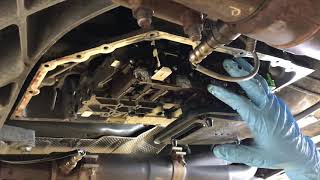
On the 2009-2010 Silverado 2500, which is primarily equipped with the 6L90 (gas engines) or Allison 1000 (diesel engines) transmissions, the fluid pressure sensors are not simple, externally-mounted parts. For the very common 6L90, they are integrated into the Transmission Electro-Hydraulic Control Module (TEHCM). This design means that a single sensor failure often necessitates the replacement of the entire TEHCM assembly, a more complex and costly repair that requires removing the transmission pan and valve body. 🎬 Watch: Step-by-step guide to removing the 6L90 valve body For the Allison transmission, the issue is more commonly a failed internal wiring harness or the pressure switch manifold.
Diagnostic Flowchart
Tap your situation to follow the diagnostic path that matches what you're seeing on this vehicle.
Symptoms You May Notice
- Harsh, erratic, or delayed shifting
- Transmission stuck in one gear (limp mode)
- Check Engine Light or Transmission Warning Light illuminated
- Vehicle unexpectedly shifts into neutral
- Reduced fuel efficiency due to inhibited torque converter lockup
- "Range Inhibit" message on the driver information center (as noted in TSB #PIP4379N)
- Replacing the entire transmission when only the TEHCM is faulty. Proper diagnosis is key to avoiding this expensive mistake.
- Replacing external sensors that are not related to the internal pressure switches.
- Assuming the entire TEHCM must be replaced when only the pressure switch laminate plate/seals have failed, which is a much cheaper repair.
Most Likely Causes
- Faulty Transmission Electro-Hydraulic Control Module (TEHCM) / Pressure Switch Assembly 🔴 High Probability → Shop Transmission Assembly The pressure sensors are integrated into the TEHCM on the common 6L90 transmission. The entire module is a known failure point, with early versions (2009-2010) being particularly susceptible to internal circuit faults and pressure switch failures. Sometimes, the issue is torn rubber diaphragms or a delaminated plate on the TEHCM, which can cause pressure loss and trigger the code.
How to confirm: Use a professional scan tool to monitor live data for TFP Sensor 'B'. If the voltage is stuck high (around 5V) regardless of gear or engine RPM, and the wiring is confirmed to be good, the TEHCM is faulty. Visual inspection after removal may show torn rubber seals on the TEHCM surface.
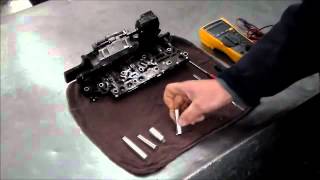
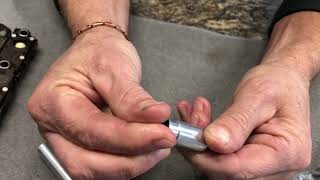
Typical fix: Replace the entire TEHCM assembly located inside the transmission. The new module must be programmed to the vehicle's VIN. In some cases, if only the rubber seals are torn, a specialized kit can be used to repair the TEHCM without full replacement. 🎬 See how to reseal the pressure switches yourself
Est. part cost: $400-$800 for a new OEM unit, or under $100 for a seal repair kit. - Damaged or Shorted Wiring 🟡 Medium Probability The wiring harness, both external and internal to the transmission, is exposed to heat, vibration, and potential road debris. Wires can chafe and short to a power source, creating a 'circuit high' condition. The main connector at the transmission case is a common point for corrosion or pin damage.
How to confirm: Inspect the external transmission harness for any signs of melting, chafing, or corrosion, paying close attention to where it passes near hot exhaust components or the power steering pump pulley. Perform a continuity test and check for a short to voltage on the signal wire for TFP sensor 'B' between the TCM connector and the transmission case connector.
Typical fix: Repair or replace the damaged section of the wiring harness. Pigtail connectors are available for common repair points.
Est. part cost: $20-$250 - Low or Contaminated Transmission Fluid ⚪ Low Probability → Shop Transmission Assembly
How to confirm: Check the transmission fluid level and condition using the dipstick. The fluid should be at the correct level, red in color, and not smell burnt. While unlikely to cause a 'circuit high' fault directly, severe contamination with clutch material can indicate broader internal failures that may accompany electronic faults.
Typical fix: Perform a transmission fluid and filter change using the manufacturer-specified fluid (ACDelco DEXRON-VI). This is a necessary first step but is unlikely to resolve the P0848 code on its own.
Est. part cost: $75-$150
Rare But Worth Checking
- Faulty Transmission Control Module (TCM): → Shop Transmission Assembly If the TEHCM and wiring are confirmed to be good, the main TCM could be at fault, though this is rare as the control logic is integrated into the TEHCM on 6L90 transmissions.
Diagnosis Steps
- Check the transmission fluid level and condition. Ensure it is full and not burnt or contaminated.
- Use a professional-grade scan tool to check for all stored DTCs. Note all codes, especially other transmission-related ones like P0700, P0843, etc.
- View live data from the Transmission Fluid Pressure (TFP) sensors. Observe the voltage for sensor 'B'. A reading stuck at or near 5V confirms the 'circuit high' condition.
- Inspect the main transmission wiring harness and the large round connector at the transmission case for visible damage, corrosion, or loose pins.
- If external wiring is intact, drop the transmission pan to inspect the internal wiring harness and the connector to the TEHCM.
- If no wiring faults are found, the TEHCM/pressure switch assembly is the most likely culprit. Inspect the TEHCM's rubber seals for tears before deciding on full replacement vs. repair.
- After replacement or repair, the new or existing TEHCM must be programmed to the vehicle's VIN.
- Clear all DTCs and perform a transmission adaptive pressure relearn procedure, followed by a test drive to ensure the repair is successful.
Parts You'll Likely Need
- Transmission Electro-Hydraulic Control Module (TEHCM)
(OEM #ACDelco 24256861 (for 2010+ models, supersedes earlier part numbers like 24241350 for 2009))— This module contains the fluid pressure sensors and control solenoids. It is the most common point of failure for code P0848 on these trucks with the 6L90 transmission.
Trusted brands: ACDelco (OEM), Sonnax (Remanufactured)
OEM price range: $400-$800
Aftermarket price range: $350-$600 - Automatic Transmission Fluid (DEXRON-VI) — Required when dropping the transmission pan to replace the TEHCM. Only DEXRON-VI should be used.
Trusted brands: ACDelco, Valvoline, Castrol
OEM price range: $10-$15 per quart
Aftermarket price range: $8-$12 per quart - Transmission Pan Gasket and Filter Kit — The gasket must be replaced anytime the pan is removed, and it is best practice to replace the filter at the same time.
Trusted brands: ACDelco, Fel-Pro, ATP
OEM price range: $40-$70
Aftermarket price range: $25-$50
Related Codes That Often Appear With This One
- P0700 — This is a general code indicating the TCM has requested the check engine light. It almost always appears with specific transmission codes like P0848.
- P0701 — A general TCM malfunction code. TSB #PIP4379N specifically states to diagnose P0701 first if it is present, as it may indicate a more systemic issue.
- P0843 — This code is for TFP Sensor 'A' Circuit High. Seeing multiple pressure sensor codes together strongly points towards a faulty TEHCM or a wiring harness issue common to all sensors.
- P0877 — This code is for TFP Sensor 'D' Circuit High. Like P0843, its presence alongside P0848 reinforces the likelihood of a TEHCM or harness failure.
- P0751 — Shift Solenoid 'A' Performance/Stuck Off. TSBs list this code alongside pressure switch codes, indicating a potential hydraulic or electrical fault within the valve body/TEHCM assembly.
Technical Service Bulletins (TSBs) & Recalls
- PIP4379N: Mentions P0848 as one of several transmission codes that can cause harsh shifting or a range inhibit. It advises technicians to diagnose code P0701 first if it is present.
- TSB 23-NA-142 / Customer Satisfaction Program N232428780: While for later model years, this TSB addresses issues with improperly machined valve body separator plates in 6L90 transmissions, highlighting a history of manufacturing-related issues within the valve body assembly that can lead to transmission failure.
Platform-Specific Known Issues
- TEHCM Programming is Mandatory: → Shop Transmission Valve Body A new TEHCM for a 6L90 transmission is essentially a blank slate. It must be programmed with the vehicle's specific VIN and the latest GM calibration software before it will function. Some companies sell pre-programmed modules, which can save on labor costs at a shop. A dealer or well-equipped independent shop will charge between $100 and $300 for this programming service alone.
- TEHCM Laminate Plate/Seal Failure: → Shop Transmission Valve Body In some instances, the entire electronic module is not faulty. Instead, the laminated plate with integrated rubber seals that sits between the TEHCM and the valve body can tear or delaminate. This causes an internal pressure leak that the sensors detect, triggering the code. Aftermarket kits are available to replace just these seals, which is a much more affordable repair than replacing the entire TEHCM.
Mechanic-Grade Diagnostic Values
- TEHCM Pressure Switch Resistance — expected: 0.5 to 10 Ohms (per Sonnax documentation), though real-world measurements may be lower (0.3-0.4 Ohms).. Failure: A complete absence of resistance (open circuit) indicates a definite failure. However, due to the nature of the contacts, a resistance reading alone may not be conclusive.
- TEHCM Pressure Switch Signal Voltage (Scan Tool) — expected: Switches between 'High' (approx. 12V) and 'Low' (approx. 0V) as gears are commanded.. Failure: The parameter for TFP Switch 'B' is stuck on 'High' or 'Open' and does not change state when it should.
Hidden / Shadow Codes Worth Checking
- P0756 + P0848 Combination: When DTC P0756 (Shift Solenoid 'B' Performance/Stuck Off) and P0848 are set together, it may indicate that the shift valve 2 is mechanically stuck in the destroked position, or there is an open in the pressure switch 2 signal circuit. (see via This is a diagnostic pattern noted in service literature, visible on any standard professional scan tool that can read both codes.)
Scan Tool Commands That Help
- GDS2 / Tech2 / Professional Scan Tool: Solenoid Output Controls — During diagnosis with the TEHCM removed and attached to a test plate, a technician can command individual solenoids ON and OFF to verify the corresponding pressure switch changes state. This helps isolate a faulty switch or solenoid within the TEHCM assembly.
- GM SPS (Service Programming System): Module Programming/Setup — This is a mandatory step after installing a new TEHCM. The module must be programmed with the vehicle's VIN and the latest GM calibrations, otherwise the vehicle will not start or shift correctly.
- GDS2 / Professional Scan Tool: Transmission Adaptive Pressure Relearn (Fast Learn) — After programming a new TEHCM or servicing the transmission, this procedure must be performed to clear old adaptive data and allow the TCM to quickly learn the hydraulic characteristics of the new/repaired components for smooth shifting.
Wiring & Ground Locations
- X175 — The main round electrical connector on the passenger side of the transmission case.. This is the critical connection point between the external vehicle harness and all internal transmission electronics, including the TEHCM. Corrosion, moisture, or pushed-out pins here can directly cause a 'circuit high' fault like P0848.
- G103 — Located at the left rear of the engine compartment on the cowl, often above the brake booster. Also described as being part of the main negative battery cable at the left front of the engine block.. This is a major engine and body ground point. While a failure here would likely cause multiple, widespread issues, a poor ground can introduce electrical noise and voltage offsets that may lead to intermittent and difficult-to-diagnose sensor circuit faults.
- G107 — A ground stud on the engine, near the oil filter housing.. As an engine ground, this ensures the engine block and components attached to it have a solid ground path. A loose or corroded connection here could contribute to erratic electronic behavior.
Real Owner Repair Stories
- Go-Parts.com forum summary (2011 Chevrolet Silverado with 6.2L V8 and 6L80E transmission) — Check Engine Light with codes P0848 and P0873.
❌ Tried (didn't work) Initial diagnosis suggested replacing the entire TEHCM.
✅ What actually fixed it The owner dropped the pan and found the laminated plate with integrated rubber seals on the TEHCM had delaminated and was leaking. Replacing only this plate/seal assembly with an aftermarket kit resolved both codes without needing to replace or reprogram the entire TEHCM. - YouTube video by Gary Ferraro (2008 Chevy Silverado 2500 with 6.0L motor and 6L90 transmission) — Slipping, not running right, multiple pressure control solenoid codes ('stuck on'/'stuck off') and a pressure switch code.
✅ What actually fixed it The TEHCM was removed and the internal pressure switches were tested and found to have low resistance. The video demonstrates the process of rebuilding the pressure switches using a Sonnax tool kit, which was the prescribed fix for the pressure switch code.
"I Checked Everything" — The Actual Cause
- In the context of this electronic code, a similar pattern exists where electrical checks are clean, but the fault persists. Service information notes that having both P0848 and P0756 (Shift Solenoid 'B' Stuck Off) can indicate a mechanically stuck shift valve inside the valve body. A technician who only focuses on replacing the TEHCM and checking wiring might miss this underlying mechanical/hydraulic cause for the electrical code.
OEM Part Supersession History
24241350 / 24252114→24256861— This is the 'Gen 1' TEHCM used in 2009 models, known for frequent pressure switch issues. The new part number for 2010+ models features improved solenoids and an updated pressure manifold gasket to address failure points.
Heads up: While they may physically connect, early and late TEHCMs are generally not interchangeable due to internal calibration and hardware differences. Using the wrong year module can cause immediate limp mode or no-start conditions.24256861→19431596— This appears to be a newer, upgraded replacement part number for the TEHCM, released after a period of significant supply shortages.
Model Year Variations Within This Range
- 2009: The 2009 Silverado 2500 uses the first-generation 6L90 TEHCM (part numbers 24241350 / 24252114). These early modules are known to have a higher frequency of pressure switch failures.
- 2010: The 2010 model uses the updated TEHCM (part number 24256861), which features improved solenoids and a redesigned pressure manifold gasket to increase durability and address the known issues from the earlier design.
Helpful Videos

We Have This Part in Stock

The information in this article is provided for general reference and educational purposes only. Vehicle specifications, procedures, and part compatibility can vary by production date, trim level, and region. Always consult your vehicle's factory service manual and verify part numbers before purchasing or performing repairs. Safety-critical components such as airbags, seat belts, and braking systems should be installed by a qualified professional.
- Chevrolet SILVERADO 2500:
- 🧭 Diagnostic Flowchart
- 🎬 Helpful Videos
- 🛍️ Shop This Part
- What's Unique About the 2009-2010 Chevrolet SILVERADO 2500
- Symptoms You May Notice
- Most Likely Causes
- Rare But Worth Checking
- Diagnosis Steps
- Parts You'll Likely Need
- Related Codes That Often Appear With This One
- Technical Service Bulletins (TSBs) & Recalls
- Platform-Specific Known Issues
- Mechanic-Grade Diagnostic Values
- Hidden / Shadow Codes Worth Checking
- Scan Tool Commands That Help
- Wiring & Ground Locations
- Real Owner Repair Stories
- "I Checked Everything" — The Actual Cause
- OEM Part Supersession History
- Model Year Variations Within This Range
- 🎟️ Get 5% Off