

P0856 on 2007-2009 Cadillac SRX: Traction Control Signal Fault Causes and Fixes
On a 2007-2009 Cadillac SRX, code P0856 is almost always caused by a poor connection at the main transmission electrical connector (X1). This is a known issue documented in GM Technical Service Bulletin #PIC4740E. Inspecting and cleaning this large, round connector on the driver's side of the transmission is the most common and cost-effective fix.
- P0856 on a 2007-2009 SRX is a communication code, not a mechanical failure.
- The most likely cause is a corroded or loose main transmission connector (X1), as per GM TSB #PIC4740E.
- Do NOT replace expensive modules like the EBCM or TCM without first thoroughly inspecting and cleaning the X1 connector and checking chassis grounds.
- This issue will disable your traction control and StabiliTrak systems, so it should be addressed for safety.
- The fix is often inexpensive, requiring only contact cleaner and dielectric grease, but the diagnosis can be labor-intensive.
What's Unique About the 2007-2009 Cadillac SRX
For this generation of Cadillac SRX and other concurrent GM platforms like the STS and CTS, the P0856 code is strongly linked to a specific, documented failure point. While many vehicles might set this code for a faulty module, on the SRX, the root cause is frequently a poor connection at the main transmission harness connector, known as X1. This large, round connector is located on the driver's side of the transmission case and is susceptible to moisture and corrosion, which leads to unseated or damaged terminal pins. This single point of failure can cause a cascade of communication failures between the transmission (TCM), engine (ECM), and brake control (EBCM) modules, as detailed in GM Technical Service Bulletin PIC4740E.
Diagnostic Flowchart
Tap your situation to follow the diagnostic path that matches what you're seeing on this vehicle.
Symptoms You May Notice
- Check Engine Light illuminated
- Traction Control / StabiliTrak warning light illuminated
- "Service Traction Control" or "Service StabiliTrak" message on the driver information center
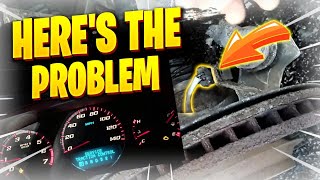
- Traction control system is disabled 🎬 Watch: How to fix ABS, Traction Control, and Stabilitrak lights
- Possible erratic or hard transmission shifting
- In rare cases, a no-start or stalling condition if communication loss is severe
- Door locks may cycle intermittently while driving
- Replacing the Electronic Brake Control Module (EBCM) without first inspecting the transmission X1 connector and chassis grounds.
- Replacing wheel speed sensors, which typically set their own specific C-codes (like C0035-C0050) and do not directly cause a P0856 communication fault.
Most Likely Causes
- Poor Connection at Transmission Connector X1 🔴 High Probability → Shop Transmission Assembly This is a well-documented issue covered by GM TSB #PIC4740E. The connector is a large, round, 16-pin connector on the driver's side of the transmission, and its location makes it susceptible to moisture intrusion, leading to corrosion and backed-out pins.
How to confirm: Visually inspect the pins and sockets of the X1 connector for any signs of green or white corrosion, moisture, or pins that are not fully seated. The TSB advises to gently tug on each wire to ensure the terminals are locked in place, as a side load can give a false sense of security.
Typical fix: Disconnect the connector, thoroughly clean both the male and female sides with an electrical contact cleaner, apply dielectric grease to the seal to prevent moisture, and ensure it is fully seated. Damaged terminals may need to be replaced using a terminal repair kit.
Est. part cost: $5-$30 - Corroded Chassis Ground 🟡 Medium Probability On many GM vehicles, critical grounds for the control modules are located on the frame rail, often behind the front wheel well liner, where they are exposed to road salt and moisture. A poor ground for the EBCM can cause communication faults.
How to confirm: Locate the main EBCM ground point, typically on the frame rail under the driver's side door or near the EBCM itself. Disassemble the ground connection and inspect for rust or corrosion between the terminal and the frame.
Typical fix: Remove the ground bolt, clean the wire terminal and the frame mounting point down to bare metal using a wire brush or sandpaper, and re-secure the connection. Applying a protective coating can prevent future corrosion.
Est. part cost: $0-$5 - Wiring Issue (Chafing/Damage) ⚪ Low Probability Wiring harnesses can become damaged from chafing against other components, improper repairs, or heat exposure over time. The TSB for related vehicles like the CTS also notes to check for harness chafing near the bell housing.
How to confirm: Visually inspect the wiring harness between the ECM, EBCM, and TCM for any signs of damage, particularly where it routes near the engine and transmission. A multimeter would be used to check for continuity and shorts on the specific CAN bus circuits (pins 6 and 14 of the OBD-II port).
Typical fix: Repairing the damaged section of wire and protecting it from future damage with loom or tape.
Est. part cost: $5-$50
Rare But Worth Checking
- Failed Electronic Brake Control Module (EBCM): → Shop ABS Control Module While possible, module failure is far less common than the wiring and connector issues described above. Always rule out the common causes first, as replacing a module is expensive and may not solve the problem if the root cause is a bad connection. The EBCM is located at the front left side of the engine bay.
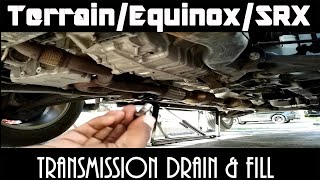
- Failed Transmission Control Module (TCM): → Shop Transmission Assembly The TCM is often implicated because the problematic X1 connector attaches to it. However, the module itself is usually not the point of failure. The TSB specifically points to the external connection. A faulty TCM 🎬 See this walkthrough for a V6 transmission drain and fill is more likely to present with specific shifting codes in addition to communication faults.
Diagnosis Steps
- Scan for all codes in all modules. Note any communication codes (U-codes) or other transmission (P-codes) and chassis (C-codes) that are present, especially those listed in TSB PIC4740E.
- Prioritize diagnosis based on TSB #PIC4740E. Locate the large, round transmission X1 connector on the driver's side of the transmission housing.
- Disconnect the battery.
- Disconnect the X1 connector and meticulously inspect both halves for any signs of green/white corrosion, moisture, or bent/backed-out pins.
- As per the TSB, gently pull on each individual wire going into the connector to ensure the terminal is securely locked in place.
- If corrosion is found, clean the terminals using a dedicated electrical contact cleaner and a small brush. Ensure all terminals are dry.
- Apply a thin layer of dielectric grease to the connector seal to prevent future moisture intrusion.
- Reconnect the connector, ensuring it clicks and is fully seated.
- Locate and inspect the main chassis grounds for the EBCM, often found on the frame rail below the driver's side front door. Disassemble, clean to bare metal, and re-secure the connection.
- Reconnect the battery, clear all codes, and perform a test drive to see if the code returns.
- If the code persists, the wiring between the modules must be tested for continuity and shorts. Only after confirming the wiring is intact should module replacement be considered.
Parts You'll Likely Need
- Electrical Contact Cleaner — Needed to clean corrosion from the transmission X1 connector, which is the most common cause of the fault.
Trusted brands: CRC, WD-40 Specialist
Aftermarket price range: $5-$15 - Dielectric Grease — Applied to the cleaned connector to seal it from moisture and prevent the problem from recurring.
Trusted brands: Permatex, ACDelco
Aftermarket price range: $5-$10 - Transmission Connector Terminal
(OEM #Consult dealer with VIN; terminal repair kits are available.)— If a pin in the X1 connector is corroded beyond cleaning or is backed out and won't lock, the individual terminal must be replaced. GM offers terminal repair kits.
Trusted brands: ACDelco
OEM price range: $10-$40 per terminal
Related Codes That Often Appear With This One
- U0073 — Control Module Communication Bus 'A' Off. This code directly indicates a network communication failure, which is the root cause described in TSB #PIC4740E.
- U0100 — Lost Communication With ECM/PCM. This often appears with P0856 when the X1 connector issue is present, disrupting communication across the network.
- U0121 — Lost Communication With Anti-Lock Brake System (ABS) Control Module. This points to a communication breakdown with the EBCM, which is directly related to the P0856 fault.
- P0700 — Transmission Control System (TCS) Malfunction. This is a general code indicating the TCM has stored a fault. It frequently accompanies P0856 due to the shared communication lines and the problematic X1 connector.
- P2544 — Transmission Torque Request Circuit. This code is also explicitly mentioned in TSB #PIC4740E and is directly related to the same communication fault as P0856.
Technical Service Bulletins (TSBs) & Recalls
- PIC4740E: Addresses a condition of no communication or multiple communication DTCs (including P0856, P0700, P2544, U0073, U0100, U0121) being set. It points to unseated pins or corrosion in the transmission X1 connector as the primary cause for SRX, STS, CTS, and ATS models.
Platform-Specific Known Issues
- GM Technical Service Bulletin #PIC4740E explicitly identifies an issue with the transmission X1 connector.
Mechanic-Grade Diagnostic Values
- High-Speed GMLAN Bus Resistance — expected: 60 Ohms (± 5 Ohms). Failure: A reading of ~120 Ohms indicates an open in the circuit or one of the two terminating resistors has failed. A reading significantly less than 60 Ohms indicates a short between the CAN High and Low wires.
- High-Speed GMLAN High (CAN+) Voltage — expected: ~2.6 Volts (Key On, Engine Off). Failure: Voltage significantly different from 2.6V, or no voltage, indicates a circuit fault.
- High-Speed GMLAN Low (CAN-) Voltage — expected: ~2.3 Volts (Key On, Engine Off). Failure: Voltage significantly different from 2.3V, or no voltage, indicates a circuit fault.
- EBCM Power Supply — expected: 12V+ at the module's power pin. Failure: Voltage below 11V suggests a power supply issue that can cause communication codes like U0121, which is often seen with P0856.
Scan Tool Commands That Help
- Tech 2 / GDS2: Module Communication Status — When P0856 is present with multiple U-codes, this function allows a technician to see which modules are actively communicating on the CAN bus. This helps isolate whether the EBCM, TCM, or another module is offline, guiding the diagnostic path toward the point of failure (like the X1 connector).
- Tech 2 / GDS2: Clear All DTCs — After performing a physical repair like cleaning the X1 connector or a ground point, a full system clear is necessary. Some modules may hold onto communication history, and a global clear ensures all systems re-establish communication and allows for a clean test drive to verify the fix.
Wiring & Ground Locations
- X1 Connector — On the driver's side of the transmission housing. It is a large, round, multi-pin connector.. This is the primary failure point identified in TSB PIC4740E for P0856 and related communication codes. Poor connections here directly interrupt signals between the TCM, ECM, and EBCM.
- EBCM (Electronic Brake Control Module) — At the front left side of the engine bay, attached to the ABS hydraulic unit. On some SRX models, it may be necessary to remove the washer solvent container bracket or wheelhouse liner for access.. The P0856 code is a fault related to the signal from this module. While the module itself is rarely the cause, its wiring and ground connections are critical to check.
- G100 / G106 — Engine grounds. G100 is on the right rear of the engine on the cylinder head. G106 is on the top right side of the engine manifold block.. Poor engine grounds can introduce electrical noise and voltage drops, disrupting communication between modules like the ECM and TCM, which can contribute to network instability and codes like P0856.
- DLC (Data Link Connector) Pins 6 & 14 — Inside the vehicle, typically under the driver's side dashboard.. These are the terminals for the High-Speed GMLAN network. All diagnostic resistance and voltage measurements for the CAN bus are taken from these two pins.
Real Owner Repair Stories
- cadillacforums.com user discussion (2007 Cadillac SRX) — Check engine light, traction control light, Stabilitrak light on. Codes U0100, U0121, U0140, P0700, and P0856 present.
❌ Tried (didn't work) Initial diagnosis pointed towards multiple module failures, which was incorrect.
✅ What actually fixed it The user was directed to TSB PIC4740E. The problem was traced to the transmission harness connector (X1). After disconnecting, cleaning the pins, applying dielectric grease, and reconnecting, all codes were cleared and did not return. This confirms the TSB as the correct fix for this exact cluster of codes.
Helpful Videos
We Have This Part in Stock


The information in this article is provided for general reference and educational purposes only. Vehicle specifications, procedures, and part compatibility can vary by production date, trim level, and region. Always consult your vehicle's factory service manual and verify part numbers before purchasing or performing repairs. Safety-critical components such as airbags, seat belts, and braking systems should be installed by a qualified professional.
- Cadillac SRX:
- 🧭 Diagnostic Flowchart
- 🎬 Helpful Videos
- 🛍️ Shop This Part
- What's Unique About the 2007-2009 Cadillac SRX
- Symptoms You May Notice
- Most Likely Causes
- Rare But Worth Checking
- Diagnosis Steps
- Parts You'll Likely Need
- Related Codes That Often Appear With This One
- Technical Service Bulletins (TSBs) & Recalls
- Platform-Specific Known Issues
- Mechanic-Grade Diagnostic Values
- Scan Tool Commands That Help
- Wiring & Ground Locations
- Real Owner Repair Stories
- 🎟️ Get 5% Off