

P0869 on 2013 Ram 2500: Transmission Line Pressure High Causes and Fixes
For a 2013 Ram 2500 with the 68RFE transmission, code P0869 almost always points to a failing transmission line pressure sensor. This sensor gives faulty high-pressure readings, often maxing out at 252 psi on a cold start, causing harsh shifting and forcing the truck into limp mode. Replacing the sensor, which is located inside the transmission oil pan, is the most common and effective fix.
- P0869 means the transmission line pressure is too high, which is a serious issue that can cause drivability problems and damage the transmission if ignored.
- The most likely cause on a 2013 Ram 2500 is a faulty transmission line pressure sensor, located inside the oil pan on the valve body.
- Symptoms include harsh shifting, the truck going into 'limp mode', and the Check Engine Light.
- Diagnosis should involve checking live data with a capable scan tool to see if the pressure sensor is reporting irrationally high values, especially when the vehicle is first started.
- While a DIY fix is possible for experienced individuals, it is rated as difficult due to the need for special tools and work inside the transmission. Professional service is recommended.
What's Unique About the 2013-2013 Ram 2500
The 2013 Ram 2500, particularly with the 6.7L Cummins engine, uses the 68RFE automatic transmission. This transmission is known for electronic issues, and P0869 is a very common fault. The problem is frequently traced back to the transmission's line pressure sensor rather than a major mechanical failure. In fact, several Technical Service Bulletins (TSBs) from Ram list P0869, often alongside P0933 (Hydraulic Pressure Sensor Range/Performance), indicating it's a recognized pattern failure. The fix for these TSBs often involves a PCM software update to change the fault sensitivity, but a faulty sensor remains the primary hardware cause.
Diagnostic Flowchart
Tap your situation to follow the diagnostic path that matches what you're seeing on this vehicle.
Symptoms You May Notice
- Harsh, abrupt, or jarring gear shifts.
- Vehicle entering 'limp mode', often stuck in a single gear (typically 4th).
- Check Engine Light or Transmission Warning Light is on.
- Delayed engagement when shifting into Drive or Reverse.
- Erratic shifting behavior, sometimes corrected by engaging Tow/Haul mode.
- Transmission overheating, potentially with a burning smell from the fluid.
- Buzzing noise from the transmission area when in Park or Neutral, which can indicate the main regulator valve is maxed out due to limp mode.
- Replacing the entire transmission when only a sensor is at fault.
- Replacing the solenoid pack ($300+) when the much cheaper line pressure sensor ($100) was the actual problem.
- Assuming low transmission fluid is the cause; while low fluid causes many issues, P0869 specifically points to *high* pressure.
- Replacing the valve body when the issue is purely electronic (sensor or solenoid).
Most Likely Causes
- Faulty Transmission Line Pressure Sensor 🔴 High Probability → Shop Transmission Assembly This is the most widely reported failure for P0869 on the 68RFE transmission. Forum discussions and mechanic reports consistently identify this sensor as the primary culprit, often failing by sending a false, maxed-out pressure reading.
How to confirm: Use a scan tool (like AlfaOBD or a professional Snap-On scanner) to monitor live transmission data. A classic symptom is observing the 'Actual Line Pressure' reading stuck at a high value like 252 psi immediately upon a cold start, while 'Desired Line Pressure' is much lower. If the sensor's reading is erratic or doesn't match a mechanical pressure gauge, it's faulty.
Typical fix: Replace the line pressure sensor (transducer). This requires draining the transmission fluid, removing the oil pan, and then removing the valve body to access the sensor. It is often recommended to replace the transmission filters at the same time.
Est. part cost: $70-$200 - Sticking Pressure Control Solenoid (PCS) 🟡 Medium Probability → Shop Transmission Clutch Pressure Control Solenoid The solenoid, part of the larger solenoid pack, regulates pressure. If it gets stuck due to debris or internal failure, it can fail to lower the pressure as commanded by the PCM. This is a common misdiagnosis for a bad sensor, leading to unnecessary replacement.
How to confirm: Diagnosis involves using an advanced scan tool to monitor the Pressure Control Solenoid duty cycle while observing line pressure. If the duty cycle is at its maximum (around 38-62%, commanding low pressure) but the actual pressure remains high (and is verified by a mechanical gauge), the solenoid is likely stuck.
Typical fix: Replace the entire transmission solenoid/TRS assembly (solenoid pack). This part is mounted to the valve body inside the transmission.
Est. part cost: $300-$600 - Internal Valve Body Issue ⚪ Low Probability → Shop Transmission Valve Body The aluminum valve body bores can wear over time, causing valves (like the solenoid switch valve or pressure regulator valve) to stick. This wear can lead to cross-leaks or an inability to regulate pressure correctly. This is more common on higher-mileage trucks (over 80,000 miles).
How to confirm: This is diagnosed after ruling out the sensor and solenoid pack. It requires removing and inspecting the valve body for worn bores, stuck valves, or loose accumulator plates.
Typical fix: Repair the valve body with an oversized valve kit, or replace it entirely, often with an upgraded aftermarket unit from brands like Sonnax or RevMax.
Est. part cost: $500-$1200 for a replacement, less for a rebuild kit. - Wiring or Connector Issue ⚪ Low Probability
How to confirm: Visually inspect the main transmission wiring harness and the large round connector for damage, corrosion, or fluid intrusion. Check for proper pin tension ('pin drag') on the terminals related to the line pressure sensor and solenoid, as repeated connections can cause them to loosen. Corrosion inside the line pressure sensor connector, sometimes hidden under a yellow cap, is a known issue.
Typical fix: Repair the damaged wiring or clean/replace the faulty connector. Applying dielectric grease can help prevent future corrosion.
Est. part cost: $20-$150
Rare But Worth Checking
- Faulty Powertrain Control Module (PCM): This is a very rare cause. Before suspecting the PCM, all other possibilities must be exhaustively ruled out. Sometimes, a PCM software update (flash) as described in TSBs #18-091-16 or #18-043-17 can resolve the issue by changing how the PCM interprets sensor data. A true hardware failure of the PCM is unlikely.
Diagnosis Steps
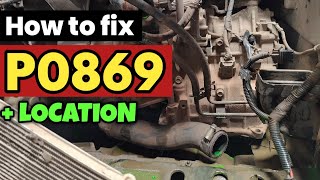
- Connect an OBD-II scanner and confirm P0869 is present. 🎬 Watch: A quick overview of the P0869 code and symptoms. Note any other codes, especially P0933, P0934, or P0935.
- Check the transmission fluid level and condition. Ensure it is at the correct level and does not smell burnt. Overfilling can cause high pressure.
- Use a scan tool capable of reading live transmission data (e.g., AlfaOBD, Snap-On). Monitor 'Actual Line Pressure' and 'Desired Line Pressure'.
- Observe the pressure reading on a cold start. If 'Actual Line Pressure' immediately reads a static high number (like 252 psi) while 'Desired' is low (e.g., ~70-100 psi), the line pressure sensor is almost certainly faulty.
- If the readings seem plausible, compare the scan tool's pressure reading to a mechanical pressure gauge connected to a test port on the transmission to verify the sensor's accuracy. The scan tool reading should match the gauge within ±10 psi.
- Inspect the main round transmission electrical connector and harness for corrosion, bent pins, or fluid wicking up the harness. Pay special attention to the line pressure sensor connector itself, checking for hidden corrosion under the cap.
- If the sensor is confirmed to be sending inaccurate high readings, the fix is to replace the line pressure sensor.
- If the sensor is accurate and pressure is genuinely high, investigate the pressure control solenoid (PCS) duty cycle. If the PCM is commanding maximum duty cycle (to lower pressure) and it remains high, suspect a stuck solenoid or a mechanical issue in the valve body.
Parts You'll Likely Need
- Transmission Line Pressure Sensor
(OEM #4799758AF (replaces 4799758AD))— This sensor is the most frequent failure point for code P0869 on the 68RFE transmission. It directly measures the pressure that is being reported as too high and is known to fail by sending false high readings.
Trusted brands: Mopar, Dorman (601-215), ATS Diesel (3030022326)
OEM price range: $100-$200
Aftermarket price range: $50-$120 - Transmission Solenoid Pack Assembly
(OEM #68002342AD)
Related Codes That Often Appear With This One
- P0933 — Stands for 'Hydraulic Pressure Sensor Range/Performance'. This code is almost always seen with P0869 because they both point to a fault in the same line pressure sensor circuit. P0933 indicates the sensor's signal is irrational or out of its expected electrical range, while P0869 indicates the pressure value it's reporting is too high.
- P0934 — 'Line Pressure Sensor Circuit Low'. This indicates a specific electrical fault (low voltage) in the sensor's circuit, which can accompany the general high-pressure reading.
- P0935 — 'Line Pressure Sensor Circuit High'. This indicates a specific electrical fault (high voltage) in the sensor's circuit and often appears with P0933 if the sensor fails in a high-voltage state.
- P0871 — 'OD Pressure Switch Rationality'. High line pressure can affect the operation of other hydraulic circuits and pressure switches, causing rationality codes for other gear circuits like Overdrive.
Technical Service Bulletins (TSBs) & Recalls
- 18-091-16: Flash: Powertrain Diagnostic And System Improvements. Lists P0869 as a code whose fault-setting logic can be updated by a PCM software flash.
- 18-057-15 REV A: Predecessor to the above TSB, also listing P0869 as part of a software update.
- 18-030-14 REV. B: An earlier TSB also related to PCM software updates for a group of transmission codes including P0869.
Platform-Specific Known Issues
- TSB #18-091-16: This bulletin from July 2016 involves reprogramming the PCM with updated software. It addresses a condition where a Malfunction Indicator Lamp (MIL) may illuminate for P0869 and a host of other transmission codes. The software update changes the sensitivity for setting the fault, making it a 'two-trip' fault instead of a 'one-trip' fault, which can prevent the light from coming on due to brief, intermittent spikes. However, it does not fix an underlying hardware failure like a bad sensor.
- TSB #18-043-17: Superseding previous bulletins, this TSB from May 2017 also involves a PCM flash for powertrain diagnostic and system improvements on the 6.7L diesel, which can affect how transmission codes are managed.
- Weak Stock Transmission: The 68RFE is generally considered a weak point when the 6.7L Cummins engine's power is increased or when used for heavy towing. The stock components, including the valve body and torque converter, struggle to handle the stress, which can exacerbate pressure regulation issues.
Mechanic-Grade Diagnostic Values
- Pressure Control Solenoid (PCS) Resistance — expected: ~4.9 Ohms. Failure: Significant deviation from 4.9 Ohms indicates a faulty solenoid coil.
- Other Shift Solenoids Resistance (UD, OD, 2C, 4C, etc.) — expected: ~1.3 Ohms. Failure: Significant deviation from 1.3 Ohms indicates a fault in that specific solenoid.
- Pressure Control Solenoid (PCS) Duty Cycle — expected: Varies from ~5% (max pressure) to ~62% (min pressure).. Failure: If the duty cycle is near its maximum (~62%) to command low pressure, but actual pressure remains high, it points to a mechanical or hydraulic blockage, not a control issue.
- Line Pressure Sensor Voltage (for P0934/P0935) — expected: Varies with pressure, typically between 0.35V and 4.75V.. Failure: Voltage below 0.35V triggers P0934 (Circuit Low). Voltage above 4.75V triggers P0935 (Circuit High).
- Line Pressure Sensor Reading (Key On, Engine Off) — expected: ~30 psi. Failure: A reading significantly different from 30 psi with the engine off suggests a faulty sensor or circuit issue.
Scan Tool Commands That Help
- wiTECH or equivalent (e.g., AlfaOBD): Quick Learn — This procedure must be performed after replacing the valve body, solenoid pack, or rebuilding the transmission to allow the TCM to recalibrate clutch volume indexes (CVIs) and ensure proper shift quality.
- wiTECH or equivalent (e.g., AlfaOBD): EMCC Reset/Relearn — This function resets the learning for the torque converter clutch and should be performed after major transmission work or when addressing torque converter related issues.
Wiring & Ground Locations
- Line Pressure Sensor Connector — On the passenger side of the transmission case, connecting directly to the line pressure sensor.. This connector is a known point of failure. Corrosion can build up inside the connector, sometimes hidden under a yellow protective cap, causing erratic or false high-pressure readings that trigger P0869 and P0933.
- Transmission Solenoid / TRS Assembly Connector — The main round electrical connector on the transmission case that provides the connection for the entire solenoid pack and internal harness.. A poor connection, fluid intrusion, or damaged pins at this main connector can disrupt the signals for the pressure control solenoid and the line pressure sensor, leading to P0869 and other related codes. Pin 12 is the Pressure Control Solenoid Control circuit.
- Transmission Control Module (TCM) — For the 6.7L Diesel, the TCM is housed in the New Generation Controller (NGC) located at the rear of the engine compartment, near the right (passenger side) inner fender.. This is the module that receives the signal from the line pressure sensor and controls the pressure control solenoid. All wiring for these components terminates here.
Real Owner Repair Stories
- Turbo Diesel Register forum user (2008 Ram 3500 with 68RFE) — Slipping, going into limp mode (1st-4th gear only). Constantly throwing P0871 and occasionally P0934 (Line Pressure issue).
❌ Tried (didn't work) Complete transmission rebuild., Replacing the solenoid pack twice., Replacing the line pressure sensor twice., Checking electrical connectors twice.
✅ What actually fixed it The issue was suspected to be a worn Solenoid Switch Valve (SSV) bore in the main valve body, which was not replaced during the initial rebuild. The final fix required replacing the entire valve body. - Reddit user (2013 Ram 1500 with 65RFE (similar architecture)) — Check Engine Light with code P0869.
❌ Tried (didn't work) Replacing the solenoid pack and performing a transmission service., Replacing the transmission pressure sensor.
✅ What actually fixed it The user was still diagnosing the issue after replacing the most common parts. The dealership's next step was to recommend a valve body replacement, indicating the problem was likely a mechanical/hydraulic issue within the valve body itself, not the electronic components that had already been replaced.
OEM Part Supersession History
4799758, 4799758AC, 4799758AD→4799758AF— Standard part revision and improvement by the manufacturer.
Heads up: Aftermarket sensors are noted by some transmission specialists to be prone to failure or inaccurate readings; using the genuine Mopar OEM part is often recommended for reliability.
Helpful Videos
We Have This Part in Stock

The information in this article is provided for general reference and educational purposes only. Vehicle specifications, procedures, and part compatibility can vary by production date, trim level, and region. Always consult your vehicle's factory service manual and verify part numbers before purchasing or performing repairs. Safety-critical components such as airbags, seat belts, and braking systems should be installed by a qualified professional.
- Ram 2500:
- 🧭 Diagnostic Flowchart
- 🎬 Helpful Videos
- 🛍️ Shop This Part
- What's Unique About the 2013-2013 Ram 2500
- Symptoms You May Notice
- Most Likely Causes
- Rare But Worth Checking
- Diagnosis Steps
- Parts You'll Likely Need
- Related Codes That Often Appear With This One
- Technical Service Bulletins (TSBs) & Recalls
- Platform-Specific Known Issues
- Mechanic-Grade Diagnostic Values
- Scan Tool Commands That Help
- Wiring & Ground Locations
- Real Owner Repair Stories
- OEM Part Supersession History
- 🎟️ Get 5% Off