

P0872 on 2016-2021 Mazda CX-3: Transmission Pressure Switch 'C' Circuit Low Causes and Fixes
This code on a Mazda CX-3 almost always points to an internal transmission issue, specifically a stuck oil pressure switch within the control valve body of the FW6A-EL transmission. This is a known issue covered by Mazda TSBs. The fix typically involves replacing the entire control valve body assembly, which is a complex and costly repair, though in some cases a TCM reprogram is the first step.
- P0872 on a 2016-2021 Mazda CX-3 is not a simple sensor failure; it's a symptom of a known internal transmission problem.
- Look for a cluster of codes: P0872 is rarely alone and is often joined by P0842, P0847, P0877, and P0780.
- The most common and manufacturer-recommended fix is the replacement of the transmission's control valve body.
- This is not a DIY-friendly repair. It is complex, expensive, and requires professional service.
- Always check transmission fluid level and condition first, but be prepared for the valve body to be the ultimate cause.
What's Unique About the 2016-2021 Mazda CX-3
The 2016-2021 Mazda CX-3, along with other models using the Skyactiv-Drive 6-speed automatic transmission (FW6A-EL), is subject to a well-documented issue outlined in multiple Technical Service Bulletins (TSBs). The problem isn't usually an isolated failure of a single sensor, but rather contamination within the transmission's control valve body that causes one or more internal oil pressure switches to get stuck. This is why P0872 is frequently seen with a cluster of other pressure switch and gear ratio codes, pointing to a systemic internal fault rather than a simple sensor failure.
Diagnostic Flowchart
Tap your situation to follow the diagnostic path that matches what you're seeing on this vehicle.
Symptoms You May Notice
- Check Engine Light is on
- Automatic Transaxle (AT) warning light is on
- Harsh or erratic shifting
- Transmission slipping or failing to engage gears
- Vehicle stuck in 'limp mode' (a single gear)
- Manual shift mode may be disabled
- Delayed engagement when shifting from Neutral to Drive
- Replacing only a single pressure sensor. The sensors are typically integrated into the valve body and are not sold separately. The issue is often contamination affecting the whole unit, not just one component.
- Performing a transmission flush. Mazda specifically warns against flushing for this transmission; only a drain-and-fill is recommended. A flush could potentially dislodge more debris and worsen the problem.
Most Likely Causes
- Faulty Control Valve Body / Stuck Oil Pressure Switch 🔴 High Probability → Shop Engine Oil Pressure Switch Mazda TSBs #05-002-23 and #0500215 directly state this issue is caused by contamination entering a passage and causing oil pressure switches within the control valve body to stick. This is a known pattern failure for this transmission across multiple Mazda models.
How to confirm: Diagnosis is typically confirmed when P0872 appears alongside other related codes (P0842, P0847, P0877, P0780, P1738). A diagnostic scan showing this pattern strongly points to the valve body as per the TSB.
Typical fix: Replace the entire control valve body assembly. In some earlier or different models, a TCM software update was the first step, but for this vehicle and code set, replacement is the common and prescribed repair.
Est. part cost: $800-$1500 - Low or Contaminated Transmission Fluid 🟡 Medium Probability → Shop Transmission Assembly While Mazda calls the ATF-FZ fluid 'lifetime,' it can degrade from heat cycles or become contaminated with wear particles. This contamination is the very cause of the sticking pressure switches mentioned in the TSBs. Low fluid levels can also cause erratic pressure and shifting issues.
How to confirm: Check the transmission fluid level and condition. The fluid should be blue (Mazda ATF-FZ) and not smell burnt. This is a crucial first step, though a fluid change alone may not free a badly stuck switch.
Typical fix: Perform a transmission fluid drain-and-fill with genuine Mazda ATF-FZ. If a leak is present, the source must be repaired first. This is often attempted before a valve body replacement but may not be a permanent solution.
Est. part cost: $100-$250 for fluid - Wiring Harness Issue ⚪ Low Probability
How to confirm: Visually inspect the external wiring harness leading to the transmission for any signs of chafing, corrosion, or damage. A more thorough check would involve testing for continuity at the TCM connector, but this is less likely as the problematic components are internal to the transmission.
Typical fix: Repair or replace the damaged section of the wiring harness.
Est. part cost: $50-$300
Rare But Worth Checking
- Failed Transmission Control Module (TCM): → Shop Transmission Assembly On these Mazda models, the TCM is integrated with the control valve body and is not a separate unit. A failure of the TCM electronics would necessitate replacing the entire valve body assembly. A standalone TCM failure causing just this one code is very rare.
Diagnosis Steps
- Check the transmission fluid level and condition. The fluid must be the correct Mazda ATF-FZ (blue). If low, top it off and check for leaks. If dark or burnt, a fluid change is warranted, but the underlying issue may persist.
- Use an OBD-II scanner to check for other stored trouble codes. The presence of codes like P0842, P0847, P0877, and P0780 is a strong indicator of the known TSB issue.
- Consult Mazda TSB #05-002-23. The diagnostic path for this specific cluster of codes points directly toward a problem with the control valve body.
- Inspect the transmission's external wiring harness and connectors for any visible damage, corrosion, or loose connections.
- If other codes are not present and the fluid is fine, a technician may use a high-end scan tool to monitor live data from the transmission pressure switches to confirm if switch 'C' is electrically stuck.
- Given the known issues and TSBs, the most likely diagnostic conclusion is the need to replace the control valve body assembly.
Parts You'll Likely Need
- Control Valve Body Assembly
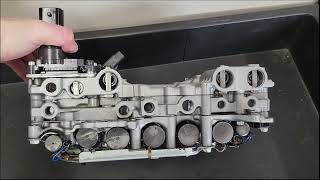
(OEM #FZ01-21-200 (Casting # FZ01 or FZA1, verify with VIN))— This assembly contains the oil pressure switches that are known to fail due to contamination, as documented in Mazda TSBs. The switches are not serviced individually, and the assembly includes the integrated TCM.
Trusted brands: Mazda (OEM)
OEM price range: $1200-$1800
Aftermarket price range: $350-$700 (Remanufactured) - Automatic Transmission Fluid (ATF)
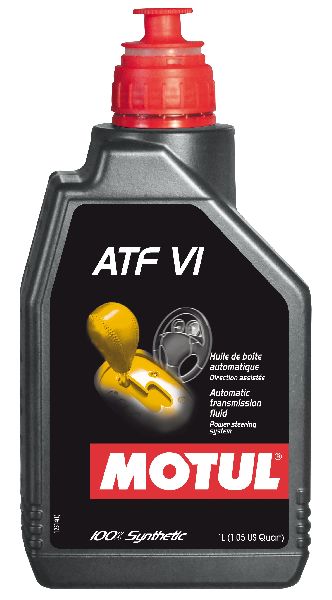
(OEM #0000-FZ-113E-01)— The fluid must be drained to replace the valve body and should be replaced with new, correct-specification fluid (Mazda ATF FZ, which is blue). Approximately 4-5 quarts are needed for a drain and fill.
Trusted brands: Mazda, Idemitsu (OEM supplier), Ravenol
OEM price range: $20-$30 per quart
Aftermarket price range: $15-$25 per quart
Related Codes That Often Appear With This One
- P0842 — Relates to Oil Pressure Switch No. 1 ('B') being stuck on. Often appears as part of the same valve body failure.
- P0847 — Relates to Oil Pressure Switch No. 2 ('A') being stuck on. Often appears as part of the same valve body failure.
- P0877 — Relates to Oil Pressure Switch No. 4 ('B') being stuck on. Often appears as part of the same valve body failure.
- P0780 — Indicates a general gear shifting malfunction, which is a direct symptom of the pressure switches failing.
- P1738 — A manufacturer-specific code for an automatic transaxle internal malfunction, often triggered by the same valve body issue.
Technical Service Bulletins (TSBs) & Recalls
- 05-002-23: Check Engine light and A/T Warning light on with one or more of these DTCs (P0842, P0847, P0872, P0877, P0780, P1738) Stored in TCM Memory.
- 0500215: Check Engine light and A/T Warning light on with one or more of these DTCs (P0842, P0847, P0872, P0877, P0780, P1738) Stored in TCM Memory.
- 05-005/14: An earlier TSB that also details the pressure switch failure due to contamination and lists the same group of DTCs.
Platform-Specific Known Issues
- A known issue documented in TSB #05-002-23 and earlier bulletins affects 2016-2021 CX-3 models. It describes how contamination in the control valve body can cause oil pressure switches to stick, triggering P0872 and other related codes. The official repair often involves replacing the control valve body and then performing an 'Initial Learning Procedure' with a Mazda diagnostic tool.
Mechanic-Grade Diagnostic Values
- Continuity check on wiring between TCM and transmission connector for pressure switch 'C' (TPS1) — expected: Below 1 Ω. Failure: A reading higher than 1 Ω indicates excessive resistance in the harness.
- Resistance to ground on pressure switch 'C' (TPS1) circuit wiring — expected: 10 kΩ or higher. Failure: A reading lower than 10 kΩ indicates a short to ground in the harness.
- Resistance of Pressure Control Solenoid (Main Line) — expected: 5-7 ohms. Failure: A reading outside this range indicates a faulty solenoid coil.
- Resistance of On/Off Solenoid (Shift Valves) — expected: 11-14 ohms. Failure: A reading outside this range indicates a faulty solenoid coil.
Hidden / Shadow Codes Worth Checking
- P1738: Manufacturer-specific code for 'Automatic Transaxle Internal Malfunction'. Its presence alongside P0872 strongly reinforces the diagnosis of an internal valve body failure, as noted in Mazda's diagnostic procedures. (see via Standard OBD-II scanner with manufacturer-specific code reading capability.)
Scan Tool Commands That Help
- Mazda M-MDS (or equivalent high-end scanner): Initial Learning Procedure — This procedure is mandatory after replacing the control valve body or oil pressure switches. It allows the TCM to learn the hydraulic characteristics of the new components to ensure proper shift quality. Failure to perform this can result in harsh shifting and new DTCs.
- Mazda M-MDS (or equivalent high-end scanner): Active Test: Control the Shift Position — Used during diagnosis to manually command gear shifts while monitoring the live data PID for the pressure switch (e.g., 'TPS 1 Switch'). This can confirm if the switch is electrically stuck on or off, independent of actual hydraulic pressure.
- Manual Procedure (No Scan Tool): Manual Initial Learning Mode Activation — As a non-dealer alternative to force the transmission into a learning state. The procedure involves a specific sequence of shifting the lever and pressing the start button with the brake applied to erase learned values and begin a new learning cycle.
Wiring & Ground Locations
- TCM Connector Pin F72-9 (TPS1) — At the Transmission Control Module (TCM), which is integrated into the control valve body inside the transmission oil pan.. This is the specific pin at the TCM that receives the signal from the No. 3 oil pressure switch. Testing for continuity between this pin and the transmission harness connector is a key diagnostic step.
- Transmission Wire Connector F73-17 (TPS1) — The main electrical connector on the outside of the transmission case that connects the internal transmission harness to the main vehicle harness.. This is the external test point for the No. 3 oil pressure switch circuit before it enters the main vehicle harness to the TCM.
- Main Transmission Ground — A primary ground cable runs from the negative battery terminal to a bracket on top of the transmission case.. While not specific to this DTC, a poor main ground for the transmission can cause a wide range of erratic electronic behaviors and shifting issues. Ensuring this connection is clean and tight is a fundamental check.
Real Owner Repair Stories
- Reddit user on r/mazda3 (2017 Mazda 3, 115,000 miles) — Hard shifting, kicking during downshifts.
❌ Tried (didn't work) A transmission shop was hesitant to rebuild the valve body, claiming parts were hard to find, and instead quoted $3500 for a used transmission.
✅ What actually fixed it A professional technician in the thread clarified that the correct repair is to replace the entire valve body/TCM mechatronic unit from Mazda. The solenoids are factory-calibrated to the specific TCM, which is why individual component replacement is not recommended and why shops may opt for a full transmission swap if they are not equipped for the proper valve body replacement and relearn procedure. - Reddit user on r/mazda3 (2015 Mazda 3 iSport) — No communication with the internal TCM after a PCM replacement.
❌ Tried (didn't work) Replacing the PCM did not resolve the communication issue with the transmission.
✅ What actually fixed it The dealer diagnosed a faulty valve body, which contains the integrated TCM. The final fix was the replacement of the valve body assembly. The dealer quoted approximately $1800 ($1300 for the OEM part FZ21-21-100J, $500 for labor). - Reddit user on r/mazda3 (2016 Mazda 3 2.0L) — Needed to replace the entire transmission.
✅ What actually fixed it The user replaced the transmission with a used unit from another Mazda 3. After the physical replacement, they drove the car to bring the fluid to temperature and then performed a manual reinitialization procedure. This worked successfully without requiring a dealer-level scan tool to flash the system, confirming the viability of the manual relearn process when using a compatible used part.
OEM Part Supersession History
FZ01-21-200→FZ21-21-100J, WTY238740A— These part numbers all refer to the FW6A-EL valve body assembly (mechatronic unit). Variations may exist based on model year or specific application, but they are often used interchangeably in listings for remanufactured units. Always verify the correct part number with the vehicle's VIN.
Heads up: While physically similar, using a valve body from a different engine size (e.g., 2.0L vs 2.5L) or a significantly different model year without proper verification and potential reprogramming can lead to shift quality issues.
Model Year Variations Within This Range
- 2013-2015 (Primarily): Early TSBs for this issue sometimes listed TCM reprogramming with an updated calibration file as the first step before parts replacement. Later bulletins and field experience for the 2016+ models more commonly point directly to replacing the control valve body, suggesting that the software fix was not always sufficient and that hardware improvements were made in later production.
Helpful Videos
We Have This Part in Stock


The information in this article is provided for general reference and educational purposes only. Vehicle specifications, procedures, and part compatibility can vary by production date, trim level, and region. Always consult your vehicle's factory service manual and verify part numbers before purchasing or performing repairs. Safety-critical components such as airbags, seat belts, and braking systems should be installed by a qualified professional.
- Mazda CX-3:
- 🧭 Diagnostic Flowchart
- 🎬 Helpful Videos
- 🛍️ Shop This Part
- What's Unique About the 2016-2021 Mazda CX-3
- Symptoms You May Notice
- Most Likely Causes
- Rare But Worth Checking
- Diagnosis Steps
- Parts You'll Likely Need
- Related Codes That Often Appear With This One
- Technical Service Bulletins (TSBs) & Recalls
- Platform-Specific Known Issues
- Mechanic-Grade Diagnostic Values
- Hidden / Shadow Codes Worth Checking
- Scan Tool Commands That Help
- Wiring & Ground Locations
- Real Owner Repair Stories
- OEM Part Supersession History
- Model Year Variations Within This Range
- 🎟️ Get 5% Off