

P0935 on 2009-2010 Dodge Dakota: Line Pressure Sensor Circuit High Causes and Fixes
On a 2009-2010 Dodge Dakota, code P0935 indicates the transmission line pressure sensor circuit is reading a voltage that is too high. This is most often caused by a failed line pressure sensor, which is located externally on the passenger side of the transmission. Expect harsh shifting and possible limp mode until fixed.
- P0935 on a 2009-2010 Dakota means the transmission line pressure sensor circuit has an abnormally high voltage reading, typically at or near 5 volts.
- The most likely cause is a failed line pressure sensor, which is located externally on the passenger side of the 45RFE/545RFE transmission.
- Symptoms include harsh, banging shifts and the transmission possibly entering a protective "limp mode."
- Driving with this code is not recommended as it can cause excessive wear and damage to internal transmission components.
- Diagnosis involves checking the sensor's voltage, inspecting its wiring for damage, and replacing the sensor if it's leaking or internally shorted. Always check battery health first, as low system voltage can trigger false codes.
What's Unique About the 2009-2010 Dodge DAKOTA
The 2009-2010 Dodge Dakota is typically equipped with a 45RFE or 545RFE transmission. On these RFE transmissions, the P0935 code is specifically called out in Technical Service Bulletin #18-093-15. Unlike some other vehicles where the sensor is internal and requires removing the valve body, the line pressure sensor on these transmissions is an external component. It is located on the passenger side, near the rear of the transmission, and is often protected by a small heat shield, making it more accessible for diagnosis and replacement.
Diagnostic Flowchart
Tap your situation to follow the diagnostic path that matches what you're seeing on this vehicle.
Symptoms You May Notice
- Harsh, delayed, or erratic shifting
- Loud banging noise when shifting into gear or between gears
- Transmission stuck in one gear (limp mode)
- Illuminated Check Engine Light / Malfunction Indicator Lamp (MIL)
- Delayed engagement when shifting from Park to Drive or Reverse
- Decreased fuel efficiency
- Replacing the entire valve body or solenoid pack when only the external sensor is at fault.
- Condemning the transmission for an internal failure when it is an external electrical issue.
- Replacing the PCM before thoroughly testing the sensor and wiring harness for shorts.
Most Likely Causes
- Failed Line Pressure Sensor 🔴 High Probability The sensor is exposed to heat from the nearby exhaust, which can accelerate failure. It can also develop internal shorts or leak ATF (Automatic Transmission Fluid) through the electrical connector, causing a bad reading.
How to confirm: Visually inspect the sensor for fluid leaks at the connector. Test the sensor's output voltage with a scan tool; a reading at or near 5 volts with the key on indicates a failed sensor. If the sensor is disconnected and the high voltage reading on the scan tool drops, the sensor is confirmed to be the fault.
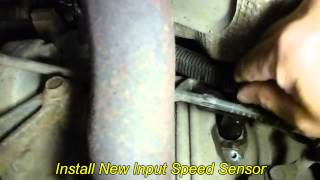
Typical fix: Replace the line pressure sensor and the O-rings. The sensor is located on the passenger side of the transmission, often protected by a heat shield held on by two 15mm nuts. 🎬 Watch: Step-by-step guide to replacing the external line pressure sensor.
Est. part cost: $50-$120 - Wiring or Connector Issue 🟡 Medium Probability The wiring harness is near the hot exhaust and can become brittle, chafed, or melted, leading to a short to voltage. The pins in the connector itself can also become corroded.
How to confirm: Inspect the wiring harness and connector leading to the line pressure sensor for any signs of damage, corrosion, or melting. Check for a short to voltage on the signal wire (typically the T38 circuit) using a multimeter. A voltage reading above 5.5 volts on the signal circuit with the sensor disconnected points to a short.
Typical fix: Repair the damaged section of wiring or replace the connector pigtail. Ensure the repaired harness is properly secured away from the exhaust.
Est. part cost: $15-$40 - Faulty Powertrain Control Module (PCM) ⚪ Low Probability → Shop Engine Control Module (ECM) PCM failure is not common for this specific issue. It is more likely that a low system voltage from a failing battery or alternator could cause multiple, seemingly unrelated codes to appear at once.
How to confirm: This should be the last resort after the sensor and wiring have been definitively ruled out. Advanced diagnostics using a transmission simulator (like Miller tool #8333) are required to confirm the PCM is the source of the high voltage reading.
Typical fix: Replace and reprogram the PCM.
Est. part cost: $400-$800
Diagnosis Steps
- Check for other stored trouble codes with an OBD-II scanner. Note any other codes, especially those related to transmission pressure or system voltage like P0562.
- Check transmission fluid level and condition. While not a direct cause of a 'circuit high' code, it's a fundamental first step.
- Visually inspect the line pressure sensor and its electrical connector on the passenger side of the transmission. Look for ATF leaks, corrosion, or heat damage to the wiring. The sensor is behind a heat shield.
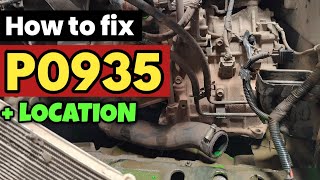
- Using a scan tool with live data, monitor the line pressure sensor voltage with the key on, engine off. A reading at or near 5.0 volts indicates a problem in the circuit or sensor. 🎬 See this video for a breakdown of the P0935 circuit high code.
- Disconnect the sensor's electrical connector. If the voltage reading on the scan tool drops significantly (e.g., to 0V), the sensor has an internal short and is faulty.
- If the voltage remains high with the sensor disconnected, inspect the wiring harness between the sensor and the PCM for a short to voltage. Pay close attention to the signal wire (T38 circuit). A reading above 5.5 volts indicates a short.
- If both the sensor and wiring check out, the issue may be with the Powertrain Control Module (PCM), though this is rare. Professional diagnosis with specialized tools is recommended to confirm.
Parts You'll Likely Need
- Transmission Line Pressure Sensor
(OEM #04799758AF)— This sensor is the most common failure point for code P0935 on this vehicle due to heat exposure and potential for internal electrical faults or fluid leaks.
Trusted brands: Mopar, Standard Motor Products (SMP), Dorman
OEM price range: $80-$120
Aftermarket price range: $50-$90
Related Codes That Often Appear With This One
- P0934 — This code is for 'Line Pressure Sensor Circuit Low.' Seeing both P0934 and P0935 can indicate an intermittent wiring problem or a sensor that is failing erratically.
- P1745 — This is a manufacturer-specific code for 'Transmission Line Pressure Too High,' which is a direct consequence of the condition that sets P0935.
- P0869 — This code for 'Line Pressure High' can be set when the PCM detects that the actual line pressure is higher than desired, a condition that can be caused by the same sensor fault.
- P0700 — This is a generic Transmission Control System Malfunction code that often appears alongside more specific transmission codes like P0935 to indicate a fault has been registered in the TCM.
Technical Service Bulletins (TSBs) & Recalls
- 18-093-15: Flash: MIL Illumination With Transmission And Driveability Improvements. This TSB applies to RFE transmissions and can address the P0935 code, often by reprogramming the PCM with updated software.
Platform-Specific Known Issues
- TSB #18-093-15 mentions that P0935 can be set on all RFE transmissions (like the 45RFE/545RFE in the Dakota) and that attempting to clear the code may be unsuccessful until the underlying fault is repaired. The TSB may also involve a PCM software flash.
- A user on a Reddit forum for Dodge Dakota owners reported a 2005 model with P0935 alongside a cluster of other electrical and transmission codes, including P0562 (System Voltage Low). The community suggested that a failing battery can cause numerous false codes on these trucks, and it should be tested and replaced first before chasing sensor issues.
Mechanic-Grade Diagnostic Values
- Line Pressure Sensor Signal Circuit (T38) to Ground — expected: High resistance (Megaohms). Failure: Voltage reading above 5.5 volts with sensor disconnected indicates a short to voltage.
- Sensor Ground Circuit (K900) Resistance — expected: Below 5.0 ohms. Failure: Resistance above 5.0 ohms indicates an open in the ground circuit.
- Line Pressure Sensor Signal Circuit (T38) Resistance — expected: Below 5.0 ohms (when testing continuity end-to-end). Failure: Resistance above 5.0 ohms indicates an open in the signal circuit.
- Scan Tool vs. Mechanical Gauge Line Pressure — expected: Readings should be within 34 kPa (5 psi) of each other.. Failure: A significant difference points to either a faulty sensor (if scan tool is wrong) or a hydraulic issue (if gauge is wrong).
Scan Tool Commands That Help
- wiTECH / Professional Scan Tool: Transmission Simulator Test (using Miller tool #8333) — To test the PCM and wiring independently of the sensor. The simulator sends known-good pressure signals to the PCM; if the scan tool still shows incorrect readings, the fault is in the wiring or PCM.
- wiTECH: Quick Learn — This procedure should be performed after replacing and programming a new PCM to allow the transmission control system to relearn adaptive values.
Wiring & Ground Locations
- (T38) Line Pressure Sensor Signal — Runs from the external line pressure sensor connector to the PCM harness connector (may be C2 or C4 depending on configuration).. This is the primary wire carrying the voltage signal. A short to voltage on this wire is a common cause of P0935.
- (K900) Sensor Ground — Runs from the line pressure sensor connector to the PCM harness connector to provide a ground reference.. An open or high resistance in the ground circuit can cause the signal voltage to float high, triggering the code.
- Miller tool #8815 — This is a PCM Pinout Box, a special tool that connects between the PCM and its harness connector.. It allows a technician to safely probe the circuits at the PCM without damaging the sensitive connector terminals.
Real Owner Repair Stories
- DodgeForum.com user 'badblackram06' (Dodge Ram with 545RFE transmission) — Check Engine Light with codes P2704 and P0935.
❌ Tried (didn't work) Initial diagnosis was uncertain.
✅ What actually fixed it For the P0935 code, the fix was cleaning corrosion from the terminals of the line pressure sensor connector. - Reddit user 'Mental-Difference106' (2005 Dodge Dakota) — A large number of codes at once, including P0935, P0934, P0869, P0700, and P0562.
❌ Tried (didn't work) The user was considering major repairs based on the number of codes.
✅ What actually fixed it Community members advised that the P0562 (System Voltage Low) code was the likely root cause. A failing battery is known to cause numerous, seemingly unrelated electrical fault codes on these trucks. The recommended first step was to replace the battery, clear the codes, and see which ones returned.
OEM Part Supersession History
4799758, 4799758AD→04799758AF— Part revision and improvement by the manufacturer.
Heads up: While aftermarket versions exist, using the OEM Mopar part is often recommended by forum users and technicians for best reliability and to avoid repeat failures.
Helpful Videos
We Have This Part in Stock

The information in this article is provided for general reference and educational purposes only. Vehicle specifications, procedures, and part compatibility can vary by production date, trim level, and region. Always consult your vehicle's factory service manual and verify part numbers before purchasing or performing repairs. Safety-critical components such as airbags, seat belts, and braking systems should be installed by a qualified professional.
- Dodge DAKOTA:
- 🧭 Diagnostic Flowchart
- 🎬 Helpful Videos
- 🛍️ Shop This Part
- What's Unique About the 2009-2010 Dodge DAKOTA
- Symptoms You May Notice
- Most Likely Causes
- Diagnosis Steps
- Parts You'll Likely Need
- Related Codes That Often Appear With This One
- Technical Service Bulletins (TSBs) & Recalls
- Platform-Specific Known Issues
- Mechanic-Grade Diagnostic Values
- Scan Tool Commands That Help
- Wiring & Ground Locations
- Real Owner Repair Stories
- OEM Part Supersession History
- 🎟️ Get 5% Off