

OBD-II Code P0973: Shift Solenoid 'A' Control Circuit Low
What P0973 means, why it triggers, and how to fix it
- P0973 triggers when the Shift Solenoid 'A' circuit drops below 0.5V, forcing the transmission into limp mode and limiting you to 2nd or 3rd gear.
- Inspect the transmission wiring harness for chafing and test the solenoid's resistance (typically 11-25 Ohms) before buying replacement parts.
- Use a bi-directional scanner to perform a 'click test' on the solenoid; hearing no click confirms a dead solenoid or a broken wire.
- Stop driving immediately to prevent a $200 electrical fix from escalating into a $3,000+ transmission rebuild due to burnt clutches.
What Does P0973 Mean?

P0973 indicates the Transmission Control Module (TCM) detected a fault in the electrical circuit for Shift Solenoid 'A'. This solenoid is an electronically controlled valve that directs transmission fluid to change gears. The 'low' designation means the circuit has insufficient voltage, usually caused by a short to ground, preventing the solenoid from activating when commanded.
Technical definition: The SAE/OBD-II definition for P0973 is "Shift Solenoid 'A' Control Circuit Low." This means the TCM or Powertrain Control Module (PCM) detects voltage in the control circuit for shift solenoid 'A' is below the manufacturer's specified threshold—typically under 0.5V when it should be near battery voltage. The TCM flags the fault, records freeze frame data, and engages a fail-safe limp mode to protect the transmission.
Can I Drive With P0973?
Yes, But With Caution. You can drive short distances, but doing so risks severe damage. The transmission will likely shift harshly, get stuck in limp mode, or accelerate poorly. Continuing to drive with a low voltage fault causes overheating, leading to catastrophic damage like clutch failure (a $1,000+ repair), valve body damage ($500-$1,200), or a complete transmission replacement ($2,000-$4,000). Stop driving immediately to prevent minor electrical issues from becoming major mechanical failures.
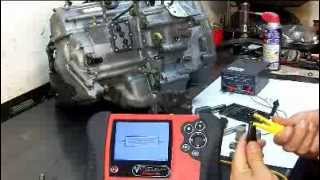
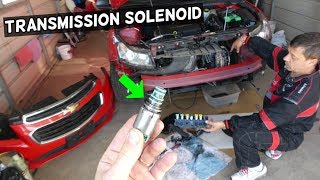
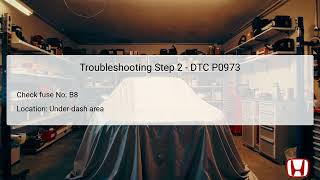
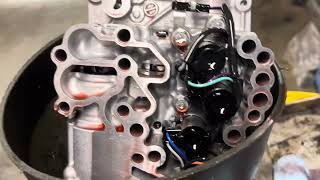
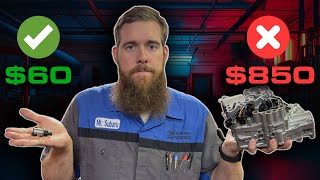
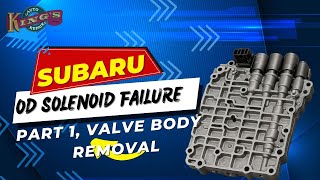
🎬 Watch: A complete P0973 diagnosis and repair walkthrough.Common Causes

- Damaged or corroded wiring/connectors (Very Common) — Wires leading to the shift solenoid chafe against metal, melt from exhaust heat, or break from vibration, causing a short to ground. Connectors also corrode or fill with moisture, destroying the electrical connection.
- Failed Shift Solenoid 'A' (Common) — The solenoid's internal coil winding burns out or shorts, resulting in abnormally low resistance. This prevents it from functioning when commanded by the TCM.
- Low or dirty transmission fluid (Common) — Low fluid starves the solenoid of hydraulic pressure. Dirty fluid contaminated with metal shavings clogs internal screens, causing the solenoid to stick or fail electrically.
- Blown fuse or faulty relay (Uncommon) — A blown fuse or a bad relay in the power supply circuit for the transmission solenoids cuts off power entirely, triggering a low voltage code.
- Weak vehicle battery or bad ground (Uncommon) — A failing battery or a poor ground connection causes systemic low voltage issues, which the TCM interprets as a specific solenoid circuit fault.
- Contaminated fluid from internal cooler leak (Uncommon) — If the transmission cooler integrated into the radiator fails, engine coolant mixes with transmission fluid. This highly conductive mixture shorts out the solenoid's electronics.
- Internal transmission failure (Less Common) — Severe internal wear within the transmission's valve body causes pressure issues that trigger this code, usually accompanied by heavily contaminated fluid.
- Faulty Transmission Control Module (TCM) (Rare) — The computer controlling the transmission fails and stops sending the correct signal to the solenoid. This is diagnosed only after exhausting all other electrical possibilities.
Symptoms

- Transmission stuck in one gear (Limp Mode) — The transmission locks into a fail-safe gear (often 2nd or 3rd) to prevent internal damage, severely limiting acceleration and top speed.
- Harsh, erratic, or delayed shifting — The vehicle jerks, slips, or pauses during gear changes, particularly on the 1-2 shift where solenoid 'A' is heavily utilized.
- Inability to shift into certain gears — The vehicle completely loses specific gears. For example, affected Honda models often lose the ability to shift into 2nd or 5th gear.
- Transmission slipping — Engine RPMs rise without a corresponding increase in vehicle speed, indicating the internal clutches are failing to engage properly.
- Decreased fuel economy — Because the transmission cannot shift efficiently, the engine operates outside its optimal RPM range, burning significantly more fuel.
- Check Engine Light is on (also visible on scanner) — The Check Engine Light illuminates immediately. Some vehicles also display a flashing 'D' or transmission-specific warning light.
Diagnostic Flowchart
Tap your situation to follow the diagnostic path that matches what you're seeing on this code.
Common Fixes & Costs
- Repair or Replace Damaged Wiring — Parts: $10-$50, Labor: $100-$300, ~1.0-2.5 hr book time (Intermediate)
- Replace Shift Solenoid 'A' — Parts: $20-$100, Labor: $150-$400, ~2.0-4.0 hr book time (Intermediate)
- Replace Blown Fuse — Parts: $1-$10, Labor: $0-$50, ~0.2 hr book time (Beginner)
- Transmission Fluid and Filter Change — Parts: $40-$120, Labor: $120-$250, ~1.0-1.5 hr book time (DIY)
- Replace Transmission Solenoid Pack — Parts: $75-$600, Labor: $200-$500, ~2.5-5.0 hr book time (Professional)
Used vs. New Parts: Buying Guide
When a used part is worth it: A used solenoid from a low-mileage donor vehicle is cost-effective for older, high-mileage cars, provided it is tested with a multimeter before installation.
Donor-vehicle mileage cap: roughly under 80000 miles for the part to have meaningful remaining life.
Donor quality checklist:
- Verify the donor vehicle's mileage and reason for salvage.
- Inspect the part for visible corrosion on connectors.
- Test the resistance of the used solenoid to ensure it is within spec.
- Match the part number exactly.
Decision logic:
- If The part is under $100 new. → Buy a new aftermarket or OEM part for a longer warranty.
- If The vehicle is over 150,000 miles and the budget is tight. → A tested, used solenoid is an acceptable risk.
- If The part is a complete solenoid pack or valve body. → Favor a new or remanufactured unit to avoid paying high labor costs twice.
Warranty tradeoff: Used parts have a 30-90 day warranty covering only the part. New aftermarket parts offer 1-year warranties. New OEM parts offer the best guarantee at the highest cost.
Worst-case if a used part fails: $300-$600 if a used solenoid fails, requiring repeat labor costs.
What Happens If You Wait — Timeline
- 0-1 month: Check Engine Light illuminates. Shifting becomes noticeably harsher or delayed on the 1-2 shift. The transmission occasionally enters limp mode. (MPG impact: 3-8%% · Added cost: $0-$50 in wasted fuel. Risk of towing cost ($100-$300).)
- 1-3 months: Continued driving with a low voltage circuit causes the affected solenoid to overheat, breaking down the transmission fluid locally. Slipping becomes frequent. (MPG impact: 5-12%% · Added cost: $50-$150 in wasted fuel.)
- 3-6 months: Overheated, burnt fluid circulates, accelerating wear on clutch packs and contaminating the valve body. Shifting becomes highly erratic. (MPG impact: 10-20%% · Added cost: $500-$1,200 for valve body replacement and premature clutch wear.)
- 6+ months: Widespread internal failure. Burnt clutches shed excessive material, completely clogging the filter and valve body. The transmission stops functioning. (MPG impact: 20%+% · Added cost: $2,000-$4,000+ for a complete transmission rebuild or replacement.)
Cost of Not Fixing It
- Immediate (0-1 month): Harsh shifting, poor fuel economy, and potential for being stranded in limp mode. (Added cost: Risk of towing costs ($100-$300).)
- Short Term (1-6 months): The transmission overheats, burning fluid and damaging clutch packs and seals. This leads to expensive valve body damage. (Added cost: $500-$1,200 for valve body damage.)
- Long Term (6+ months): Catastrophic internal transmission failure requiring a complete rebuild or replacement. (Added cost: $2,000-$4,000+)
Diagnosis Steps

- Scan for Codes & Review Freeze Frame Data
Use an OBD-II scanner to check for all transmission codes. The presence of other solenoid codes (e.g., P0976 for Solenoid 'B') points to a shared wiring or TCM issue rather than a single bad solenoid.
Tools: OBD-II scanner (Beginner) - Check the Transmission Fluid
Verify the transmission fluid level and condition. Dark, burnt-smelling fluid with metal particles indicates severe internal damage. Check the radiator for milky, pink fluid, which confirms coolant cross-contamination.
Tools: Transmission dipstick (if equipped), clean rag (Beginner) - Inspect Fuses and Wiring
Check the transmission control system fuses. Visually inspect the wiring harness leading to the transmission for chafing, melting, or corrosion, paying special attention to the main connector at the transmission case.
Tools: Flashlight, vehicle fuse diagram (Intermediate) - Commanded Solenoid Test (Click Test)
Using a bi-directional scan tool, command Shift Solenoid 'A' on and off while listening to the transmission pan. A distinct 'click' confirms the solenoid is trying to work. No click confirms a dead solenoid or a broken circuit.
Tools: Bi-directional OBD-II scanner, stethoscope (optional) (Advanced) - Live Data & Voltage Verification
Monitor 'Shift Solenoid A Voltage' on a scanner. With the key on/engine off, voltage should be near 12.6V. When commanded ON, it drops to near 0V. If voltage is stuck under 0.5V regardless of command, you have a definitive short to ground.
Tools: Bi-directional OBD-II scanner (Advanced) - Test the Solenoid Circuit for Shorts
Disconnect the TCM and transmission connectors. Use a multimeter to check for continuity between the control wire and the vehicle's chassis ground. Any continuity (reading other than 'OL') indicates a short in the harness.
Tools: Multimeter, vehicle-specific wiring diagram (Advanced) - Quantitative Resistance Check
Measure the solenoid's internal resistance with a multimeter. A reading below the specified range indicates a shorted solenoid. Common specs: Honda (12-25 Ω), Toyota (11-15 Ω), GM (20-30 Ω).
Tools: Multimeter, socket set, drain pan, vehicle service manual (Advanced) - Test the Vehicle Battery
Test the battery to ensure it provides adequate voltage (above 12.4V with the engine off) and verify the main transmission ground connection is clean and tight.
Tools: Multimeter or battery tester (Intermediate) - Backprobe the Solenoid Connector
With the engine running, backprobe the solenoid's connector pins. Check for voltage on the power wire and ground on the control wire when the TCM commands the solenoid on. This isolates the fault to the solenoid itself or the TCM driver.
Tools: Multimeter with backprobe pins, vehicle-specific wiring diagram (Advanced)
When This Code Triggers (Freeze-Frame Conditions)
- Engine Coolant Temp: 175-210°F (Vehicle is at full operating temperature.)
- RPM: 1200-2500 RPM (During light to moderate acceleration when a gear change is commanded.)
- Engine Load: 25-55% (The engine is working under normal driving load.)
- Vehicle Speed: 20-50 mph (Occurs during city or suburban driving when shifting between lower gears (e.g., 1-2 or 2-3 shift).)
Related Codes
- P0974 — The opposite code: 'Shift Solenoid 'A' Control Circuit High.' P0973 indicates a short (low resistance), while P0974 indicates an open circuit (infinite resistance).
- P0972 — Indicates the circuit's performance is out of spec, but not specifically high or low. P0973 is a more precise diagnosis of a low voltage condition.
- P0750 - P0754 — General malfunction codes for Shift Solenoid 'A'. P0751 (Stuck Off) suggests a mechanical issue, whereas P0973 points directly to an electrical circuit problem.
- P0976, P0979 — Low circuit codes for other shift solenoids. Multiple low circuit codes simultaneously strongly suggest a shared power supply or ground issue, not multiple failed solenoids.
Climate & Environmental Factors
- Road Salt / De-icing Agents: Road salt and de-icing chemicals coat the undercarriage, accelerating corrosion on the transmission wiring harness, connectors, and ground points. This corrosion compromises insulation and creates electrical shorts.
- High Humidity: Moisture penetrates weathered wiring connectors and harnesses. This causes corrosion and creates unintended electrical paths to ground, triggering P0973 even without direct salt exposure.
How to Talk to a Mechanic About This Code
Say this: "I have a P0973 code for the Shift Solenoid 'A' Control Circuit Low. Please start by checking the wiring harness for shorts to ground and test the solenoid's resistance before recommending a part replacement."
This directs the mechanic to perform a proper electrical diagnosis first, preventing them from swapping expensive parts and hoping for a fix.
Avoid saying:
- 'My transmission is acting weird, can you fix it?'
- 'Just replace the shift solenoid, I read online that's the problem.'
- 'Do whatever you think is best, I just need it running.'
Questions to ask before authorizing the repair:
- What was the specific resistance reading you got from the solenoid? Was it in spec?
- Did you find a short to ground in the wiring harness?
- Have you checked for any Technical Service Bulletins (TSBs) for this code?
- What is the warranty on the recommended repair?
Where to Take It: Dealer vs Independent vs Chain
- Dealer:
Strong choice if under warranty or facing a complex manufacturer issue. Otherwise, the most expensive option.
Best for: Vehicles under powertrain warranty., Known manufacturer-specific issues (e.g., Subaru CVT valve body)., Complex electrical issues requiring proprietary software.
Downsides: Highest labor rates., Defaults to replacing entire assemblies instead of smaller components. (Typical cost: +50% vs. baseline) - Independent Shop:
A good choice if the shop has strong electrical diagnostic skills to find wiring faults.
Best for: Out-of-warranty vehicles., Common diagnostic tasks on popular vehicle makes.
Downsides: Quality varies widely; vet shops by ASE certifications., May lack specialized tools for very new models. (Typical cost: +0% vs. baseline) - Chain Shop:
AVOID. The risk of misdiagnosis and being sold an unnecessary repair is very high.
Best for: Simple, routine maintenance like oil changes.
Downsides: Technician skill varies dramatically., High pressure to upsell full transmission rebuilds., Lack specialized diagnostic equipment. (Typical cost: -10% vs. baseline)
When to Walk Away From the Repair
If the estimated repair cost exceeds 40-50% of the car's private-party value, seriously consider selling or trading in the vehicle.
- Car worth $8000, fix is $850: Fix it. This repair is well below the threshold and extends the car's life.
- Car worth $4000, fix is $1800: Borderline. The repair approaches 50% of the car's value. Get a second opinion.
- Car worth $2500, fix is $2000: Walk away. The repair cost is not economically sensible.
What Scan Tool You Need for This Code
Minimum: An OBD-II scanner that reads transmission codes and views live data.
A basic $20 reader only gives the code. You need live data to see solenoid voltage, and a bi-directional tool to command the solenoid for a 'click test'.
Budget: Innova 1000 / BlueDriver (~$100) — Reads transmission codes and displays live data streams. Cannot command the solenoid for active testing.
Mid-range: Foxwell NT510 Elite / Launch Creader CRP129X (~$150) — Offers bi-directional control to command the shift solenoid on and off, allowing you to perform the crucial 'click test'.
Professional: Autel MaxiCOM MK808 / ThinkCar 689BT (~$450-600) — Provides full bi-directional control and advanced live data graphing to monitor solenoid command signals in real-time.
Rent vs buy: Auto parts stores offer free loaner tools for one-time use. If you do regular maintenance, invest in a mid-range bi-directional scanner.
How to Clear the Code After You Fix It
- Reconnect any disconnected components.
- Use an OBD-II scan tool to erase the DTCs from the TCM/PCM.
- Perform a complete transmission drive cycle to verify the fix.
Drive cycle (~20 minutes): Cold start and idle for 3 minutes. Drive in stop-and-go traffic, cycling through lower gears. Accelerate to 55 mph for 10 minutes. Safely stop, idle for a minute, and turn off the engine.
Readiness monitors affected: Comprehensive Component Monitor, Transmission Control Monitor
Before emissions retest: drive at least 50 miles to fully set monitors.
Watch out for:
- Clearing the code without fixing the electrical fault causes the code to return immediately.
- Disconnecting the battery resets all OBD-II readiness monitors, causing an automatic emissions test failure until a drive cycle is completed.
Will This Fail Emissions / State Inspection?
Yes — this code typically fails an OBD-II emissions inspection.
- California: An active P0973 is an automatic failure. After repair, it stores as a Permanent DTC (PDTC). The vehicle must be driven through multiple drive cycles to clear the PDTC before passing.
- New York: An active P0973 code results in an automatic failure. All required readiness monitors must be in the 'Ready' state.
- Texas: In emissions-testing counties, an active P0973 fails the OBD-II inspection. The Check Engine Light must be off.
Most Commonly Affected Vehicles
- Honda Accord, Civic, Pilot, CR-V, Odyssey (2005-2017) — Extremely common. Often caused by a short to ground in the solenoid circuit. A TSB for 2005 Accords notes metal contamination on solenoid contacts requires replacement.
- Chevrolet / GM Malibu, Cobalt, HHR, Equinox, Sierra (2005-2012) — Commonly related to a failed solenoid or debris clogging the screen. Access often requires dropping the subframe to remove the transmission side cover.
- Subaru Outback, Forester, Impreza (2010-2015) — On CVT transmissions, P0973 indicates a failure of the solenoid within the valve body, frequently requiring replacement of the entire valve body assembly.
- Toyota Corolla, Tundra, Camry (2003-2013) — Diagnostics involve checking solenoid resistance directly at the ECU connector. A resistance of 8 Ω or less is considered a definitive short.
- Ford Focus, Fusion, Bronco Sport (2012-2021) — Often diagnosed as a short to ground in the electrical circuit. On some 8-speed transmissions, a corrupted solenoid strategy in the PCM requires a software reflash.
- Acura MDX, TL (2004-2014) — Shares Honda transmission designs and is susceptible to the same solenoid and wiring harness issues.
- Saturn Vue, Ion (2003-2009) — These GM-platform vehicles exhibit P0973 due to faulty shift solenoids or wiring issues within the transmission harness.
- Hyundai Elantra, Sonata (2007-2016) — Causes range from faulty wiring to internal solenoid failure.
Manufacturer-Specific Notes
- Honda/Acura: Diagnostic procedures emphasize testing wiring before replacing the solenoid. The flashing 'D' light on the dash is a classic secondary indicator. Specified resistance is typically 12-25 Ohms.
- Toyota/Lexus: The service manual specifies checking for a short circuit by measuring solenoid resistance directly at the ECM connector pins first, saving significant diagnostic time.
- Chevrolet/GM: On vehicles with the 4T45-E transmission, accessing shift solenoids requires removing the transmission side cover, necessitating partial removal of the subframe.
- Subaru: In modern CVTs, shift solenoids are integrated into the main valve body assembly. P0973 often means the entire valve body must be replaced as a single unit.
Real Owner Stories
2007 Toyota Corolla with 1.8L, P0973
Check engine light came on, car was shifting erratically.
What they tried:
- Mechanic dropped the transmission pan and tested the solenoids.
- Shift solenoid 'A' showed a resistance of 1.9 Ohms, a definitive short circuit (spec is 11-15 Ohms).
- Inspection revealed transmission fluid had contaminated the radiator.
Outcome: The mechanic replaced the shorted solenoid pack and the radiator to prevent the new solenoids from being damaged by contaminated fluid. The shifting issue was resolved.
Lesson: Always check for cross-contamination between the cooling and transmission systems, as coolant destroys transmission electronics.
2010 Chevy Cobalt, P0973 and P0700
Vehicle had no first gear or overdrive. Codes P0973 and P0700 were present.
What they tried:
- Technician diagnosed a shorted shift solenoid 'A'.
- Accessing the solenoid required 7.1 hours of labor due to subframe interference.
- The solenoid was replaced.
Outcome: Replacing the solenoid fixed the shifting problems and cleared the codes.
Lesson: On certain vehicles (like the Cobalt, HHR, and Malibu), solenoid replacement is highly labor-intensive. Be absolutely certain the solenoid is the fault before committing to the repair.
2005 Honda CR-V, P0973
Check Engine Light on, RPMs running high, speed limited to 30 mph.
What they tried:
- Owner suspected a full transmission failure.
- Shop referenced Honda TSB 05-071 for this specific code.
Outcome: The TSB indicated ferrous contamination on the solenoid's contact area caused a short. Replacing shift solenoid 'A' fixed the issue without replacing the transmission.
Lesson: Always check for Technical Service Bulletins (TSBs). A known issue often has a straightforward fix prescribed by the manufacturer.
Multiple GM vehicles with P0973 and P0976
Driver experienced multiple solenoid low voltage codes simultaneously after installing aftermarket electronic accessories.
What they tried:
- Owner traced back recent work and found they tapped into a 12v power source in the rear fuse box.
- Disconnecting the newly installed relay caused all transmission codes to disappear.
Outcome: The aftermarket wiring created a voltage drop on a circuit shared by the TCM, triggering false codes. Removing the wiring resolved the problem.
Lesson: If multiple solenoid codes appear at once, the problem is a shared power or ground issue, not multiple failed solenoids.
How to Prevent This Code From Triggering
- Change automatic transmission fluid at recommended intervals. (Every 30,000 to 60,000 miles.) — Old fluid loses lubricating properties and fills with debris. This debris clogs the fine passages inside shift solenoids, causing them to stick or fail electrically.
- Use the exact OEM-specified transmission fluid. (Every fluid change.) — Using the wrong fluid damages seals and causes incompatible chemical reactions, leading to solenoid and valve body failure.
- Perform an underbody wash after winter seasons. (Annually.) — Washing the undercarriage removes corrosive road salt, preventing it from destroying transmission wiring harnesses and ground points.
- Inspect the transmission wiring harness. (Annually during an oil change.) — Securing loose wiring with a zip tie prevents the insulation from rubbing against chassis parts or hot exhaust, avoiding short circuits.
Frequently Asked Questions
What is the most common misdiagnosis for P0973?
The most common mistake is immediately replacing Shift Solenoid 'A'. The code often returns because the actual problem was a chafed wire shorting to the chassis or a corroded connector. Always test the wiring first.
What's the difference between replacing a single solenoid and a solenoid pack?
A single solenoid is an individual component replaced on its own. A solenoid pack bundles multiple solenoids into one unit. If your car uses a pack and one solenoid fails, you must replace the entire, more expensive assembly.
What is a shift solenoid?
A shift solenoid is an electronically controlled valve inside your automatic transmission. The computer sends it an electrical signal to direct transmission fluid, which changes the gears.
Can I fix P0973 myself?
A beginner can check fuses and transmission fluid. However, diagnosing electrical faults with a multimeter or replacing the solenoid inside the transmission pan is an advanced job. Consult a professional if you lack electrical experience.
How much does it cost to fix P0973?
The cost varies widely. A blown fuse is under $20, while a wiring repair costs $100-$300. Replacing a single shift solenoid ranges from $200 to $500, but replacing an entire solenoid pack or valve body exceeds $600.
Will clearing the code fix the problem?
No. Clearing the code only turns off the check engine light temporarily. Because P0973 indicates a hard electrical fault, the code returns immediately after the computer runs its self-test.
Is Shift Solenoid 'A' the same as Solenoid '1'?
Yes, depending on the manufacturer, Shift Solenoid 'A' is also referred to as Shift Solenoid Valve S1 or SS1. Check your specific service manual for terminology.
Can a bad battery cause a P0973 code?
Yes, though less common. A weak battery causes low voltage across the entire vehicle. The sensitive TCM interprets this systemic low voltage as a specific fault in the solenoid circuit.
Key Takeaways
- P0973 triggers when the Shift Solenoid 'A' circuit drops below 0.5V, forcing the transmission into limp mode and limiting you to 2nd or 3rd gear.
- Inspect the transmission wiring harness for chafing and test the solenoid's resistance (typically 11-25 Ohms) before buying replacement parts.
- Use a bi-directional scanner to perform a 'click test' on the solenoid; hearing no click confirms a dead solenoid or a broken wire.
- Stop driving immediately to prevent a $200 electrical fix from escalating into a $3,000+ transmission rebuild due to burnt clutches.
Helpful Videos



Shop the Parts Behind P0973
Below are the parts most often responsible for code P0973, ranked by how frequently each one is the actual culprit (per the diagnosis above). Tap any to see what we have for your vehicle.



The information in this article is provided for general reference and educational purposes only. Vehicle specifications, procedures, and part compatibility can vary by production date, trim level, and region. Always consult your vehicle's factory service manual and verify part numbers before purchasing or performing repairs. Safety-critical components such as airbags, seat belts, and braking systems should be installed by a qualified professional.
- 🧭 Diagnostic Flowchart
- 🎬 Helpful Videos
- 🛍️ Shop This Part
- What Does P0973 Mean?
- Can I Drive With P0973?
- Common Causes
- Symptoms
- Common Fixes & Costs
- Used vs. New Parts: Buying Guide
- What Happens If You Wait — Timeline
- Cost of Not Fixing It
- Diagnosis Steps
- When This Code Triggers (Freeze-Frame Conditions)
- Related Codes
- Climate & Environmental Factors
- How to Talk to a Mechanic About This Code
- Where to Take It: Dealer vs Independent vs Chain
- When to Walk Away From the Repair
- What Scan Tool You Need for This Code
- How to Clear the Code After You Fix It
- Will This Fail Emissions / State Inspection?
- Most Commonly Affected Vehicles
- Manufacturer-Specific Notes
- Real Owner Stories
- 2007 Toyota Corolla with 1.8L, P0973
- 2010 Chevy Cobalt, P0973 and P0700
- 2005 Honda CR-V, P0973
- Multiple GM vehicles with P0973 and P0976
- How to Prevent This Code From Triggering
- Frequently Asked Questions
- What is the most common misdiagnosis for P0973?
- What's the difference between replacing a single solenoid and a solenoid pack?
- What is a shift solenoid?
- Can I fix P0973 myself?
- How much does it cost to fix P0973?
- Will clearing the code fix the problem?
- Is Shift Solenoid 'A' the same as Solenoid '1'?
- Can a bad battery cause a P0973 code?
- Key Takeaways
- 🎟️ Get 5% Off