

OBD-II Code P0979: Shift Solenoid 'C' Control Circuit Low
What P0979 means, why it triggers, and how to fix it
- P0979 is an electrical short-to-ground code, not an internal mechanical transmission failure.
- Check the 7.5A transmission fuse first on Honda and Acura models before replacing any parts.
- Test the solenoid resistance with a multimeter; a reading near 0 ohms confirms an internal short requiring replacement.
- Driving with a P0979 code in limp mode for more than a few days overheats the transmission, risking a $2,500+ rebuild.
- Verify TCM software updates exist, such as TSB 21-009-20 for 2019 Ram 1500s, to avoid unnecessary $1,000+ hardware replacements.
What Does P0979 Mean?

The Transmission Control Module (TCM) detected low voltage in the Shift Solenoid 'C' control circuit. This solenoid acts as an electronic gate directing transmission fluid to shift gears; when its circuit fails, the transmission cannot shift correctly.
Technical definition: SAE/OBD-II defines P0979 as "Shift Solenoid 'C' Control Circuit Low". The Transmission Control Module (TCM) sets this code when it reads near-zero volts on the solenoid 'C' control circuit for more than 2 seconds. The TCM expects battery voltage (12V) when the solenoid is off. A near-zero reading typically indicates a short circuit to ground.
Can I Drive With P0979?
Yes, But With Caution. You can drive the vehicle, but it will have noticeable shifting problems and enter a 'limp mode' with limited gear availability. This mode gets you to a safe location, not for continued daily driving. Driving for extended periods overheats the transmission, accelerates wear on internal clutches, and turns a simple electrical fix into a catastrophic transmission failure requiring a $2,500+ rebuild. Repair the issue immediately.
Common Causes

- Damaged, corroded, or shorted wiring/connectors (Very Common) — Wiring harnesses chafe against chassis components, melting insulation and causing a short to ground. Road salt and moisture corrode connectors, disrupting the electrical signal.
- Blown transmission circuit fuse (Common) — A voltage spike or short circuit blows the dedicated transmission fuse, cutting power and causing a low voltage code. On Honda and Acura models, this is typically a 7.5A fuse in the under-dash box.
- Failed Shift Solenoid 'C' (Common) — The solenoid's internal wire coil develops a short circuit, dropping voltage to zero and triggering the code.
- Low or dirty transmission fluid (Common) — Low fluid causes pressure drops, while metallic debris in dirty fluid makes solenoids stick mechanically or short out electrically.
- Poor electrical ground (Less Common) — A loose or corroded ground strap creates electrical resistance and voltage drops that trigger circuit codes.
- Damaged internal transmission wiring harness (Less Common) — The internal harness connecting solenoids to the external connector becomes brittle from constant heat and fluid exposure, causing an internal short.
- Low battery voltage (Uncommon) — System voltage dropping below 9V causes the TCM to behave erratically and set false solenoid codes.
- Faulty Transmission Control Module (TCM) (Rare) — The internal driver circuit powering the solenoid shorts out. Consider this only after exhaustively testing all wiring and solenoids.
Symptoms

- Check Engine Light is on — The Malfunction Indicator Lamp (MIL) illuminates immediately when the fault is detected.
- Flashing transmission warning light — A gear-shaped or 'A/T' dashboard light flashes to indicate a critical transmission fault.
- Vehicle stuck in 'limp mode' (also visible on scanner) — The transmission defaults to a single gear (often 2nd or 3rd) to prevent damage, causing poor acceleration and high RPMs at highway speeds.
- Harsh, delayed, or failed shifts (also visible on scanner) — The transmission slams into gear, hesitates significantly, or refuses to shift entirely.
- Inability to access certain gears (also visible on scanner) — Solenoid 'C' failure blocks specific gears; Honda models frequently lose access to 2nd and 5th gear. 🎬 Watch: Diagnosing a shorted shift solenoid on a Honda Odyssey.
- Decreased fuel economy (also visible on scanner) — Improper gear selection increases engine RPMs and fuel consumption by 5-15%.
Diagnostic Flowchart

Tap your situation to follow the diagnostic path that matches what you're seeing on this code.
Common Fixes & Costs
- Replacing Blown Fuse — Parts: $1-$5, Labor: $0-$50, ~0.1 hr book time (Beginner)
- Repairing Damaged Wiring or Connectors — Parts: $10-$50, Labor: $150-$600, ~2.5 hr book time (Intermediate)
- Replacing Shift Solenoid 'C'
— Parts: $25-$150, Labor: $200-$500, ~2.5 hr book time
(Professional)
: OEM 28500-RT4-003 (Solenoid Assy. C) (Alt: Dorman, Rostra, WVE/NTK)
: OEM 31825AA051 (Lock-up), C63712 (AWD) (Alt: Rostra, Natpro, Transtar)
: OEM R8402284AA (Reman Valve Body) (Alt: Dorman 609-052, Standard Motor Products TCS309) - Transmission Fluid and Filter Change — Parts: $50-$120, Labor: $100-$250, ~1 hr book time (Intermediate)
- Replacing the Transmission Control Module (TCM) — Parts: $200-$1000, Labor: $150-$500, ~2 hr book time (Professional)
Used vs. New Parts: Buying Guide
When a used part is worth it: For a shift solenoid, buying used is rarely recommended. The high labor cost to access the solenoid outweighs the small initial savings. Consider used parts only for older, low-value vehicles where the owner accepts the risk of a repeat repair.
Donor-vehicle mileage cap: roughly under 60000 miles for the part to have meaningful remaining life.
Donor quality checklist:
- Verify the exact OEM part number, as multiple solenoids in a transmission look similar but are not interchangeable.
- Avoid parts from vehicles scrapped due to transmission failure.
- Test the resistance of the used solenoid with a multimeter before installation.
Decision logic:
- If Labor for replacement is more than 3x the cost of a new part → Always buy a new OEM or high-quality aftermarket part with a warranty.
- If Vehicle is over 150K miles and repair budget is extremely limited → A tested, low-mileage used solenoid is a high-risk but viable option.
- If The part is a solenoid pack (multiple solenoids sold as one unit) → Favor new, as the chance of one of the used solenoids failing is much higher.
Warranty tradeoff: Used solenoids from a salvage yard offer a 30-90 day functional warranty that excludes labor. New aftermarket parts carry a 1-year to limited lifetime warranty.
Worst-case if a used part fails: 400-800. This represents the cost of the failed used part plus the full labor charge to remove it and install a second replacement part.
What Happens If You Wait — Timeline
- 0-1 month: Check Engine Light is on with code P0979. Shifting becomes harsh or delayed. The vehicle occasionally enters 'limp mode,' limiting gears. (MPG impact: 5-10%% · Added cost: $25-75 in wasted fuel.)
- 1-3 months: Harsh shifting becomes frequent and severe. High RPMs during limp mode operation overheat the transmission fluid, accelerating its breakdown. (MPG impact: 10-15%% · Added cost: $100-250 in wasted fuel and premature fluid degradation.)
- 3-6 months: Sustained overheating from slipping and harsh shifts damages internal clutch packs and seals. Burnt fluid clogs other solenoids and passages. (MPG impact: 15-20%% · Added cost: $500-1,200 (Internal clutch/seal damage is now likely, repair costs escalate beyond the original electrical issue).)
- 6+ months: Catastrophic internal failure. Widespread damage to clutches, bands, and the torque converter. The original electrical fix is now a full transmission rebuild. (MPG impact: 20-30%+% · Added cost: $2,500-5,000+ (Full transmission rebuild or replacement is required).)
Cost of Not Fixing It
- 0-1 month: Harsh shifting, limp mode engagement, and a 5-15% drop in fuel economy. Drivability is poor. (Added cost: 50-100)
- 1-6 months: High RPM operation overheats transmission fluid. This accelerates wear on internal clutches and seals. (Added cost: 400-800)
- 6+ months: Catastrophic internal transmission failure. Burnt fluid and destroyed clutches require a complete transmission rebuild. (Added cost: 2500-5000)
Diagnosis Steps
- Scan for All Trouble Codes
Use an OBD-II scanner to read all stored codes. Note any other solenoid-related codes (e.g., P0976, P0980) as this indicates a shared power or ground issue rather than an isolated solenoid failure.
Tools: OBD-II Scanner (Beginner) - Inspect Fuses and Grounds
Check the fuse boxes for blown transmission fuses (specifically the 7.5A fuse on Hondas). Inspect main ground straps from the battery to the chassis and engine for corrosion.
Tools: Fuse puller, Socket set (Beginner) - Check the Transmission Fluid
Verify fluid level and condition. Dark, burnt, or metallic fluid requires immediate replacement and indicates internal wear.
Tools: Rag or paper towel (Beginner) - Inspect the External Wiring Harness
Visually check the transmission harness for chafed wires, melted loom, or corroded pins. Wiggle the harness with the engine running to see if it triggers symptoms.
Tools: Flashlight, Safety glasses (Intermediate) - [PRO TIP] Test Circuit Voltage
Backprobe the Solenoid 'C' control wire at the transmission connector. With the key on, engine off (KOEO), voltage should be ~12V. A 0V reading confirms the 'Circuit Low' condition.
Tools: Digital Multimeter (with backprobes), Wiring Diagram (Advanced) - [PRO TIP] Test for Short to Ground
Disconnect the transmission and TCM connectors. Measure resistance between the Solenoid 'C' pin on the harness and chassis ground. Continuity confirms a short to ground in the wiring harness.
Tools: Digital Multimeter, Wiring Diagram (Advanced) - [PRO TIP] Test the Solenoid's Internal Resistance
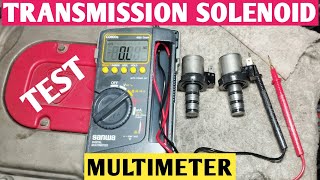
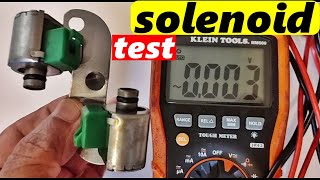
Measure resistance of Solenoid 'C' at the transmission pins. Near 0 ohms indicates an internal short. (Honda: 10-20 Ohms, Subaru Lock-up: 12-13.5 Ohms, Ram 8HP75: 5-10 Ohms).
Tools: Digital Multimeter, Wiring Diagram (Advanced) - [PRO TIP] Perform a Solenoid Activation Test
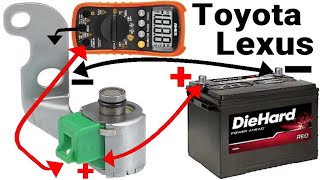
Apply a 9V battery to the solenoid terminals. An audible 'click' confirms mechanical actuation. No click means the solenoid is physically stuck.
Tools: 9V Battery or Fused Jumper Wires (Advanced) - [PRO TIP] Analyze Live Scan Tool Data
Monitor Solenoid C commanded state vs. circuit voltage. Voltage should drop to 0V only when commanded ON. If it stays at 0V, the circuit is permanently shorted.
Tools: Advanced OBD-II Scan Tool (Advanced) - Check for TCM Software Updates
Check manufacturer TSBs. 2019 Ram 1500s frequently resolve P0979 with a TCM software update rather than hardware replacement.
Tools: Access to TSB database, Professional Scan Tool (Professional) - Inspect the Internal Transmission Harness
Drain fluid and remove the oil pan to inspect internal wiring for brittle or damaged sections. This is typically done concurrently with solenoid replacement.
Tools: Socket set, Drain pan, Gasket scraper (Professional)
When This Code Triggers (Freeze-Frame Conditions)
- Engine Coolant Temp: 180-210°F (Vehicle at normal operating temperature.)
- RPM: 1500-2500 RPM (During or just after a gear shift attempt at cruise or light acceleration.)
- Engine Load: 25-55% (Steady driving or moderate acceleration, not heavy load.)
- Vehicle Speed: 25-50 mph (The fault logs when the TCM attempts to shift into a gear controlled by solenoid 'C'.)
Related Codes
- P0980 — Shift Solenoid 'C' Control Circuit High. The opposite of P0979, caused by an open circuit rather than a short to ground.
- P0978 — Shift Solenoid 'C' Control Circuit Range/Performance. Indicates an intermittent wiring problem or a failing solenoid coil.
- P0700 — A generic ECM code indicating the TCM stored a fault. Always accompanies specific transmission codes.
- P0976 / P0977 — Shift Solenoid 'B' codes. Multiple solenoid codes indicate a shared power supply issue, blown fuse, or faulty TCM.
Climate & Environmental Factors
- Road Salt / Saline Environments: Saltwater is a powerful electrolyte that accelerates corrosion on wiring harnesses and connector pins, causing shorts to ground.
- High Humidity: Traps moisture inside wiring looms, worsening existing micro-cracks and perpetuating electrical shorts.
How to Talk to a Mechanic About This Code
Say this: "I have a P0979 code for the Shift Solenoid 'C' control circuit. Please perform an electrical diagnosis on the wiring harness and fuses before recommending a solenoid replacement."
This signals you understand P0979 is a circuit code, not just a bad part. It directs the shop to test wires and voltages instead of immediately replacing the most likely component, saving you money if the fault is a chafed wire.
Avoid saying:
- 'My transmission is slipping, can you fix it?'
- 'My check engine light is on, can you look at it?'
- 'Just replace shift solenoid C.'
Questions to ask before authorizing the repair:
- Did you test the resistance of the solenoid, and what was the reading?
- Did you test the control circuit wiring for a short to ground between the TCM and the transmission connector?
- If the solenoid needs replacement, is the new part an OEM or quality aftermarket brand, and what is the warranty on the part and labor?
- For my Honda/Acura, did you check the 7.5A transmission fuse?
- For my 2019 Ram, did you check for TSB 21-009-20 regarding a software update?
Where to Take It: Dealer vs Independent vs Chain
- Dealer:
Recommended if the vehicle is under warranty or has a known TSB. For out-of-warranty vehicles, a specialized independent shop is more cost-effective.
Best for: Vehicles under powertrain warranty, Manufacturer-specific TSBs (like the Ram 1500 software update), Complex diagnostics on newer or European vehicles where specialized tools are required
Downsides: Highest labor rates, often 1.5-2x an independent shop., Prefers to replace an entire assembly (like a valve body) rather than a single component (like one solenoid). (Typical cost: +50% vs. baseline) - Independent Shop:
Best fit for most out-of-warranty P0979 repairs. An independent transmission specialist excels at targeted, cost-effective electrical diagnostics.
Best for: Out-of-warranty vehicles where cost is a major factor., Shops that specialize in transmission repair with deep expertise in electrical diagnostics., Common vehicles (Honda, Subaru, Ford) where these issues are well-documented.
Downsides: Quality and expertise vary widely; look for ASE certifications and positive reviews on transmission work., Lacks access to the very latest manufacturer software or specialized tools for brand-new models. (Typical cost: +0% vs. baseline) - Chain Shop:
AVOID for P0979 diagnosis. This code requires specific electrical and transmission expertise that is not the focus of chain repair shops.
Best for: Simple, routine maintenance like oil changes or brake jobs.
Downsides: Technician skill varies dramatically., Lacks the specialized knowledge for in-depth transmission electrical diagnostics., Not equipped or willing to perform detailed wiring repairs. (Typical cost: -10% vs. baseline)
When to Walk Away From the Repair
If the estimated repair cost exceeds 40-50% of the car's private-party value, consider your options.
- Car worth $5000, fix is $2500: Walk away. The repair cost is 50% of the car's value, and for a major component like the transmission, it's a significant risk.
- Car worth $15000, fix is $800: Fix it. The repair cost is well below the threshold and significantly less than a down payment on a new vehicle.
- Car worth $3000, fix is $450: Fix it, especially if it's a simple wiring or fuse issue. This is a relatively low-cost repair that restores full function to the vehicle.
- Car worth $2500, fix is $1800: Walk away. The repair cost is nearly 75% of the car's value. It makes no financial sense to invest this much into an aging vehicle.
What Scan Tool You Need for This Code
Minimum: A scanner that reads manufacturer-specific transmission codes (not just generic P-codes) and displays live data for transmission PIDs (Parameter IDs).
A $20 basic code reader only shows the P0979 code. It cannot show critical live data, such as the TCM's commanded state for the solenoid versus the actual circuit voltage, which is essential for diagnosing wiring versus solenoid failures.
Budget: BlueDriver Pro (~$100) — Reads engine, transmission, ABS, and SRS codes. Displays live data streams from the TCM, allowing you to monitor the solenoid circuit's behavior in real time on your smartphone.
Mid-range: Foxwell NT510 Elite (~$180) — Offers full system diagnostics and deep transmission analysis. Provides bidirectional control, allowing you to command the shift solenoid to activate directly from the scanner to test its mechanical function.
Professional: Autel MaxiCOM MK808Z (~$500) — A full-tablet scanner providing dealership-level diagnostics. Features powerful bidirectional controls for active testing of all solenoids, advanced data graphing, and transmission adaptations needed after a repair.
Rent vs buy: For a one-time diagnosis, AutoZone's Loan-A-Tool program allows you to borrow an OBD-II scanner for a fully refundable deposit. If you do your own maintenance regularly, buying a scanner in the $100-$200 range offers the best long-term value.
How to Clear the Code After You Fix It
- Use an OBD-II scan tool to clear the diagnostic trouble codes.
- Reconnect the battery if it was disconnected for the repair.
- Perform a complete drive cycle to allow the vehicle's readiness monitors to run.
Drive cycle (~20 minutes): Start the engine from a cold start (parked for 8+ hours). Let it idle for 2-3 minutes. Drive in stop-and-go city traffic for about 10 minutes, including several complete stops. Then, drive at a steady highway speed (around 55 mph) for 5-10 minutes. Allow the vehicle to cool down completely.
Readiness monitors affected: Comprehensive Component Monitor, Catalyst Monitor, Oxygen Sensor Monitor
Before emissions retest: drive at least 50 miles to fully set monitors.
Watch out for:
- Clearing the code without fixing the underlying short circuit causes the code to return immediately.
- Disconnecting the battery clears the code but resets all OBD-II readiness monitors, causing an automatic emissions test failure.
Will This Fail Emissions / State Inspection?
Yes — this code typically fails an OBD-II emissions inspection.
- California: An illuminated Check Engine Light is an automatic failure. After repair, a complete drive cycle must be performed to set all readiness monitors before the vehicle can be re-tested.
- New York: The NYS DMV inspection includes an OBD-II scan. Any active fault code like P0979 that illuminates the Check Engine Light results in an immediate failure.
- Texas: In the 17 counties requiring emissions testing, an active P0979 code causes the vehicle to fail the OBD-II portion of the inspection.
Most Commonly Affected Vehicles
- Honda Odyssey, Accord, Pilot (2011-2022) — Extremely common. Check the 7.5A fuse first. Prevents shifts into 2nd and 5th gear on Pilots.
- Acura TL, MDX (2005-2019) — Shares Honda platforms and identical electrical faults. Check the fuse, wiring, then solenoid.
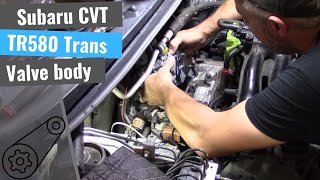
- Subaru Outback, Forester, Crosstrek, Impreza (2013-2019) — TR580 CVT solenoid circuit codes are common. Replace individual solenoids instead of the entire $2,000 valve body.
- Ram 1500 (2019) — TSB 21-009-20 resolves P0979 with a TCM software update, avoiding hardware replacement.
- Chevrolet Cruze, Malibu, Equinox (2011-2016) — 6T40 transmissions suffer from contaminated fluid clogging solenoid screens.
- Ford Focus, Fusion, Escape (2012-2018) — 6F35 transmissions experience wiring harness chafing and internal solenoid failures.
- BMW 3-Series (E90/E92) (2006-2013) — Broken wires inside the center console gear shifter assembly frequently cause this code.
- Nissan Altima, Rogue, Sentra (2013-2019) — CVT wiring and solenoid failures trigger this code before major transmission failure.
Manufacturer-Specific Notes
- Honda/Acura: P0979 is almost always a short circuit. Check the 7.5A fuse (labeled B5 or C31) in the under-dash fuse box first.
- Subaru: Dealers often quote $2,000+ for a full valve body replacement. Independent shops replace the individual failed solenoid for under $500.
- Ram (FCA): TSB 21-009-20 fixes P0979 on 2019 1500s with a TCM software update. Reprogram before replacing parts.
- BMW: Check for broken wiring inside the center console gear shifter assembly before diagnosing the internal Mechatronics unit.
Real Owner Stories
2019 Honda Odyssey with 64K miles
Vehicle displayed 'Transmission problem' and 'System Emission Problem' on the dash. The code scanned was P0979.
What they tried:
- Checked the battery, which was fine.
- Took it to the dealer for diagnostics. The dealer attempted a transmission software update which failed multiple times, rendering the vehicle inoperable.
Outcome: The dealer determined the Transmission Control Module (TCM) failed during the update process and replaced it, covering the $1,300 cost. This resolved the P0979 code.
Lesson: On late-model Hondas, an intermittent P0979 is sometimes related to software. However, diagnostic software updates on a potentially faulty module carry a small risk of module failure.
2015 Subaru Forester with 60K miles
The dashboard lit up with warning lights. Dealer diagnosed a solenoid circuit fault and quoted $2,200 for a full valve body replacement.
What they tried:
- Owner declined the expensive dealer repair.
- Researched the issue and found that individual solenoids can be replaced on the TR580 CVT.
- Purchased an aftermarket AWD solenoid for $55 and replaced it themselves.
Outcome: Replacing the single failed solenoid fixed the issue. The owner then had a transmission shop perform a fluid drain-and-fill ($155) and did the CVT relearn procedure at home. Total cost was a fraction of the dealer's quote.
Lesson: On Subarus with CVT issues, don't automatically accept a full valve body replacement quote. Individual solenoids are available and can be replaced by a skilled DIYer or independent shop for significantly less money.
2008 Acura MDX with 200K miles
Vehicle came to an independent shop with code P0979 after another shop replaced the wrong solenoid trying to fix it.
What they tried:
- The previous shop replaced an easily accessible, but incorrect, solenoid.
- The new shop correctly identified the location of Shift Solenoid 'C' and tested it with a multimeter.
Outcome: The multimeter test showed the old solenoid had a resistance of 4.4 Ohms, indicating an internal short. The new OEM solenoid measured 16.6 Ohms, which was within spec. Replacing the correct solenoid fixed the code.
Lesson: Misdiagnosis is common. A P0979 code points to a specific solenoid ('C'). Always use a wiring diagram to locate the correct component and test it before replacing it.
How to Prevent This Code From Triggering
- Perform regular transmission fluid changes. (Every 30,000 to 60,000 miles, or as per manufacturer's severe service schedule.) — Clean fluid prevents the buildup of metallic debris and sludge that causes solenoids to stick or short out electrically.
- Apply dielectric grease to transmission electrical connectors. (Whenever the connector is disconnected for service.) — Dielectric grease seals out moisture and oxygen, preventing the corrosion on connector pins that causes high resistance and intermittent circuit faults.
- Periodically inspect the transmission wiring harness. (During oil changes or other under-hood maintenance.) — Visually checking for wires rubbing against sharp metal edges or exhaust components catches potential shorts before they happen.
- Clean battery terminals and main ground straps. (Annually, especially in climates with high humidity or road salt.) — A clean, tight ground connection ensures stable voltage. Corroded grounds cause voltage drops and electrical noise, triggering false solenoid codes.
Frequently Asked Questions
Can I fix P0979 myself?
A skilled DIYer can check fuses, test wiring for shorts with a multimeter, and change transmission fluid. However, replacing internal solenoids requires draining the transmission and dropping the oil pan. Stop DIY and go to a transmission shop if you lack electrical diagnostic experience or tools.
What happens if I ignore P0979?
Ignoring this code causes persistent shifting problems and forces the vehicle into limp mode. Continued operation overheats the transmission fluid and rapidly degrades internal clutches. This heat damage turns a minor electrical fix into a $2,500+ complete transmission rebuild.
Will replacing Shift Solenoid 'C' definitely fix the problem?
Not necessarily. P0979 is a circuit code indicating low voltage. The root cause is often a short in the wiring harness, a corroded connector, or a blown fuse rather than the solenoid itself.
What are some common misdiagnosis mistakes for P0979?
The most common mistake is immediately replacing the solenoid without testing the circuit. On Hondas, failing to check the 7.5A fuse first wastes time and money. On 2019 Rams, ignoring available software updates leads to unnecessary valve body replacements.
Could a dead battery or jump-start cause a P0979 code?
Yes, modern electronic transmissions require stable voltage to operate correctly. A weak battery dropping below 9V causes the TCM to log false solenoid codes. An improper jump-start creates a voltage surge that blows the transmission circuit fuse.
Is Shift Solenoid 'C' inside or outside the transmission?
On most modern automatic transmissions, shift solenoids are located inside the transmission attached to the valve body. Accessing them requires draining the fluid and removing the transmission oil pan.
How do I know if the problem is the wiring or the solenoid?
Isolate the fault by testing the solenoid's resistance at the transmission connector with a multimeter. If resistance is near 0 ohms, the solenoid is internally shorted and requires replacement. If resistance is within spec, test the wiring harness for a short to ground.
What does 'short to ground' mean?
A short to ground means the solenoid's power wire lost its insulation and is touching the vehicle's metal frame or engine. This creates a shortcut for the electricity, dropping circuit voltage to zero. The TCM detects this zero-voltage state and triggers the P0979 code.
Key Takeaways
- P0979 is an electrical short-to-ground code, not an internal mechanical transmission failure.
- Check the 7.5A transmission fuse first on Honda and Acura models before replacing any parts.
- Test the solenoid resistance with a multimeter; a reading near 0 ohms confirms an internal short requiring replacement.
- Driving with a P0979 code in limp mode for more than a few days overheats the transmission, risking a $2,500+ rebuild.
- Verify TCM software updates exist, such as TSB 21-009-20 for 2019 Ram 1500s, to avoid unnecessary $1,000+ hardware replacements.
Helpful Videos



Shop the Parts Behind P0979
Below are the parts most often responsible for code P0979, ranked by how frequently each one is the actual culprit (per the diagnosis above). Tap any to see what we have for your vehicle.



The information in this article is provided for general reference and educational purposes only. Vehicle specifications, procedures, and part compatibility can vary by production date, trim level, and region. Always consult your vehicle's factory service manual and verify part numbers before purchasing or performing repairs. Safety-critical components such as airbags, seat belts, and braking systems should be installed by a qualified professional.
- 🧭 Diagnostic Flowchart
- 🎬 Helpful Videos
- 🛍️ Shop This Part
- What Does P0979 Mean?
- Can I Drive With P0979?
- Common Causes
- Symptoms
- Common Fixes & Costs
- Used vs. New Parts: Buying Guide
- What Happens If You Wait — Timeline
- Cost of Not Fixing It
- Diagnosis Steps
- When This Code Triggers (Freeze-Frame Conditions)
- Related Codes
- Climate & Environmental Factors
- How to Talk to a Mechanic About This Code
- Where to Take It: Dealer vs Independent vs Chain
- When to Walk Away From the Repair
- What Scan Tool You Need for This Code
- How to Clear the Code After You Fix It
- Will This Fail Emissions / State Inspection?
- Most Commonly Affected Vehicles
- Manufacturer-Specific Notes
- Real Owner Stories
- 2019 Honda Odyssey with 64K miles
- 2015 Subaru Forester with 60K miles
- 2008 Acura MDX with 200K miles
- How to Prevent This Code From Triggering
- Frequently Asked Questions
- Can I fix P0979 myself?
- What happens if I ignore P0979?
- Will replacing Shift Solenoid 'C' definitely fix the problem?
- What are some common misdiagnosis mistakes for P0979?
- Could a dead battery or jump-start cause a P0979 code?
- Is Shift Solenoid 'C' inside or outside the transmission?
- How do I know if the problem is the wiring or the solenoid?
- What does 'short to ground' mean?
- Key Takeaways
- 🎟️ Get 5% Off