

OBD-II Code P1042: Valvetronic Control Circuit Malfunction
What P1042 means, why it triggers, and how to fix it
- Code P1042 on a BMW almost always points to a failure in the Valvetronic system, typically the eccentric shaft sensor or the Valvetronic motor.
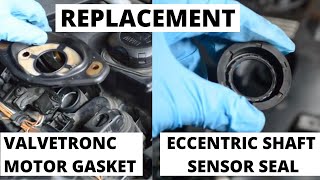
- The number one cause of failure is a small, inexpensive seal that leaks engine oil into the connector of the very expensive eccentric shaft sensor, contaminating it.
- Key symptoms include a rough idle, significantly reduced engine power ('limp mode'), difficulty starting, and a potential clicking noise from the engine.
- Repair is expensive primarily due to high labor costs (4-8 hours) because the engine's valve cover must be removed to access the components.
- Before replacing expensive parts, always test the battery and charging system, as low voltage is a common cause of Valvetronic faults.
- On many other brands like Dodge, Chevrolet, and Toyota, P1042 indicates a problem with a fuel injector or a related system like MultiAir, not the valvetrain.
What Does P1042 Mean?
P1042 is a manufacturer-specific code, most commonly used by BMW. It means the engine's computer (DME) has detected a problem with the Valvetronic system, which is responsible for controlling how much the engine's intake valves open. This system replaces a traditional throttle plate to improve efficiency and engine response, so a fault can cause noticeable driving issues. On other makes like Dodge, Chevrolet, and Honda, this code points to a fuel injector or MultiAir system issue.
Technical definition: For BMW vehicles, P1042 is officially defined as 'VVT (Valvetronic) Control Circuit Malfunction' or 'VVT Control Motor, Position Control, Control Deviation'. This indicates the computer has detected a fault in the electrical circuit for the Valvetronic system or that the system's actual position does not match its commanded position. For Dodge/Chrysler vehicles with MultiAir engines, it can mean 'Implausible Data from Cylinder 2 oil supply solenoid valve'. For many other makes like Chevrolet, Honda, and Toyota, it indicates a 'Fuel Injector Circuit Malfunction' for a specific cylinder.
Can I Drive With P1042?
Yes, But With Caution. Driving is possible, but the engine will be in a 'limp mode' with significantly reduced power, rough idling, and potential stalling. It is strongly advised to drive only to a repair shop. Continued driving, especially for more than 50-100 miles, allows unburned fuel to enter the exhaust, which can overheat and destroy the catalytic converter. This can turn a sub-$1500 repair into a $3000+ repair by adding the cost of a new catalytic converter.
Common Causes
- Leaking Eccentric Shaft Sensor Seal 🔴 Very Common → Shop Engine Variable Valve Lift Eccentric Shaft Sensor — The small gasket sealing the eccentric shaft sensor to the valve cover becomes brittle and fails, allowing engine oil to leak into the sensor's electrical connector. This oil contamination is the leading cause of sensor failure and related Valvetronic codes.
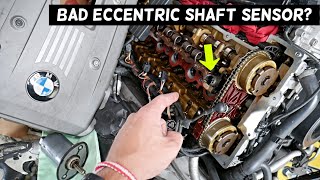
- Failed Eccentric Shaft Sensor 🔴 Very Common → Shop Engine Variable Valve Lift Eccentric Shaft Sensor — This sensor provides critical feedback to the computer on the exact position of the eccentric shaft. It often fails internally due to oil contamination from a bad seal, leading to incorrect signals, poor engine operation, and limp mode.
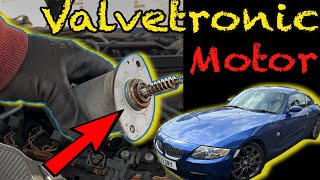
- Failed Valvetronic Motor (Actuator) 🟠 Common — This electric motor physically moves the eccentric shaft. Over time, the motor can wear out, develop internal shorts, or become sluggish, preventing it from adjusting valve lift as commanded by the DME.
- Weak Battery or Poor Electrical Connections 🟠 Common — The Valvetronic system is highly sensitive to voltage. A weak battery, failing alternator, or a corroded/loose engine ground strap can cause voltage drops that lead to erratic behavior and trigger a P1042 code, even if the motor and sensor are healthy.
- Worn Eccentric Shaft 🟡 Less Common — The eccentric shaft itself, which is moved by the Valvetronic motor, can develop wear on its gear teeth or lobes, especially with poor oil maintenance. This creates excessive resistance, preventing the motor from moving it smoothly and causing position errors.
- Clogged VANOS Non-Return Check Valves 🟡 Less Common — The VANOS system and Valvetronic system are related. Small, filtered check valves that maintain oil pressure for the VANOS system can get clogged with sludge. This can starve the cylinder head of proper oil flow, causing symptoms like rough idle that can be misdiagnosed as a Valvetronic issue.
- Damaged Wiring or Connectors ⚪ Rare — The wiring harness for the Valvetronic motor or eccentric shaft sensor can become brittle and damaged from engine heat and vibration, causing an open or short circuit. Oil from a leaking sensor can also wick down the harness, causing further damage.
- Failed Engine Control Module (DME) ⚪ Very Rare — In rare cases, a severe short-circuit in the Valvetronic motor can feed back and damage the driver circuits inside the main engine computer (DME), requiring expensive DME repair or replacement.
Symptoms
- Check Engine Light On — The engine computer will illuminate the Check Engine Light on the dashboard to alert the driver of the fault.
- Reduced Engine Power and Limp Mode — The car will feel sluggish and slow to accelerate as the engine enters a fail-safe 'limp mode,' where valve lift is fixed and engine speed is limited to prevent damage.
- Rough or Unstable Idle — The engine may shake, hunt for idle, or stall because the Valvetronic system cannot maintain precise airflow at low speeds.
- Difficult or Slow Engine Starting — The engine may crank for an extended period before starting, or fail to start on the first try, particularly when the engine is cold.
- Audible Clicking or Grinding Noise from Engine — A failing Valvetronic motor or a binding eccentric shaft can produce a noticeable clicking, grinding, or rapid ticking sound from the top of the engine, even before starting the car.
- Significantly Reduced Fuel Economy — When the Valvetronic system fails, the engine defaults to using the throttle body for load control, which is much less efficient, leading to a noticeable drop in MPG.
Diagnosis Steps
- Read the Fault Codes
Use a BMW-capable OBD-II scanner to confirm P1042 is present. Check for other related codes like P1017, P1030, 2A67 (Valvetronic Plausibility), or 2A6B (Valvetronic Power Limitation), which can help pinpoint the exact component failure.
Tools: BMW-Specific OBD-II Scanner 🟢 Beginner - Inspect the Eccentric Shaft Sensor Connector
Locate the round eccentric shaft sensor on the top front of the valve cover. Unplug its electrical connector and meticulously inspect for any sign of engine oil inside the plug or on the sensor's pins. Oil here is a definitive sign the sensor's internal seal has failed and it is compromised.
Tools: Small flathead screwdriver 🟢 Beginner - Test Battery and Charging System
The Valvetronic system requires stable voltage. Before condemning expensive parts, test the battery's health and the alternator's output. A voltage drop during cranking or operation can cause these codes. A healthy system requires 11-14 volts. Ensure the engine ground strap is clean and tight.
Tools: Multimeter, Battery Tester 🟢 Beginner - PRO TIP: Test Valvetronic Motor Directly
Disconnect the Valvetronic motor connector. Using fused jumper wires, briefly apply 12V power from the car battery to its two terminals. The motor should spin forcefully. Reverse the polarity, and it should spin forcefully in the opposite direction. A slow, weak, or non-responsive motor is faulty.
Tools: Fused jumper wires, 12V power source 🟡 Intermediate - Perform Valvetronic Limit Learn Procedure
Using a capable BMW-specific scan tool (like ISTA), command the Valvetronic system to relearn its end-stop positions. A failure to complete this procedure points directly to a hardware problem (sensor, motor, or binding shaft).
Tools: Advanced Bi-Directional Scan Tool (ISTA) 🟠 Advanced - PRO TIP: Analyze Motor Current Draw
While running the limit learn procedure with an oscilloscope connected, monitor the motor's current draw. A healthy system will show a smooth current ramp that spikes sharply to 35-45 amps as the shaft hits each mechanical end stop. A jagged waveform or no spike indicates a binding shaft or failing motor. The DME limits current to a maximum of 40 amps, but will allow up to 20 amps for periods longer than 200 milliseconds.
Tools: Oscilloscope with current probe, Advanced Scan Tool 🔴 Professional - PRO TIP: Check Eccentric Shaft Sensor Signal
With the sensor connected and ignition on, use a scan tool to monitor the eccentric shaft angle in degrees. While running a limit learn procedure, the angle should sweep smoothly from its minimum (~0-30 degrees) to its maximum (~225 degrees) position. Any dropouts, erratic readings, or a value that is stuck indicates a failed sensor or wiring issue.
Tools: Advanced Bi-Directional Scan Tool, Wiring Diagram 🔴 Professional - ADVANCED: Test Valvetronic Motor Resistance
Disconnect the Valvetronic motor connector. Set a multimeter to resistance (Ohms). Measure the resistance between the two pins on the motor. A healthy motor should read between 0 and 5 Ohms. Next, measure the resistance from each pin to the engine block (ground). The reading should be infinite (Open Loop). Any continuity to ground indicates an internal short in the motor.
Tools: Multimeter 🟠 Advanced - Inspect Components Under the Valve Cover
This requires removing the valve cover. Visually inspect the eccentric shaft for worn gear teeth and the Valvetronic motor's worm gear for damage. Check for sludge buildup or signs of oil starvation. This is a necessary step for any component replacement.
Tools: Socket set, Torque wrench, Screwdrivers 🟠 Advanced - Check VANOS Non-Return Check Valves
As a final check for confounding issues, locate and remove the two VANOS check valves on the side of the cylinder head. Inspect their filter screens for sludge and metal debris. Clogged screens can cause oil pressure issues that mimic Valvetronic faults. Clean with brake cleaner or replace if necessary.
Tools: 19mm Socket, Pick tool, Brake cleaner 🟡 Intermediate
Common Fixes & Costs
- Replace Eccentric Shaft Sensor and All Gaskets
— Parts: $300-$510, Labor: $400-$900
🔴 Professional
: OEM
: OEM - Replace Valvetronic Motor (Actuator)
— Parts: $250-$500, Labor: $400-$900
🔴 Professional
: OEM
: OEM - Replace Eccentric Shaft, Motor, and Sensor
— Parts: $1500-$2000, Labor: $1000-$1800
🔴 Professional
: OEM - Replace Valve Cover and All Gaskets
— Parts: $150-$450, Labor: $300-$600
🟡 Intermediate
: OEM - For Dodge Dart: Replace MultiAir Actuator
— Parts: $800-$1200, Labor: $500-$900
🔴 Professional
: OEM
Most Commonly Affected Vehicles
- BMW 3-Series (E90, E91, E92, E93) (2006-2013) — Models with the N52 and N51 (SULEV) engines are highly prone to Valvetronic failures. Some N51 models may have extended warranty coverage (15yr/150k miles) on the eccentric shaft sensor.
- BMW 5-Series (E60, E61) (2006-2010) — The N52-equipped 525i, 528i, and 530i models share the same Valvetronic components and common failure points like the sensor and motor.
- BMW X3 (E83) (2007-2010) — The N52 engine in the first-generation X3 is very susceptible to oil leaks that contaminate the eccentric shaft sensor, triggering P1042.
- BMW X5 (E70) (2007-2013) — E70 X5 models using the 3.0si N52 engine or the turbocharged N55 engine are commonly affected by Valvetronic motor and shaft failures.
- BMW 1-Series (E82, E88) (2008-2013) — The 128i with the N52 engine is also a common candidate for P1042 and the associated Valvetronic system repairs.
- Dodge Dart (2013-2016) — On the Dart with the 2.0L/2.4L MultiAir engine, P1042 refers to 'Implausible Data from Cylinder 2 oil supply solenoid valve'. The part number for the injectors was updated from 04593986AA to 04593986AB, suggesting a revision to address issues.
- Chevrolet Various (N/A) — On many Chevrolet vehicles, P1042 indicates a 'Malfunction in the Fuel Injector 2 Circuit', pointing to an electrical issue with the injector, its wiring, or the ECM.
- Honda Various (N/A) — For Honda, P1042 is defined as 'No. 2 Cylinder Injector Circuit Shorted', indicating a problem with the fuel injector circuit for cylinder 2.
Manufacturer-Specific Notes
- Audi / Volkswagen: On these vehicles, P1042 means 'Injector 2, Supply Voltage - Circuit Malfunction', pointing to a problem with the fuel injector on cylinder 2 or its wiring, not the valve system.
- Dodge / Chrysler / Jeep: For these brands, P1042 means 'Implausible Data from Cylinder 2 Oil Supply Solenoid Valve', related to the MultiAir valve control system. This often requires replacement of the entire MultiAir actuator assembly, also known as the 'brick'.
- Saab: On a Saab, P1042 indicates 'Injector Cylinder 4 Shorting To Battery +', a fault with the fuel injector on cylinder 4.
- Toyota: On Toyota vehicles, P1042 is defined as 'Injector 2 Supply Voltage Circuit Malfunction'.
- BMW: Many owner forums reference a SULEV (Super Ultra Low Emission Vehicle) warranty that extends coverage for certain components, including the eccentric shaft sensor, to 15 years or 150,000 miles on applicable N51 engines. Owners should always check with a dealer using their VIN to confirm coverage before paying for repairs. Forum discussions confirm successful warranty claims for the eccentric shaft sensor, valve cover gasket, and even the Valvetronic motor under this program.
Related Codes
- P1017 — This code for 'Valvetronic Eccentric Shaft Sensor Plausibility' often appears with P1042, indicating the sensor's signal is unbelievable. How to Differentiate: P1017 points almost exclusively to a faulty eccentric shaft sensor itself, whereas P1042 is a more general circuit malfunction that could also be the motor or wiring.
- P1030 — Indicates 'Valvetronic Monitoring Sluggish Movement,' pointing directly to a failing Valvetronic motor that can't keep up with commands or a physically binding eccentric shaft. How to Differentiate: If you see P1030, the primary suspect is the Valvetronic motor or mechanical resistance. P1042 can be caused by the motor, but also by the sensor or electrical issues.
- 2A67, 2A6B — These are BMW-specific fault codes for 'Valvetronic, internal fault' and 'Valvetronic, power limitation'. They are often the underlying faults that trigger the generic P1042 code and strongly point to a failing motor or sensor.
- P030X (e.g., P0304) — Misfire codes on a specific cylinder can appear alongside P1042, especially on Dodge Darts where the code relates to a specific cylinder's MultiAir solenoid.
DIY vs Professional
Climate & Environmental Factors
- Cold Weather: Cold temperatures can exacerbate issues. Engine oil becomes thicker, increasing strain on the Valvetronic motor and potentially making a sluggish motor or binding shaft more noticeable. Gaskets and seals that are already brittle may be more prone to leaking in cold weather. Cold start problems are a common symptom when the sensor fails to set the proper valve lift at shutdown.
- High Temperatures: Heat can cause electrical components to fail. A Valvetronic motor with an internal short may work when cold but fail once the engine bay reaches operating temperature. Engine heat also accelerates the degradation of wiring insulation and rubber gaskets, leading to failures.
Frequently Asked Questions
What is the Valvetronic system and how is it different from VANOS?
Valvetronic is BMW's system for controlling intake valve *lift* (how far the valves open) to manage engine load without a traditional throttle plate. VANOS is a separate system that controls valve *timing* (when the valves open and close). They work together, but P1042 is a Valvetronic-specific fault.
Can I just replace the cheap sensor seal instead of the expensive sensor?
You can, but it is only effective if you catch the leak before any oil has entered the electrical connector. If oil is already present, the sensor is contaminated and will almost certainly fail soon, making the labor of replacing only the seal a waste of time and money.
Why is the repair for P1042 on a BMW so expensive?
The high cost is primarily due to labor. To access and replace either the sensor or the motor, a technician must remove the entire engine valve cover, a job that can take 4 to 8 hours. The parts themselves, especially if using OEM or Genuine BMW parts, are also costly.
What are the most common misdiagnoses for P1042?
A common mistake is replacing the sensor or motor when the root cause is electrical. Always test the battery, alternator, and ground connections first. Another misdiagnosis is confusing a VANOS system fault (like clogged solenoids or check valves) for a Valvetronic problem, as both can cause a rough idle.
Can I use a cheap aftermarket sensor or motor?
While low-cost aftermarket parts are available, experienced technicians and owners strongly advise against them. The Valvetronic system is critical and sensitive. Using a non-OEM part (VDO is the OEM supplier for the sensor) often leads to premature failure, requiring the expensive labor to be repeated.
What does the Valvetronic motor sound like when it's failing?
A failing Valvetronic motor or binding eccentric shaft can make a distinct, rapid clicking or light grinding noise from the top of the engine. This sound can sometimes be heard for a few seconds when you unlock the car, as the system runs a self-check, or while the engine is running.
Can I clean the eccentric shaft sensor if it has oil in it?
No. While you can clean the oil out of the electrical *connector* with contact cleaner, the damage occurs inside the sealed sensor unit itself. Once oil has wicked past the internal seals, the sensor's electronics are compromised and it cannot be repaired, only replaced.
Helpful Videos
Shop the Parts Behind P1042
Below are the parts most often responsible for code P1042, ranked by how frequently each one is the actual culprit (per the diagnosis above). Tap any to see what we have for your vehicle.


The information in this article is provided for general reference and educational purposes only. Vehicle specifications, procedures, and part compatibility can vary by production date, trim level, and region. Always consult your vehicle's factory service manual and verify part numbers before purchasing or performing repairs. Safety-critical components such as airbags, seat belts, and braking systems should be installed by a qualified professional.
- 🎬 Helpful Videos
- 🛍️ Shop This Part
- What Does P1042 Mean?
- Can I Drive With P1042?
- Common Causes
- Symptoms
- Diagnosis Steps
- Common Fixes & Costs
- Most Commonly Affected Vehicles
- Manufacturer-Specific Notes
- Related Codes
- DIY vs Professional
- Climate & Environmental Factors
- Frequently Asked Questions
- What is the Valvetronic system and how is it different from VANOS?
- Can I just replace the cheap sensor seal instead of the expensive sensor?
- Why is the repair for P1042 on a BMW so expensive?
- What are the most common misdiagnoses for P1042?
- Can I use a cheap aftermarket sensor or motor?
- What does the Valvetronic motor sound like when it's failing?
- Can I clean the eccentric shaft sensor if it has oil in it?
- 🎟️ Get 5% Off