

OBD-II Code P1065: A Dual-Meaning Diagnostic Guide for ECM Power and Fuel Pressure Faults
What P1065 means, why it triggers, and the definitive guide to fixing it on your vehicle
- P1065 indicates an ECM power loss on Nissan/Infiniti vehicles or a fuel pressure regulation fault on VW/Audi diesels, requiring completely different diagnostic paths.
- For Nissan and Infiniti models, test the $20 ECM power relay inside the Intelligent Power Distribution Module (IPDM) before replacing expensive computer components.
- On VW and Audi TDI engines, a difference of over 30 bar between specified and actual fuel rail pressure points directly to a faulty N276 regulator or G247 sensor.
- Clear the P1065 code immediately if it appears after a battery replacement or dead battery event, as power interruptions trigger a false positive in over 50% of cases.
What Does P1065 Mean?
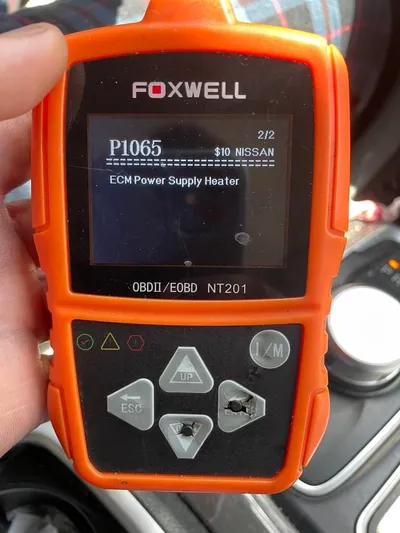
P1065 is a manufacturer-specific code with two entirely different meanings. For Nissan and Infiniti, it signifies a malfunction in the constant power supply circuit to the Engine Control Module (ECM). The ECM requires this backup power to retain vital memory for diagnostics, fuel trims, and idle settings. The code triggers when the ECM detects an interruption in that power source. For Volkswagen, Audi, and Honda diesels, P1065 indicates a fuel pressure problem, specifically 'Fuel Pressure Regulation: Control Difference' or 'Fuel Rail Pressure Lower Than Expected'.
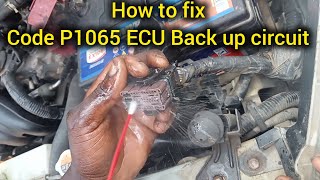
Technical definition: For Nissan/Infiniti, P1065 is 'ECM Power Supply Circuit Malfunction,' indicating compromised backup Random Access Memory (RAM) power. 🎬 Watch this guide on fixing the ECU backup circuit. For VW/Audi (TDI) and Honda (i-DTEC), it is 'Fuel Pressure Regulation: Control Difference', meaning actual fuel rail pressure significantly deviates from the ECM's requested pressure.
Can I Drive With P1065?
No — Do Not Drive. Driving is not recommended. If the code is for ECM power supply (common on Nissan/Infiniti), you face a significant risk of the engine stalling at any time, creating a serious safety hazard. If the code is for low fuel pressure (common on VW/Honda Diesel), continuing to drive causes the engine to run lean, leading to detonation, melted pistons, and catastrophic engine damage, with potential repair costs exceeding $5,000.
Common Causes

- Faulty ECM Power Relay in IPDM (Nissan/Infiniti) (Very Common) — The relay supplying constant power to the ECM is a primary failure point in Nissan and Infiniti vehicles. It is housed in the Intelligent Power Distribution Module (IPDM) and fails internally, cutting off keep-alive power.
- Loose or Corroded Battery Terminals (Common) — A poor battery connection frequently causes intermittent power loss to the entire vehicle, triggering a P1065 code even if the car still starts.
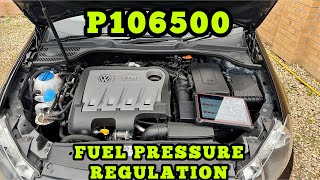
- Faulty Fuel Pressure Regulator or Sensor (VW/Audi/Honda) (Common) — For diesel engines showing this code, a faulty fuel pressure regulator (N276) 🎬 See how to fix fuel pressure regulation on VW and Audi. or fuel rail pressure sensor (G247) is the primary cause, leading to a mismatch between target and actual fuel pressure.
- Blown Fuse or Fusible Link (Common) — A dedicated fuse protects the ECM's keep-alive memory circuit. If this fuse blows due to a short or age, the ECM loses its constant power source.
- Water Intrusion into IPDM (Common) — On many Nissan/Infiniti models, clogged cowl drains cause rainwater to overflow directly onto the IPDM, shorting internal circuits and causing this code alongside other electrical gremlins.
- Parasitic Battery Drain (Common) — A component failing to shut down slowly drains the battery. On 2003-2008 Infiniti G35s, the factory Bose radio/CD changer is a known culprit that drops system voltage enough to set a P1065.
- Damaged Wiring Harness or ECM Connector (Less Common) — Wires leading from the battery to the IPDM and ECM fray or corrode. Moisture-induced corrosion on the ECM connector pins creates an open circuit.
- Failing Alternator (Less Common) — A weak alternator causes low system voltage while running, providing insufficient power to maintain ECM functions and triggering P1065 alongside charging system codes.
- Failing Engine Control Module (ECM) (Rare) — Internal ECM failure is rare and must only be considered after meticulously ruling out the battery, wiring, and IPDM.
Symptoms

- Engine Stalls or Hesitates — Due to intermittent power loss or incorrect fuel pressure, the engine stalls unexpectedly, hesitates, or enters a 'limp-home' mode with reduced power.
- Engine Cranks but Does Not Start — If the ECM lacks power, it cannot manage fuel and ignition. If fuel pressure is too low, the engine cranks but fails to start.
- Rough Idle — On VW/Audi TDI models, a discrepancy in fuel pressure regulation manifests as a rough, vibrating idle.
- Multiple Warning Lights (VDC, SLIP, ABS) — A failing ECM or IPDM disrupts CAN bus communication, causing a cascade of dashboard warning lights as other modules report communication loss.
- Check Engine Light On (also visible on scanner) — The most common indicator, often accompanied by other warning lights depending on the root cause.
- No Communication with Scan Tool (scan-tool only — no driver-felt sign) — If the ECM has no power, a diagnostic scan tool cannot establish a connection, making code reading impossible until power is restored.
Diagnostic Flowchart

Tap your situation to follow the diagnostic path that matches what you're seeing on this code.
Used vs. New Parts: Buying Guide
When a used part is worth it: A used IPDM is a viable option for older, high-mileage vehicles where the cost of a new OEM module ($700+) is a significant fraction of the car's total value. It makes sense only if purchased from a reputable seller offering a warranty.
Donor-vehicle mileage cap: roughly under 100000 miles for the part to have meaningful remaining life.
Donor quality checklist:
- Verify the seller offers at least a 90-day warranty and a return policy.
- Ensure the part does not come from a flood-damaged vehicle, as this causes rapid failure.
- Match the part number exactly. Superseded or different numbers may not be compatible without reprogramming.
- Visually inspect the connector pins for any signs of corrosion or burning before installation.
Decision logic:
- If Vehicle is less than 8 years old or has low mileage (<80k) → Buy a new OEM or high-quality aftermarket part. The reliability and warranty are worth the extra cost.
- If Vehicle is over 10 years old and budget is the primary concern → A used part from a warrantied source is an acceptable risk. Be prepared for the possibility of it failing sooner than a new part.
- If The specific failure is a known manufacturing defect that was corrected in later versions (e.g., white vs. black IPDM) → Strongly favor a new, updated part or a used part from a newer vehicle that already has the updated design.
Warranty tradeoff: Used parts typically come with a 30-90 day functional warranty. New aftermarket parts offer a 1-year to limited lifetime warranty. New OEM parts carry a 1-year/12,000-mile warranty.
Worst-case if a used part fails: $300-$600 if a used part is faulty or fails shortly after the warranty period, as this requires paying for repeat diagnostic and labor costs plus the cost of another replacement part.
What Happens If You Wait — Timeline
- Immediate: For Nissan/Infiniti: Intermittent stalling at low speeds or a no-start condition. For VW/Audi: Check Engine Light on with a flashing glow plug light, rough idle, and engine entering 'limp mode' with reduced power. (MPG impact: 0-5% (Nissan), 5-15% (VW)% · Added cost: $100-$300 (Potential cost of towing))
- 1-3 Months: For Nissan/Infiniti: Stalling becomes frequent and unpredictable, creating a significant safety risk. For VW/Audi: Continued driving with incorrect fuel pressure increases exhaust gas temperatures, stressing the turbocharger and clogging the Diesel Particulate Filter (DPF). (MPG impact: 5-10% (Nissan), 15-25% (VW)% · Added cost: $800-$2,500 (Cost for DPF cleaning/replacement or turbo damage))
- 3-6 Months: For Nissan/Infiniti: Constant voltage spikes and drops cause permanent damage to the Engine Control Module (ECM). For VW/Audi: Prolonged lean operation damages fuel injector nozzles and leads to piston ring land wear from excessive heat. (MPG impact: 10-15% (Nissan), 25%+ (VW)% · Added cost: $1,800-$4,000 (Cost for ECM replacement or fuel injector replacement))
- 6+ Months: For VW/Audi: Catastrophic engine failure. Extreme combustion temperatures from running lean lead to melted pistons or scored cylinder walls, requiring a complete engine replacement. (MPG impact: N/A (Engine Failure)% · Added cost: $5,000-$10,000+ (Cost for a used or rebuilt engine))
Cost of Not Fixing It
- Immediate: Nissan/Infiniti models risk sudden stalling, creating a severe safety hazard. VW/Honda models experience rough running and limp mode. (Added cost: Potential cost of towing ($100-$300) or an accident.)
- 1-3 months: VW/Honda engines running lean increase combustion temperatures, damaging injectors and clogging the Diesel Particulate Filter (DPF). (Added cost: $800-$2,500)
- 3+ months: Prolonged lean operation causes catastrophic engine failure, including melted pistons and damaged cylinder heads, requiring a complete engine overhaul. (Added cost: $5,000-$10,000+)
When This Code Triggers (Freeze-Frame Conditions)
- Fault Trigger: Varies by Cause (For Nissan/Infiniti, the code sets during startup immediately after an intermittent power loss event. For VW/Audi/Honda, it triggers when a significant deviation between specified and actual fuel pressure is detected.)
- Engine RPM: 850-1500 RPM (For VW/TDI, the fault appears at or just above idle, when fuel pressure regulation is unstable.)
- Vehicle Speed: 0-20 mph (Frequently occurs at low speeds or while stopped, corresponding with the low RPM trigger condition.)
- Engine Load: 20-60% (The fault logs under light to moderate load conditions, not necessarily during heavy acceleration.)
- System Voltage: < 11.8V or > 13.5V (For the ECM power fault, the trigger is a voltage drop during cranking or a voltage spike, rather than specific engine operating parameters.)
Related Codes
- U1000 — A CAN communication code often seen with P1065 on Nissans. If the ECM loses power (P1065), it drops off the communication network, triggering the U1000. Resolving the P1065 power issue clears the U1000.
- P0603 — Means 'Internal Control Module Keep Alive Memory (KAM) Error'. P1065 points to the external circuit causing the power loss, while P0603 is the ECM's internal report that memory was lost. Fix P1065 first.
- P0562 — 'System Voltage Low'. This is a direct cause of P1065. If both codes are present, diagnose P0562 first by testing the battery and alternator.
- P1610 - P1615 — These are Nissan immobilizer (NATS) codes. An intermittent ECM power supply causes the ECM and BCM to lose their security handshake, triggering these codes. They are a symptom of the root P1065 power issue.
Climate & Environmental Factors
- High Humidity / Heavy Rain: Clogged cowl drains cause rainwater to overflow and drip directly onto the IPDM, which is often located near the battery. This water intrusion is a primary cause of IPDM failure and P1065 on Nissan/Infiniti models.
- Extreme Cold: Cold weather weakens marginal batteries. The increased current draw required to start a cold engine causes system voltage to drop low enough to trigger a P1065 code, even if the car eventually starts.
- Altitude: There is no direct correlation between altitude and the triggering of P1065. The underlying electrical or fuel pressure faults are not significantly impacted by changes in atmospheric pressure.
How to Clear the Code After You Fix It
- Reconnect battery if disconnected for repair.
- Use an OBD-II scan tool to erase the P1065 and any related fault codes.
- Perform a complete drive cycle to allow the vehicle's readiness monitors to run.
Drive cycle (~30 minutes): From a cold start (engine off for 8+ hours), start the engine and idle for 2-3 minutes. Drive in stop-and-go traffic for 5-10 minutes. Accelerate to a steady highway speed (55-60 mph) and maintain for at least 15 minutes. Allow the vehicle to cool down completely. Use a scan tool to confirm readiness monitors have been set.
Readiness monitors affected: Catalyst Monitor, Evaporative System Monitor, Oxygen Sensor Monitor
Before emissions retest: drive at least 100 miles to fully set monitors.
Watch out for:
- Simply disconnecting the battery clears the code but resets all emissions readiness monitors, causing an automatic smog test failure.
- The code returns immediately if the underlying electrical or fuel pressure fault has not been properly repaired.
- Failing to complete the full drive cycle leaves monitors in a 'Not Ready' state, blocking an emissions test.
Will This Fail Emissions / State Inspection?
Yes — this code typically fails an OBD-II emissions inspection.
- California: An illuminated Check Engine Light results in an automatic smog test failure. After repair, all required readiness monitors must be complete; a 'Not Ready' status also causes a failure.
- New York: The NYS DMV inspection includes an OBD-II scan. An active P1065 code and illuminated MIL causes the vehicle to fail the emissions portion of the inspection.
- Texas: In the 17 counties requiring emissions testing, an illuminated Check Engine Light is an automatic failure. Even after repair, the vehicle cannot pass until the readiness monitors have been set by completing a drive cycle.
Most Commonly Affected Vehicles
- Nissan Altima (2002-2012) — Highly prone to P1065 from a faulty ECM relay within the IPDM. The IPDM itself is a common failure item.
- Infiniti G35 (2003-2008) — Often caused by a faulty ECM relay or parasitic battery drain from the factory Bose audio system's CD changer.
- Nissan Maxima (2004-2008) — A well-documented issue pointing to the ECM power supply circuit, often traced back to the IPDM relay or the module itself.
- Nissan Frontier, Pathfinder, Xterra (2005-2015) — The ECM power relay is a common failure point. Nissan issued a service bulletin for 2005-2006 models with the original white-colored IPDM, providing an updated relay (Part No. 284B7-CW29E).
- Nissan Titan, Armada (2004-2006) — Included in the service bulletin for faulty ECM relays in the original white IPDM, which caused stalling and no-start conditions.
- Volkswagen Jetta, Golf, Passat (TDI Models) (2009-2015) — On these TDI engines, P1065 means 'Fuel Pressure Regulation: Control Difference'. It is typically caused by a failing fuel pressure regulator (N276) or sensor (G247) on the high-pressure fuel rail.
- Honda Accord, CR-V (i-DTEC Diesel Models) (2008-2015) — For Honda's 2.2L diesel engines, P1065 means 'Fuel Rail Pressure Lower Than Expected'. Diagnosis focuses on the fuel filter, fuel pump, and injector leak-off.
- Chevrolet Cruze, Sonic, Trax (2011-2016) — On these GM models, P1065 points to an ECM Power Supply Circuit Malfunction, focusing on fuses, relays, and wiring integrity.
Manufacturer-Specific Notes

- Nissan / Infiniti: This code almost always relates to the IPDM E/R (Intelligent Power Distribution Module Engine Room). The internal, non-serviceable ECM relay was a known defect in early, white-colored IPDMs, leading Nissan to release updated black-box versions.
- Volkswagen / Audi: On VAG diesel (TDI) engines, P1065 is strictly a fuel pressure code meaning 'Fuel Pressure Regulation: Control Difference'. The cause is almost always the fuel pressure regulator or sensor on the common rail. VW issued a warranty extension for the High-Pressure Fuel Pump (HPFP) on certain 2009-2012 TDI models to 10 years/120,000 miles.
- BMW: On many BMWs, P1065 is completely unrelated and means 'VVT Limp Home Request - Full Stroke Position Not Reached'. It points to a fault in the Valvetronic variable valve lift system.
- Hyundai / Kia: For some Hyundai and Kia models, P1065 relates to the 'Oil Pressure Control Valve Stuck On', a component of the variable valve timing (VVT) system, and has no connection to the ECM's main power supply.
Real Owner Stories
2005 Nissan Pathfinder with no-start and P1065
The vehicle cranked but would not start, or stalled intermittently. The P1065 code returned immediately after being cleared. The owner had recently replaced a corroded battery terminal.
What they tried:
- Cleared the code by disconnecting the battery, but it returned on the second startup.
- Checked fuses related to the ECM.
Outcome: The root cause was a faulty ECM relay inside the Intelligent Power Distribution Module (IPDM). The fix was replacing the relay with an updated version, resolving the stalling permanently.
Lesson: On a Nissan/Infiniti with stalling or no-start and a P1065, the IPDM's internal ECM relay is the prime suspect. Swap the ECM relay with an identical one from a non-critical system (like the horn) to see if the car starts.
2010 VW Golf TDI with rough idle
The car developed a rough, vibrating idle and felt like it was running on 3 cylinders below 1100 RPM. A P1065 code for 'Fuel Pressure Regulation Control Difference' was present.
What they tried:
- Scanned the vehicle with VCDS, confirming a significant difference between specified and actual fuel rail pressure at idle.
Outcome: The problem was resolved by replacing the entire fuel rail, which included a new fuel pressure regulator (N276) and fuel rail pressure sensor (G247).
Lesson: For VW/Audi TDI engines, P1065 is a fuel system fault. A rough idle points directly to the fuel rail components. Replacing the entire rail with OEM parts is a common and effective solution.
2003 Infiniti G35 with 170k miles
The battery died overnight repeatedly. After disconnecting and reconnecting the battery to save it, a P1065 code appeared. The car ran fine otherwise.
What they tried:
- Disconnected the negative terminal after every drive to prevent the battery from dying.
Outcome: The issue was traced to a parasitic draw from the OEM Bose 6-disc CD changer. Unplugging the CD changer resolved the battery drain, and clearing the P1065 code fixed the issue permanently.
Lesson: On older Infiniti G35s, if you have a P1065 accompanied by a dying battery, test for a parasitic draw. The factory radio/CD changer is a common culprit and can be unplugged to confirm.
2004 Nissan 350Z with P1065 after DIY work
The owner disconnected the battery for a week to perform maintenance. After reconnecting it, the car ran rough at low RPMs and set a P1065 code.
What they tried:
- Used a scanner to clear the code, but it returned.
- Performed an ECU reset procedure.
Outcome: The code was a 'false positive' triggered by the extended battery disconnection. The ECM's keep-alive memory was lost. After clearing the code and performing a throttle position relearn procedure, the issue was resolved.
Lesson: If P1065 appears immediately after a battery disconnection, it is often a false positive. Clear the code with a scan tool and drive the car. If it doesn't return, no further action is needed.
How to Prevent This Code From Triggering
- Clean Cowl Drains Annually (Nissan/Infiniti) (Once per year, especially before rainy seasons) — Leaves and debris clog the drains below the windshield, causing rainwater to overflow directly onto the IPDM. Keeping these drains clear prevents IPDM water damage and failure.
- Clean and Tighten Battery Terminals (Every oil change or every 6 months) — Corrosion and loose terminals create high resistance, causing intermittent voltage drops to the entire electrical system. This triggers a 'false' P1065 code and stresses all electronics.
- Replace Fuel Filter on Schedule (Diesel Models) (Every 20,000 miles or as per manufacturer's interval) — A clogged fuel filter restricts flow, forcing the high-pressure fuel pump to work harder and making it difficult to maintain target rail pressure, leading to P1065.
- Use Diesel Fuel Lubricity Additives (VW/Audi TDI) (Every fill-up) — The CP4 high-pressure fuel pump is sensitive to the lower lubricity of US diesel fuel. Additives improve lubrication, reducing wear on the pump and preventing catastrophic failure.
- Avoid Running Below a Quarter Tank of Fuel (Diesel Models) (Daily habit) — The in-tank lift pump relies on being submerged in diesel fuel for cooling. Frequently running the tank low causes the pump to overheat, leading to premature failure and low-pressure supply issues.
Frequently Asked Questions
I got P1065 after disconnecting my battery. Is it a real problem?
This is very common. The ECM logs this code when it detects a loss of its keep-alive power. If you recently disconnected the battery or had it die, clear the code, ensure terminals are tight, and drive the vehicle to see if it returns.
Is P1065 an expensive fix?
Costs vary dramatically based on the root cause. A blown fuse or corroded terminal costs under $50, while an IPDM replacement approaches $1,000. A failed ECM is the most expensive repair, often exceeding $1,800 for the part and programming.
What is an IPDM and where is it?
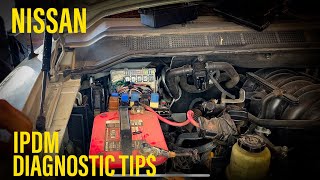
The IPDM (Intelligent Power Distribution Module) is Nissan/Infiniti's smart fuse and relay box. It is usually located in the engine compartment next to the battery. It holds fuses and relays and uses its own processor to control them.
Can I just replace the ECM relay in the IPDM?
On older, white-colored IPDMs, the ECM relay was internal and non-serviceable, requiring full unit replacement. On newer black IPDMs, the ECM relay is a standard, swappable component. While Nissan officially advises against swapping relays, it remains a highly effective diagnostic step.
Why does the code definition change for different car brands?
OBD-II codes starting with 'P0' are generic and identical across all vehicles. Codes starting with 'P1' are manufacturer-specific, allowing carmakers to provide detailed diagnostic information. Always verify the exact definition for your specific vehicle's make and model.
What is a common misdiagnosis for P1065?
The most common and costly misdiagnosis is replacing the ECM prematurely. Always rule out battery connections, fuses, the ECM relay, and the IPDM itself before condemning the computer. On diesel models, test the regulator and sensor before replacing the expensive high-pressure fuel pump.
My car has P1065 and U1000. Which do I fix first?
Fix P1065 first. The U1000 code indicates a CAN communication error caused by the ECM losing power and dropping off the network. Restoring power to the ECM resolves the P1065 and automatically clears the U1000 code.
Key Takeaways
- P1065 indicates an ECM power loss on Nissan/Infiniti vehicles or a fuel pressure regulation fault on VW/Audi diesels, requiring completely different diagnostic paths.
- For Nissan and Infiniti models, test the $20 ECM power relay inside the Intelligent Power Distribution Module (IPDM) before replacing expensive computer components.
- On VW and Audi TDI engines, a difference of over 30 bar between specified and actual fuel rail pressure points directly to a faulty N276 regulator or G247 sensor.
- Clear the P1065 code immediately if it appears after a battery replacement or dead battery event, as power interruptions trigger a false positive in over 50% of cases.
Helpful Videos
Shop the Parts Behind P1065
Below are the parts most often responsible for code P1065, ranked by how frequently each one is the actual culprit (per the diagnosis above). Tap any to see what we have for your vehicle.


The information in this article is provided for general reference and educational purposes only. Vehicle specifications, procedures, and part compatibility can vary by production date, trim level, and region. Always consult your vehicle's factory service manual and verify part numbers before purchasing or performing repairs. Safety-critical components such as airbags, seat belts, and braking systems should be installed by a qualified professional.
- 🧭 Diagnostic Flowchart
- 🎬 Helpful Videos
- 🛍️ Shop This Part
- What Does P1065 Mean?
- Can I Drive With P1065?
- Common Causes
- Symptoms
- Used vs. New Parts: Buying Guide
- What Happens If You Wait — Timeline
- Cost of Not Fixing It
- When This Code Triggers (Freeze-Frame Conditions)
- Related Codes
- Climate & Environmental Factors
- How to Clear the Code After You Fix It
- Will This Fail Emissions / State Inspection?
- Most Commonly Affected Vehicles
- Manufacturer-Specific Notes
- Real Owner Stories
- 2005 Nissan Pathfinder with no-start and P1065
- 2010 VW Golf TDI with rough idle
- 2003 Infiniti G35 with 170k miles
- 2004 Nissan 350Z with P1065 after DIY work
- How to Prevent This Code From Triggering
- Frequently Asked Questions
- I got P1065 after disconnecting my battery. Is it a real problem?
- Is P1065 an expensive fix?
- What is an IPDM and where is it?
- Can I just replace the ECM relay in the IPDM?
- Why does the code definition change for different car brands?
- What is a common misdiagnosis for P1065?
- My car has P1065 and U1000. Which do I fix first?
- Key Takeaways
- 🎟️ Get 5% Off