

P1072 on 2007-2013 Toyota Corolla 1.5L: Decoding the 'Phantom' Code and Fixing the Real P0172 'System Too Rich' Issue
P1072 is a common scanner error for the actual trouble code, P0172 (System Too Rich). On the 1.5L 1NZ-FE engine, this is most often caused by a dirty Mass Airflow (MAF) sensor or leaking/dirty fuel injectors. The first and cheapest step is to clean the MAF sensor, which costs around $15 for a can of cleaner. If that fails, suspect the fuel injectors.
- The code P1072 on your scanner is an error; the real code you need to diagnose is P0172 (System Too Rich).
- For the 1NZ-FE engine, the most likely cause is a dirty MAF sensor. Cleaning it with dedicated cleaner is a cheap and effective first step.
- If cleaning the MAF sensor improves fuel trims but doesn't fix them completely, the next most probable cause is a leaking or poorly flowing fuel injector.
- Check live data: normal MAF at idle is ~1.6-1.7 g/s, and long-term fuel trims should be within +/- 10%. P0172 will show trims of -20% or more negative.
What's Unique About the 2007-2013 Toyota Corolla
The specified 2007-2013 Toyota Corolla with a 1.5L 1NZ-FE engine is a configuration primarily found in international markets, such as the Japanese Domestic Market (JDM) Toyota Corolla Axio. For this specific 1NZ-FE engine, the P0172 code is well-documented. The Denso Mass Airflow (MAF) sensor is known to be sensitive to contamination, and dirty or leaking fuel injectors have been identified as a direct cause of this code on this platform. A detailed diagnostic case on a 1NZ-FE engine showed that after cleaning a dirty MAF sensor, the long-term fuel trim improved from -38% to -20%, but the code returned until faulty fuel injectors were replaced, which brought trims back to normal.
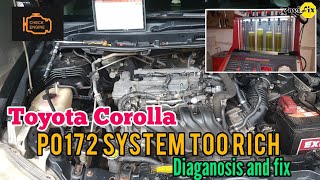
🎬 Watch: Diagnostic walkthrough of a Toyota P0172 rich codeSymptoms You May Notice
- Check Engine Light is on
- Reduced fuel economy
- Strong smell of gasoline from the exhaust
- Black smoke from the tailpipe
- Rough or unstable idle
- Engine hesitation or lack of power, sometimes described as knocking on acceleration
- Hard starting, especially when the engine is cool
- Replacing spark plugs or ignition coils. A diagnostic case on the 1NZ-FE showed that replacing these parts did not fix the P0172 code, which was ultimately traced to the MAF and injectors.
Most Likely Causes
- Dirty Mass Airflow (MAF) Sensor 🔴 High Probability The MAF sensor measures the amount of air entering the engine. When contaminated with oil or dirt, it under-reports airflow, causing the ECM to inject too much fuel. This is a very common issue on many Toyota engines, including the 1NZ-FE. The Denso sensor uses a fine platinum wire that is sensitive to contamination.
How to confirm: Use a scan tool to monitor the MAF sensor reading at idle. For the 1.5L 1NZ-FE, a normal reading is around 1.6-1.7 g/s. A significantly higher reading (e.g., over 2.0 g/s) at idle suggests a dirty sensor, causing the ECM to incorrectly calculate a higher engine load and inject more fuel.
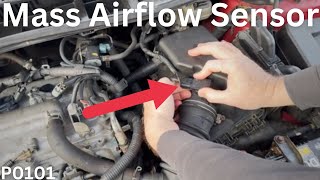
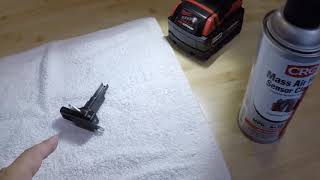
Typical fix: Remove the sensor and clean it carefully with a dedicated MAF sensor cleaner spray. Do not touch the sensor wires. Let it dry completely before reinstalling. 🎬 Watch: How to inspect and clean your Toyota MAF sensor
Est. part cost: $10-$20 for cleaner - Leaking or Dirty Fuel Injectors 🟡 Medium Probability Fuel injectors can become clogged with deposits or wear out, causing them to leak fuel into the cylinders or have an inconsistent spray pattern. This has been confirmed as a root cause for P0172 on the 1NZ-FE engine after a MAF cleaning did not fully resolve the issue. One injector flowing just a little more than the others can cause a rich condition.
How to confirm: If cleaning the MAF sensor does not resolve the negative fuel trims, fuel injectors are the next likely cause. A professional injector cleaning and flow test service can confirm if they are leaking or have an improper spray pattern. A diagnostic on a 1NZ-FE showed one injector flowing significantly more volume than the others, which was the ultimate cause of the P0172 code.
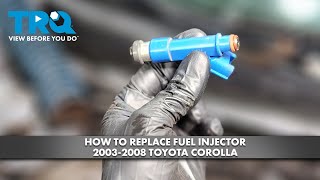
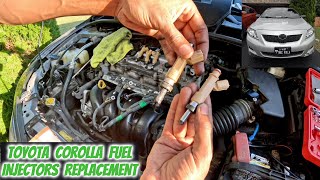
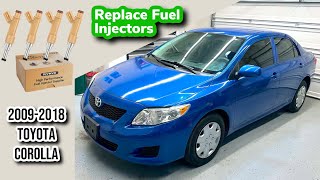
Typical fix: Have the fuel injectors professionally cleaned and flow-tested, or replace them with new or remanufactured units. Using quality brands like Denso is recommended. Replacement is often necessary as cleaning may not restore faulty injectors. 🎬 Watch: Step-by-step Toyota Corolla fuel injector replacement
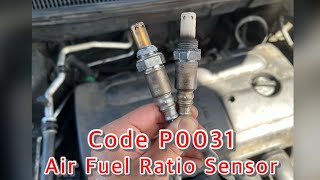
Est. part cost: $50-$150 per injector - Faulty Air/Fuel Ratio Sensor (Bank 1, Sensor 1) ⚪ Low Probability → Shop Oxygen Sensor This sensor, also known as the upstream oxygen sensor, is critical for fuel control. If it becomes sluggish or fails, it can send an incorrect 'rich' signal to the ECM, causing the computer to pull fuel unnecessarily.
How to confirm: Use a scan tool to monitor the sensor's voltage. A healthy sensor will fluctuate rapidly between approximately 0.1V and 0.9V. A sensor that is stuck high or responds sluggishly may be faulty.
Typical fix: Replace the Air/Fuel Ratio sensor. It is located on the exhaust manifold before the catalytic converter. Denso is the OEM supplier.
Est. part cost: $80-$200
Rare But Worth Checking
- Severely Clogged Engine Air Filter: A completely blocked air filter can restrict airflow enough to cause a rich condition. It's a simple maintenance item that should always be checked first.
- High Fuel Pressure: A failing fuel pressure regulator can cause excessive pressure in the fuel rail, leading to a rich mixture. This is less common than sensor or injector issues but can be identified by a hissing sound near the fuel rail.
- Leaking EVAP Purge Solenoid: If the purge valve sticks open, it can create a vacuum leak that introduces un-metered fuel vapors into the intake manifold, causing a rich condition.
Diagnosis Steps
- Confirm the code with a reliable OBD-II scanner. If it shows P1072, assume the real code is P0172.
- Use the scanner to view live data, specifically the Short-Term Fuel Trim (STFT) and Long-Term Fuel Trim (LTFT). For P0172, you will see highly negative numbers (e.g., -20% or more) as the ECM tries to pull fuel.
- Check the engine oil for fuel smell. A strong gasoline odor can indicate leaking injectors causing fuel to dilute the oil.
- Inspect the engine air filter and replace it if it is dirty or clogged.
- Locate the MAF sensor on the intake tube after the air filter box. Disconnect and remove it.
- Spray the sensor's wires and components liberally with dedicated MAF sensor cleaner. Let it air dry completely before reinstalling.
- Clear the trouble codes, start the engine, and monitor the fuel trims again. A successful MAF cleaning on a 1NZ-FE can cause a significant drop in negative fuel trims (e.g., from -38% to -20%), but if they don't return to near zero, another problem exists.
- If fuel trims are still highly negative, the next step is to investigate the fuel injectors. Remove the injectors and send them to a professional service for cleaning and flow testing to check for leaks and volume inconsistencies.
- If injectors are confirmed to be good, investigate the air/fuel ratio sensor for proper operation using the live data on your scan tool. Check for rapid voltage fluctuation.
- Check fuel pressure to rule out a faulty fuel pressure regulator.
Parts You'll Likely Need
- Mass Airflow (MAF) Sensor Cleaner — This is the highest probability, lowest cost first step to fix a P0172 code on this engine.
Trusted brands: CRC, WD-40 Specialist
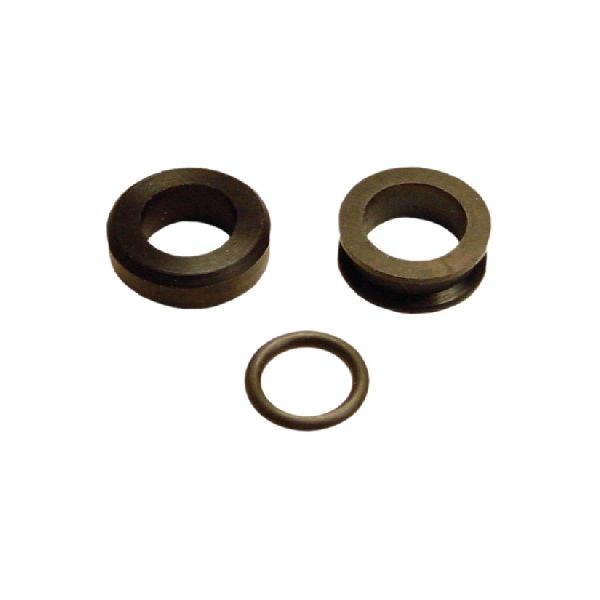
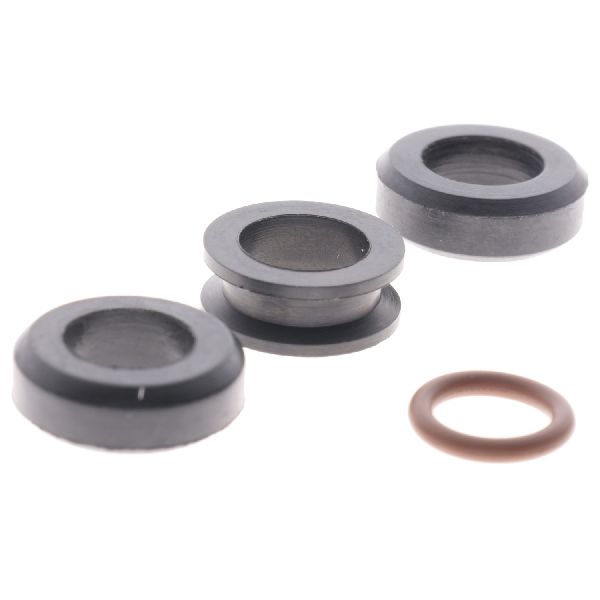
Aftermarket price range: $10-$20 - Fuel Injector
(OEM #23250-21020, 23209-21020)— A documented cause of P0172 on the 1NZ-FE engine when a MAF cleaning is not sufficient. Part numbers 23209-21040 and 23250-21040 are also functionally identical replacements used in various 1NZ-FE applications.
Trusted brands: Denso (OEM)
OEM price range: $150-$250
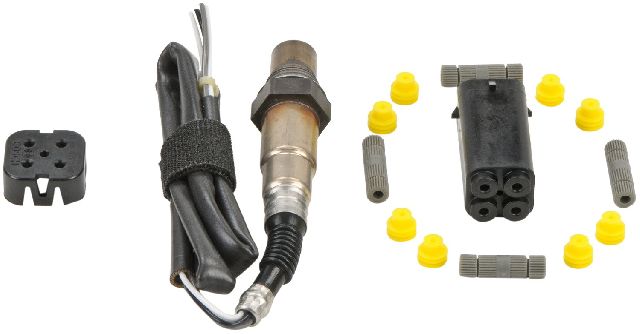
Aftermarket price range: $50-$150 - Air/Fuel Ratio Sensor
(OEM #Denso 234-9021 or 234-9052 (verify fitment))— This is the primary sensor for fuel control. If it fails, it can cause a persistent rich condition. Denso is the OEM supplier.
Trusted brands: Denso, Bosch
OEM price range: $180-$250
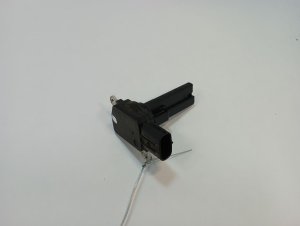
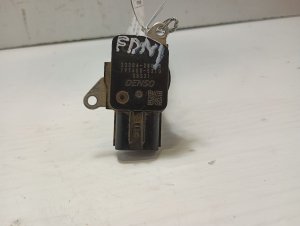
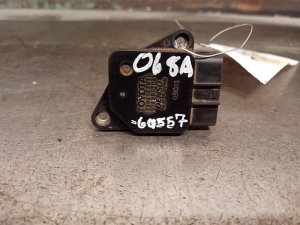
Aftermarket price range: $80-$150 - Mass Airflow (MAF) Sensor
(OEM #Denso 197-6030 (insert only), Toyota 22204-22010)— If cleaning the sensor does not resolve the issue, the sensor itself may have failed. Denso is the OEM supplier.
Trusted brands: Denso (OEM)
OEM price range: $140
Aftermarket price range: $40-$80
Related Codes That Often Appear With This One
- P0300, P0301, P0302, etc. — If a single fuel injector is leaking badly, it can cause a misfire in that specific cylinder, triggering a corresponding misfire code alongside the P0172.
- P0101 — This code indicates a MAF sensor circuit range/performance issue. It often appears with P0172 because a dirty or faulty MAF sensor is a common root cause for both codes.
Mechanic-Grade Diagnostic Values
- Fuel Pressure (at idle) — expected: 304 to 343 kPa (44.1 to 49.7 psi). Failure: Pressure significantly above this range indicates a faulty regulator or restricted return line.
- Residual Fuel Pressure — expected: 147 kPa (21 psi) or more, 5 minutes after engine stop. Failure: Pressure dropping below this indicates a leaking injector, faulty fuel pump check valve, or leaking regulator.
- Fuel Injector Resistance — expected: 11.6 to 12.6 Ω at 20°C (68°F). Failure: Resistance outside this range indicates a faulty injector coil.
- Fuel Injector Flow Volume — expected: 47 to 58 cm³ per 15 seconds, with no more than 11 cm³ difference between injectors.. Failure: An injector flowing significantly more than others will cause a rich condition.
- Mass Airflow (MAF) Sensor Voltage at ECM — expected: 1.1 to 1.5 V at idle with A/C OFF. Failure: Voltage significantly outside this range can indicate a faulty sensor or wiring issue.
- Mass Airflow (MAF) Sensor Reading (Key-On, Engine-Off) — expected: Approx. 0.28 g/sec. Failure: A reading other than the specified value with the engine off points to a sensor or wiring fault.
- Air/Fuel Ratio Sensor (Upstream O2) Voltage at ECM — expected: 3.3 V with Ignition ON (engine off). Failure: Incorrect voltage in a KOEO state suggests a sensor or wiring fault.
- Long Term Fuel Trim (LTFT) Malfunction Threshold — expected: Within approx. +/- 20%. Failure: The P0172 code is typically set when the combined short and long-term fuel trims go below -35%. Viewing this value in freeze frame data is critical.
Hidden / Shadow Codes Worth Checking
- Freeze Frame Data: Not a code, but a critical snapshot of engine parameters (RPM, vehicle speed, coolant temp, and crucially, fuel trims) at the exact moment the P0172 was set. This data is invaluable for determining the conditions that caused the rich fault. (see via Any standard OBD-II scanner with live data or freeze frame capability.)
- Pending Code: The P0172 fault may be stored as a 'Pending Code' after the first drive cycle where the rich condition is detected, before the Check Engine Light illuminates on the second consecutive fault. (see via Most OBD-II scanners will show pending codes.)
Scan Tool Commands That Help
- Toyota Techstream: Active Test: Fuel Pump Speed Control — Allows the technician to command the fuel pump on to test for fuel pressure and listen for pump operation without starting the engine.
- Toyota Techstream: Vehicle Control / INSPECTION MODE — This mode is used to allow the engine to idle for checks like measuring fuel pressure under stable running conditions.
- Toyota Techstream or advanced scanner: Active Test: EVAP Purge VSV — Allows the technician to manually command the EVAP purge solenoid open and closed to check for physical operation and see its effect on fuel trims, helping to diagnose a stuck-open valve.
Wiring & Ground Locations
- MAF Sensor Connector (C26) — On the MAF sensor body, located in the air intake tube right after the air filter housing.. This is the primary connection for the sensor that provides airflow data. Test for voltage and continuity here. Pin 3 (VG) is the signal wire to the ECM, and Pin 2 (E2G) is the sensor ground.
- ECM Connector (C20) — Typically located behind the glove box on this generation of Corolla.. Allows for checking continuity from the sensor to the computer. The MAF signal arrives at pin C20-118 (VG) and its ground is at C20-116 (E2G). The A/F sensor signal is at C20-112 (A1A+).
- Engine/ECU Grounds — Key ground points for the engine harness are typically located on the cylinder head and intake manifold. The main ECU body ground is often secured to the chassis behind the dashboard.. A poor ground for the MAF sensor (E2G) or the ECU itself can cause incorrect sensor readings, leading to fuel trim errors like P0172.
Real Owner Repair Stories
- YouTube Channel 'learn auto scanning' (2008 Toyota Allion 1.5L 1NZ-FE) — Check Engine Light (P0172), low power, high fuel consumption, knocking on acceleration.
❌ Tried (didn't work) Replaced spark plugs (twice), Replaced two ignition coils, Replaced Air/Fuel ratio sensor, Performed engine tune-up (twice)
✅ What actually fixed it The fuel injectors were removed and tested on a Launch CNC 602 machine. The test revealed inconsistent flow rates. After installing a balanced set of injectors, the long-term fuel trim dropped to 0% and the short-term trim stabilized near -5%, resolving the rich condition.
When the Usual Fixes Don't Work
- In a documented repair of a 1NZ-FE engine with P0172, the common first steps of replacing the A/F sensor and ignition components did not solve the problem. The ultimate fix required professionally testing and replacing the fuel injectors, which were found to be flowing inconsistently. This highlights that while cleaning the MAF sensor is a good first step, a persistent P0172 on this engine often points directly to the fuel injectors as the root cause.
OEM Part Supersession History
22204-0D030, 22204-0C020→22204-22010— Part consolidation and potential design updates by Toyota/Denso over the years.
Model Year Variations Within This Range
- 2007-2013 (all): All vehicles in this range with the 1NZ-FE engine use an Electronic Throttle Control System (ETCS-i), which was standardized on this engine starting in 2005. This means diagnostics related to idle air control valves (IACV) found on older engines are not applicable.
Diagnostic Flowchart
Other Known Issues on This Vehicle
Issues unrelated to this code that are worth knowing about as an owner of this generation:
- Excessive Oil Consumption 🟠 Medium — More common on high-mileage engines (over 100,000 miles / 160,000 km), often due to piston rings sticking or worn valve seals.
- Water Pump Failure 🟠 Medium — The water pump bearing or seal can fail with age, leading to coolant leaks from the weep hole or a whining/grinding noise from the front of the engine.
- Timing Chain Stretch 🟡 Low — After 100,000+ miles, the timing chain may stretch, causing a rattling sound on cold startups. While not as severe as in other engines, it is a known high-mileage wear item.
- VVT-i Solenoid / Filter Clogging 🟡 Low — The oil control valve (OCV) for the VVT-i system has a small filter screen that can become clogged with sludge if oil changes are neglected, leading to VVT-i related codes (like P1349) and rough running.
Used vs. New Parts: Buying Guide for This Vehicle
When a used part is the smart pick: For this repair, obtaining used parts is generally not recommended for the core components. However, structural or passive parts like a MAF sensor housing (if the insert is being replaced), connectors, or sections of the intake tube are perfectly acceptable from a reputable salvage yard.
Donor-vehicle mileage cap: roughly under 80000 miles for the part to have meaningful remaining life.
What to inspect on the donor part:
- Check for a clean, well-maintained donor vehicle without signs of front-end collision or engine fire.
- If pulling a MAF sensor, inspect the connector for corrosion and the sensor wires for any visible contamination or damage.
- Ask for the vehicle's VIN to check its history if possible.
OEM-only on this vehicle (don't cheap out):
- Air/Fuel Ratio Sensor (Oxygen Sensor)
- Fuel Injectors
Aftermarket brands forum-validated for this vehicle:
- Denso (for sensors and injectors, as they are the Original Equipment Manufacturer)
- CRC (for Mass Airflow Sensor Cleaner)
Brands owners have reported issues with on this vehicle:
- Unbranded, 'no-name' electronic sensors and fuel injectors from online marketplaces. These are frequently poorly calibrated, fail quickly, and can make diagnosis more difficult.
Real Owner Stories
Aggregated from forums and TSBs cited above. Mileages and costs reflect what owners reported in those sources.
2010 Toyota Corolla 1.8L — 48000 miles
Symptoms: Check engine light on with codes P0101 and P0172.
What fixed it: Cleaning the Mass Airflow (MAF) sensor.
Source hint: BobIsTheOilGuy.com - 'P0101 & p0172; 2010 Toyota Corolla 1.8l 48k miles'
1999 Toyota Corolla 1.8L
Symptoms: Rough idle and a hissing noise near the engine.
What fixed it: The user was investigating a rich condition (P0172) and identified symptoms common to the platform.
Source hint: Reddit r/Cartalk - '99 Corolla Code P0172 Running too Rich, Not Sure of Where to Go.'
Toyota Corolla 1.5L 1NZ-FE
Symptoms: Highly negative fuel trims (STFT and LTFT) and engine knocking on acceleration.
What fixed it: Professional injector cleaning and flow test service revealed one injector was flowing significantly more volume than the others; replacing/cleaning the injectors resolved the issue after MAF cleaning failed.
Source hint: Article Context
Related OBD-II Codes
Frequently Asked Questions
My scanner shows P1072 on my 1NZ-FE Corolla, but I can't find much info on it. Is this a common Toyota code?
What is the most likely cause for a rich condition on the 1.5L 1NZ-FE engine?
What should the MAF sensor reading be at idle for a healthy 2007-2013 Corolla 1.5L?
I cleaned my MAF sensor but my fuel trims are still highly negative. What is the next step for this specific engine?
Can I use any cleaner to fix the MAF sensor on my Corolla?
Is there a specific brand of replacement parts recommended for the 1NZ-FE fuel system?
Helpful Videos


Used OEM Parts in Stock
New Aftermarket Parts Available


The information in this article is provided for general reference and educational purposes only. Vehicle specifications, procedures, and part compatibility can vary by production date, trim level, and region. Always consult your vehicle's factory service manual and verify part numbers before purchasing or performing repairs. Safety-critical components such as airbags, seat belts, and braking systems should be installed by a qualified professional.
- Toyota Corolla:
- 🧭 Diagnostic Flowchart
- 🎬 Helpful Videos
- 🛍️ Shop This Part
- What's Unique About the 2007-2013 Toyota Corolla
- Symptoms You May Notice
- Most Likely Causes
- Rare But Worth Checking
- Diagnosis Steps
- Parts You'll Likely Need
- Related Codes That Often Appear With This One
- Mechanic-Grade Diagnostic Values
- Hidden / Shadow Codes Worth Checking
- Scan Tool Commands That Help
- Wiring & Ground Locations
- Real Owner Repair Stories
- When the Usual Fixes Don't Work
- OEM Part Supersession History
- Model Year Variations Within This Range
- Other Known Issues on This Vehicle
- Used vs. New Parts: Buying Guide for This Vehicle
- Real Owner Stories
- 2010 Toyota Corolla 1.8L — 48000 miles
- 1999 Toyota Corolla 1.8L
- Toyota Corolla 1.5L 1NZ-FE
- Related OBD-II Codes
- Frequently Asked Questions
- 🎟️ Get 5% Off