

P1101 on 2014-2023 Ford Transit Connect 2.5L: MAF Sensor Fault Causes and Fixes
For a 2014-2023 Transit Connect with the 2.5L engine, code P1101 is most often caused by a dirty Mass Airflow (MAF) sensor. The fix is usually to clean it with dedicated MAF sensor cleaner, a 1/5 difficulty DIY job that costs about $15. If that doesn't work, check for vacuum leaks before replacing the sensor, which is a less common failure.
- P1101 on your Transit Connect 2.5L means the MAF sensor reading is out of its expected range.
- Before buying any parts, spend $15 on a can of dedicated MAF sensor cleaner and clean the sensor. This is the most common fix.
- If cleaning the sensor doesn't work, thoroughly inspect the intake hose and vacuum lines for cracks or loose connections.
- Do not replace the MAF sensor unless you have ruled out a dirty sensor and vacuum leaks first.
- This is a very DIY-friendly repair, requiring only basic hand tools and a can of cleaner to start.
What's Unique About the 2014-2023 Ford Transit Connect
The 2.5L Duratec in the Transit Connect is a straightforward, naturally aspirated engine known for its reliability. Unlike Ford's turbocharged EcoBoost engines that use multiple pressure sensors and are prone to oil contamination from the PCV system causing P1101, the code on this platform typically points to simpler issues. The most common culprits are a MAF sensor contaminated by dust or debris from the air filter, or unmetered air entering the engine through a simple vacuum leak in a hose or gasket.
Symptoms You May Notice
- Check Engine Light is on
- Rough, unstable, or fluctuating idle.
- Engine stalling, especially when coming to a stop or at low RPM.
- Hesitation, stumbling, or lack of power during acceleration.
- Reduced fuel economy.
- A hissing sound from the engine bay, indicating a possible vacuum leak.
- Replacing the oxygen (O2) sensors. While a vacuum leak can sometimes trigger lean codes (P0171), the O2 sensors are usually just reporting the problem, not causing it.
- Replacing the throttle body. Unless there are specific throttle body codes present (like P2111 or P2135), it is rarely the cause of a P1101 fault.
Most Likely Causes
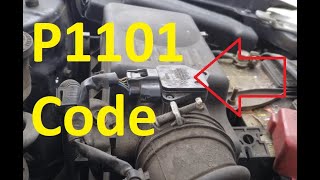
- Dirty or Contaminated Mass Airflow (MAF) Sensor 🔴 High Probability → Shop Fuel Injection Air Flow Meter The MAF sensor's delicate sensing wires are located in the intake tract and can become coated with fine dust, dirt, or oil vapor over time, insulating them and causing inaccurate readings. This is the most common and easiest-to-fix cause for P1101. 🎬 Watch: A breakdown of P1101 causes and common fixes.
How to confirm: Visually inspect the sensor's wires after removal. If they appear dull, dusty, or coated, they need cleaning. The definitive test is to clean the sensor and see if the code and symptoms resolve. A car may run better after disconnecting a faulty MAF sensor because the computer defaults to a pre-programmed 'limp' mode.
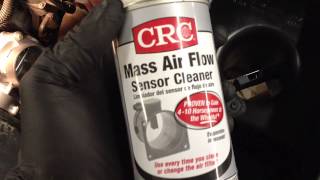
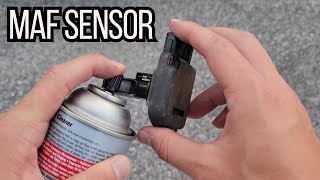
Typical fix: Remove the MAF sensor and clean it thoroughly with a dedicated MAF sensor cleaner spray. Do not touch the sensor wires with anything. Allow it to dry completely before reinstalling. 🎬 See this guide on cleaning your MAF sensor properly.
Est. part cost: $10-$20 for a can of MAF cleaner. - Vacuum Leak 🟡 Medium Probability Rubber and plastic vacuum hoses, intake ducting, and gaskets can crack, become brittle, or loosen over time, allowing unmetered air to enter the engine after the MAF sensor. This extra air isn't measured by the sensor, causing the PCM to see a discrepancy and trigger P1101. This is often seen with a P0171 (System Too Lean) code.
How to confirm: Visually inspect all intake and vacuum hoses for cracks or loose connections. A professional can perform a 'smoke test' which fills the intake with vaporized smoke to easily reveal the source of any leaks.
Typical fix: Replace the cracked hose, leaking gasket, or tighten the loose connection that is causing the leak.
Est. part cost: $5-$100 depending on the specific hose or gasket that has failed. - Faulty Mass Airflow (MAF) Sensor ⚪ Low Probability → Shop Fuel Injection Air Flow Meter
How to confirm: If cleaning the sensor and confirming there are no vacuum leaks does not resolve the code, the sensor's internal electronics have likely failed. This can be confirmed by monitoring the sensor's output (g/s) with a scan tool; if it's erratic, non-responsive, or gives readings far below expected values under load, the sensor is bad.
Typical fix: Replace the MAF sensor with a new unit.
Est. part cost: $75-$250
Rare But Worth Checking
- Damaged Wiring or Connector: The wiring harness leading to the MAF sensor can become frayed or corroded, causing an intermittent signal. While not specific to P1101, Ford has issued TSBs for this vehicle (e.g., TSB 16-0163 for P0443) related to wiring harnesses chafing on other components, so a visual inspection of the harness is worthwhile.
- Plugged PCV Orifice: → Shop PCV Valve Though more common on other engines, a clogged Positive Crankcase Ventilation (PCV) system can cause excessive crankcase pressure. This can disrupt normal air/fuel metering and potentially trigger a P1101. A GM service bulletin (20-NA-047) for P1101 on different engines points directly to a plugged PCV orifice as the cause, suggesting it's a valid, though rare, diagnostic path if other causes are ruled out.
Diagnosis Steps
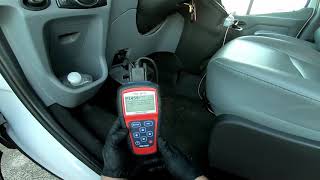
- Read the Code: Use an OBD-II scanner to confirm P1101 is the primary code. Note any other codes present, especially P0171 or P0101.
- Inspect the Air Intake System: Visually inspect the entire air intake tract from the air filter box, past the MAF sensor, and all the way to the throttle body. Look for obvious cracks in the plastic/rubber, disconnected hoses, or loose clamps. Ensure the air filter is clean and properly seated.
- Clean the MAF Sensor: Disconnect the battery. Unplug the MAF sensor's electrical connector (note: some connectors have a red locking tab that must be slid out before the release tab can be pressed). Remove the two security Torx screws (T20H size with a center pin) and carefully pull the sensor out. Spray the sensor's wires and elements generously with dedicated MAF sensor cleaner. Do NOT touch the wires. Let it air dry completely for at least 20-30 minutes before reinstalling.
- Clear Codes and Test Drive: Reinstall the clean sensor, reconnect the connector and battery, and clear the codes with your scanner. Drive the vehicle to see if the code returns. If it does not, the problem is solved.
- Check for Vacuum Leaks: If the code returns, the next step is to check for vacuum leaks. With the engine running, you can carefully spray short bursts of brake cleaner or an unlit propane torch around gasket surfaces and vacuum lines. A change in engine idle indicates you've found the leak. For a more definitive test, have a shop perform a smoke test.
- Test the MAF Sensor Circuit: If no vacuum leaks are found, check the MAF sensor's wiring for damage. Use a multimeter to check for proper voltage (typically a 5V reference and 12V power), ground, and signal integrity at the connector.
- Replace the MAF Sensor: If all previous steps fail to resolve the issue, the MAF sensor itself is likely faulty and should be replaced with a quality OEM or aftermarket part.
Parts You'll Likely Need
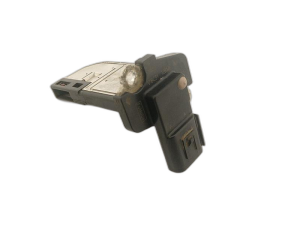
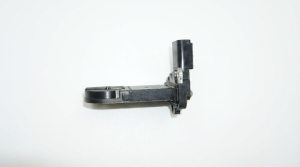
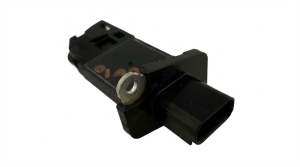
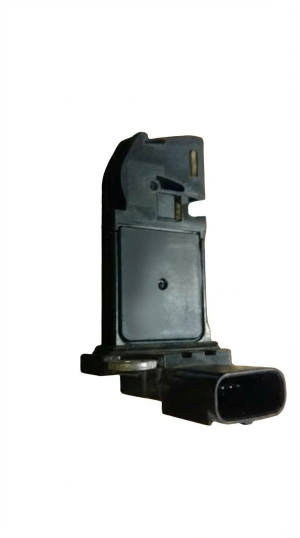
- Mass Airflow (MAF) Sensor
(OEM #AFLS-196 (Service Part), CP9Z-12B579-B (Engineering Part))— This is the part that fails if cleaning the original sensor and fixing any vacuum leaks does not resolve the P1101 code.
Trusted brands: Motorcraft, Bosch, Denso, Walker, Hitachi
OEM price range: $140-$230
Aftermarket price range: $75-$150 - MAF Sensor Cleaner — This is the first and most common fix. A contaminated sensor is far more likely than a completely failed one.
Trusted brands: CRC, Liqui Moly, WD-40 Specialist
Aftermarket price range: $10-$20
Related Codes That Often Appear With This One
- P0101 — This is the generic SAE equivalent of P1101. They both point to a MAF sensor range/performance issue and can appear together.
- P0171 — System Too Lean (Bank 1). This code is often triggered alongside P1101 if the root cause is a vacuum leak, which allows unmetered air into the engine, creating a lean air/fuel mixture.
- P1450 — Unable to Bleed Up Fuel Tank Vacuum. This code often points to a faulty canister purge valve. A stuck-open purge valve can create a vacuum leak, which may also trigger P1101 under certain conditions. 🎬 Watch: How to replace the purge valve for P1450 codes.
Platform-Specific Known Issues
- Brittle Air Filter Housing Clips: → Shop Air Cleaner Assembly The clips holding the air filter housing cover can become brittle and break. If the cover is not sealed properly, it can allow unfiltered, dirty air to bypass the filter and contaminate the MAF sensor, leading to P1101. When servicing the air filter, care should be taken with these clips.
Mechanic-Grade Diagnostic Values
- MAF Sensor Live Data (g/s) at Idle — expected: Approximately 2.5 g/s. A general rule is that the g/s reading at idle should be close to the engine's displacement in liters.. Failure: A reading significantly higher (e.g., 17 g/s) or lower than the expected 2.5 g/s at a stable idle suggests a faulty sensor or a major vacuum leak.
- MAF Sensor Voltage (KOER - Key On, Engine Running at idle) — expected: Approximately 0.8V to 1.2V at a stable, warm idle.. Failure: A voltage reading significantly outside this range, or one that is stuck (e.g., 1.7V at idle), points to a sensor or wiring issue.
- MAF Sensor Voltage (KOEO - Key On, Engine Off) — expected: 0.0V. The sensor should not read any voltage when the engine is not running.. Failure: Any voltage reading above 0.0V with the engine off indicates a faulty sensor or a wiring short.
- MAF Sensor Connector Pin Voltages (KOEO) — expected: One pin should have 12V+ (battery voltage), one pin should be ground (0.0V), and the signal wire should be 0.0V.. Failure: Missing 12V power or a bad ground (voltage reading higher than 0.1V on the ground pin) indicates a wiring or fuse issue upstream of the sensor.
Wiring & Ground Locations
- G101 — Lower left rear of the engine.. A poor engine ground can cause erratic sensor readings. While not directly tied to the MAF sensor in all diagrams, ensuring the main engine grounds are clean and tight is a critical step in diagnosing any electronic sensor fault.
- G100 / G103 / G106 — Left side of the engine compartment.. These are primary chassis grounds in the engine bay. The MAF sensor's circuit ultimately relies on a solid ground path back to the battery. Corrosion or looseness at these points can introduce resistance and voltage drops, affecting sensor performance.
- MAF Sensor Connector — On the air intake tube, immediately after the air filter housing.. This is the primary point for testing power, ground, and signal for the MAF sensor. The pins are typically for 12V power, chassis ground, signal ground, and the 0-5V signal wire back to the PCM.
Real Owner Repair Stories
- YouTube video by 'Ford Tech Makuloco' (paraphrased from similar documented repairs) (Ford vehicle with P1450 and lean codes (often accompanying P1101)) — Rough idle, stalling after refueling, and a hissing noise from the engine bay. Check engine light on with P1450 and sometimes P0171/P1101.
❌ Tried (didn't work) Cleaning the MAF sensor., Searching for a traditional vacuum leak with a smoke test.
✅ What actually fixed it The canister purge valve was stuck open, creating a constant vacuum leak that the MAF sensor could not account for. Replacing the purge valve resolved the lean condition and the associated P1101 code.
"I Checked Everything" — The Actual Cause
- A common scenario is a smoke test revealing no leaks in the main intake tract, but the actual cause is a stuck-open EVAP canister purge valve. This introduces unmetered fuel vapors (acting as a vacuum leak) into the intake manifold *after* the throttle body, which can confuse the PCM's expected airflow calculations and trigger P1101, often with P0171 and P1450.
OEM Part Supersession History
CP9Z-12B579-B→No direct supersession found, this remains the current engineering part number.— N/A
Heads up: The service part number is often listed as AFLS-196. Both refer to the same sensor for this application. Ensure the replacement is specified for the 2.5L engine, as other Ford engines use physically similar but electronically different sensors.
Diagnostic Flowchart
Other Known Issues on This Vehicle
Issues unrelated to this code that are worth knowing about as an owner of this generation:
- 6F35 Transmission Failures and Driveability Issues 🔴 High → Shop Transmission Assembly — Widespread. Can occur at any mileage, but issues like shuddering, harsh shifting, and delayed engagement are commonly reported from 60,000 miles onward. Some failures occur much earlier. (Ref: Recall 21S24 was issued for a detached shifter cable bushing, which could prevent the vehicle from securing in Park, but does not address the internal mechanical/hydraulic failures.)
- Intake Manifold Runner Control (IMRC) Stuck 🟠 Medium → Shop Engine Intake Manifold — Common at higher mileage (80,000+ miles). Carbon buildup can cause the runner flaps to stick, or the plastic actuator components can fail, leading to codes like P2006 (Stuck Closed) or P2004 (Stuck Open).
- Faulty Canister Purge Valve 🟡 Low — A common failure item that can cause stalling after refueling, rough idle, and EVAP system codes (e.g., P0455). It's a relatively inexpensive and easy part to replace.
- Cooling Fan Module/Sensor Failure 🟠 Medium — Reported issue where the cooling fans fail to activate, causing the temperature gauge to read high, even if the engine isn't critically overheating. This is often due to a faulty cylinder head temperature sensor or the fan control module itself.
Used vs. New Parts: Buying Guide for This Vehicle
When a used part is the smart pick: A used OEM MAF sensor from a low-mileage (under 60,000 miles) wrecked vehicle can be a cost-effective alternative to a new aftermarket part. Since the primary failure mode is contamination (which can be cleaned), a functional used sensor is often a reliable choice.
Donor-vehicle mileage cap: roughly under 60000 miles for the part to have meaningful remaining life.
What to inspect on the donor part:
- Check the donor vehicle's mileage if possible.
- Inspect the sensor for physical damage to the housing or connector.
- Look at the sensing wires; if they are physically broken, the part is useless. If they are just dirty, it can likely be cleaned.
- Ensure it is a genuine Ford/Motorcraft part by looking for the logo.
OEM-only on this vehicle (don't cheap out):
- While not strictly 'OEM-only', electronic sensors like the MAF are critical for engine management. Using a genuine Ford/Motorcraft part, whether new or used, is highly recommended to avoid calibration issues common with some budget aftermarket brands.
Aftermarket brands forum-validated for this vehicle:
- Hitachi
- Bosch
- Denso
- Walker Products
Brands owners have reported issues with on this vehicle:
- Unnamed, no-brand 'white box' parts from online marketplaces are a significant gamble. They often have poor calibration, leading to persistent performance issues or the code returning quickly.
Related OBD-II Codes
Frequently Asked Questions
I'm seeing P1101 on my 2014-2023 Ford Transit Connect; what is the most likely cause for this specific engine?
Does the shifter cable recall (21S24) have anything to do with my P1101 code?
My air filter housing clips are broken; could this be causing my P1101 code?
Can I use any cleaner to fix the MAF sensor on my Transit Connect?
Is it true that the 2.5L engine in my Transit Connect shares parts with Mazda models?
My van is stalling after I get gas and has a P1101; are these related?
Helpful Videos
We Have This Part in Stock

The information in this article is provided for general reference and educational purposes only. Vehicle specifications, procedures, and part compatibility can vary by production date, trim level, and region. Always consult your vehicle's factory service manual and verify part numbers before purchasing or performing repairs. Safety-critical components such as airbags, seat belts, and braking systems should be installed by a qualified professional.
- Ford Transit Connect:
- 🧭 Diagnostic Flowchart
- 🎬 Helpful Videos
- 🛍️ Shop This Part
- What's Unique About the 2014-2023 Ford Transit Connect
- Symptoms You May Notice
- Most Likely Causes
- Rare But Worth Checking
- Diagnosis Steps
- Parts You'll Likely Need
- Related Codes That Often Appear With This One
- Platform-Specific Known Issues
- Mechanic-Grade Diagnostic Values
- Wiring & Ground Locations
- Real Owner Repair Stories
- "I Checked Everything" — The Actual Cause
- OEM Part Supersession History
- Other Known Issues on This Vehicle
- Used vs. New Parts: Buying Guide for This Vehicle
- Related OBD-II Codes
- Frequently Asked Questions
- 🎟️ Get 5% Off