

P1101 on 2010-2012 Saab 9-5: Intake Air Flow Performance Causes and Fixes
On a 2010-2012 Saab 9-5 with the 2.0T engine, code P1101 is most often caused by an unmetered air leak in the intake system, particularly from charge air cooler hoses or a faulty PCV system. Start by inspecting all intake hoses for cracks and loose clamps, especially the connection at the throttle body. If no leaks are found, clean the MAF sensor. If the issue persists, the integrated PCV system in the camshaft cover is a likely culprit.
- P1101 on your Saab 9-5 means there is a discrepancy in the air intake system.
- Do not immediately replace the MAF sensor. The most common cause is an unmetered air leak from a cracked or loose hose.
- Thoroughly inspect all intake piping between the air filter and the throttle body before buying any parts.
- A faulty PCV system is a very common, documented cause for this code on related GM engines and should be a primary suspect.
- Cleaning the MAF sensor with a dedicated cleaner is a cheap and effective diagnostic step.
What's Unique About the 2010-2012 Saab 9-5
The 2010-2012 Saab 9-5 (NG9-5) is built on the General Motors (GM) Epsilon II platform and primarily uses the GM 2.0L Turbo (LHU) engine. For this reason, P1101 is strongly linked to issues common on this GM engine family. Multiple GM Technical Service Bulletins (TSBs) point to two main culprits: a plugged PCV orifice in the camshaft cover causing excessive crankcase pressure (TSB 20-NA-047), or leaks at the charge air cooler (CAC) connections (TSB PIP5402C, 18-NA-333). Therefore, diagnosis must extend beyond the MAF sensor and focus heavily on the integrity of the entire boosted intake path and the PCV system.
Symptoms You May Notice
- Check Engine Light is on
- Reduced engine power or 'limp mode'
- Rough or unstable idle
- Hesitation during acceleration
- Stalling when stopped
- Decreased fuel economy
- Whistle type noise from the engine bay, especially on startup or acceleration.
- Immediately replacing the MAF sensor without checking for air leaks. An air leak is more common and will cause a brand new MAF sensor to read incorrectly, leading to the same code.
- Replacing the throttle body when it only needs to be cleaned.
Most Likely Causes
- Air leak in the intake system (Post-Turbo) 🔴 High Probability The turbocharged intake system has numerous pressurized hoses and couplers. GM TSB 18-NA-333 specifically calls out a poor connection of the Charge Air Cooler (CAC) outlet hose at the throttle body. TSB PIP5402C points to a missing or damaged O-ring seal in the CAC coupler. These rubber and plastic parts can crack, split, or loosen over time.
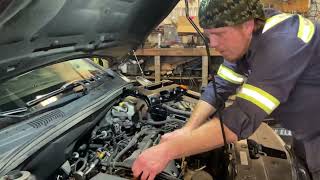
How to confirm: Visually inspect all intake ducting from the turbo to the throttle body. Pay close attention to the hose connections at the intercooler and throttle body. 🎬 Watch: Finding and fixing common P1101 air leaks. A smoke test is the most effective way to find leaks in the pressurized charge pipes.
Typical fix: Reseat and tighten the hose clamp at the throttle body. Replace a missing/damaged O-ring or replace the cracked/damaged charge air hose.
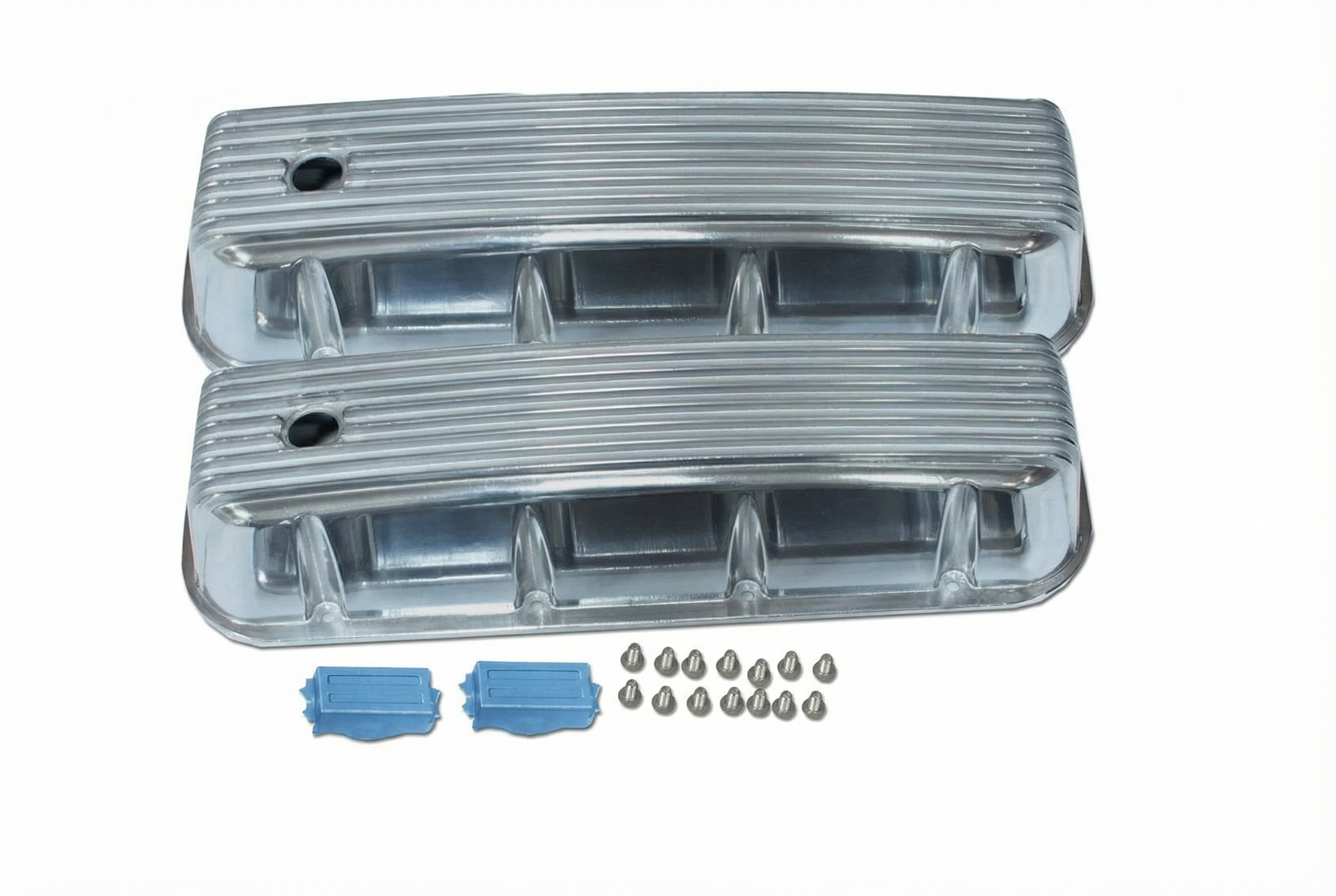
Est. part cost: $20 (O-ring) - $250 (hose) - Plugged PCV Orifice / Faulty Camshaft Cover 🔴 High Probability → Shop PCV Valve GM TSB 20-NA-047 describes how a plugged PCV orifice leads to excessive crankcase pressure, which the ECM interprets as an airflow rationality fault, triggering P1101. The PCV system, including the non-serviceable orifice, is integrated into the camshaft cover (valve cover) on the LHU engine.
How to confirm: Check for excessive crankcase pressure. A mechanic can use a manometer to measure pressure at the dipstick tube; readings above 0 inches of water at hot idle indicate a problem. A simpler, less precise test is to remove the oil cap at idle; strong suction or pressure suggests a PCV malfunction.
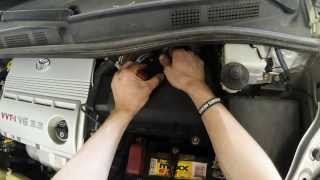
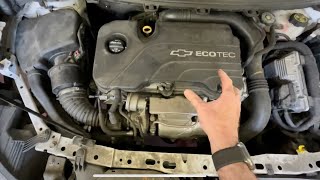
Typical fix: The official fix is to replace the entire camshaft cover assembly. 🎬 Watch: Step-by-step guide to replacing the camshaft cover and PCV. The cover contains the updated PCV orifice and passages. The OEM part number is GM 55564395, which may be superseded by 12605217.
Est. part cost: $150-$420 - Dirty or Faulty Mass Airflow (MAF) Sensor 🟡 Medium Probability → Shop Fuel Injection Air Flow Meter Oil vapor from a malfunctioning PCV system or fine dust bypassing the air filter can contaminate the MAF sensor's delicate sensing wire, causing inaccurate readings. Aftermarket oiled air filters are a common source of contamination.
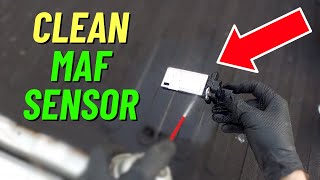
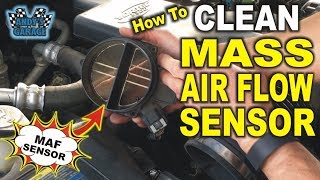
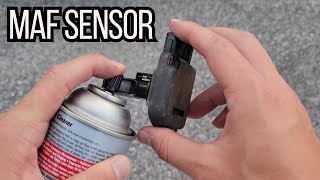
How to confirm: Remove the sensor and visually inspect the sensing elements. If they appear dirty, clean them ONLY with dedicated MAF sensor cleaner spray. 🎬 See how to safely clean your MAF sensor elements. A scan tool can monitor the MAF reading in g/s; erratic or illogical readings that don't correspond to engine RPM changes indicate a problem.
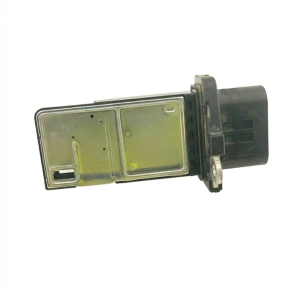
Typical fix: Clean the sensor with MAF sensor cleaner. If cleaning doesn't resolve the issue, replace the MAF sensor. The OEM part is typically a Bosch sensor, GM part number 15865791.
Est. part cost: $20 (cleaner) or $115-$250 (new sensor) - Dirty Throttle Body ⚪ Low Probability → Shop Fuel Injection Throttle Body Carbon and oil from the PCV system can build up around the throttle plate, restricting airflow at idle or preventing the plate from closing properly, which can confuse the airflow model.
How to confirm: Remove the intake duct connected to the throttle body and inspect the throttle plate and bore for black, sticky buildup. A scan tool may show a high 'Throttle Body Idle Air Flow Compensation' percentage.
Typical fix: Clean the throttle body bore and plate with throttle body cleaner and a soft cloth or brush. An idle relearn procedure may be necessary afterward.
Est. part cost: $15-$25
Rare But Worth Checking
- Leaking Turbocharger Seals: If the turbocharger's internal seals fail, oil can be forced into the intake system, contaminating the intercooler, piping, and sensors, which can trigger P1101 along with other codes like P0299 (Engine Underboost). This is often accompanied by blueish smoke from the exhaust.
- Aftermarket Air Intake or Filter: The Saab factory service information specifically warns that some aftermarket air filters or intake systems can cause this code to set. A poorly fitting or overly oiled filter can skew MAF sensor readings and trigger the code.
Diagnosis Steps
- Read the code with an OBD-II scanner and check for any other stored codes.
- Visually inspect the entire air intake system, especially the charge air cooler hoses and their connections at the intercooler and throttle body. Look for obvious cracks, splits, loose clamps, or signs of oil residue indicating a leak.
- Check the engine air filter. A severely clogged or improperly installed filter can cause this code.
- If you have an aftermarket 'oiled' air filter, check if it has been recently over-oiled.
- Carefully remove and inspect the MAF sensor for contamination. If dirty, clean it with dedicated MAF sensor cleaner and let it dry completely before reinstalling.
- Perform a crankcase pressure test. With the engine at hot idle, carefully try to remove the oil cap. Significant suction or pressure points to a PCV system problem. For a more accurate test, a manometer should be used at the oil dipstick tube.
- Perform a smoke test on the intake system to check for vacuum and boost leaks that are not visually apparent. This is the most reliable way to find unmetered air leaks.
- Inspect and clean the throttle body if significant carbon buildup is present.
- If all else fails, the issue could be a faulty MAF sensor or, in rare cases, a problem with the ECM.
Parts You'll Likely Need
- Camshaft Cover (Valve Cover)
(OEM #55564395 / 12605217)— The PCV valve/orifice is integrated into the cover on the 2.0T LHU engine. A clog or failure requires replacing the entire cover assembly to resolve high crankcase pressure issues causing P1101.
Trusted brands: ACDelco, Genuine GM/Saab
OEM price range: $250-$420
Aftermarket price range: $150-$250 - Charge Air Cooler Hose / Duct — The rubber/plastic hoses carrying pressurized air from the turbo can crack or split with age and heat, causing unmetered air leaks, a primary cause of P1101.
Trusted brands: ACDelco, Genuine Saab/Orio
OEM price range: $150-$250
Aftermarket price range: $50-$150 - Mass Airflow (MAF) Sensor
(OEM #15865791)— If cleaning the sensor doesn't work, the sensor itself may have failed and is providing incorrect data to the ECM.
Trusted brands: Bosch, Delphi, ACDelco
OEM price range: $115-$200
Aftermarket price range: $80-$150 - MAF Sensor Cleaner — This is a low-cost first step. Often, simply cleaning a dirty MAF sensor is enough to fix the problem.
Trusted brands: CRC, WD-40
OEM price range: $15-$20
Aftermarket price range: $15-$20
Related Codes That Often Appear With This One
- P0171 — System Too Lean (Bank 1). An unmetered air leak that causes P1101 also allows extra, unmeasured air into the engine. The oxygen sensors detect this as a lean condition, triggering P0171.
- P0068 — Throttle Body Airflow Performance. This code is often listed alongside P1101 in service manuals as they both relate to a mismatch between expected and actual airflow.
- P0299 — Turbocharger/Supercharger Underboost. This code often appears with P1101 when there is a significant air leak in the pressurized intake tract after the turbo, such as a cracked charge pipe or intercooler. The leak causes both the airflow mismatch (P1101) and the loss of boost pressure (P0299).
Technical Service Bulletins (TSBs) & Recalls
- GM TSB 20-NA-047: Addresses high crankcase pressure from a plugged PCV orifice causing oil leaks and/or DTC P1101. Details the procedure for testing crankcase pressure and replacing the orifice/camshaft cover.
- GM TSB 18-NA-333: Points to a poor installation of the Charge Air Cooler (CAC) outlet air hose at the throttle body as a cause for P1101 and a potential whistle noise. The fix is to simply remove and properly reinstall the hose.
- GM TSB PIP5402C: Instructs technicians to inspect for a missing or damaged O-ring seal in the charge air cooler coupler on the passenger side as a cause for P1101, P015B, and P0101. Recommends using a smoke machine to isolate leaks.
Platform-Specific Known Issues
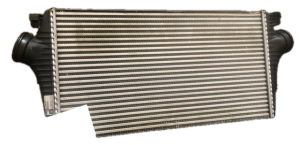
- Cracked Charge Air Cooler Hose: → Shop Intercooler A common failure point discussed on forums like SaabCentral is the charge air cooler outlet hose, particula
Mechanic-Grade Diagnostic Values
- Mass Airflow (MAF) Sensor Reading at Idle — expected: 2.0 - 7.0 g/s (grams/second) at normal operating temperature. A common rule of thumb is that the g/s reading should be close to the engine's displacement in liters (e.g., ~2.0 g/s for the 2.0L engine).. Failure: A reading significantly higher or lower than the engine displacement at idle, or a reading that does not increase smoothly with RPM, indicates a problem.
- Mass Airflow (MAF) Sensor Reading at 2500 RPM — expected: 15 to 25 g/s.. Failure: The reading should rise in a steady, linear fashion with RPM. If the graph of the reading is erratic, rises too slowly, or too quickly, it can indicate a faulty sensor or an air leak.
- Mass Airflow (MAF) Sensor Signal Voltage — expected: Between 0.5V and 4.5V during normal operation. Some sources cite a KOER (Key On Engine Running) self-test range of 0.46V to 2.44V.. Failure: A voltage below 0.2V or above 4.9V will typically set a specific MAF sensor circuit code (like P0100). A P1101 is set when the voltage is within range but doesn't correlate with other sensor inputs.
- Short-Term Fuel Trim (STFT) after disconnecting MAF sensor — expected: With the MAF sensor disconnected, the engine enters a backup speed-density fuel mode. The STFT should quickly correct towards 0% (+/- 10%).. Failure: If disconnecting the MAF sensor causes high fuel trims to normalize, it strongly suggests the MAF sensor was providing inaccurate (but not out-of-range) data, causing the P1101.
Scan Tool Commands That Help
- Tech2 / GDS2 (GM Dealer Tool): Throttle Sweep Test — According to Saab/GM diagnostic procedures for P1101/P0068, a technician can perform a throttle sweep test while monitoring the TAC Motor parameter. This helps verify if the throttle body is responding correctly and not a source of the airflow mismatch.
- Tech2 / GDS2 (GM Dealer Tool): Snapshot / Data Review — The official diagnostic procedure involves taking a data snapshot while slowly increasing engine RPM to 3,000 and back to idle. Reviewing this data allows a technician to see if the MAF sensor g/s parameter changes smoothly and gradually, which is critical for diagnosing P1101.
Wiring & Ground Locations
- G107 — Engine compartment, forward of the battery.. This is a primary ground point for the engine control system. A corroded or loose G107 can cause erratic voltage and signal readings for multiple sensors, including the MAF, leading to rationality codes like P1101.
- MAF Sensor Connector (Pin 5) — At the MAF sensor electrical connector.. On some similar GM applications, the MAF signal wire is Pin 5 (often a brown/blue wire). Probing this pin is necessary for checking the sensor's output voltage directly, though many modern GM MAF sensors output a frequency signal instead of a simple 0-5V analog voltage, making a scan tool the preferred diagnostic method.
Real Owner Repair Stories
- YouTube - Fixing the Infamous GM / Chevy P1101 (Buick Encore 1.4L Turbo (similar GM engine family)) — Persistent P1101 code.
❌ Tried (didn't work) Replaced camshaft/valve cover (for PCV issue), Installed an external PCV fix kit, Replaced MAF sensor
✅ What actually fixed it The final fix was replacing a cracked intercooler hose (charge pipe). A proper diagnosis was not performed initially, leading to unnecessary parts replacement. The air leak from the hose was the root cause.
OEM Part Supersession History
12576410→15865791— Updated design or manufacturer change for the Mass Airflow (MAF) Sensor.55558673→55564395— Updated design for the Camshaft Cover, likely to address PCV issues.15835855, 92234619→19181416— Updated part for the Power Brake Booster Check Valve Kit.
Diagnostic Flowchart
Real Owner Stories
Aggregated from forums and TSBs cited above. Mileages and costs reflect what owners reported in those sources.
2011 Buick Regal 2.0L Turbo
Symptoms: Severe hesitation and low power condition accompanied by multiple codes.
What fixed it: The owner chased the issue by replacing coils, spark plugs, and solenoids in an attempt to fix the severe hesitation and airflow codes.
Source hint: Edmunds.com Forum: 2011 Buick Regal 2.0L Turbo HELP ME! P340, P341, P1101 codes
Buick Encore 1.4L
Symptoms: P1101 MAF code triggering the check engine light.
What fixed it: After replacing the valve cover (PCV) and cleaning the MAF and throttle body, the ultimate cause was found to be a cracked intercooler hose.
Source hint: YouTube: Fixing the Infamous GM / Chevy P1101 MAF Code on my Buick Encore 1.4L
1.5L LFV Engine
Symptoms: P1101 code accompanied by an engine misfire.
What fixed it: A failed PCV system was confirmed as the root cause via a crankcase pressure test, agreeing with a prior shop's diagnosis.
Source hint: YouTube: P1101 PCV Valve Diagnosis 1.5L LFV… Bonus Misfire Diagnosis
Saab 9-5
Symptoms: Check engine light with P1101 code.
What fixed it: Identified and replaced a cracked charge air cooler outlet hose, which is a common failure point discussed on the forums.
Source hint: SaabCentral forum (Vehicle Specific Issues: Cracked Charge Air Cooler Hose)
Related OBD-II Codes
Frequently Asked Questions
Does GM TSB 20-NA-047 apply to my 2010-2012 Saab 9-5?
I hear a whistle noise from the engine bay on startup. Is this related to P1101?
Can a bad O-ring cause the P1101 code on my Saab 9-5?
How do I test if the PCV system is causing my P1101 code?
What MAF sensor part number do I need if cleaning it doesn't clear the P1101 code?
Why is my Saab 9-5 going into 'limp mode' with a P1101 code?
Helpful Videos

We Have This Part in Stock

The information in this article is provided for general reference and educational purposes only. Vehicle specifications, procedures, and part compatibility can vary by production date, trim level, and region. Always consult your vehicle's factory service manual and verify part numbers before purchasing or performing repairs. Safety-critical components such as airbags, seat belts, and braking systems should be installed by a qualified professional.
- Saab 9-5:
- 🧭 Diagnostic Flowchart
- 🎬 Helpful Videos
- 🛍️ Shop This Part
- What's Unique About the 2010-2012 Saab 9-5
- Symptoms You May Notice
- Most Likely Causes
- Rare But Worth Checking
- Diagnosis Steps
- Parts You'll Likely Need
- Related Codes That Often Appear With This One
- Technical Service Bulletins (TSBs) & Recalls
- Platform-Specific Known Issues
- Mechanic-Grade Diagnostic Values
- Scan Tool Commands That Help
- Wiring & Ground Locations
- Real Owner Repair Stories
- OEM Part Supersession History
- Real Owner Stories
- 2011 Buick Regal 2.0L Turbo
- Buick Encore 1.4L
- 1.5L LFV Engine
- Saab 9-5
- Related OBD-II Codes
- Frequently Asked Questions
- 🎟️ Get 5% Off