

P1107 on 2004-2011 GMC Canyon: MAP Sensor Circuit Low Intermittent Causes & Fixes
On a 2004-2011 GMC Canyon, code P1107 almost always points to broken wires inside the insulation of the MAP sensor's wiring harness, a known issue cited in GM TSB #PIP4409F. The break is typically within a few inches of the connector. The fix is usually an inexpensive wiring pigtail repair, costing under $30 for the part, rather than replacing the sensor itself.
- P1107 on a 2004-2011 GMC Canyon is almost certainly a wiring issue near the MAP sensor connector.
- Before buying any parts, perform a 'wiggle test' on the MAP sensor harness with the engine running to see if it affects the idle.
- Do not replace the MAP sensor without first ruling out the wiring harness, as this is the most common misdiagnosis.
- The fix is typically inexpensive, requiring a new connector pigtail and basic wiring skills.
- This code is often accompanied by P0107, P0106, and P0300, which are all related to the same root cause.
What's Unique About the 2004-2011 Gmc CANYON
The first-generation GMC Canyon and its sibling, the Chevrolet Colorado (GMT355 platform), are highly susceptible to this specific code due to a well-documented wiring issue. General Motors issued Technical Service Bulletin #PIP4409F which identifies that the wires for the MAP sensor circuit frequently break *inside* the insulation, usually within 1-3 inches of the sensor connector. The external wire may look perfectly fine, but the internal copper strands fracture from engine vibration and heat, causing the intermittent signal that triggers P1107.
Diagnostic Flowchart
Tap your situation to follow the diagnostic path that matches what you're seeing on this vehicle.
Symptoms You May Notice
- Check Engine Light is on
- Engine runs rough or has a poor/unstable idle
- Hesitation or stumbling during acceleration
- Engine may stall, especially at idle
- Decreased fuel economy
- Black smoke from the exhaust if the fuel mixture becomes too rich
- Replacing the MAP sensor without first performing a 'wiggle test' on the wiring harness. On this specific truck, the wiring is the most common failure point, not the sensor itself, as confirmed by TSB #PIP4409F and numerous owner experiences.
Most Likely Causes
- Broken Wires in MAP Sensor Harness 🔴 High Probability → Shop Manifold Absolute Pressure Sensor As documented in TSB #PIP4409F, the wiring harness near the MAP sensor connector is prone to internal wire breakage from engine vibration and heat cycles. The break is typically within inches of the connector, but the insulation often remains intact, hiding the damage.
How to confirm: With the engine running, gently wiggle the wiring harness within 1-3 inches of the MAP sensor connector. If the engine's idle changes, stumbles, or stalls, the wiring is faulty. This is the definitive 'wiggle test'. You can also backprobe the signal wire (typically Light Green) with a multimeter; wiggling the harness will cause the voltage to drop out if the wire is broken internally.
Typical fix: Replace the MAP sensor connector pigtail. This involves cutting off the old connector and splicing the new one in its place using butt connectors or solder and heat shrink tubing. Common pigtails include ACDelco PT2187 or Dorman 645-203.
Est. part cost: $15-$40 - Faulty Manifold Absolute Pressure (MAP) Sensor 🟡 Medium Probability → Shop Manifold Absolute Pressure Sensor
How to confirm: If the wiring is confirmed to be good, test the sensor. Using a scan tool, check the MAP sensor voltage with the key on, engine off (KOEO), which should be ~4.5V at sea level. At idle, it should drop to ~1.0-2.0V. If readings are stuck or do not change with engine vacuum, the sensor is likely bad.
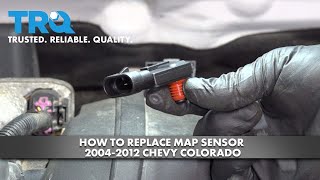
Typical fix: Replace the MAP sensor. It is mounted on the intake manifold and held in place by a small clip. 🎬 See this walkthrough on how to replace the MAP sensor. The OEM part number is often ACDelco 213-4658.
Est. part cost: $40-$80 - Poor Connection at MAP Sensor or PCM ⚪ Low Probability → Shop Manifold Absolute Pressure Sensor
How to confirm: Visually inspect the pins in the MAP sensor connector and the corresponding pins at the Powertrain Control Module (PCM) for corrosion, moisture, or being bent/backed out. Ensure the PCM connector is fully seated.
Typical fix: Clean the connector pins with an appropriate electrical contact cleaner. If a pin is damaged, the connector pigtail will need to be replaced.
Est. part cost: $5-$25
Rare But Worth Checking
- Faulty Powertrain Control Module (PCM): → Shop Engine Control Module (ECM) This is extremely rare. The PCM should only be considered after all other possibilities, including wiring and the sensor itself, have been exhaustively tested and ruled out.
Diagnosis Steps
- Connect an OBD-II scanner to confirm P1107 is present and check for other codes like P0106, P0107, or P0300.
- With the engine idling, perform a 'wiggle test': gently move the wires around within 1-3 inches of the MAP sensor connector. Listen for any change in the engine's idle speed or smoothness. If it stumbles or stalls, you have found the faulty wiring.
- If the wiggle test is inconclusive, perform a visual inspection of the harness for any obvious signs of damage, chafing, or corrosion.
- With the Key On, Engine Off (KOEO), use a multimeter to backprobe the connector. Identify the three wires: 5-volt reference (typically Gray), ground (typically Orange/Black), and signal (typically Light Green).
- Verify the 5-volt reference and ground are stable. Wiggle the harness again while monitoring these voltages. Any dropouts indicate a wiring fault.
- If power and ground are good, monitor the signal wire. 🎬 Watch: A mechanic's guide to testing MAP sensor circuit voltages. It should read around 4.0-4.5V at KOEO and drop to 1.0-2.0V at idle. If the voltage is stuck or drops out during a wiggle test, the wiring is the confirmed problem.
- If all wiring tests pass and the signal is stable during wiggling, the MAP sensor itself is the most likely remaining culprit. Replace the sensor.
Parts You'll Likely Need
- MAP Sensor Connector Pigtail
(OEM #ACDelco PT2187 (GM 88988505))— This is the most common fix for the known wiring issue on this platform. It replaces the faulty connector and provides new wires for splicing.
Trusted brands: ACDelco, Dorman (645-203), Standard Motor Products
OEM price range: $25-$40
Aftermarket price range: $15-$25 - Manifold Absolute Pressure (MAP) Sensor
(OEM #ACDelco 213-4658 (GM 12623671))— If the wiring is confirmed to be good, the sensor itself has likely failed and is the next most common part to be replaced.
Trusted brands: ACDelco, Bosch, Delphi, NGK
OEM price range: $60-$90
Aftermarket price range: $40-$80
Related Codes That Often Appear With This One
- P0107 — This is the generic SAE code for 'MAP/Barometric Pressure Circuit Low Input'. P1107 is the manufacturer-specific code for an intermittent version of this fault.
- P0106 — This code for 'MAP/Barometric Pressure Circuit Range/Performance' can be set when the signal is erratic, which is a direct result of the intermittent connection causing P1107. It is explicitly mentioned in TSB #PIP4409F.
- P0300 — This code for 'Random/Multiple Cylinder Misfire' is a direct symptom. The faulty MAP signal causes incorrect fuel and timing adjustments, leading to an unstable air/fuel mixture and misfires. It is also listed in TSB #PIP4409F.
- P0171 — This code for 'System Too Lean' can occur if the PCM receives an incorrect low-pressure signal, causing it to deliver less fuel than necessary. This is another code associated with the issue in TSB #PIP4409F.
Technical Service Bulletins (TSBs) & Recalls
- PIP4409F: Addresses an engine running rough with codes P0106, P0107, P0171, P0300, P0502, P1107, and P2431. It directs technicians to inspect the Manifold Absolute Pressure sensor circuits for being broken inside of the insulation, typically within inches of the MAP sensor connector. This TSB applies to 2004-2012 Canyon/Colorado and 2006-2010 Hummer H3.
Platform-Specific Known Issues
- The primary issue is the wiring harness defect where MAP sensor circuit wires break inside the insulation near the connector, as detailed in GM TSB #PIP4409F.
- Owner experiences on forums like 355nation.net overwhelmingly confirm that replacing the pigtail connector is the correct fix, often after mistakenly replacing the sensor first.
Mechanic-Grade Diagnostic Values
- MAP Sensor Signal Voltage (Key On, Engine Off) — expected: ~4.0V - 4.8V (reflects atmospheric pressure). Failure: Voltage is significantly lower, near 0V, or fluctuating without input.
- MAP Sensor Signal Voltage (Engine at Idle) — expected: ~1.0V - 2.0V (reflects high engine vacuum). Failure: Voltage is stuck high (near KOEO reading), stuck low, or drops out intermittently.
- 5-Volt Reference at MAP Connector — expected: Stable 4.9V - 5.1V. Failure: Voltage is low, absent, or unstable during a wiggle test.
- Ground Circuit Voltage Drop at MAP Connector — expected: < 0.1V (100 millivolts). Failure: Voltage is higher than 0.1V, indicating a poor ground connection.
Wiring & Ground Locations
- MAP Sensor Connector — On the intake manifold, near the firewall, often difficult to see and reach.. This is the primary failure point. The wires within 1-3 inches of this connector are known to break internally due to heat and vibration, as per TSB PIP4409F.
- SP105 / SP106 — Main engine bay ground splice packs, often located near the battery and airbox.. In rare cases where the pigtail and sensor are good, corrosion or looseness at these main ground points can cause a floating ground, leading to erratic sensor readings including P1107.
- G101 / G106 — G101 is at the front lower block of the engine; G106 is on the front center frame cross rail. These grounds serve the Engine Control Module (ECM).. These are the primary grounds for the ECM itself. A problem here would likely cause multiple, more severe issues than just P1107, but they are part of the overall sensor ground path.
Real Owner Repair Stories
- Common narrative from 355nation.net and coloradofans.com forums (2004-2011 GMC Canyon / Chevy Colorado (all engines)) — Check Engine Light with code P1107, often accompanied by P0106 and P0300. Engine runs very rough at idle, hesitates, and sometimes stalls.
❌ Tried (didn't work) Replacing the MAP sensor. This is the most common first step owners take, but it almost never fixes the issue.
✅ What actually fixed it Performing a 'wiggle test' on the MAP sensor wiring harness confirmed the fault. Splicing in a new MAP sensor pigtail connector (ACDelco PT2187 or equivalent) resolved all symptoms and codes permanently.
OEM Part Supersession History
Varies by year→ACDelco 213-4658 (GM 12623671)— Part consolidation and potential design updates by GM over the years.
Heads up: While older part numbers existed, 213-4658 is the current specified replacement for the sensor. However, for code P1107, the sensor is rarely the fault; the pigtail is the key part.
Model Year Variations Within This Range
- 2007: In 2007, the base engines were updated from the 2.8L I4 and 3.5L I5 to the 2.9L I4 and 3.7L I5. However, this engine change did not affect the location, function, or common failure mode of the MAP sensor circuit for code P1107. The wiring pigtail remains the most common cause across all 2004-2011 models.
Helpful Videos


The information in this article is provided for general reference and educational purposes only. Vehicle specifications, procedures, and part compatibility can vary by production date, trim level, and region. Always consult your vehicle's factory service manual and verify part numbers before purchasing or performing repairs. Safety-critical components such as airbags, seat belts, and braking systems should be installed by a qualified professional.
- Gmc CANYON:
- 🧭 Diagnostic Flowchart
- 🎬 Helpful Videos
- What's Unique About the 2004-2011 Gmc CANYON
- Symptoms You May Notice
- Most Likely Causes
- Rare But Worth Checking
- Diagnosis Steps
- Parts You'll Likely Need
- Related Codes That Often Appear With This One
- Technical Service Bulletins (TSBs) & Recalls
- Platform-Specific Known Issues
- Mechanic-Grade Diagnostic Values
- Wiring & Ground Locations
- Real Owner Repair Stories
- OEM Part Supersession History
- Model Year Variations Within This Range
- 🎟️ Get 5% Off